The Best Of The Dish This Weekend

Hay Festival Of Literature And The Arts -2014

Two stand-outs: a miraculous rendition of Michael Jackson’s Billie Jean on beer-bottles; and a prayer for all of us by that remarkable Catholic/Buddhist monk of doubt, Thomas Merton.

Other posts worth checking out: the influence of John Cheever on Mad Men; how Philip Roth is still subject to the charge of anti-Semitism even today; seeing an AIDS patient in Holbein’s painting of Christ in the tomb; a charming moment between Pope Francis and Israeli prime minister Netanyahu – subsequently distorted by news headlines; a poem on frogs; and an analysis of slut-shaming.

The most popular posts of the weekend were Was Dietrich Bonhoeffer Gay? (probably), followed by Can Atheists Believe In Jesus? (yes, they can.)

See you in the morning.

(Photo: Tiger Lily Vyse, 7, with Pearl Vyse, 5, during the Hay Festival on May 28, 2014 in Hay-on-Wye, Wales. The Hay Festival is an annual festival of literature and arts which began in 1988. By Matthew Horwood/Getty Images.)

New Dish, New Media Update

Some readers have asked about – and some bloggers have written about – the kind and generous profile of yours truly in the Washingtonian. Dylan Byers concludes from the piece that blogs are dead, and that the only relevant practitioners of online journalism are beat-bloggers embedded in larger media entities … like, er, Dylan Byers, it turns out. I’d say Dylan is obviously right that the era in which blogs were the primary form of online howler beaglejournalism is over. Once we had charted a path, the big media companies swooped in behind us, with their current model of page-view-based revenue, paid for with “sponsored content”. But that doesn’t seem to me to mean the end of blogs, as such. They still exist and thrive all over the place – big and small. You can’t read the Dish without finding out about newer ones all the time. So it’s not either/or; it’s both/and.

Which form is best at “owning the morning” or maximizing ad revenues? Probably Politico. But – and here’s the main thing – that is not now and never has been my ambition. I blogged because it gave me a freedom no other form could. Period. As for pageviews, any site with a meter like ours is going to lose some traffic after being completely free – but gain a huge amount in stability, subscriptions, reader-support, and freedom from the pageview-dollar connection. Our loss so far – and it’s about 20 percent from our non-metered days, from about a million readers a month to 800,000 – does no harm to the product and, because we’re not solely dependent on ads for our survival, is largely irrelevant. It also jumps around with the news cycle and viral surges. So this February, for instance, we had more than 2 million uniques – double our average at the Atlantic.

But there’s an obvious difference between our independent model and the previous ones. At the Beast and Atlantic, I used to obsess over traffic numbers – because they directly correlated with income. Now, we obsess over subscription revenue, which is our business model. Yes, the Atlantic and Politico have gone on to become even bigger in terms of pageviews – and I remain proud to have played a part in creating the current, thriving Atlantic.com. But you know what? We have almost 30,000 subscribers, which is 30,000 more than Politico has, 30,000 more than the Huffington Post has, 30,000 more than the Beast has, and 30,000 more than Vox or 538.

And if Dylan thinks that’s “diminishing returns”, he’s empirically wrong. Our revenue this past year is now at $917K, and growing all the time. Here’s the latest monthly update on revenue:

Screen Shot 2014-06-01 at 9.04.14 PM

Our revenue, as you can see, is now remarkably steady – and immune to ups and downs in news cycles – and at $35K this past month, after $35K in April. Last May’s total in contrast was $19K. So our monthly revenue is close to double last year’s – far from diminishing. And because our revenue comes from subscribers, not advertizers, and is on auto-renew, we are also stable enough to be free of the ethical messes that so many big sites need to keep themselves inflated, with their large staffs and traffic ambitions. So if blogs are “over”, this little one seems to show few signs of slowing down. We’re planning some more business model innovations in the near-future – to continue forging a new path for online media which isn’t in hock to the pageview, clickbait metrics which are doing so much to drag the quality of journalism down.

Who knows if we’ll succeed? But it’s incredibly interesting, fun and rewarding even if we fail. And what we have – in a way Politico never will – is a community of truly engaged and dedicate readers who now contribute as much to the blog as the staff do. That’s what makes this so much more worthwhile: in my view, one of the more eclectic, informed and diverse conversations anywhere on the web. But I’m guessing you knew that already.


“What Will Survive Of Us Is Love”

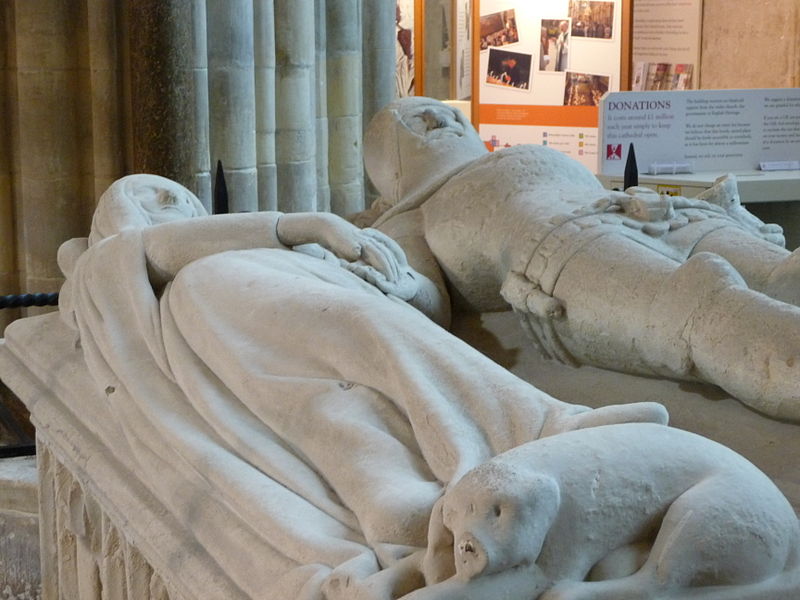
800px-Arundel_Tomb_at_Chichester_Cathedral_(2)

That’s how usually-more-dour Philip Larkin famously ended his poem “An Arundel Tomb.” John G. Messerly ponders what he might have meant:

Larkin may be implying that the lovers are joined in death as they were in life, at least until the ravages of time finally erase their stone figures. Maybe the joined hands were the sculptor’s idea and do not reflect a real love at all–perhaps that is the meaning of the line “transfigured them into untruth.” Larkin himself said the tomb deeply affected him, but he also scribbled at the bottom of one draft: “love isn’t stronger than death just because two statues hold hands for six hundred years.” Yet the poem doesn’t say that “love is stronger than death.” It says love survives us, and to survive something doesn’t make you stronger than it.

Still survival is a partial victory. But what might survive? Perhaps it is the enduring belief that love is remarkable, that its appearance in a world of anger and cruelty is so astonishing. Or perhaps it is that traces of our love reverberate through time, in ripples and waves that may one day reach peaceful shores now unbeknownst to us.

Previous Dish on Larkin and love here. Listen to my reading of Larkin’s “The Whitsun Weddings” here.

(Image: Detail of Arundel Tomb in Chichester Cathedral, which inspired the poem, via Wikimedia Commons)

When Islam Looked To The Sky

Robert Morrison reviews David King’s Islamic Astronomy and Geography, a collection of scholarly essays that shows “the productive relationship between Islam and science”:

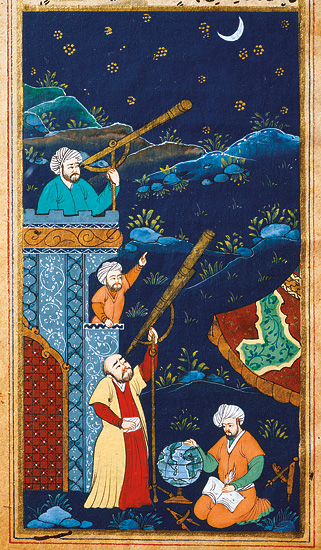
Science in Islamic societies began and developed not in spite of Islam, but along with Islam. The general essay (“Islamic Astronomy”) in this volume helps show how the dish_Astronomes rise of Islamic astronomy was linked not to a passive “download” of information from ancient Greece, Persia, and India, but to how, by the rise of the Abbasid Caliphate in 750, interest in astronomy and astrology helped initiate the Translation Movement, an enterprise in which astronomical texts first from Sanskrit and Persian, and then from Greek, were translated into Arabic. Science served the nascent empire’s purposes, whether calendar calculations, determining prayer times, taxation, or political legitimacy. …

Scholars have shown that Islam’s general opposition to astrological forecasting forced scientists to re-think the relationship between theoretical and mathematical astronomy on the one hand and their application to astrological forecasting on the other. A formal disciplinary distinction between astronomy and astrology was the result, and such a distinction facilitated advances in theoretical astronomy that coincided with the incorporation of astronomy into traditions of Islamic scholarship. Conversely, the prestige of astronomy occasioned transformations in kalam (Islam’s tradition of philosophical theology) and the result was the integration of astronomy and other sciences into traditions of religious scholarship.

(Image: Ottoman miniature from 17th century, depicting the study of the moon and stars, via Wikimedia Commons)

The Divine Vine

Ross Andersen contemplates the spiritual properties of wine:

You can tell our culture values wine by looking at the price we pay for it, and the 12039534705_80c244fc10_z dandyish glasses we drink it from: the fragile ones with the crystal pedestals. But it’s difficult to say what the first farmers made of this extraordinary substance. Early winemakers decorated their vessels, but the symbols they used have faded with the ages. There is one clue, however – a 7,000-year-old piece of pottery from Eastern Georgia with a grape cluster and stick figure etched into it. The figure appears underneath the cluster, and seems to have its arms raised in worship, suggesting that wine was considered divine from the start. Alas, the etching is too crude and worn to know for sure. What we do know is this: where we find legible symbols next to wine, on ancient vessels, or in the textual recesses of human memory, wine is almost always associated with the gods. And even today, three centuries after the Enlightenment, if you look closely, you’ll find that the vine is still spiralled tight around the supernatural.

(Image of statue of Dionysus at the Vatican by Derek Key)

Quote For The Day

“Despite all the richness of the physical world — the majestic architecture of atoms, the rhythm of the tides, the luminescence of the galaxies—nature is missing something even more exquisite and grand: some immortal substance, which lies hidden from view. Such exquisite stuff could not be made from matter, because all matter is slave to the second law of thermodynamics. Perhaps this immortal thing that we wish for exists beyond time and space. Perhaps it is God. Perhaps it is what made the universe.

Of these two alternatives, I am inclined to the first. I cannot believe that nature could be so amiss. Although there is much that we do not understand about nature, the possibility that it is hiding a condition or substance so magnificent and utterly unlike everything else seems too preposterous for me to believe. So I am delusional. In my continual cravings for eternal youth and constancy, I am being sentimental. Perhaps with the proper training of my unruly mind and emotions, I could refrain from wanting things that cannot be. Perhaps I could accept the fact that in a few short years, my atoms will be scattered in wind and soil, my mind and thoughts gone, my pleasures and joys vanished, my “I-ness” dissolved in an infinite cavern of nothingness. But I cannot accept that fate even though I believe it to be true. I cannot force my mind to go to that dark place. ‘A man can do what he wants,’ said Schopenhauer, ‘but not want what he wants,'” – Alan Lightman, The Accidental Universe.

(Hat tip: Maria Popova)

Evolution’s Expressions

dish_crichtonbrowne

Stassa Edwards calls Darwin’s 1872 work The Expression of the Emotions in Man and Animals “the most accessible of Darwin’s books”:

Far from a dry scientific text, it’s rich with colorful anecdotes drawn from theater, painting and, of course, photography. In it, he argues that man’s emotional expressions—his smiles, snarls, and frowns — are the result of natural selection. If facial communication stems from natural selection, then man must share it with other mammals. “With mankind some expressions, such as bristling the hair under the influence of extreme terror, or the uncovering of the teeth under that furious rage, can hardly be understood,” he wrote, “except on the belief that man once existed in a much lower and animal-like condition.”

Darwin looked to photography for evidence, which led him to the work of James Crichton-Browne, a neurologist who photographed the mentally ill:

The mentally ill, as Victorian mores held, were emotionally uninhibited and unconstrained. Unable to conform to social norms, the insane were hardly concerned with the suppression of emotion required by the cultured and the sane. To Darwin, Crichton-Browne’s photographs represented something more useful than marketable trinkets. The raw emotion of the inmates at West Riding Lunatic Asylum was primitive, more authentic, and certainly closer to man’s evolutionary ancestors. Crichton-Browne’s project, his interest in capturing the true look of mania, proved a valuable discovery for Darwin. …

Darwin found in Crichton-Browne a fellow scientist sympathetic to his theories and ready to expound on his observations. The correspondence between the two men is colorful…. Though Crichton-Browne refers to very few of his photographs specifically, his letters flesh out the otherwise vacant personalities captured by his camera. In a single letter, he describes the “hilarity” of sexually perverse women; the “remarkable lachrymal secretion” of “melancholics, who sit rocking themselves rhythmically backwards and forwards”; and “a stereotyped smile” of “many idiots and imbeciles who are constantly smiling and laughing, who are ‘pleas[ed] with a rattle, tickled by a straw.'”

(Image: Woman Suffering from Chronic Mania, c. 1869, by James Crichton-Browne, via Wellcome Library, London)

Rejecting Roth

Will Philip Roth ever shake his critics who accuse him of anti-Semitism? Judith Thurman checked in with the author as he recently received an honorary degree from the Jewish Theological Seminary:

The spectre of “outside” voices objecting to his recognition by a bastion of Jewish learning and Conservative theology couldn’t spoil Roth’s pleasure in the morning’s lovefest, but it rankled him. “Look,” he said, “‘Portnoy’s Complaint’ was published ten years after ‘Defender of the Faith,’ in 1969, and the Jewish reaction to it was completely understandable. I can’t say I didn’t expect it. I had no objection to it, either. I’ve always had literate Jewish readers, even if my most virulent enemy was the greatest scholar of Jewish mysticism, Gershom Scholem, who reviewed ‘Portnoy’ in Haaretz, where he wrote, ‘The writer revels in obscenity’ and ‘This is just the book that anti-Semites have been waiting for.’ And I also can’t say that, when ‘Defender of the Faith’ was published, I didn’t know that Jewish nerves were raw. I was not insensitive to the rawness, because I knew where it came from. World War II had ended only thirteen years before, and I came of age in the single most anti-Semitic decade in human history. But rabbis denouncing me from the pulpit, and in their Saturday sermon columns—well, that was disgusting, and it stung.”

The next day, the Forward published an article about the commencement—”PHILIP ROTH, ONCE OUTCAST, JOINS JEWISH FOLD” (it’s a fold that also includes Martin Luther King, Jr., who received an honorary doctorate in 1964)—and Roth sent it to me without comment. But he had one last red-light reflection:

That these displays of narrow-minded literary stupidity that first erupted in response to my work in 1959 should continue to emanate from the McCarthyite right of the Jewish establishment in 2014 is more than a little shameful. Do you think that African-American readers of James Baldwin are still up in arms, if ever they were, because in his fiction Baldwin vividly portrayed black prostitutes, drug addicts, and pimps? Do you think the African-American readers of Ralph Ellison are still up in arms, if they ever were, because in the great opening section of his masterpiece “Invisible Man” Ellison permits a southern black sharecropper to speak with relish of how he routinely has sex with his own young daughter? It’s beginning to appear that I, for one, will not live to see these disapproving Jewish readers of mine attain that level of tolerant sophistication, free from knee-jerk prudery, that has long been commonplace among African-Americans when reading their own writers.

Previous Dish on Roth and religion here.

Move Aside, Merlin

Benjamin Breen schools us on the original wizard:

John Dee of England, born in 1527, the astrologer to Queen Elizabeth and advisor to dish_dee Sir Walter Raleigh, was the true founder of the wizardly iconography and mythos. A skilled mathematician, geographer, and inventor, Dee also delved into grimoires, kabbalah, alchemy, and Biblical prophecy. He believed he’d been chosen by God to receive a new divine revelation—angels were sending him a new set of Biblical texts from heaven. And he had a sidekick: Dee believed the ultimate conduit was not himself but his servant, a mysterious ex-con named Edward Kelley, who spoke with the angels through a glass orb that the two called a “shew-stone,” or crystal ball.

Dee’s beliefs gained currency among notables including Sir Walter Raleigh and the poet Philip Sidney. Yet the Dee-Kelley enterprise ended badly, with professional failures and a surprisingly salacious personal dispute—Kelley claimed that the angels required the two men to keep everything “in common,” including Dee’s much younger wife, Jane, who was nonplussed by the idea. Kelley died young, dashing out his brains in a botched escape from a Czech castle where the Holy Roman Emperor Rudolf II had imprisoned him for claiming to transmute mercury into gold. But Dee and his mythos lived on, resurfacing throughout the seventeenth century in publications with such eye-catching titles as A True & Faithful Relation of what Passed for Many Yeers Between Dr. John Dee and Some Spirits; according to Frances Yates, Dee inspired the character of Prospero in The Tempest.

(Image: Portrait of Dee, 16th century, via Wikimedia Commons)