“Already Far Larger Than Exxon Valdez”

NPR found experts to analyze a video released – begrudgingly – by BP:

[Purdue University's Steven Wereley] made a few simple calculations and came up with an astonishing value for the rate of the oil spill: 70,000 barrels a day — much higher than the official estimate of 5,000 barrels a day. The method is accurate to a degree of plus or minus 20 percent. Given that uncertainty, the amount of material spewing from the pipe could range from 56,000 barrels to 84,000 barrels a day.

Bonus cofferdam clip here. Go here for footage from an entirely different vantage point – a plane flown by Alabama resident John Wathen. Money quote:

The Gulf appears to be bleeding. Will we ever be able to stem the tide?
For The Love Of Buses

Friedersdorf interviews Yglesias about urban affairs:

Q. Asked to allocate a billion dollars in funds on anything that falls under the rubric of urban affairs, what would you prioritize?

A. Better buses! It's rare that you have a policy issue that can be solved by throwing more money at the problem, but the technology to make bus service more frequent and equip buses with GPS systems that provide real-time schedule updates to bus stops exists and operates in many parts of the world. We should be installing it in our major cities.

The Psychology Of Home Shopping

McArdle takes on QVC in the latest issue:

The QVC process is so finely calibrated that a producer watches call volume in real time; whenever it spikes, the host hears a voice in his or her ear: “Whatever you just said, say it again. It’s working.” The lessons are disseminated to other hosts, and to the product spokespeople, who must spend hours training before they may present their products on air.

Nightmare Scenarios

Bruce Schneier doesn't like them:

There's a certain blindness that comes from worst-case thinking. An extension of the precautionary principle, it involves imagining the worst possible outcome and then acting as if it were a certainty. It substitutes imagination for thinking, speculation for risk analysis and fear for reason. It fosters powerlessness and vulnerability and magnifies social paralysis. And it makes us more vulnerable to the effects of terrorism.

Worst-case thinking means generally bad decision making for several reasons. First, it's only half of the cost-benefit equation. Every decision has costs and benefits, risks and rewards. By speculating about what can possibly go wrong, and then acting as if that is likely to happen, worst-case thinking focuses only on the extreme but improbable risks and does a poor job at assessing outcomes.

The US Isn’t Greece? Ctd

Avent says Leonhardt is missing the point:

On the face of things, the problems are similar: revenues minus spending equals a negative number in both America and Greece. And Mr Leonhardt seems stuck on that similarity.

But the differences are crucial. Greece needs to come up with that 6% right now, in the space of a couple of years, in an environment of negative economic growth, because markets are close to refusing to lend Greece any additional money. America needs to close that 6% gap over the space of several decades, during which time it is likely to grow at a real annual rate of about 2.5%.

Do you see how these situations are different?

The Daily Wrap

Today on the Dish, Andrew kept the heat on Kagan, a reader turned up the temperature, she continued to be coy, Crist went to bat for her, David Sessions surveyed the Christianists, Serwer joined the race/ethnicity debate, and Kinsley sounded off. In election fallout, Andrew and a reader examined the proposals for electoral reform, the Tories touted their religious and gay diversity, the Brits showed up the US, and the BBC made a funny flub.

Oil spill updates here, here, and here. HCR update here. More on the drug war here, here, and here. The debate over Israel and smears carried on here and here. Get your Palin fix here and here.

In assorted coverage, Leonhardt defended himself on Greece, Sara Rubin looked at the lettuce threat in Arizona, Drum replied to Andrew about atheism and the afterlife, Friedersdorf lovingly hated on NYC, Lewis Black pwned Beck, several more readers added to the burqa discussion, and others rapped about Modern Family. Paternal superhero here. Super creepy ad here.

— C.B.

Askers vs Guessers

Oliver Burkeman makes a distinction:

We are raised, the theory runs, in one of two cultures. In Ask culture, people grow up believing they can ask for anything – a favour, a pay rise– fully realising the answer may be no. In Guess culture, by contrast, you avoid "putting a request into words unless you're pretty sure the answer will be yes… A key skill is putting out delicate feelers. If you do this with enough subtlety, you won't have to make the request directly; you'll get an offer. Even then, the offer may be genuine or pro forma; it takes yet more skill and delicacy to discern whether you should accept."

Neither's "wrong", but when an Asker meets a Guesser, unpleasantness results.

Chait takes issue with that last line.

Face Of The Day

99167928

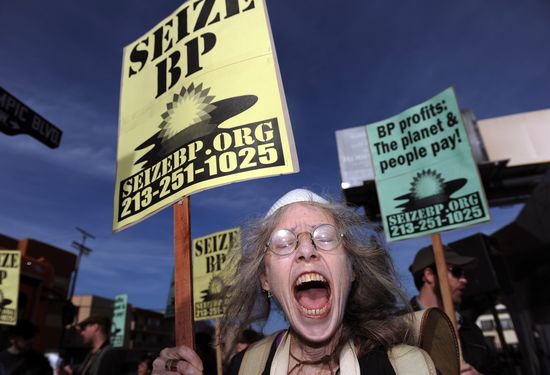
A protester shouts slogans against BP during a demonstration in front of the BP 'Green Curve' Station, in Los Angeles, California, on May 12, 2010. BP battled on May 12 to cap a huge oil leak, lowering a box dubbed 'a top-hat' into the Gulf of Mexico amid mounting US anger over a spill flowing unchecked into the sea for three weeks. Frustrated by the failure to staunch the leak, President Barack Obama dispatched a top team to BP's command center in Houston, Texas, to throw the administration's scientific expertise behind the British oil giant's efforts. Photo by Gabriel Bouys/AFP/Getty Images.

Safe To Vote Against Her? Ctd

Serwer counters Green and Ponnuru:

Somehow, it doesn't occur to either of them to mention that Kagan is less controversial because she's white, because she's not the first woman on the Court, the first Jew, or even the first Jewish woman. Her nomination to the Court isn't perceived as a usurpation of a position of power meant for white people. And it's really quite odd that Green and Ponnuru conclude that Sotomayor wasn't "safe" to vote against. Only nine Republicans voted for her. How is a vote in which three-quarters of the party's caucus votes "no" not a safe "no" vote?

I find the hand-wringing over this interesting because I can't imagine a scenario in which Sotomayor could have been confirmed with Kagan's resume.