Super splicer hh offers up another gem:
List of referenced movies here.
[T]he prospect of a Godless world is more salient for some than for others. Nietzsche wrote about this in the broader cultural sense…and Linker talks about it later in the personal sense: "There are no disappointments recorded in the pages of [New Atheist] books, no struggles or sense of loss. Are they absent because the authors inhabit an altogether different spiritual world than the catastrophic atheists?" Speaking for myself: yes. I have never in my life felt the need to believe in God, and that lack simply doesn't inspire any emotional resonance in me. I don't know why this is, but I do know that I don't feel empty inside, I'm perfectly capable of feeling wonder and awe, and there's no sense of loss or anything else involved in any of this. Linker might regard that as unfathomable, finding the tortured brooding of the catastrophic atheist more to his liking, but it's so. And I have no idea how you discuss this. Linker feels the pull of the supernatural and I don't, and all the conversation in the world won't change that or make it any more explicable.
I totally respect Kevin's position, even though I could not share it if I tried. If I may intrude, and ask a questoin I do not mean to be loaded, just curious: I wonder what Kevin thinks happens to him when he dies? And how does he feel about that – not just emotionally but existentially? These questions can be addressed without talking of God. And yet they reveal something about what it is to be human.
Jessica Grose follows the abstinence arc of former sex blogger Lena Chen:
People just a micro-generation younger than Chen are wise to the downside of overexposure and already seem less inclined to reveal themselves. According to a recent Pew study on Internet habits, only 14 percent of teens now blog, down from 28 percent in 2006. Even on social networking sites like Facebook, millennials are becoming protective of their privacy: Most have put privacy boundaries on their online profiles, and a New York Times article from last month discussed the lengths to which striving high schoolers go to keep their Facebook activity hidden from college admissions officers. Just this past weekend in an article called "The Tell-All Generation Learns to Keep Things Off-Line," the Times discussed the myriad ways in which teens are keeping their online profiles squeaky clean.

TDW jumps aboard a new cause:
Not a single episode of ABC’s uproarious new sitcom Modern Family goes by that I don’t find myself ranting and raving over the pseudo-progressivism of having an openly gay couple on a primetime TV show, and going out of your way to avoid having them show real-world physical affection toward one another. Happily, I am not alone in my diatribe: A Facebook campaign was recently launched to convince ABC to let the adorable duo smooch to their hearts’ content on national television. […It's] about recognizing that when two people are in a committed relationship, they kiss each other on the lips.
Good As You, which provided the screenshot, still finds the show "funny, sweet, progressive, and genuinely pro-family (no quotes)." The shot is, perhaps, a perfect distillation of where the culture now is on gays: fine but not equal.
It's getting more serious.
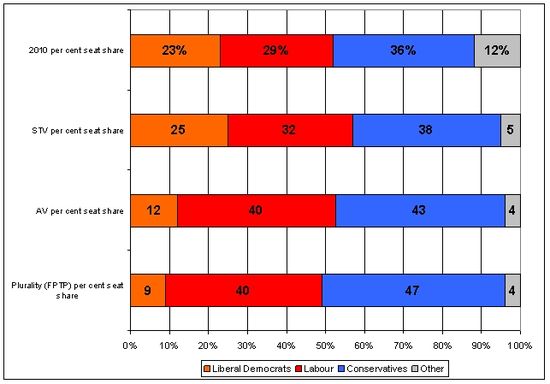
LSE explains various voting systems and provides the graph above showing how they would have changed the 2010 British election. More clarity here. As I understand the current Con-Lib referendum plan, it would be a move to AV, slightly increasing Liberal representation, and slightly reducing Tory representation. I'd vote for it. I care about maintaining a one-member-one constituency relationship. But I do think it has become deeply unfair under the current rules, and it's time for a change.
A reader writes:
I've been a reader for a few years now, but this one post is the one I'll remember when I think about how special your blog is. However, it should have come with a NSFW warning – tears are streaming down my cheeks as I type this, face averted so the boss can't see. I have a 14 year old with Asperger's and this son could be mine and this mom could be me.
Another writes:
Thanks for running this. I lost my mother when I was 7. My father died three years later. I lived in an orphanage in Chicago from shortly after my mother's death until I was 12. They didn't have a syndrome name for it back then, but I was a shy boy. I'm 54 now, married, no kids. After watching that piece two things occurred to me: I couldn't remember ever having that kind of conversation with a female elder in my life. And I had forgotten what it was like to have a mother.
And that brought me to tears. Belated happy Mothers Day.
Stephen Asma tries to get a handle on it:
[T]he soul is meaningful to many of us without any scientific verification of its existence.
That is not the same as just having faith in the soul despite a lack of evidence. I'm not suggesting that familiar view. What I'm suggesting is more sly—the soul can be deeply meaningful whether it exists or not, and it can be deeply meaningful even if you disbelieve in its literal, metaphysical existence. That is not the usefulness of fictions and delusions. It's the usefulness of an expressive folk language that can't be replaced by a scientific language.
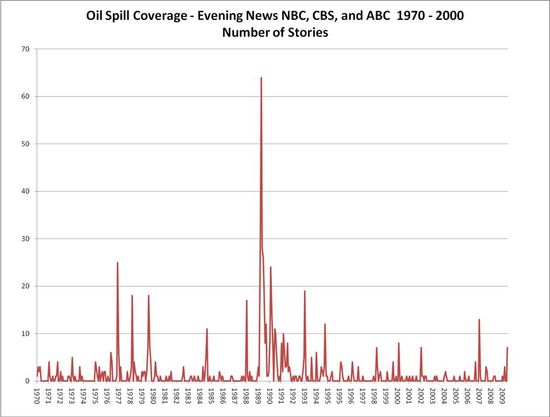
Contra Jesse Smith, Plumer argues that there aren't enough pictures of oil-covered birds:
After the Exxon Valdez disaster, you had scores of images of ducks and otters slathered in crude. There were pictures of dead whales washed up against gleaming black rocky beaches. It was lurid—and impossible to ignore. By contrast, [Drexel sociologist Robert Brulle] points out, not a lot of oil from the BP has reached the shores of the Gulf Coast yet. Even groups like Greenpeace have only been able to rustle up a handful of pictures of a few of ducks covered with a little bit of oil. That's not the sort of thing that drives TV coverage. And it may mean that the current spill makes far less of a dent in public opinion than past disasters have.
Now, part of the explanation here is that BP has been quite deft at managing appearances. For one, they're using hundreds of thousands of gallons of chemical dispersants to break up the oil before it can reach the beaches, causing it to sink down to the sea floor. In some cases, these dispersants could be more harmful, ecologically speaking, then letting the oil wash ashore. We don't know what's in these chemicals and there's a very high potential that they could do a lot of damage to the food chain in the Gulf. Indeed, that's why Exxon was constrained from using dispersants in Prince William Sound back in 1989. But, from BP's perspective (and the Obama administration's), avoiding the sort of graphic imagery that Exxon had to deal with in Alaska seems appealing.
More uproar in the inbox over Kagan, this time for "The Purity Of Her Careerism." A reader writes:
Since when does taking risks make someone a good judge? Judges are tasked with determining outcomes based on a clear interpretation of facts as it applies to the law. To expect a judge, especially a judge on the highest court in the land, to take risks completely misunderstands both the position and the law. Your qualms that Kagan did not stake out any controversial or even clear cut positions politically actually makes her more appealing as a judge, not less. Passion and risk have always been the opponents of a proper application of the law, going all the way back to Aristotle. And it should remain so today, even if we insist on politicizing everything else.
Another writes:
Your qualms about Kagan are easily distilled: you wish she acted more like a blogger.
Another:
I think you are wrong about her. I listened to a Toobin interview and I was gobsmacked by one line: "She got along with everyone in college." Now I don't know about your college, but my college experience involved passionate intellectual duels with fireworks and explosives over competing ideas. I think that is why Obama wants her. After all, he was the same way at Harvard Law. And didn't you endorse him because of it?
Another
You indicate that you felt uneasy about the fact that she had wanted to be a Supreme Court Justice since childhood. However, back during the 2008 election campaign, when Republicans were criticizing Obama’s “careerism” for just the same thing (writing an essay in grammar school about wanting to be President), you lambasted them for being unreasonable. I think you’re being inconsistent here.
Another:
As for her "careerism", it's a bit unfair to say she has never made any hard or isolating decisions in her career. What about her desire to bar military recruiters from campus for which she is now taking flack, or for pushing to hire more conservative faculty at Harvard? But the real unfairness in this criticism is that her nomination to serve as a federal appellate court judge was blocked by Republicans a decade ago. She WOULD have made many decisions by now, and left a paper record for conservatives to dissect, if she was confirmed to the job that she was obviously qualified for and desired at that time.
Another:
What risks were taken by Roberts and Alito? Is that really the standard? And where did they experience professional life outside of the same type of East Coast elite community that you and Brooks discuss? The only difference is that they were conservative and she is not. Roberts and Kagan's careers are almost eerily similar in their progression — Harvard, presidential administration, nominated young for circuit court and being held up by politics, pursuing other highly abstract career (appellate lawyer at fancy firm vs. HLS dean), time in SG's office. I think that a test is being written for Kagan that is very different from what has been expected of other nominees.
Another:
Living a life, particularly as a minority woman even in liberal corridors of power, does not necessarily get you confirmed for any jobs, let alone with the Supremes. In fact, the past few hearings have been nothing if not a fuzzing and fudging of the candidate's life and opinions to make them more palatable for the confirmation process and the Senate. I say this not as a PC attempt to cry victim on behalf of women lawyers and judges. But the fact is, there have been only three women Supremes compared to how many men? It is a different playing field for women in the law, one that does particularly reward radicals or even strong opinions.
 The Dish