Picturing Disaster

Jesse Smith fears that footage and photos of oil-covered animals obscure the true horror of oil spills:

The image of the oil-soaked bird isn't powerful because it suggests the threat to the species, and the food chain, and the entire ecosystem. It's powerful because it's a bird, and it's covered in oil, and you know it doesn't want to be, and that it may be in pain, and that it is, at the very least, terrified. A dirty or dead bird — or turtle or shark or fish — is proof that an oil spill is bad news; if they weren't, the Los Angeles Times and the Sacramento Bee and CBS News and others wouldn't be working so hard to shoehorn them into their coverage.

Would an oil spill that lacked these oily animals be any less dangerous? No, but to know that you'd have to motivate your brain to read science news and dissect the infographics and maps. This is hard work. Pictures are easier. You see a dead turtle, and your heart thinks it understands just how bad this situation is. And if you don't, well, how bad can things be?

More images of injured and dead wildlife here.

Rebound?

Andrew Sprung reviews Stephen Rose's new book:

Rose is in his element in the book's middle chapters, in which he parses Census, Current Population Survey and other data on Americans' incomes and wealth to debunk what he defines as five myths: that all income gains in the last thirty years have gone to the rich; that the middle class is declining; that good jobs have been disappearing; that international trade is to blame; and that employee benefits are disappearing.

Some of these myths he dispatches more thoroughly than others; his argument with liberal economists such as Jacob Hacker and Elizabeth Warren is often aptly characterized as a glass half empty/half full dispute because at times he emphasizes different aspects of a data set that is not in dispute.  This is almost literally true when Rose points out that "54 percent of households had no credit card debt after paying their monthly bill; this means that the median credit card debt of Americans is zero" (212). Okay — it also means that almost half of Americans are paying double-digit interest rates on a credit card balance every month.

The Daily Wrap

98948083

Today on the Dish, Andrew reacted at length to the nomination of Elena Kagan. Hanna Rosin thought Andrew’s kind of inquiry was out of line and readers agreed. Blogger reax here and here. Beinart targeted Kagan’s views on military recruitment, Balko did the same on executive power, the NYT dug into her pseudo-personal past, AOL dug deeper, and Google users deeper still. More from John Palrey and Kagan herself. Ugly rhetoric from Ed Whelan, Bill Kristol, and an assortment of others on the far right.

In British election fallout, Gordon Brown announced his intention to resign. Subsequent commentary and analysis here, here, here, here, here, and here. Possible replacements for Brown here. Andrew offered his take here and especially here, fearing a death knell for the Tories.

In assorted coverage, the concrete dome failed to stop the oil leak. Iraq update here and EU economic crisis here. McCain made of chump of himself, Goldblog alleged some anti-Semitism, Israeli officials piled on Goldstone, McArdle fumed over the puppycide video, and Scott Morgan talked legalization. Yglesias award here, Mothers’ Day tribute here, dog-blogging here, and cool ad here.

— C.B.

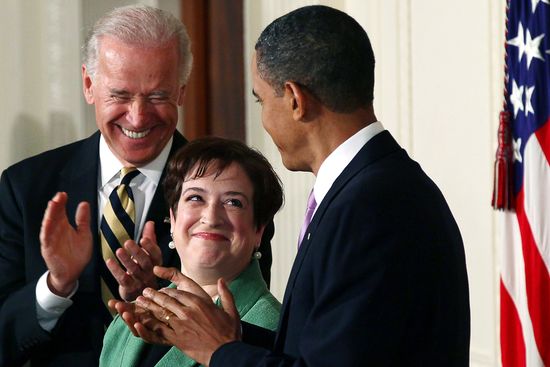
(U.S. President Barack Obama (R) is joined by Vice President Joe Biden while introducing Solicitor General Elena Kagan (C) as his choice to be the nation’s 112th Supreme Court justice during an event in the East Room of the White House May 10, 2010 in Washington, DC. If confirmed by the U.S. Senate, the former Harvard Law School dean would be the first justice to join the high court without prior judicial experience since William Rehnquist in 1972. Kagan was selected by Obama to replace retiring Justice John Paul Stevens. Photo by Win McNamee/Getty Images.)

The Questions Did Not Begin On The Right

A useful primer from AOL News on the orientation question. A new nugget from Kagan's past:

The Associated Press turned up a 1997 memo that revealed Kagan urging then-President Bill Clinton to support a ban on late-term abortion. Kagan and Bruce Reed, her boss in the White House domestic policy office, told Clinton that he should support the ban in a legislative compromise; the compromise failed, and he vetoed a stricter Republican ban. The document came from Clinton's presidential library in Little Rock.

Gibbs today said of questions about Kagan's sexual orientation:

"It's not anything I'm going to get into."

Don't ask, don't tell: the Obama administration's policy for the military and the Supreme Court.

A Death Blow To The Tory Party?

HAGUEJeffJMitchell:Getty

One feels the stomach lurch a little if one remains a British conservative. From the heady days of the 1980s and even 1990s – eighteen years of continuous Tory rule – we have now had thirteen years of Labour, three elections in which the ghost of Thatcherism was revived with ever decreasing effect, then a major rebranding and personable, decent new leader with sane, centrist policies … the end result is 36 percent. And that barely more than a third of the vote – and no seats in Scotland – comes after one of the worst recessions in memory, and one of the least agreeable prime ministers in modern times.

Or to put it another way: 63 percent of Britons did not want a Tory government after 13 years of Labour. That's the logic behind Gordon Brown's maneuver today. He's gambling that on most issues, the Liberal Democrats are actually closer to Blairite liberalism than Cameroonian conservatism. Get rid of the Brown stigma and the natural alliance has time to form. There's more as well of course: judging whether getting into government right now would in fact be fatal to any party, given the country's finances; personal pique; and the entire question of electoral reform.

But the latter is the real issue now. The Liberals fumbled their last chance for electoral reform in the 1970s. One senses they cannot fail to use their leverage for it now. If the result of the bargaining after this election is proportional representation in one form or another, there will never be a majority Conservative government in Britain again. There won't be a Labour majority government either, but given the deep left-liberal majority in Britain, coalition politics will move Britain indelibly leftward. Remember that Thatcher never won anything close to a majority of the popular vote – she kept winning because the left split and the electoral system allowed her to divide and rule. But what happens when the Tories can only divide and compromise?

That's why one senses an epochal shift here. David Cameron has an agonizing choice to make – try for a minority government that will make all the tough and right decisions and get pummeled at the polls in six months; try to get an agreement with the Liberals without p.r.; fail to get a deal on p.r. and have Labour make it instead and form a short-term government with the Liberals and smaller parties and try again for a victory in a few months before p.r. can be installed; or risk allowing Labour and the Liberals to stitch up the system for the center-left for the indefinite future while in government together. I don't know the inside details – no one seems to – but I'd almost rather hand this poisoned chalice to Clegg and Miliband and hope for the best in a few months' time.

Still, this is a nerve-wracking time for Tories. The consequences of these nail-biting days are not just about who will govern Britain for the next six months or five years. The consequences are the very structure of British politics for a generation. Expecting a conservative revival, we may be witnessing a "progressive" game-changer.

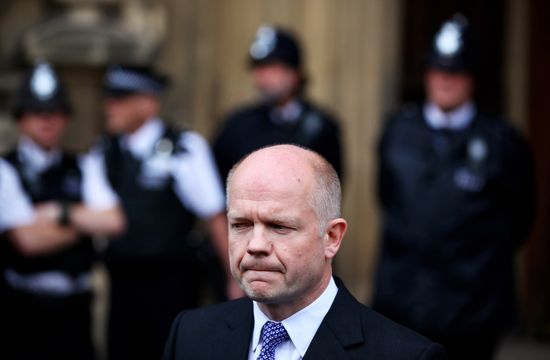
(Photo: William Hague, the Conservative Shadow Foreign Secretary, addresses media outside the Houses of Parliament on May 10, 2010 in London, England. Prime Minister Gordon Brown has announced that he is to stand down as Prime Minister and Labour Party leader. He also said that negotiations with the Liberal Democrats are taking place to try and form a coalition government. By Jeff J Mitchell/Getty Images)

The Evolving Politics And Ethics Of The Closet

John Tabin says I have no consistency on this topic. He's well within his rights to link to pieces (or mere sentences in posts) I have written over two decades to find evolution or shifts, but I think he's wrong to say my slight evolution on this is simply out of pique. I have always found the coercive exposure of details of people's private sex lives to be appalling and cruel. Readers may have noticed that I have barely touched the story of George Rekers, just as I was not among those most eager to pounce on Larry Craig. My core reason is that exposing the complicated lives of people by single acts or humiliating moments is a form of cruelty, and no civil rights movement can or should be built on cruelty to others.

I haven't budged on this an iota, but on the question of homosexual orientation outside of any sexual acts, the world has indeed changed. To begin with, it has gone from a taboo subject to one of the most urgently discussed. It has shaped our current politics in church and state. It has become one of the most vital questions before the courts. Whereas two decades ago, there were virtually no openly gay figures, there are now countless, especially lesbians (and we do not need to know anything about the details of their private lives to know they are who they are). I'm all for privacy; I am not for dishonesty about simple facts of a person's public identity. That can be a fine judgment, but it must be related to shifting mores and standards. In my NYT magazine piece, I tried to adjust my 1991 position to 1999, after one of the seismic decades in gay rights. And my point then was precisely that time had changed things a little:

There comes a point, surely, at which the diminishing public stigmatization of homosexuality makes this kind of coyness not so much understandably defensive as simply feeble: insulting to homosexuals, who know better, and condescending to heterosexuals, who deserve better. It's as if the closet has had every foundation and bearing wall removed but still stands, supported by mere expediency, etiquette and the lingering shards of shame. Does no one have the gumption to just blow it down?

And of course, it has largely been blown down. Because the other thing that has changed in those two decades is the media. Whatever we believe should be public knowledge is largely irrelevant now. Google reveals all. Blogs talk about things previously sealed from view. The Internet has made the MSM's role of what is "fit to print" more declarative than decisive. The NYT's bizarre profile of Kagan, which plumbs every minute aspect of her most intimate and private life while saying nothing whatever about her emotional relationships, home, dating, or indeed anything that might even touch upon her sexual orientation, gay or straight, is so contrived in its avoidance of the obvious it is almost comic. To put it bluntly: the NYT can produce 4,500 words on a person and barely address the three most common Google searches on her name. There is some kind of disconnect here, no?

So I stick to my guns. If Obama had not publicly declared someone's life experiences to be essential to his pick of a Supreme Court Justice, it would be one thing. If I were invading one iota of someone's privacy when the press has already ransacked it, it would be another. If there were no openly gay public figures or officials and a justice's sexual orientation would make it impossible for her to be confirmed, it would be another. But when every aspect of someone's life is for public view except for one, and when that one aspect is as pertinent to a person's life experience as ethnicity or gender or religion or family, then I am not required to uphold a double standard I do not share, and which, in fact, I find to be riddled with prejudice. So I feel it is completely defensible to ask the question and print the answer. That's all. No exposure of private matters; just honesty about public ones. No search and destroy mission into private affairs; just fair-minded clarity about public ones. And that matters.

That goes for liberals as well as conservatives. It is others who are being inconsistent on this, not me.
How Immigration Patterns Have Changed

Derek Thompson provides a visual. Meanwhile, Eric Barker highlights a study on who is negatively impacted by immigration:

Using data from the 1960–2000 US censuses, we find that a 10% immigration-induced increase in the supply of workers in a particular skill group reduced the black wage of that group by 2.5%, lowered the employment rate by 5.9 percentage points, and increased the incarceration rate by 1.3 percentage points.