Clegg Gets Leverage?

Bagehot writes that "this is bold and desperate act by Mr Brown—a kind of political kamikaze, immolating himself in a bid to prevent David Cameron becoming prime minister":

The beneficiary, perhaps, will be Nick Clegg and the Liberal Democrats. After a long meeting with his MPs this afternoon, Mr Clegg's negotiator, David Laws, emerged to say that his party was seeking more details from the Tories over various aspects of policy (see my last post). Mr Brown's statement has provided Mr Clegg with some extremely useful leverage in his negotiations with Mr Cameron. The Tories have hitherto been confident that Mr Clegg had no viable alternative to dealing with them. Perhaps he still doesn't; but Mr Brown's act of self-sacrifice will leave them feeling much less sanguine.

James Forsyth, on the other hand, thinks this helps the Tories.

Too Much, Too Late?

Cowen gives his thoughts on the massive emergency plan to stabilize the Euro. Salmon's reading of the situation:

[W]hile the EU’s trillion dollars is surely sufficient to prevent any country from having to default in the next few years, I fear that its enormity will only exacerbate tensions between the euro zone countries over the long term. They’re not all partners together anymore: now they’re bifurcating into the rich lenders, on the one hand, and the formerly-profligate debtors, on the other. The mind-boggling sums involved are only going to increase resentments both of the south in the north and of the north in the south.

The Men – And Woman – Who Could Replace Brown

The Telegraph provides a useful list of suspects. It just seems odd to me that after this election, someone who was not in any of the debates could somehow become prime minister in a party that clearly won many fewer votes and seats than the Tories. That's why it actually makes sense to me that Clegg would be PM running a Labour-dominated cabinet, perhaps with his own chancellor. But we are in such uncharted territory that I really have no idea what's being mooted behind closed doors.

Kagan On The Gay Ban – In Her Own Words

From 2005. More nuanced than some are saying:

To all members of the HLS community:

I write to let you know that this fall, the Office of Career Services (OCS) will provide assistance to the U.S. military in recruiting students, as it has done for most of the past three years. This email gives newcomers to our community some background on this issue, describes recent developments affecting it, and states my own views on the matter.

The Law School's anti-discrimination policy, adopted in 1979, provides that any employer that uses the services of OCS to recruit at the school must sign a statement indicating that it does not discriminate on various bases, including sexual orientation. As a result of this policy, the military was barred for many years from using the services of OCS. The military retained full access to our students (and vice versa) through the good offices of the Harvard Law School Veterans Association, which essentially took the place of OCS in enabling interviews to occur. In 2002, the then-Dean of the Law School, Robert Clark, in consultation with other officers of the University, reluctantly created an exception from the law school's general anti-discrimination policy for the military. The Dean took this action because of a new ruling by the Department of Defense stating that unless the Law School lifted its ban, the entire University would lose federal funding under a statute known as the Solomon Amendment. (This amendment denies federal funds to an educational institution that "prohibits or in effect prevents" military recruiting.)

The Law School's own resources were not at risk: we do not receive any of the kinds of federal funding that the Amendment threatens to cut off. The University, however, receives about 15% of its operating budget from the federal government, with the Medical School and the School of Public Health receiving by far the largest share of this money for scientific and medical research. The Dean determined (as did all other law school deans) that he should make an exception to the School's anti-discrimination policy in the face of this threat to the University's funding and research activities.

I continued this exception in effect, for the same reasons, through the 2003 and 2004 fall recruiting seasons. In the meantime, a consortium of law schools and law school faculty members (FAIR) brought suit challenging the Defense Department's policy on constitutional grounds. Harvard Law School is not a member of FAIR, but 54 faculty members, including me, filed an amicus brief in that suit articulating different, statutory grounds for overturning the Department's policy. In November 2004, the Court of Appeals for the Third Circuit issued a decision in the FAIR case, holding that the Defense Department's policy violates First Amendment freedoms. The Supreme Court granted review of this decision; the Third Circuit's ruling is stayed pending the Supreme Court's decision, which is expected later this year. (Much the same group of HLS faculty members, including me, will file an amicus brief tomorrow in the Supreme Court litigation. I also understand that the University expects to join an amicus brief filed by Yale and other universities.)

Although the Supreme Court's action meant that no injunction applied against the Department of Defense, I reinstated the application of our anti-discrimination policy to the military (after appropriate consultation with University officials) in the wake of the Third Circuit's decision; as a result, the military did not receive OCS assistance during our spring 2005 recruiting season. My hope in taking this action was that the Department would choose not to enforce its interpretation of the Solomon Amendment while the Third Circuit opinion stood. Over the summer, however, the Department of Defense notified the University that it would withhold all possible funds if the Law School continued to bar the military from receiving OCS services.

As a result, I have decided (again, after appropriate consultation) that we should lift our ban and except the military from our general non-discrimination policy. This will mean that the military will receive OCS assistance during the fall 2005 recruiting season. I have said before how much I regret making this exception to our antidiscrimination policy. I believe the military's discriminatory employment policy is deeply wrong – both unwise and unjust. And this wrong tears at the fabric of our own community by denying an opportunity to some of our students that other of our students have.

The importance of the military to our society – and the great service that members of the military provide to all the rest of us – heightens, rather than excuses, this inequity. The Law School remains firmly committed to the principle of equal opportunity for all persons, without regard to sexual orientation. And I look forward to the time when all our students can pursue any career path they desire, including the path of devoting their professional lives to the defense of their country.

Best, Elena Kagan

From Red and Blue To Orange and Green

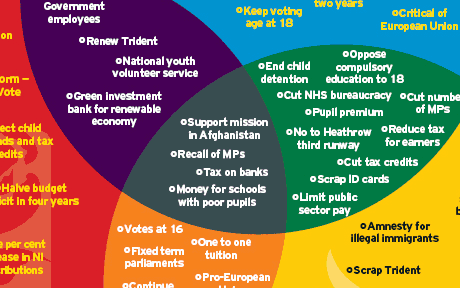
Below is a Venn Diagram (courtesy of the Telegraph) of where Tory, Liberal and Labour policy preferences overlap. Will Britain go orange or green?

Venn_1633095a

Gordon Brown’s pledge to move on as soon as his party selects a new leader makes the future of Britain more likely to be orange than green. There’s a lot that’s murky right now but I suspect that electoral reform remains the stumbling block for a Cameron-Clegg coalition government. Cameron’s right will not tolerate both an alliance with Liberals and a new electoral system that would ensure that there would almost certainly never be a solely Tory government in the future. Clegg’s base is also extremely nervous of being coopted by the Tories in a government whose main task will be to slash public spending.

So the option of a Lib-Lab pact – as in the 1970s – is real again. If it works, I suspect it would mean some sort of move toward proportional representation – and a new era in British politics. It would also mean the entrenchment of Britain as a more European center-left social democracy – a decisive rejection of its Thatcherite re-orientation in the 1980s.

More interesting: both Labour and the Liberals are pointing to deficit reduction as their first priority. But could Clegg be prime minister? I doubt it. Here’s the man I’d be looking at right now: David Miliband. But how soon could Labour switch its leader?

The Tory-Lib Dem Talks

There had been rumors all morning that the two parties were close to a deal deal but Gordon Brown's resignation as Labour leader – and intent to resign as soon as constitutionally possible as prime minister – may have changed everything. Tim Montgomerie's reading of events from earlier today:

Some members of Team Cameron wanted a formal coalition – 'the change coalition' as it has been described by Guido Fawkes and Iain Dale. That is unlikely.  Too many Liberal Democrats regard a formal coalition as electoral suicide. It would see them lose all prospect of victory in Lib/Lab marginal seats.  The only way they could be persuaded into a coalition was a very strong commitment on proportional representation. Team Cameron has toyed with the idea of offering a PR referendum for the Commons and PR for the Lords but they are aware that the party in the Commons, Lords and in the country would be very unhappy with any such concessions.

Aides to David Cameron are nonetheless pleased with the negotiations. The conversations between Cameron and Clegg have been "warm". Britain is likely to have a second election within a year but the good personal relations between senior Conservatives and Liberal Democrats and a range of concessions (including some cross-party working groups) should be enough to give Britain a stable government in the forthcoming months.

Guido is less sanguine:

LibDemVoice has just released a poll of LibDem members – 80% say that without significant progress on electoral reform the deal is off.  So that is one part of the triple-lock that the key may not be in in.  The Federal Executive is the other part of the lock – some 35 strong, which means that if 9 liberal-lefties or PR purists say nay, it will have less than 75% support and the deal is off.

Massie's contribution:

It's not unreasonable for Clegg to think of his party's future electoral fortunes, even at a time like this. But he may be damned if he does and damned anyway if he doesn't. A formal arrangement, complete with seats in the cabinet and a Programme for Government, ties him to the fortunes of a government that is going to have to make many unpopular decisions. In return, of course, he can advance liberal aims across a range of government departments and this is no small bauble. No Liberal leader in decades has had such an opportunity.

But clearly such an arrangement means he is likely to stand or fall with Cameron. Their fates will be bound together and it's not impossible to see how, some years down the line, this could – only could mind – lead to a slow but irrevocable split in his party as the left drifts off to Labour and the right is slowly absorbed by the Conservatives. This could happen even if, at some point, the Liberal Democrats achieve their much-cherished voting reform. Greater love hath no man than that he lay down his party for his country and a seat at the top table.

Brown Will Resign As Labour Leader – And The Plot Thickens

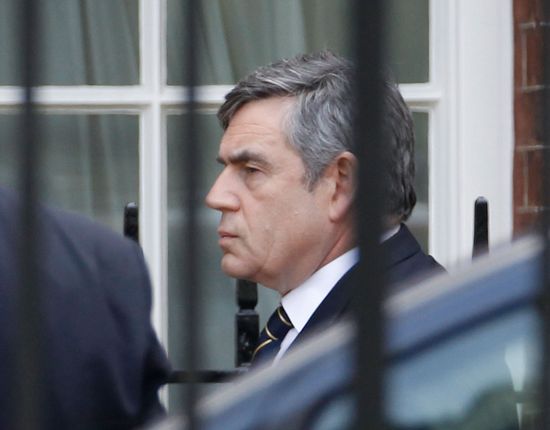
BROWNOVERChristopherFurlong:Getty

Nick Robinson looks at Labour's scheming:

One group in the Cabinet is arguing that the Tories won the election, that they could govern as a minority as Harold Wilson did and that Labour should relish going into opposition in such a strong position.

Another larger group argues that if there is a chance of forming a "progressive alliance" then Labour should take it. It is clear, though, that the presence of Brown is a block to any such deal. Thus, what is being discussed is for the Prime Minister to announce his intention to resign after seeing through the transition to a new coalition government, managing the current economic crisis and passing the instant legislation he promised to change the voting system. Those proposing this solution argue that it allows Labour to say that the Lib Dems aren't choosing their leader whilst meeting their demands for a change.

On cue, Gordon Brown resigns. From Politics Home's live-blog:

Laura Kuenssberg reports that Liberal Democrat insiders have said that the next step will be to enter formal discussions with the Labour Party.

More live-blogging at the FT.

(Photo: Christopher Furlong/Getty.)

Barring The Military From Campus

This will, inevitably, be an issue in the Kagan nomination. Peter Beinart explains his position here. And, for what it's worth, I agree with him. The Obama administration's policy – which was Clinton's and Bush's – is that servicemembers can still be fired solely because of their sexual orientation. It's wrong, counter-productive, harmful to national security, and based on bigotry. But barring the entire military from recruiting at Ivy League schools as a response seems deeply wrong to me. We can still honor the military while disagreeing with its recruitment policies. And ensuring that the best students are available for recruitment is one way to reform the military, not enable it in one specific area.

So Is She Gay?

It is no more of an empirical question than whether she is Jewish. We know she is Jewish, and it is a fact simply and rightly put in the public square. If she were to hide her Jewishness, it would seem rightly odd, bizarre, anachronistic, even arguably self-critical or self-loathing. And yet we have been told by many that she is gay … and no one will ask directly if this is true and no one in the administration will tell us definitively.

In a word, this is preposterous – a function of liberal cowardice and conservative discomfort. It should mean nothing either way. Since the issue of this tiny minority – and the right of the huge majority to determine its rights and equality – is a live issue for the court in the next generation, and since it would be bizarre to argue that a Justice's sexual orientation will not in some way affect his or her judgment of the issue, it is only logical that this question should be clarified. It's especially true with respect to Obama. He has, after all, told us that one of his criteria for a Supreme Court Justice is knowing what it feels like to be on the wrong side of legal discrimination. Well: does he view Kagan's possible life-experience as a gay woman relevant to this? Did Obama even ask about it? Are we ever going to know one way or the other? Does she have a spouse? Is this spouse going to be forced into the background in a way no heterosexual spouse ever would be? A reader asks Jeffrey Toobin the obvious question:

From the description of your relationship with Ms. Kagan, I would bet that you have some insight on the claims of her sexual identity. One month ago there were reports that Ms. Kagan was gay and those reports were quickly followed by stern – offensive? – rebuttals by the Obama administration. This is apparently a big deal even though we aren't supposed to talk about "it." Mr. Toobin, did Ms. Kagan bring a date to your wedding? Why can't we discuss this matter? If she were married – to a man – there would not be silence. Would there be if she were married to a woman? Would she be nominated if she were?

To put it another way: Is Obama actually going to use a Supreme Court nominee to advance the cause of the closet (as well as kill any court imposition of marriage equality)? And can we have a clear, factual statement as to the truth? In a free society in the 21st Century, it is not illegitimate to ask. And it is cowardly not to tell.

Kagan Reax: “An Exquisite Curator Of Her Own Career”

SCOTUSBlog is the go to place for news of this sort. Here's their 9,750 word profile of Kagan. Contra Greenwald:

Some have criticized Elena Kagan for supposedly favoring a strong view of executive power.  They equate her views with support for the Bush Administration’s policies related to the “war on terror.”  Generally speaking, these critics very significantly misunderstand what Kagan has written.

Kagan’s only significant discussion of the issue of executive power comes in her article Presidential Administration, published in 2001 in the Harvard Law Review.  The article has nothing to do with the questions of executive power that are implicated by the Bush policies – for example, power in times of war and in foreign affairs.  It is instead concerned with the President’s power in the administrative context – i.e., the President’s ability to control executive branch and independent agencies.  That kind of power is concerned with, for example, who controls the vast collection of federal agencies as they respond to the Gulf oil spill and the economic crisis.

Ambinder:

The more intense fire will come from the activist left, whose representatives have already voiced objections to Kagan's record of jurisprudence, her Cantabrigian clubbiness, her record on diversity, and the way that she seems to have constructed her career to leave as little in the way of a paper trail as possible. Remember, all judicial battles are fought on the right's terrain, so Democratic judges always have to pledge fidelity to a legal formalism they don't really believe in. As long as the Democrats have the votes, Republicans will have to grudgingly accept that this is the reality behind confirmation-process appearances. The critique from the left has been assisted by Ed Whelan, an influential commentator on the right, who appeared to compare Kagan's pragmatism to prostitution, borrowing a quip from Bernard Shaw. … BTW: seven GOP Senators voted for her confirmation as SG.

Chait:

Paul [Campos] makes a good case for why Kagan's credentials are unusual for a Supreme Court justice. It's certainly true that she has avoided expressing views about legal questions. I disagree, though, with the conclusion that this makes her a blank slate. There is a lot you can glean about a person based on professional and personal interaction. In some ways, these experiences can teach you more. Nothing about Antonin Scalia's judicial record would prepare you to expect him to produce a sweeping activist ruling like Bush v. Gore. But if you knew him personally, understood his conservatism and deep resentment of the left, then you might not be shocked. All this is to say that I believe it is possible, through the kind of engagement Obama and others have had with Kagan, to paint a portrait of a legal mind no less accurate than the portrait we have of many Supreme Court nominees.

Adam Sorensen:

Never having served on the bench, Kagan's record is relatively thin (no Connecticut firefighters this time) but here are the issues likely to come up during confirmation: Some on the left take issue with her minority hiring record while dean of Harvard Law and charge she was too complacent on the Bush/Cheney approach to executive power and national security. (More from Glenn Greenwald here.) Some on the right will make hay of her outspoken opposition to "Don't Ask, Don't Tell" and her subsequent resistance to allow military recruiting at Harvard. (More from Ed Whelan here.)

Marcy Wheeler looks at the bright side:

Given that Republicans will try to oppose Kagan on perceived sexual orientation, it’ll make potential gay bashing of Vaughn Walker over the Prop 8 trial much less effective and–assuming Kagan is confirmed–potentially counter-productive for the haters.

Dave Weigel sketches out the opposition's argument:

We're already seeing a line of criticism develop. If I can sum it up in the bluntest possible language, Kagan is a New York, Ivy League elitist, a critic of the military during wartime, who was picked because President Obama is all of those things. It will be less difficult for conservatives to drum up skepticism about her than it was the self-made Sonia Sotomayor, who tripped up conservatives when they went overboard in accusing her of benefiting from her race.

Ed Morrissey:

For “the most transparent administration in history,” Kagan has a very thin paper trail to give clues to her beliefs.  She has not published much — a rarity among Harvard Law deans — which Ed Whelan argues doesn’t meet Kagan’s own standards for Supreme Court justices.

What does all this mean?  It signals that the White House doesn’t want a big fight over a Supreme Court confirmation.  They don’t want to appoint someone with a track record of judicial activism or a record of strong political advocacy.  Obama wants a stealth candidate, someone who can win a relatively quick confirmation battle.  Of the names floated by the White House after Stevens’ retirement, Kagan attracted the least amount of public opposition.

It is also worth mentioning that Kagan has critics on the left who believe that she is almost a closet conservative. I highly doubt that is in fact the case. Kagan has a long record of liberal views and involvement with liberal causes. It is significant that there aren’t any noteworthy conservative or libertarian legal scholars or activists who believe that Kagan is somehow one of them or even believe that she is a centrist. Ed Whelan’s recent “baffle[ment]” at claims that Kagan “might secretly harbor some conservative legal views” is representative of the dominant view of her on the right, including among right of center legal scholars who know her well, such as Harvard’s Charles Fried. Still, there is at least a small chance that Kagan’s left-wing critics have divined her true views correctly. Even if she isn’t any kind of conservative or libertarian, she might be less liberal than administration supporters hope. With Kagan, that possibility at least exists. Not so with most of the other plausible nominees. The small but not infinitesmal chance that Kagan might actually turn out to less liberal than I expect is another strike in her favor.

Drum wishes Obama had gone for a more "solidly progressive nominee::

When Obama compromises on something like healthcare reform, that's one thing. Politics sometimes forces tough choices on a president. But why compromise on presidential nominees? Why Ben Bernanke? Why Elena Kagan? He doesn't have to do this. Unfortunately, the most likely answer is: he does it because he wants to. Some socialist, eh?

Jeffrey Toobin and Elena Kagan are old friends:

As it happens, this weekend I was finishing “The Bridge,” the new biography of Obama by David Remnick, our boss here at the magazine. Since Kagan’s nomination was imminent, I was struck by certain similarities between the President and his nominee. They are both intelligent, of course, but they also share an ability to navigate among factions without offending anyone. Remnick’s Obama is very… careful. He takes no outlandish stands or unnecessary risks. He is an exquisite curator of his own career. All of this is true of Kagan as well.

But on the Court, Kagan will have to do something she’s not done before. Show her hand. Develop a clear ideology. Make tough votes. I have little doubt she’s up to the job, but am less clear on how she’ll do it. 

Matt Steinglass:

People are simply not going to entertain the idea that the former dean of Harvard Law School is unqualified for the job of Supreme Court justice. And that's not really a good thing… [T]he increasing concentration of Harvard and Yale grads is a problem. When the names of these elite universities serve as an inoculation against accusations of insufficient qualifications and grant their graduates qualified immunity in confirmation battles, those universities acquire a quasi-governmental power. It's a kind of Ivy-judiciary complex. It might be nice if the next nominee came from someplace else, to break up the duopoly a bit. I hear there are a couple of decent law schools west of the Hudson River.

Jonathan Bernstein:

[W]e have estimates from various pundits and experts about the points on an ideological line where the various rumored nominees will fall.  I think we're all kidding ourselves, however, if we think these are anything other than very, very, rough estimates.  Not only is it impossible to know exactly how any potential nominee will vote once on the court (even if she has an extensive paper trail; writing a law review article, giving a speech, and even writing a lower court opinion are just very different things than participating at the Supreme Court level), but the truth is we really have no idea what the key issues are going to be over the term of a nominee.  Especially when the president follows the current partisan incentives and chooses a young nominee.