“A Tech-Enhanced Yenta”

That’s how Maureen O’Connor describes The Dating Ring, a matchmaking start-up that crowdfunded a campaign to fly female New Yorkers to meet men in San Francisco. Along with 15 other women, O’Connor braved the trip. Here’s an excerpt from Day 3 of her journey, which she describes as “the night things get dark”:

Some of the men at this party are more eccentric than those we received as matches. A programmer who donated “several hundred dollars” to the Crowdtilt likens the donation to “giving $2 to a homeless person.” In an affectless voice, he analyzes the relative Asian-ness of each of my facial features, then explains his frustration with online dating: “I prefer to use reality as my platform. There’s zero latency, no lag. Do you know what lag is? When you do something online, you don’t get a response right away. Meeting women in reality — boom! — fully responsive.” As he says this, he begins to touch me. I flee. Soon thereafter, [Dating Ring co-founder] Emma Tessler points out a different man she believes to be “obsessed with” me. She offers to run interference, and I do not see him again. …

As the party grows, we become inundated with men. We are experiencing gender imbalance in the wild, and it is chaos. Every time I turn, there are men lined up waiting to deliver carefully rehearsed greetings or to initiate repartee. At this point, I am so exhausted from constant socializing — even Lyft rides feel like first dates — that I feel a breakdown coming on.

Meanwhile, Shaila Dewan considers dating sites as the quintessential online brokers (NYT):

The good news is that the more seemingly useless brokers are, somewhat counterintuitively, the more valuable they can be in signaling our interest – what [author Paul] Oyer might call the “money to burn” move. If anyone can wink at you free on a dating website, or for that matter beam in a job résumé, their actions don’t mean much. On the other hand, if someone fills out hundreds of questions and pays $60 a month – or in the case of a job applicant, researches a company and writes a detailed proposal – it signals a much deeper interest. Academic economists, in fact, use this sort of signaling in their own hiring process. When top-tier candidates are interested in working at lower-tier schools – for reasons of geographical preferences or spousal considerations, perhaps – they are encouraged to send a special “winking” signal to schools that might otherwise consider them out of their league. [One] Korean dating site has tried something similar, holding a special event in which most participants could send two virtual roses. The signaling worked. Not only was the response rate higher for people who received a rose, but the roses worked better on people of middling desirability, those who might not otherwise believe that someone of higher desirability was a serious suitor. So, on some level, an expensive broker does nothing more than indicate the level of your game.
Inside The Kink Community

Melissa Gira Grant, author of Playing the Whore: The Work of Sex Work, explores the porn production studio of Kink.com. She describes the studio as a “rare accomplishment” that “aims to favorably represent a sexual subculture, that holds free sex parties and (paid) public tours, [and] that positions itself as a San Francisco institution with unironic civic pride.” In the studio’s penthouse, called the Upper Floor, Kink hosts live sex shows:

[F]or some of Kink.com’s community members, performing on the Upper Floor could feel more like a service Kink offered to them. There are probably more public sex play spaces in the San Francisco Bay Area than anywhere else in this hemisphere, but Kink’s are certainly more lavish and, for some, come with a certain prestige that just having kinky sex in a homegrown dungeon—without the cameras, without the “fame”—does not. After the parties, [Upper Floor producer] Stefanos told me, he sometimes sends the guests still photographs that he thinks they’d like as keepsakes. They can post them to their online profiles on sites like Fetlife, on pseudonymous personal blogs, or slightly blurred on Instagram.

“This is almost the ultimate form of ‘do what you love,’” said Georgina Voss, a researcher and writer who examines how technologies are designed, interpreted, and regulated, particularly in the creative and culture industries, including the adult industry.

I rang her over Skype to ask her if the porn industry was going the way of all creative industries online: replacing the professionals with amateurs. With “do what you love,” Voss referred back to Miya Tokumitsu’s essay of the same name in Jacobin. It’s easier to direct porn performers to “do what you love,” perhaps, when even the producers who depend on it don’t readily regard the work of performing sex as work, but instead as sexual expression.

This reluctance, along with the various poor working conditions we’re supposed to absorb in exchange for “doing what we love,” Voss said, is in a way “almost the perfect storm of what’s going on in culture industries. Because what is more fun than sex—with someone you love in a really nice place?”

Previous Dish on Gira Grant here and here.

“The Poet Laureate Of Twitter”

That’s the title Adam Plunkett bestows upon Patricia Lockwood:

Lockwood is famous—more than thirty thousand people follow her on Twitter—but the source of her fame is almost entirely owing to her tweets and not to her poetry. Even the exception, her most famous poem, “Rape Joke,” could read as a series of exceptional tweets. She’s made for the medium. It rewards her particular talents for compression, provocation, mockery, snark.

Her ongoing series of “Sexts,” an extended parody of sexual text messages, is disarming as well as unsettling, because it moves quickly between the dumb voice that Lockwood captures so well and something entirely different—something hectoring, obscene, and sinister.

“‘I’m so wet,’ you murmur. Marmaduke raises his glistening face. ‘That’s because I’m famous for drool,’ he laughs.” “I go up to heaven and open God’s Bible. It contains only a single sext: ‘Im hard.'” … Just as there are always followers to laugh along with her, there are always men who miss the joke. She has said, “It is so funny, still, when a man—and it’s usually a man—responds to you, going, ‘Yeah girl, I want to put soap on your boobies in the shower.’ You’re responding literally to a tweet about me riding down the neck of a brontosaurus until I come.”

Jesse Lichtenstein profiles (NYT) Lockwood, whose newest collection of poetry, Motherland Fatherland Homelandsexuals, was published this week:

“Whenever anyone asks me about process,” she said, “I’m like a cat stroked the wrong way: Get away from my belly!” But she is fundamentally a sharer, a poet for the age of sharing. “I’m verbally incontinent — anything just pours out of me,” she said. “My father’s that way. He doesn’t worry about it. My mother does. I got both. I say just the worst things the English language is capable of, and then later on I lie awake at night thinking, Oh, Tricia, you’ve done it again.”

Lockwood’s poems are most radical in their ability to convey the essential strangeness of sex and gender. “I consistently felt myself to be not male or female,” she said, “but the 11-year-old gender: protagonist. Maybe it’s a byproduct of reading a lot of books, of projecting yourself into different bodies. As an early teen, I thought I presented as androgynous, which was not true. But I had a short haircut, and I felt androgynous.”

The Case For Jacking Up Your Bar Tab

Reihan wants to raise alcohol taxes significantly:

Great Britain has seen a staggering increase in alcohol consumption since the 1990s, much of it among teenagers. Tim Heffernan, writing in the Washington Monthly, has attributed Britain’s binge-drinking crisis to its laissez-faire alcohol market, which has allowed for the vertical integration of the liquor business. America has been shielded from U.K.–style liquor conglomerates by those post-Prohibition regulations that inflate the cost of making, moving, and selling booze, but that’s now changing thanks to big multinationals like Anheuser-Busch InBev and MillerCoors, which are working hand in glove with national retail chains like Costco to make alcohol as cheap and accessible as they can.

Why would I, a great lover of the free enterprise system, want the alcohol market to be more heavily regulated?

Precisely because I’m a believer in the power of the profit motive, I understand how deadly it can be when the product being sold is intoxication. For-profit businesses exist to increase sales. The most straightforward way to do that is not to encourage everyone to drink moderately, but to focus on the small minority of people who drink the most. That is exactly what liquor companies do, and they’ll do more of it if we let Big Liquor have its way. In Marijuana Legalization: What Everyone Needs to Know, the authors estimate that at current beer prices, it costs about $5 to $10 to get drunk, or a dollar or two per drunken hour. To get a sense of what the world would look like if that price fell significantly, go to a typical town square in England on a weekend night, where alcohol-fueled violence is rampant, or to Russia, where the ruling class has used cheap vodka as a tool to keep the population drunk, passive, and stupid for generations.

Kleiman generally agrees but nitpicks:

At some points, I would differ in emphasis. It’s hard to judge how much alcoholism is a cause of the rotten Russian polity and the decrepit Russian economy and society, and to what extent it is an effect, with people drinking because there’s nothing better to do.

Status And Sluttiness

Amanda Hess peruses a sociological study showing that slut-shaming has little to do with actual sexual behavior:

The researchers interviewed more than 50 women (all of them white) from the start of their freshman year and followed them to shortly after their graduations, asking them questions about, for example, their perceptions of ‘‘a girl who is known for having sex with a lot of guys.’’ That question was an unexpected dud, yielding few thoughts from the young women in their sample. Then the college women realized that the researchers weren’t really asking for their opinions about promiscuous women. They were asking for their thoughts about “sluts”—a campus stigma that had almost nothing to do with students’ real sexual experiences, but everything to do with their social class. …

As the sociologists got to know these women, they watched as they stratified into what they defined as “high status” and “low status” social groups, with high-status women typically emerging from affluent homes around the country and rising through the Greek system, and low-status ones coming from local middle- and working-class backgrounds and coalescing into friend groups boxed out of sorority life. They found that the groups had different conceptions of what constituted a campus slut, with the low-status women pinning sluttiness on “rich bitches in sororities,” and the high-status women aligning sluttiness with women they perceived as “trashy,” not “classy.” This class-based construction of the campus slut allowed both groups to deflect the stigma of “sluttiness” onto other women and away from themselves, establish hierarchies among social groups, and police everyone’s gender performance—including their own—along the way.

Olga Khazan’s takeaway is that sluts, like hipsters, are basically anyone you don’t like:

One of the most striking things [sociologist Elizabeth] Armstrong learned was that, despite the pervasiveness of slut-shaming, there was no cogent definition of sluttiness, or of girls who were slutty, or even evidence that the supposedly slutty behavior had transpired. In the study, she notes that though “women were convinced that sluts exist” and worked to avoid the label, some of their descriptions of sluttiness were so imprecise (‘‘had sex with a guy in front of everybody”) that they seemed to be referring to some sort of apocrypha—“a mythical slut.”

“The term is so vague and slippery that no one knows what a slut was or no one knows what you have to do to be that,” she told me. “It circulated around, though, so everyone could worry about it being attached to them.”

The Muse Behind Mad Men

In a Paris Review interview we recently flagged, Mad Men creator Matthew Weiner cites the influence of John Cheever, saying that the writer “is in every aspect” of the show. Elisabeth Donnelly elaborates:

Cheever is the closest thing that Mad Men has to a spirit animal. In his life and in his work, Cheever was a faker, a man trying very hard to fit into a box, and completely aware of it. His spirit infuses the edges of Don Draper’s American story. References abound, of course: Don and Betty lived on Bullet Park Lane — Bullet Park was the title of one of Cheever’s later novels — in Ossining, New York, the suburb where Cheever lived for much of his life. I think Cheever would be delighted to see where Matt Weiner is taking Don Draper, and the flights of profound beauty and weirdness that color Mad Men.

Rebecca Makkai also explores similarities between the show and Cheever’s fiction:

Cheever’s stories often end not with action but in a tangential and meditative fugue; Weiner’s episodes end with music, arguably the filmic equivalent. The perfect discord of Betty eating ice cream to the strains of “Sixteen Going On Seventeen” ended a dark Season 5 episode better than any cliffhanger, any plot development, could have. As with a Cheever story, we haven’t wrapped things up neatly – to do so would be an insult to the complexity of what has come before – but we’re given a tonal riff on the story, plus time to absorb it all. We’ve already seen the splash of the rock in the pond, and now we’re watching the ripples. At the end of Cheever’s “A Country Husband,” the protagonist stands in his garden after a series of social and marital humiliations, and watches a neighbor dog prance “through the tomato vines, holding in his generous mouth the remains of an evening slipper.” A lesser writer might have stopped there, but Cheever takes off for outer space: “Then it is dark; it is a night where kings in golden suits ride elephants over the mountains.” If, next spring, “Mad Men” ends on a note half that strange and sublime, I’ll be satisfied.

Join The Club!

Book clubs are nothing new, observes Nichole Bernier, but “what is new, however, is that book clubs’ appetite for reading — and the power of their consumption — is becoming a publishing influencer”:

Paula Hubert, founder of Book Movement, left a career in the literary department at William Morris to monetize the marriage of book clubs and authors online. “I saw that book clubs were creating these bestsellers, and publishers were desperate to get at them but nobody could connect them,” she says. Her website now has 35,000 clubs as members, and offers book promotions and giveaways, author interviews, book of the month designation, and ads in its email newsletters. Similarly, TLC book tours is a paid online vehicle to reach readers – but in this case, via book-reviewing bloggers, whose audience is avid book club readers.

One drawback:

The elephant in the living room is the cost of this marketing. For most authors who haven’t achieved bestselling status, the onus falls on them to pay for these promotions, or to convince their publisher to do so. For many, this is a final financial straw in an artistic career that was supposed to have been about putting words on the page, but morphed into social media management by day and visits to book clubs by night.

There’s still time to catch up with the Dish’s second Book Club selection, On Looking by Alexandra Horowitz. Read about the book here and buy it here.

Face Of The Day

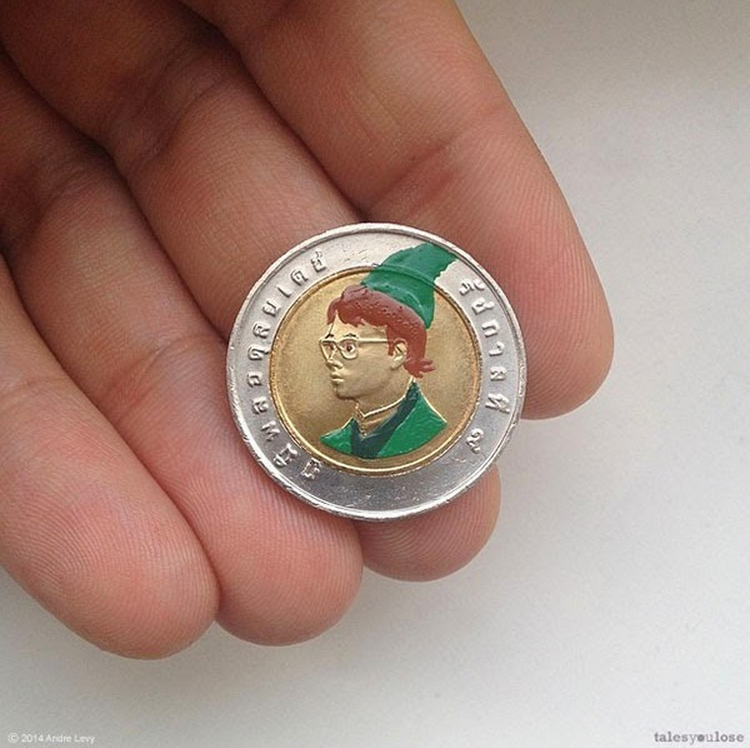
Screen Shot 2014-05-29 at 11.17.59 AM

Andre Levy’s coins take on alternate identities:

Brazilian artist and designer Andre Levy has developed an interesting, playful new pastime: painting coins. In the series, which he calls Tales You Lose, Levy uses the mini-structures of the coin’s portraits or figures to create his own, partially or fully obscuring the faces of presidents and kings to recreated the likenesses of superheroes and pop-culture icons.

See more of his work here and here.

A Short Story For Saturday

This weekend’s selection is a relatively obscure short story from Marilynne Robinson, “Connie Bronson,” published in the 1986 Summer-Fall issue of The Paris Review. How it begins:

I had one friend named Connie Bronson who lived two houses up the street from me and was one year younger than I and two grades behind because she had had brain fever. She had blood-red hair and a freckle-spattered face, and was called Bones by the boys at school, who regarded her with intense loathing and in bad weather often spent whole recesses devising other, more terrible epithets for her.

All of this was a source of great sorrow to her mother, who took a job in a drugstore so that Connie could have piano and tap-dancing lessons, and gave parties for her on every pretext, ordering huge cakes from the bakery encrusted with coarse, dusty frosting and blowsy sugar-roses, calling the mothers of each of the children in Connie’s class to be sure that the parties were well-attended.

She had once even bought the girl a pony which, since her means were limited, was very old and sickly and ill-tempered, and was put up for sale again a few weeks later because it bit Connie’s hand, breaking her little finger, which, though it was set and re-set, healed veering outward at the first knuckle. This, of course, cast a shadow over those of her mother’s hopes that rested with the piano lessons, and provided another theme for the inventions of the little boys at school.

Keep reading here. For more of Robinson’s fiction, check out one of her most loved novels, Gilead. Previous SSFSs here.