“Ritual Genital Cutting Of Female Minors,” Ctd

A reader writes:

I'm totally for confronting misogynistic bigots. Knowing how they typically respond to confrontation, and considering that it is the daughters of said bigots that are in danger here, wouldn't it be at least be worth considering that this might help some fathers that are under pressure from their families or communities to mutilate their daughters to subvert the pressure with a 'token' mutilation? I don't disagree with PZ's thoughts on this in the slightest, but the bigotry in these communities is going to take time to go away, and in the meantime if – IF – this means that a lot of girls who would have gotten the full mutilation just get a token scar instead, wouldn't that be worth the dirty feeling that even I am getting just by writing this?

Another writes:

I am a member of the American Academy of Pediatrics, and I lived in Kenya for two years right out of college. Jomo Kenyatta's doctoral thesis, which was published as "Facing Mount Kenya", clearly states the reason behind female circumcision among the Kikuyu: to deny women any sexual pleasure, so that they would not be unfaithful.  This practice, as horrifying as it may be, was adopted by a primitive society to maintain social order.  Kenyatta also said that an uncircumcised woman would be considered undesirable by any Kikuyu man.

I can assure you that the bulk of AAP membership consists of wonderful people who are oriented toward serving others and are obviously not in medicine for the money.  However, there are some who could be poster children for political correctness. They tout a cultural relativism that is very well-intentioned but has run seriously amok. American citizenship should entail saying no to primitive customs that ensured social order centuries ago: honor killings, female illiteracy, and yes, female genital mutilation. 

Another:

I'm a physician and at one point was taking care of a Nigerian woman in labor. It was my first exposure to female 'circumcision'. In this case her clitoris had been completely removed and replaced by a mass of scar tissue. It was a horrible thing to see and hard to see how such a procedure could be justified. With a male circumcision at least sexual function and response remains.

I used to do newborn circumcisions but reached a point where my conscience could not justify doing it any longer. The arguments for reduced urinary tract infections and HIV (to me) are not justification for doing an elective surgical procedure because the parent wants it done.

Tracy-Clark Flory and Katy Kelleher join the debate.
Are These Tories Really New Ones?

After the result, John Gray continues to worry about the Tories' "bigoted tendancy":

If the Conservatives tilt towards American-style fundamentalism they risk becoming permanently marginal. That's one reason why theo-conservatism, though probably more influential than in the past, isn't going to be a serious force in British politics. A more realistic danger is the growth of a type of populism similar to that which has developed in the Netherlands. For Pym Fortyn and Geert Wilders a liberal society isn't an open society. These European populists aim to make a particular interpretation of liberal values compulsory, while shutting out anyone – most obviously, religious minorities – who may not accept their interpretation of what freedom means.

An excerpt from Gray's longer mediation on this turn of events here.

Britain’s Unbroken Politics

CLEGGCAMLeonNeal:Getty

A characteristically wise column from Charles Moore:

Mr Cameron’s scheme [a Tory-Liberal coalition] is, surely, as near as we can get to what the voters wanted – a big change, but with no absolute trust placed in a single party.

So three men – all contending with difficulties within their own parties, all struggling for advantage and all to some degree disappointed – nevertheless realised that the situation had to be solved, and set about doing so. And they are managing it within the existing system. Who says it is dysfunctional?

It turns out that the least right analysis of this campaign was the one favoured by the Guardian and the BBC and, indeed, Mr Clegg. The voters were not completely disillusioned with the old politics. They found the leaders’ debates a useful stimulus, but not a replacement for parliamentary democracy. The “old” parties (actually there aren’t any new ones of any consequence) are not collapsing. Even Labour, though it did very badly, held on to its core support. Except in their leaders’ debate participation, the Liberals did not break any mould. The party that achieved by far the biggest movement – attracting more than two million extra votes – were the Conservatives. Our way of doing politics has come under strain, but has not been shaken to its foundations.

There is a chance for a truly imaginative Tory-Liberal fusion here, reinvigorating the party of the center-right. Others on the Tory right are as restless as those on the Liberal left, and blaming Cameron's move to the center for the failure to get a majority. But the Tories gained a staggering 100 seats from Labour – one of the biggest gains in British history. It's just that the mountain was so high to climb. And the polling suggests that more austerity, more anti-Europeanism, anti-gay sentiments, or crude anti-immigrant rhetoric would not have won more votes. It would have lost more.

It's also true that if you exclude Scotland, Cameron would have a clear majority. The collapse of the Tories north of the border renders Westminster's national parliament all the more bizarre, given that Scotland has its own as well. The Scots could soon face a government down south with no one elected from Scotland in it at all.

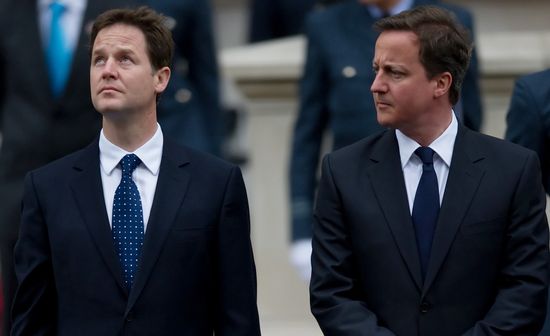
(Photo: Cameron and Clegg at a VE Day Memorial today. By Leon Neal/Getty.)

Race And Intelligence, Again, Ctd

A reader writes:

Your reader says, "I come to this as a scientist…There is no "race"…at the genetic level…There is a continuum of genetic diversity…racial categories are a cultural construct."

Ok, race is cultural construct, but so what?  Does that make racial categorization somehow less real?  When we perceive color, we are looking at a continuum frequency diversity on the electromagnetic spectrum.  Somehow we still manage to call one color red and another one blue.  You don't hear people saying the difference between red and blue is meaningless and unworthy of scientific investigation, do you?  I have a hydrangea that is red and another that is blue.  I should pretend that they are the same, and not inquire as to whether there is a genetic basis for it?  (There isn't; it's a result of varying soil acidity, but how can I know that if I'm not allowed to ask the question because someone has already told me that color is just a cultural construct?)

If there is no "race" at the genetic level, then why is it that dark skinned people with very curly hair keep having children with dark skin and curly hair?  Why do children of Asians look persistently different from children of Jews?  There is something genetic happening that affects skin, hair, facial features, disease susceptibility, and a whole host of other things.  But we are powerless to examine those differences because there's no such thing as "race" at the genetic level?  The contention is absurd on its face.

Tell it to a drug company who sees differential effectiveness and side effects among blacks, Asians, and whites.  Sorry guys, you are not allowed to record race in your clinical trials anymore, because everyone knows that information has no meaning!

Another writes:

First of all, there is no controversy whatsoever that black people, on average, have lower IQ scores than white people. Second, race is a useful construct. To me, the term simply means, a very very large, very extended family.

I would also like to take issue with your readers who argue that IQ is meaningless. Precisely the opposite is true: The central message of the Bell Curve is that IQ scores have *high predictive validity* for all kinds of things, including income. Anecdotes about purportedly dumb people that have been very successful or amazingly bright individuals that have failed in some way are meaningless behind the mountain of data that point to a key role for IQ, whatever that may be, in individuals' life outcomes.

I would like to point out that there is growing evidence that one's IQ is correlated with brain regional volumes, particularly the dorsolateral prefrontal cortex, the parietal cortex, and the connections between them. This indicates that the construct called IQ has a basis in biology. See, for example, this article in Nature Reviews Neuroscience.

Remembering How To Sleep

D.T. Max reports on the mysteries and secrets of sleep:

If we can't sleep, perhaps it's because we've forgotten how. In premodern times people slept differently, going to bed at sunset and rising with the dawn. In winter months, with so long to rest, our ancestors may have broken sleep up into chunks. In developing countries people still often sleep this way. They bed down in groups and get up from time to time during the night. Some sleep outside, where it is cooler and the effect of sunlight on our circadian rhythm is more direct. In 2002, Carol Worthman and Melissa Melby of Emory University published a comparative survey of how people sleep in a variety of cultures. They found that among foraging groups such as the Kung and Efe, "the boundaries of sleep and waking are very fluid." There is no fixed bedtime, and no one tells anyone else to go to sleep. Sleepers get up when a conversation or musical performance intrudes on their rest and intrigues them. They might join in, then nod off again.

The Math

PRCROWDPeterMacDiarmid:Getty

Nick Robinson has a useful primer on what the options for getting a parliamentary majority now are:

No party has enough seats to win votes in parliament without the support of members of other parties.

The Conservatives are the largest party with a total of 306 seats in the Commons – which would go up to 307 — if they win the delayed election in Thirsk and Molton – until now, at least, a safe Conservative seat.

If they tried to govern alone they would, in theory, face a combined opposition of 343 MPs.
In reality it’s somewhat different. Sinn Fein won 5 seats – and they don’t take their seats in the House of Commons – so the opposition benches reduce to 338.

A Con/Lib Dem coalition would give them a total of 364 – enough to govern comfortably.

A looser arrangement in which the Lib Dems agreed not to vote against a Tory Budget or the Queen’s Speech would mean 306 or 307 Tories facing a depleted opposition of 281 (that’s 338 – 57 Lib Dems)

If a Lib Dem/Conservative deal fails, Gordon Brown will try to form a government.

If Labour and the Lib Dems joined forces – the extra 57 votes are not enough to make them the biggest force even with the support of the Northern Irish SDLP (who sat on the government benches in the last parliament) and the one new Alliance MP who is allied to the Lib Dems. Together that’s 319 votes.

With the support of the nationalists from Scotland and Wales they would reach 330.

If the DUP joined too and the independent unionist and the new Green MP this alliance would have 338 votes in the Commons.

A Lib-Tory alliance is the obvious first choice. If I were Cameron, I would offer a real fusion – a few cabinet posts for the Liberals, and a commitment to single transferable vote in one-member constituencies. But he should keep the economic policy intact, and start tackling the debt immediately. He has a chance if he embraces some kind of electoral reform to gain momentum as a reformist Tory.

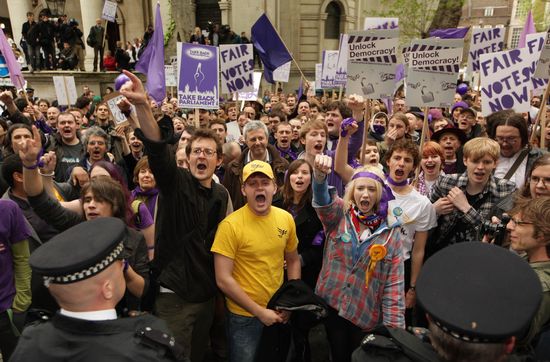
(Photo: Protestors calling for electoral reform besiege Transport House where Liberal Democrats are holding a meeting on May 8, 2010 in London, England. Over 1000 protesters have gathered in Westminster calling for proportional representation as the Liberal Democrat leadership discuss a possible coalition with the Conservative Party. By Peter Macdiarmid/Getty Images.)

Brown Rants At Clegg On The Phone

Election-front-pages-007
  That's the word from a senior Liberal:

The source told the BBC's Jon Sopel that during the leaders' conversation last night, the tone went "downhill" at the mention of resignation.

It was claimed Mr Brown's approach was to begin "a diatribe" and "a rant" and the source said the Labour leader was "threatening in his approach to Nick Clegg".

Mr Clegg was said to have came off the phone assured that it would be impossible to work with Brown because of his attitude towards working with other people.

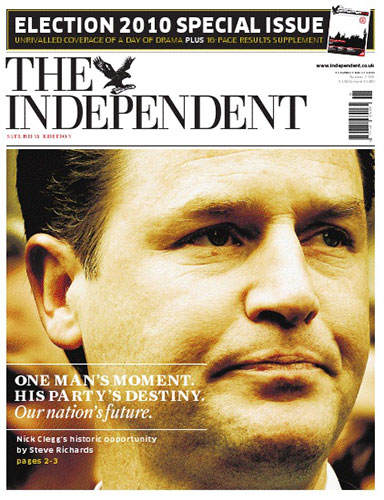
Both parties are now denying it – but they would, wouldn't they? The question of the hour is how strongly Clegg will insist on electoral reform as a condition for a new government with the Tories. And that is affected by the strongly democratic nature of Liberal Democratic politics. Clegg cannot get too far in front of his party. Meanwhile, #dontdoitnick (i.e. don't surrender on proportional representation) is rising on Twitter and an unruly crowd has assembled in London to demand electoral reform. Rick Hertzberg needs to get on a plane soon, don't you think?