"In general, comedy in purist form always makes some people uncomfortable," – Comedy Central's head of original programming Kent Alterman, defending a planned cartoon series featuring Jesus Christ.
Author: Andrew Sullivan
Quote For The Day
"But that’s cliché," – Hugh Hewitt, to Isikoff noting that we are a "country of laws."
Starving The Beast (Not)
Bruce Bartlett examines one of Alan Greenspan's worst ideas. Remember when Republicans were the fiscally responsible ones, especially in wartime:
Dwight Eisenhower kept in place the high Korean War tax rates throughout his presidency, which is partly why the national debt fell from 74.3% of gross domestic product to 56% on his watch. Most Republicans in the House of Representatives voted against the Kennedy tax cut in 1963. Richard Nixon supported extension of the Vietnam War surtax instituted by Lyndon Johnson, even though he campaigned against it. And Gerald Ford opposed a permanent tax cut in 1974 because he feared its long-term impact on the deficit.
Do the tea-partiers really represent the solid conservative truths of the past – or just the discredited fads of yesterday?
Voting Drunk, Ctd
A reader writes:
I’d like to point out to the previous reader about the most recent change to Indiana’s Alcohol laws. As of just recently, we can IN FACT purchase alcohol on an Election Day. Still on the books, however, is a ban of purchasing alcohol at grocery stores, convenience stores, and drug stores on Sundays. That one comes around every couple years or so, and continually gets rejected.
Another writes:
Bars actually were open on Tuesday for the Indiana primaries. Sorry he missed out.
A scene from the 2008 election:
Poll workers [in Albuquerque] called police after the woman began yelling and screaming at them. When the officers arrived, she had lost consciousness with a bottle of vodka tucked into her waistband. A little checking determined that it was not illegal to be drunk when casting a ballot, but election laws do prohibit liquor at voting sites and creating a disturbance. […]
Because the woman passed out before inserting her ballot into an electronic tabulator, her vote will be hand-counted.
Colbert Last Night
| The Colbert Report | Mon – Thurs 11:30pm / 10:30c | |||
| British Election Couverage – Andrew Sullivan | ||||
|
||||
“Just Nuts”
David Boaz looks at Sarah Palin's latest declaration.
What Next?
Patrick Dunleavy's analysis from earlier this morning:
There are three possible outcomes, in decreasing likelihood of their occurring:
- Cameron minority government: expect a new election in October 2010 or May 2011.
- Labour-Liberal Democrat coalition – should last at least two years, because constitutional change takes time. Gordon Brown has offered legislation to create fixed four-year terms, which might imply a government that lasts until 2014.
- Conservative-Liberal Democrat coalition – without PR being included, it’s hard to see this lasting longer than May 2011.
Are The Democrats Oversold? Ctd
Bernstein is encouraged by the jobs report:
I suspect we're now pretty much at the point that Democrats will feel safe to start actually talking up the economy. They've been very hesitant to do so to date, for lots of good reasons: most Dems still want jobs legislation, and talking up the economy undermines the case for it; the overall unemployment situation has still been terrible, and Dems don't want to sound insensitive to hard times for their constituents; and, most important of all, the Democrats certainly don't want a "Mission Accomplished" moment. These reasons are now fading, as the economic situation improves.
The Mandate
This is important:
The results of a Comres flash poll, reported by the BBC, say that 81% think that the leader of the party with the most votes in the election should be prime minister. Other results include: 51% say that the leader of the party with the most seats should be prime minister. 'In the event of a hung parliament I would prefer David Cameron to be prime minister' – 48% to 45%.
61% say they would not prefer Gordon Brown to be prime minister in the event of a hung parliament.
All Eyes On Clegg
Anne Perkins sums up the dilemma:
[T]he longer David Cameron is politely barred from Downing Street, the more such momentum as he has from winning the most votes and the most seats ebbs away. Meanwhile, Brown is holding out to Clegg what could be the last best chance of getting voting reform this generation. But if Clegg grabs the chance, he will also appear to be doing exactly what he promised not to, and preventing voters shaping the result they voted for in the greatest numbers.
Cameron is putting the ball in Clegg's court. Electoral reform is not, no matter what people may claim, a pressing issue. If Cameron offers Clegg a real deal can the Lib Dems really refuse it? The purity of opposition is all well and good but if you're given the chance of power can a serious party really refuse it, even if it demands a number of compromises, some of them unpalatable?
If the Tory right is too small minded to allow Cameron to do a deal with Clegg then they are as stupid as they are short-sighted. This is an historic opportunity to realign politics along a liberal-conservative axis. It is the chance to destroy the Labour Party as a party of government forever. If the price is real reform of the electoral system then that is a price well worth paying to free us from the economic destruction wrought time and time again, decade after decade, by a statist, big government Labour Party.
Labour’s sudden conversion to a referendum on PR derives directly from its desire to stay in office, despite having done badly in the election. There had been no such offer during the past 13 years. The Conservatives, given their antipathy to PR, are unlikely to be able to give Clegg an equivalent offer. Several complex issues would have to be decided before a Lab-Lib deal could be concluded. Such issues include: the type of PR to be offered in a referendum; timescales (eg, would the referendum take place at the end of a full Parliament, or perhaps within a shorter period); and how to ensure that neither the Commons nor the Lords could scupper the necessary legislation.
In the end, Nick Clegg will have to decide whether he wants to risk being accused of keeping Labour in office after 13 years of power, and with the Conservatives ahead in terms of seats and votes. There are big risks for the Liberal Democrats whoever they choose to side with. Another general election within a year or so now seems very likely.
Clegg’s hand on pushing for electoral reform is significantly weakened by his poor election showing. So while they won’t rule out a deal with Labour, it will mainly be to strengthen their position with the Tories. An AV referendum is probably out of the question. But the Tories could offer up some other concessions: cutting the number of (Labour) MPs, recall elections, and even fixed term parliaments.
Labour’s only chance of getting together with the Libs will be in six months or so, under a new leader. If the Tories fail at “governing in the national interest”, if they prove unpopular enough for Clegg to ditch, then a Lib-Lab coalition deal is back in play. That’s all Clegg has to scare the Tories with.
Nick Clegg has just been absolutely humiliated. (This inconvenient fact is being mostly skimmed over by the BBC today for some reason). Clegg’s new politics is a smoking ruin. Cleggmania is destined to be an amusing trivia question in years to come. He has actually lost seats. His vote share has barely gone up. He is in no position to dictate terms to anyone, and I stronly suspect he’s bright enough to know it.
The Tory leader’s smartest course of action on electoral reform would be to offer not a sausage, nothing, hee-haw.
If Cameron thinks he can bundle Clegg over the goal-line, without making any big concessions, naturally he will. If I were Cameron I would try and dare the Lib Dems not o support me, initially. Why wouldn’t he? If I were Clegg, I’d say tell, Cameron, politely, make a proper offer and demand to sit down and talk it through properly. This again is quite reasonable.
If the Tories and Lib Dems find it impossible to find common ground, then Labour come into play. Of course, both the Tories and Lib Dems know that we are sitting on the sidelines, waving hopefully.
[O]ne senior Whitehall source says that Clegg is merely setting up a "bidding war", of which this could merely be the early stages. It is worth noting that Clegg said the "first" opportunity for a deal goes to the Tories. But not the only one.
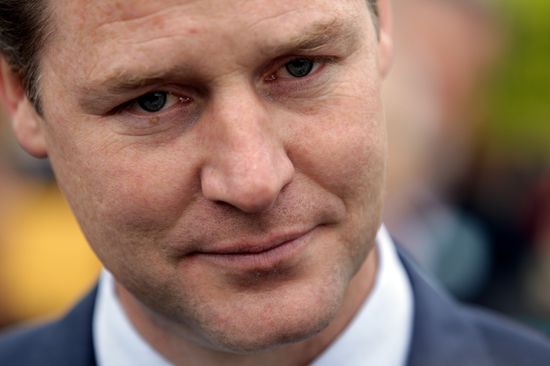
(Image: Leader of the Liberal Democrats Nick Clegg speaks to party supporters during the last day of campaigning before polling day on May 5, 2010 in Eastbourne, United Kingdom. By Dan Kitwood/Getty Images)
 The Dish