World War II was the golden age of maps? Really? This kind of nostalgic hooey is really too much sometimes. If we’re not living at the beginning of the golden age of maps, then I’ll eat my whole collection of old topos, which have been rendered essentially useless by the Internet. Not only does every person with a smartphone or tablet walk around with an exquisitely and finely detailed atlas in his or her pocket in the form of Google Maps, but it’s searchable, too. And with Google Maps comes Google Maps Engine, which can be used by businesses and schools (who can get free licenses for the product) to create interactive, to-scale maps that are driven by the same platform Google uses. And we’re not just constrained to corporately-owned and tightly-licensed maps, either. With projects like Open Street Map, we have a user-created, openly-licensed atlas that can be freely used, corrected, and tweaked by anyone who wants to contribute to it – a sort of Wikipedia of maps.
And those aforementioned paper topographic maps? They’re basically just good for decoration, now that the USGS has put up free scanned copies of all their old maps for download and has issued a new series of maps based on aerial and satellite imagery with layers that can be enabled and disabled to pick out useful information or hide useless information, all using standard PDF viewing software.
But WWII-era maps printed up in a five colors on bulky paper and with very limited amounts of detail were nice, too, I’m sure.
Can’t argue with that. Previous Dish on the current era of cartography here.
Paul Bonicelli wants Obama to take up the cause of Mariam Yahia Ibrahim, the Sudanese woman sentenced to death for apostasy because she refused to renounce the Christianity of her upbringing and embrace the Islam of her absentee father:
During the last several decades we have witnessed the rise of regimes of armed groups that claim a foundation in Islam to establish an order characterized by cruelty. They hijack one of the world’s major religions to practice a form of governance that uses brutality to enforce control and intimidation, particularly of women. A regime that is willing to torture and execute a woman recently delivered of her child simply because she holds religious views different from the regime’s dictates is truly barbaric.
And it is a direct challenge to all who have advanced civilization and serve as its guardians, whether they do their work unilaterally or via multilateral forums such as the United Nations. Bashir’s government in Sudan is the latest example; its current persecution of Ibrahim and her American husband and unborn child is a calculated and direct threat to the role the United States has been playing in the world. We should make no mistake about why Khartoum has chosen this time and circumstance to shock the world. The regime is bitter at the United States’ role in the loss of what is now South Sudan. The persecution of Ibrahim is a lashing out at the world that the United States has helped to produce. It is a challenge the United States and the West cannot afford to tolerate.
Ibrahim gave birth to a baby girl in a prison clinic on Tuesday and will be allowed to nurse the child for two years before her sentence is carried out. Her 20-month-old son is also in prison with her. Jonathan Fisher considers how the US government might go about securing their release:
The truth is that western governments have few cards to play in Sudan. This has been even more so since the election of fellow ICC indictee Uhuru Kenyatta to the presidency in Kenya and the outbreak of civil war in South Sudan in 2013, two events which have strengthened al-Bashir’s hand regionally and internationally. Threats and condemnations from the West will sadly do little to change Ibrahim’s fate. But western officials have other diplomatic tools at their disposal, notably flattery and face-time. Even the tyrants of North Korea have been known to offer clemency to prisoners when personally lobbied by former US presidents. Indeed, in 2007, al-Bashir himself pardoned a British schoolteacher imprisoned for blasphemy (naming her class’s teddy bear “Muhammad”) after a visit from British legislators. Instead of lobbying John Kerry to grant Meriam Ibrahim asylum, the two US senators from New Hampshire – home state of Ibrahim’s husband – might be better off catching the next flight to Khartoum.
Today, the vice-president who almost single-handedly broke the US military, bankrupted the country, trashed America’s moral standing and failed to secure a single WMD called president Obama the “weakest in my lifetime.” There are times when you really wonder if the man has any self-awareness at all.
Last night’s Best of the Dish featured a screenshot from the closing of the HBO documentary which repeated the untruth that the Perry decision has had a huge impact on marriage equality suits around the country (the dumb-ass argument Jo Becker tried to peddle). I’ve been told by HBO that that has been removed from the final version. Maybe HBO has gotten wise to Chad Griffin’s manipulation of gay history.
Many of today’s posts were updated with your emails – read them all here. And you can always leave your unfiltered comments at our Facebook page and @sullydish.
17 more readers became subscribers today. You can join them here. One writes:
Your reader wrote: “I can’t wait ’til you get to Provincetown and chill the fuck out for a while”. I laughed out loud. Because I don’t think that even Provincetown will necessarily meet your exacting standards of living, if memory serves. I think Jim Newell at Wonkette said it best back on July 27, 2009:
HEROIC PUNDIT RETURNS, COVERED IN POOP: You people loved Andrew Sullivan so much when he came this close to seizing the throne of Iran, last month, but then he went on vacation, leaving his blog to numerous bloodthirsty tyrants named Conor. But now he is back, and stone cold covered in shit: “This has been a bust of a summer this year on the Cape: almost no sun, an economic depression that is killing businesses and crippling real estate, and vicious hate crimes from some locals. Oh, and the sewer broke over July 4, with poo coming up out of the drains and showers and toilets. Good times.” Ah, summer with the Sullivans.
Though I haven’t thought it through in any detail, in principle, I’m open to the idea of reparations for slavery and would be perfectly willing to see my hard-earned tax dollars used for it. But I always remember that US history harbors not one, but two monstrous racial crimes. Of course African-American slavery is one, but the genocide (or ethnic cleansing, if you prefer) and dispossession of the American Indian is the other, and it is just as terrible. How would we pay reparations to them? For every square inch of this land. How much would that tab be?
Another adds more complexity:
What’s interesting about this idea is that reparations would be paid by “America,” not “White America.” So, not only would the Vietnamese Boat Person have to chip in, but so would middle-class blacks, in the form of federal taxes.
J.D. Vance asks about whites who weren’t slaveowners:
[Coates] makes no mention of the 75 percent of the southern white population that didn’t own slaves, their wages so depressed by slave labor that they lived in arguably the most unequal society in world history—with slave owners earning a median of $23,000 per year while other whites fetched about $1,500. Nor does he cite the North’s two-to-one advantage in per capita income, evidence of its superiority in every economic pursuit that didn’t require enslaved workers. There’s no mention of the literature showing that slave labor sustained the Southern economy but also retarded it. How can we decide whether reparations are due, or which portion of American society should pay them, without untangling this economic story?
Another reader doesn’t see how reparations could be carried out:
I don’t have an issue with the idea of our government providing reparations to a specific group of people for institutionalized discrimination, but in this case I think there are insurmountable practical problems. Intellectuals like Ta-Nehisi Coates love to focus on the question of whether or not reparations are deserved while avoiding the hard questions like how much is enough and who should receive them.
Assuming some set amount could be agreed upon, who should receive the reparations?
Descendants of slaves? Most people would have a difficult time proving their lineage. Even if you could prove you were descended from slaves, how much should they receive? Should someone who is half black and half white get as much as someone is who isn’t “mixed”? How about someone who may have very light skin color and European facial features? How about people who are descended from more recent immigrants?
The amount would also be an issue. I could see someone like Coates being satisfied with a symbolic official letter of apology and acknowledgement from the government along with $1.00, but I think most people would say “you owe us more than that, this isn’t good enough, you’re trying to weasel out of paying us.” For Coates reparations may mean “spiritual renewal,” but I’d bet if you asked most of your every day people on the street what “reparations” means, most of them would say a significant payout and nothing less.
Another reader wonders what reparations would mean for his family:
As the white adoptive father of two mixed race kids, I’m trying to figure out who would owe who what under TNC’s call for reparations. We have no information about their birthfathers, so I can’t be sure of their background, or indeed if one of my sons is even part-black or some other admixture. Will we have to submit them for genetic screen to determine just how black they are? Do we get an added bonus if he has Native American background as well (as many folks who see my oldest think)? Will we lose the bonus if my younger ends up half Pacific Islander rather than African (as we also think)?
Institutionalized racism has taken a horrible toll on far too many Americans, but I honestly don’t see how this is supposed to work.
Lastly, Damon Linker focuses on Coates’ larger mission:
[I]t would be a very good thing for Americans to do the hard and truthful work of reconciling “our self-image as the great democratizer with the facts of our history.”
But that, I’m afraid, is exceedingly unlikely to happen, precisely because (as Coates also notes) it would require that America become nothing less than “a new country” with a radically different form of patriotism — one much more like the national culture that has developed in Germany in the decades since its total defeat in World War II. That is a culture self-consciously devoted to collective self-examination and atonement for the sins of the country’s past.
Coates is surely right that the development of a more complicated, ambivalent form of national self-love “would represent America’s maturation out of the childhood myth of its innocence into a wisdom worthy of its founders.” But I, for one, see little evidence in the American past or present to indicate a widespread willingness to leave behind childhood myths, to grow into maturity, and to accept that the United States is somewhat less unambiguously good than we would prefer to believe.
Recent Dish on reparations and the associated debate here, here, and here.
Hal Hudson envisions how bug eating could become more popular:
Paul Rozin, who studies the psychology of disgust at the University of Pennsylvania, says new and unusual foods tend to make their way into popular culture from the top down, starting with those who can afford to dine in expensive, adventurous restaurants.
Sushi is one example of this trend. The idea of eating raw fish was largely foreign to people in the US before the 1960s, but now sushi restaurants can be found almost anywhere. “Sushi originally started with Japanese businessmen in Los Angeles. It was just a local ethnic thing for them, but then they would invite their American counterparts,” says Rozin. “It’s true of most unusual cuisine – people who are wealthy and adventurous do something, and then it becomes trendy.”
Hudson details some efforts to make insects more flavorful:
Chefs around the world are hard at work experimenting with insects to make new and appetizing foods. Nordic Food Lab – a non-profit spun out from Danish restaurant Noma – began a project to make insects delicious to the Western palate in May last year. Their chefs believe that making insects tasty could spark a wave of interest in entomophagy (see “Taste test“).
Nurdin Topham, now head chef at Nur in Hong Kong, was involved in the work, and noticed that the flavor of the insects changed depending on what they had been fed. “The diets that the insects were fed made quite a significant difference to the quality, taste and freshness, in the same way as shellfish or prawns,” he says. “There was a definite difference.”
Indeed, Tiny Farms in Austin, Texas, is already doing this. It uses a process called gut loading – in which crickets are fed certain flavored or nutrient-rich foods just before they are killed – to rear crickets that taste like honey and apples, or that are high in vitamin C.
(Photo: Salted crickets mashed with huitlacoche and wrapped in homemade tostadas over tomatillo sauce, finished with pomegranate seeds. By Flickr user Carnaval King 08)
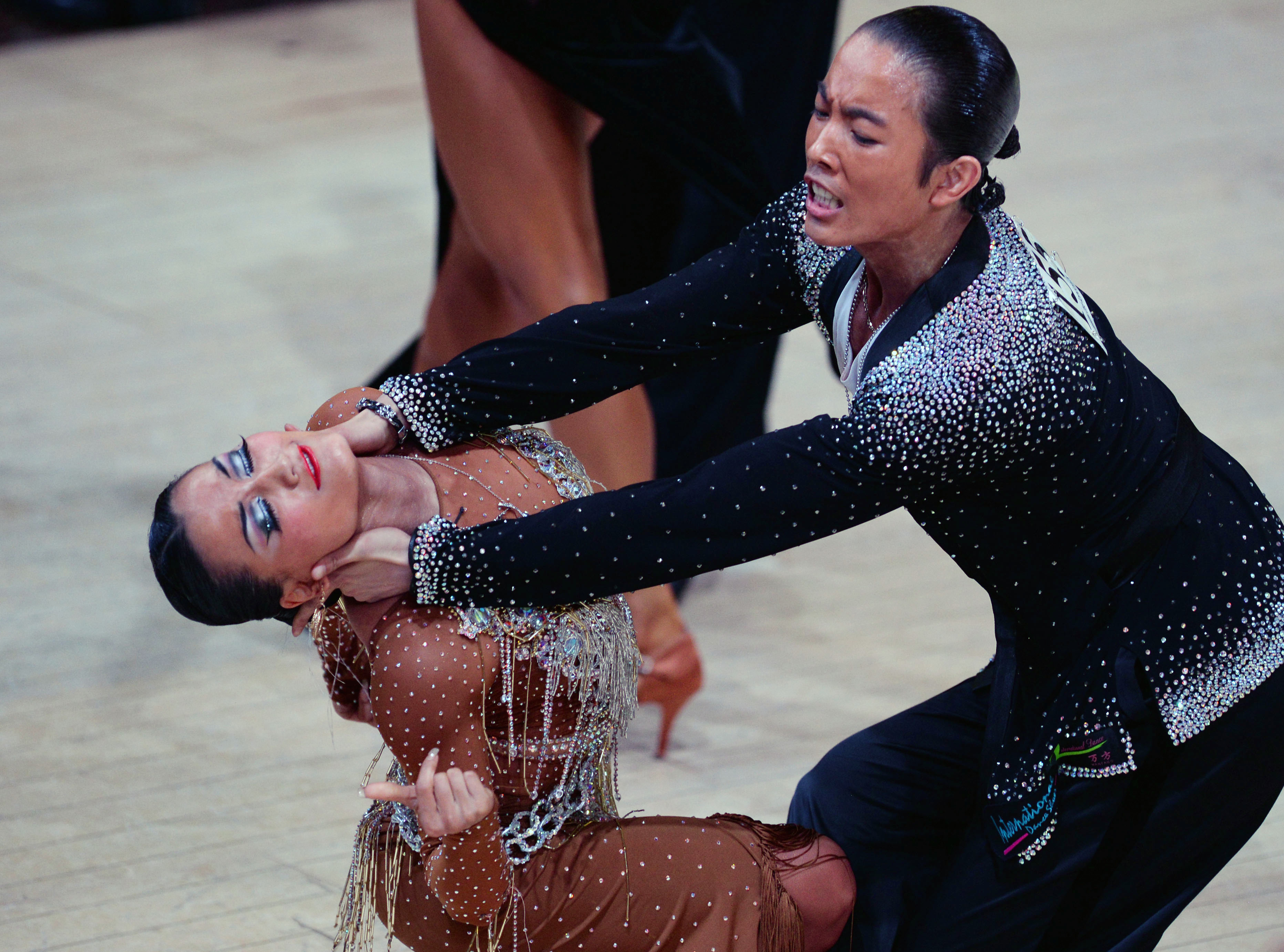
Wang Zilong and Li Yang of Hong Kong compete in the Latin section of the British Open Dance Championships at the Winter Gardens in Blackpool, England on May 28, 2014. The festival covers a nine-day period with professional and amateur couples competing in Ballroom and Latin competitions. By Nigel Roddis/Getty Images.
Carl Miller suggests that Wikipedia could be a model for policymakers:
[R]ealizing digital democracy is hard. Iceland’s attempts to do so for their constitution descended into acrimony. As Matthew Hindman has argued, the Internet hasn’t really broadened political discourse much at all – rather it has empowered a small set of elites. While hundreds of thousands of people blog about politics, only a handful of these blogs are actually read. Anyone can be on Twitter, but celebrities and journalists are more likely to be followed than you or me …
Amid these challenges, Wikipedia stands out as a twinkling beacon of hope. …
The English version [of Wikipedia] alone is 60 times larger than the last great repository of human knowledge in the English language, the Encyclopedia Britannica, and nearly as accurate. But it is also a model for how to turn an elite-driven process into a democratic one. Britannica is written by 100 full-time editors and a few thousand contributors. Wikipedia has 21,395,915 accounts on Wikipedia and 270,000 are active on a monthly basis. It has achieved something that mainstream politics has cause to envy: the routine, active engagement of hundreds of thousands of willing volunteers of often radically different background and opinion to create something used, supported, and trusted by millions. There is an exciting opportunity here: to see whether Wikipedia and Wikipedians can teach us how to improve engagement with formal politics.
Just in time for tonight’s Scripps National Spelling Bee finals, Ben Blatt runs the numbers on which words are most likely to knock a contestant out of the running:
Thanks to the folks at the National Spelling Bee (who sent me complete records for the last decade) and Merriam-Webster (which provided their pronunciations), I’ve been able to compile statistics on all of the words that have been spelled correctly (there are 5,042 of them) and incorrectly (1,409) during the traditional oral rounds. (I didn’t look at words that were part of the bee’s written test.) So, what’s most likely to throw a speller off?
You might suspect that longer words are more likely to trip up contestants. The two longest words in the data set were 17 letters apiece: triboluminescence and idiosyncratically, both of which sent their spellers home. But long words aren’t always so tricky. Five of the eight 16-letter words were spelled correctly, Michelangelesque and sphygmomanometer among them. And of the two shortest words to appear in the spelling bee in the last 10 years, gbo and rya, only the former was spelled correctly.
Reuben Fischer-Baum uses Google Ngram to show that the winning words have gotten more obscure over the years, from “therapy” in 1939 to “cymotrichous” in 2011:
Of the 15 rarest winners in bee history, 11 have come since 1995 … [The] five top words stumped Google Ngram, and didn’t appear in the corpus at all in the year prior to the bee. “Esquamulose”—meaning “not covered in scales“—wins rarest word, period; it doesn’t appear in the corpus for any year, from 1800 to 2008 (a word has to appear in at least 40 books to show up in the database). Appropriately, “esquamulose” was only a winning word in a technical sense. The 1962 contest ended in a tie after both finalists failed to spell it correctly, the first and only time that the bee has ended in such as way.
In case you missed it, Elizabeth Minkel is bothered by “ICYMI”:
I’ve lost track of the number of times I’ve seen someone apologize for sharing something “old” that was published 48 hours prior. I’ve lost track of the number of times I’ve seen something interesting and completely un-timely and thought about sharing it, only to stop myself when I noticed it had been published a year or two ago. And I’ve lost track of the number of times when I’ve seen a piece – or, for that matter, written a piece – that seems to fall flat because it came out a week or two after the bulk of an internet maelstrom.
“In Case You Missed It” makes the feeling explicit. It’s hard for a lot of us to fight the compulsion to stay up-to-the-minute – in reality, it’s impossible, but it somehow seems achievable. ICYMI makes staying connected feel like a constant game of catch-up, like finding things at a slower pace warrants some kind of disclaimer.
I’m not the first to complain about the unrelenting pace of information online, or the method of its delivery.
“The Stream,” the chronological endless scrolling nature of the present web—one new notification, one new notification – rose to prominence about five years ago. Alexis Madrigal wrote beautifully about our sense of time online last December, the valorization of “nowness,” how the next tweet inherently trumps what came before it: … We feel overwhelmed because we crave endings, and the Internet has no end. “And now, who can keep up?” Madrigal writes. “There is a melancholy to the infinite scroll.” ICYMI is a tacit acknowledgement of that psychological finish line, always being moved an inch more out of reach – I can feel it now, chipping away at me.
The Dish makes a habit of posting new material as quickly as possible after its publication, to bring you the freshest yet most comprehensive take on an issue. If we get around to certain pieces too long after their publication date, we often pass on them. But that drive towards nowness is balanced by our constant linking back to material from the archives, to feature the old alongside the new.
You’ll find the whole spectrum of humanity, from white guys to Asian guys to – well, that’s about it:
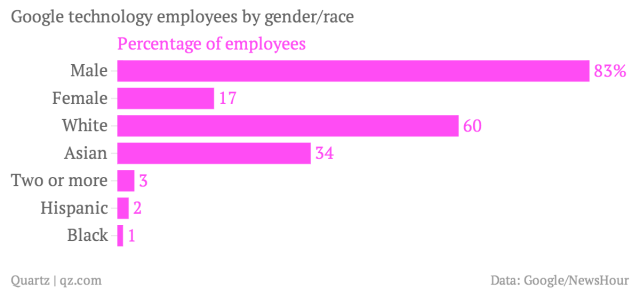
The industry has been known to have a serious diversity problem. But on Wednesday, we got a peek at just how bad it is. Google released statistics about the make-up of its work force: Men and Asians are overrepresented, and women and blacks are drastically underrepresented as compared to the overall United States work force. Most startling: Just 17 percent of Google’s technical employees are women and just 1 percent are black. In the software industry over all, according to the Labor Department, 20 percent of engineers are women and 4 percent are black.
At the entire company, when nontechnical roles are included, women account for 30 percent of employees. That is 17 percentage points below the share of women in the work force, and about equal to women’s representation among lawyers, surgeons and chief executive officers.
This chart really drives the data home:
Alison Griswold adds, “In a blog post addressing the statistics, Google tries to defend its figures by putting them in a broader context”:
“Women earn roughly 18 percent of all computer science degrees in the United States. Blacks and Hispanics make up under 10 percent of U.S. college grads and collect fewer than 5 percent of degrees in CS majors, respectively,” writes Laszlo Bock, Google’s senior vice president of people operations. It’s a fair point: The systematic education barriers to increasing diversity in tech are great. But that doesn’t mean companies like Google can’t strive to do better. (Yahoo’s Marissa Mayer has been among the prominent female executives to call for more women in tech.) Bock adds that Google is “miles from where we want to be” and wants to be more candid about its diversity issues.
While disappointed by the numbers, Victoria Turk cheers the company for disclosing them in the first place:
As the company admitted in a blog post, “We’ve always been reluctant to publish numbers about the diversity of our workforce at Google. We now realize we were wrong, and that it’s time to be candid about the issues.” Hear, hear. While the numbers might not be too optimistic, it’s great to hear a tech company—especially one with the import of Google—at least own up to their record on diversity and recognize the need to improve.
And to be sure, Google is not the only tech company with this problem. As Josh Harkinson argues, Silicon Valley is “actually doing worse than it was a decade ago, diversity-wise”:
Google is far from the only Silicon Valley firm that has been tight-lipped about its demographics. Though large companies are legally obligated to report race and gender stats to the federal government, tech firms such as Google, Apple, and Oracle long ago convinced the Labor Department to treat the data as a “trade secret” and withhold it from the public. Mike Swift of the San Jose Mercury News sued the department to get the numbers. In 2010, following a two-year legal battle, he ultimately settled for stats for a handful of the Valley’s largest companies. Swift’s data went through 2005.
To get an update, I filed a Freedom of Information Act request a few months ago asking the Labor Department for its latest race and gender data on the top 10 firms. In order of largest to smallest by market capitalization, it now consists of Apple, Google, Oracle, Cisco Systems, Intel, Gilead Sciences, eBay, Facebook, Hewlett-Packard, and VMware. When I reached out for comment, most of these companies didn’t get back to me. Google responded that it intended to make its stats public, as it now has.
The data I obtained provides some much-needed context for Google’s diversity numbers.



 The Dish