American Dogma

Aaron David Miller calls dreams of an American brokered Israeli-Palestinian peace a religion unto itself:

Like all religions, the peace process has developed a dogmatic creed, with immutable first principles. Over the last two decades, I wrote them hundreds of times to my bosses in the upper echelons of the State Department and the White House; they were a catechism we all could recite by heart. First, pursuit of a comprehensive peace was a core, if not the core, U.S. interest in the region, and achieving it offered the only sure way to protect U.S. interests; second, peace could be achieved, but only through a serious negotiating process based on trading land for peace; and third, only America could help the Arabs and Israelis bring that peace to fruition.

Read it all. It's as balanced a view of the no-hope position as you'll find. My worry is that all problems are impossible to solve until someone solves them. And in this case, the solution is so blindingly obvious getting there should be possible in two presidential terms. My own patience on this score has lessened as one absorbs the global blowback of the US-Israel conflation in the Muslim mind. But Miller's pessimism is based on cruel experience and is well worth absorbing. From his conclusion:

The believers need to re-examine their faith, especially at a moment when America is so stretched and overextended. The United States needs to do what it can, including working with Israelis and Palestinians on negotiating core final-status issues (particularly on borders, where the gaps are narrowest), helping Palestinians develop their institutions, getting the Israelis to assist by allowing Palestinians to breathe economically and expand their authority, and keeping Gaza calm, even as it tries to relieve the desperation and sense of siege through economic assistance. But America should also be aware of what it cannot do, as much as what it can.
The Kagan “Rumor”

Julian Sanchez has a judicious post on last week's commotion regarding Elena Kagan's sexual orientation. Like Julian, I found the White House's response to be totally tone-deaf:

They could simply have said that Kagan has never publicly discussed the details of her private life either way, which would have been enough to establish that the CBS story overreached. By going further and asserting that Kagan is straight—though in the absence of a verbatim quote, it’s possible that a spox really just flubbed an attempt to deny the “openly” part—they’ve made it actually newsworthy if the claim turns out to be false. Moreover, as many have noted, responding as though being called a lesbian constitutes a “charge” is a stupid goof in 2010.

If Kagan is straight, why have so many people simply assumed she's gay? If Kagan is gay, why is there such pushback against such a "charge"? I fear this is an instance where shifting mores have left someone stranded. The kind of "I'm-out-but-not-really-out" straddle cannot work any more in national public discourse. But now the White House has boxed itself, and Kagan, in.

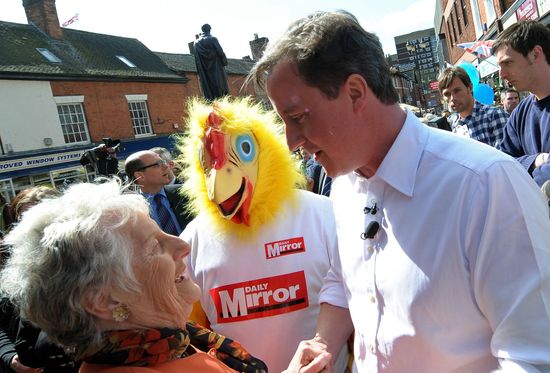
Cameron’s Week Of Chicken

CAMCHICKAdrianDennis:Getty

He's been followed around by a tabloid journalist dressed in a giant chicken suit and today got hit by an egg wielded by a student. I have to say, reading the stories of Iraq's election, that this is kind of reassuring. Cameron did get a good line out of it though:

"Now I know which came first – the chicken not the egg."

Egging has a long tradition in British politics. Harold Wilson got egged in 1970; John Prescott got a egged at "point-blank" range and punched the poor egger.

(Photo: Adrian Dennis/Getty.)

Before They Were Icons

John Meroney features footage that hasn't been seen in nearly six decades:

Today, it's an astonishing, even eerie, scene: the icon of modern American conservatism, whose rise to political prominence was galvanized by the cultural rebellion of the 1960s, fighting off an attack-at-gunpoint by the quintessential modern American rebel. But when "The Dark, Dark Hours" episode of General Electric Theater aired live from Hollywood on December 12, 1954, Ronald Reagan and James Dean were just two actors yet to find the roles that would define them.

And yet in this clip, they do seem to have stumbled across the roles that would define them.

How Big Should The Safety Net Be?

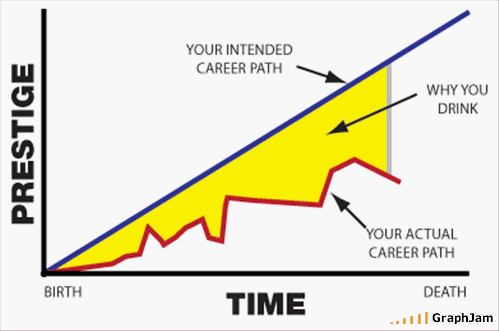
Careerchart
 
Derek Thompson looks at the unemployment insurance (UI) debate:

The San Francisco Fed has weighed in with its own report on the effect of UI on unemployment. The verdict: "We calculate that, in the absence of extended benefits, the unemployment rate would have been about 0.4 percentage point lower at the end of 2009, or about 9.6% rather than 10.0%."

Both the White House and the Fed expect unemployment to remain above 9% by the end of the year and above 8 percent through 2011. This will create significant pressure for benefits to continue, especially since the Congressional Budget Office considers UI one of the most effective fulcrums for raising aggregate demand and creating more work hours. But eventually, UI could unnaturally extend periods of unemployment, costing the government billions of dollars (both in spending and foregone tax revenue) and subsidizing the atrophy of our labor force's skills. Like so much about the federal deficit, jobless benefits today are necessary and potent medication — but they should not come with permanent refill option.

(Image from Cellania)

The Brains Of Athletes

Carl Zimmer examines them:

Del Percio’s team has…measured brain waves of athletes and nonathletes in action. In one experiment the researchers observed pistol shooters as they fired 120 times. In another experiment Del Percio had fencers balance on one foot. In both cases the scientists arrived at the same surprising results: The athletes’ brains were quieter, which means they devoted less brain activity to these motor tasks than nonathletes did. The reason, Del Percio argues, is that the brains of athletes are more efficient, so they produce the desired result with the help of fewer neurons. Del Percio’s research suggests that the more efficient a brain, the better job it does in sports. The scientists also found that when the pistol shooters hit their target, their brains tended to be quieter than when they missed.

Vaughan Bell adds his two cents.