When Your Parents Divorce Late In Life

Katie Crouch declares, “There is something decidedly disorienting about becoming a child of divorce at 40”:

For one thing, my brother and I are extravagantly late to the party. During the first wave of divorces among my parents’ group when I was 8 or 9, I pined for the family breakup. It wasn’t that I was terribly miserable. (Moderately, maybe.) The real draw was that the attention seemed glamorous. … At 40, for me my parents’ separation draws no pity slumber parties, no new cars. Blank stares are usually what I get when I drop the sad news. Though it rarely comes up. Why would it? There are no arrangements to make to pick me up from dance class, no birthday parties to choreograph.

What does it mean, when your parents split apart after you yourself have lived half of your life? For one thing, there isn’t a shred of innocence left. I know exactly what my mother and father are losing, because I’ve known these people for four decades. I’ve witnessed their stubborn affection for each other; I’m old enough to get their private jokes. If I were younger, perhaps I could trick myself into imagining a cute “Parent Trap” situation, but my middle-aged mind knows reconciliation is not possible, not after almost half a century of two people struggling with a disease no one beats. Certainly, I am less shattered than I would have been as a kid. But I am sadder, too.

I have to say I don’t find late divorce to be inherently sad. The ability in your sixties or seventies to say that you want a new start, a fresh life, if your marriage has become toxic and irreparable, strikes me as a vote of confidence in the future. Staying in a marriage that hurts both parties – out of mere pride or exhaustion – is not a great way to round out your days. And the relationship may even blossom with a little late-life distance. There’s a phrase from a Pet Shop Boys track that has long played in the back of my mind during life’s tough patches and a relationship’s constant challenges. Happiness is an option. Words to live by. Words to die with.

Shinseki’s Other Shoe Drops

The findings of the newly released inspector general’s report are pretty grim:

Some 1,700 veterans waiting for an appointment at Veteran Affairs clinics across Phoenix, Ariz. were nowhere to be found in the system’s official wait list, federal investigators reported on Wednesday. Investigators for the Veteran Affairs Office of Inspector General said they had found initial evidence of “inappropriate scheduling practices” in the Phoenix Health Care System, which had led to “significant delays in access to care.”

Although data reported by Phoenix authorities suggested a statistical sample of 226 veterans waited an average of 24 days for their first primary care appointment, the review found that those 226 veterans actually waited on average 115 days to receive a primary care appointment. Only 16 percent got an appointment in 14 days or less, according to the interim report.

Shinseki’s days appear to be numbered:

Increased calls for political action came swiftly in the report’s wake and focused on VA Secretary Shinseki.

“I haven’t said this before, but I think it’s time for Gen. Shinseki to move on,” Sen. John McCain said in an appearence on CNN Wednesday. Rep. Jeff Miller, chairman of the House Veterans’ Affairs Committee, responded to the report with a statement that said Shinseki should “resign immediately.” … In addition to Miller, four other lawmakers also called on Shinseki to resign after the report was released, adding to the more than 50 members of Congress who have called for him to step down since the scandal broke last month. At least two new Democratic senators joined the chorus Wednesday, suggesting that more members of the president’s party are turning against his appointee in the wake of the OIG’s findings.

But Mataconis points out that removing Shinseki won’t solve the VA’s problems:

In the end, of course, the problems at the Department go far deeper than Eric Shinseki. In many cases, they predate him and to a large degree they involve the actions or failures to act of people under him over which he does not have direct supervisory control. Getting rid of the Secretary of Veterans Affairs isn’t going to solve the problems at the VA unless it is also accompanied by the removal of the people further down the chain responsible for these decisions. There also needs to be examination of the bizarre incentive structure that led to the creation of secret waiting lists that made it appears as though hospitals were doing a better job of addressing veteran’s health needs than they actually were. And, a reassessment of the idea that the VA should be the source of all the health care that veterans receive. … In other words, what’s needed is a transformation of the VA from the bottom up, not just the removal of the guy at the top.

Alesh Houdek argues that the real scandal here is in how long it took for anyone to blow the whistle:

Improvements in oversight and auditing are surely part of the solution here, but there’s a much more fundamental change that needs to happen: Regular line-level employees who see wrongdoing on the part of their coworkers, or are asked to engage in wrongdoing by their supervisors, need to be able to do something about it without threat of retaliation. Any human endeavor examined closely enough is a disgraceful mess, and most of us know this most directly from our jobs. But we also instantly recognize true malfeasance when we directly encounter it. So, of all the people who were involved or knew about these terrible practices who worked at the VA, why did it take so long for the truth to come out? …

Since the Phoenix revelations, employees from VA offices around the country have gone to the press with reports that similar practices exist at their offices. Had there been a robust and reactive system for internal whistleblowing, this would not have happened.

Update from a reader:

I am an ER nurse at a VA hospital (not in Arizona, thankfully). The comments from politicians on this scandal are just asinine.

Why is nobody asking why it takes over 100 days to get a primary care appointment? I hear these same complaints from people in the ER every day, that they come to the ER because it takes months to see their PCP. It takes that long because the VA is not given the budget to hire enough PCP’s. That’s the real fucking scandal. The politicians sent our troops to war and they are not willing to pay for their care when they come back.

Is the claim really that there is some nefarious plot to keep our Veterans from seeing their providers? Who believes that shit? We just don’t have enough primary care doctors and nurse practitioners to see them. Hire some more PCP’s and the wait times will decrease.

As for privatization, that is a fucking joke. Only about half of veterans actually use the VA for their health care now, because those who receive insurance through their employer usually go to private hospitals. The ones we see on a daily basis in the ER are older, poorer, often homeless, with more illness and co-morbidities. They are a distinct population and their level of care will decline if they don’t have a specialized service like the VA serving them.

You may not believe it, but most of us working at the VA actually believe in our mission. We mean it when we thank a veteran for their service. Rather than fixing the problem, and fixing our budget, they are just trying to shuttle more money to private hospitals and continue their anti-government grandstanding. The Republican party and the weak-kneed contingent of the Democratic party make me sick. The only Senator who seems to actually care about the veterans is Bernie Sanders.

Previous Dish on the VA scandal here, here, here, and here.

George H. W. Obama

US-POLITICS-MILITARY-OBAMA-WEST POINT

Max Fisher characterizes the foreign policy doctrine laid out in Obama’s West Point commencement address as one of the most dovish in decades:

The case where Obama made his argument for dovishness most tellingly was, interestingly, on terrorism — the foreign policy issue where he has been consistently the most hawkish. No, Obama did not announce he was grounding the drones, but he made a telling case for continuing even this sole hawkish element of his foreign policy in a way that more aligned with dovish principles.

“The most direct threat to America at home and abroad remains terrorism,” Obama said, citing this as a reason for the US’s continued interest in Afghanistan and Syria, among other global hot spots. But he said the US should fight terrorism not with direct military action but indirectly. “I believe we must shift our counter-terrorism strategy – drawing on the successes and shortcomings of our experience in Iraq and Afghanistan – to more effectively partner with countries where terrorist networks seek a foothold,” he said. “We need a strategy that matches this diffuse threat; one that expands our reach without sending forces that stretch our military thin, or stir up local resentments.”

In other words, the US will continue its global fight against terrorism — the one bullets-and-bombs fight that Obama said necessitated American involvement — but will do it by shifting more to relying on regional governments that share America’s concerns about terrorism. The upside is that this means a lower US military commitment, the downside is that it will continue America’s long and ugly history of working with (and thus helping to prop up) despotic regimes.

What the fuck is “dovish” about that? It’s a judgment about how best to defeat Islamist terror, not an argument that we shouldn’t. This entire hawk-dove framework, after the last two decades, is asinine. David Corn’s takeaway from the speech is that there is no “Obama doctrine”:

For years, Obama has been trying to form and sell a balanced approach that justifies certain military interventions and limits others—while redefining national security interests to include climate change and other matters. That’s a tough task. The world is not a balanced place. It’s likely that Obama’s handling of foreign policy will continue to be judged on a case-by-case basis and less on the establishment of an integrated doctrine. Given the global challenges of this era, a grand plan may not be realistic.

I stand by my view that Obama is an old-school conservative in foreign policy (with some unfortunate liberal impulses). His obvious predecessors in style and substance are Eisenhower and George H.W. Bush. And Joe Klein considers that wise:

The President made no threats or promises that he couldn’t carry out, which was a relief. He refused to cave to his feckless domestic opponents–and he paid no commitment other than lip service to the human rights activists who represent a significant strain on his foreign policy staff. He offered no bright line “Obama Doctrine,” which is probably a very good thing. The last President who stood at West Point and offered a Foreign Policy Master Plan was George W. Bush, who made the case for pre-emptive war in 2002. We know where that led. The only appropriate doctrine in a world where the American military–and military spending–is peerless has to be subtle and humble: We’ll take each case as it comes. We’ll lead coalitions to help solve the problems of the world, but we also reserve the right to defend ourselves unilaterally against direct security threats. We will be prudent in word and deed. We won’t bluster about our “indispensability” but will prove it through our actions.

But Goldblog wishes Obama would dream bigger:

Foreign policy, for him, is a management challenge: containing threats, quieting unhappy allies, limiting damage. There is no particular vision associated with his detached, cold-eyed approach to foreign affairs. He recently described his policy this way: “You hit singles; you hit doubles; every once in a while we may be able to hit a home run.”

This is an accurate rendering of presidential reality, and yet it is strikingly unambitious, especially from a politician who initially promised so much. Obama is not the analyst in chief. He sometimes seems hesitant to set lofty goals — stopping the slaughter in Syria, rolling back the advance of autocracy — because he’s afraid that the words would commit him to action. This is understandable, given the rhetorical and actual overreach seen during George W. Bush’s first term. And yet setting impossible goals, shining-city-on-a-hill goals, speaks to the noblest part of the American experience. No, this does not mean the deployment of U.S. forces to fix problems that don’t need a military fix. It means looking for ways to advance the cause of freedom, which is the traditional role of the U.S. in the world.

My own view is that too aggressive an attempt to “advance freedom” would also misunderstand what we’ve learned from Iraq and Afghanistan, and the entire neocon project. Less is sometimes more. Imposition of “freedom” is not the same as a culture’s and a society’s indigenous maturation into modern secularism. That can be coaxed, encouraged, supported – look at the Burma policy – but a light touch is often the best option. Drum appreciates Obama’s acknowledgement that over-reliance on our military power has gotten us in huge trouble:

It’s nice to hear Obama say this so directly. Oh, the usual suspects will howl, but no one who has paid even the slightest attention to the history of the past 50 or 60 years can really question this. Our world isn’t yet beyond the need for war, but for war to be an effective instrument of policy it needs to be used judiciously. It needs to be used when core interests are at stake and, equally importantly, it needs to be used only when it’s likely to succeed on its own terms. If we don’t know how to win, or if we have unrealistic ideas of what it even means to win—both of which were the case in Afghanistan and Iraq—then we shouldn’t fight. This isn’t a matter of deep foreign policy thinking, it’s just common sense. Like it or not, there are lots of problems in the world that US military force can’t solve.

Carpenter calls the speech “magnificently sane.” The Bloomberg View editors, however, weren’t satisfied:

Set aside the contradiction between Obama’s boilerplate about how “America has rarely been stronger relative to the rest of the world” and his warnings, barely two breaths later, about China’s burgeoning military, Russia’s belligerence and the competing aspirations of a new global middle class. And never mind the awkward facts he didn’t mention, whether Russia’s absorption of Crimea or the growing nuclear threat posed by North Korea. Most troubling is the mushiness of the initiatives he proposes as a way to extend U.S. leadership without putting boots on the ground.

Start with the request to Congress for a new Counterterrorism Partnerships Fund of as much as $5 billion. Building the capacity of other nations to fight terrorism is a good investment. This proposal, though, seems more like a slush fund — covering everything from helping Syria’s neighbors cope with the turmoil next door and training security forces in Yemen to “facilitating French operations in Mali.” Such programs require the closest supervision: Mali’s 2012 coup, for instance, was led by an officer who received U.S. military training. Meanwhile, potentially working against such efforts is a planned cut of $1.6 billion in U.S. humanitarian assistance to strife-torn countries.

Neither was Kori Schake:

The president speaks of the United States as the world’s indispensable nation and cites three examples: “When a typhoon hits the Philippines, or schoolgirls are kidnapped in Nigeria, or masked men occupy a building in Ukraine — it is America that the world looks to for help.” But in two of those crises, the United States has done next to nothing.

Neither was Thomas Wright:

[T]he president failed to explain how he will use non-military tools to exercise leadership in the international order. Astonishingly, he did not mention trade once, despite the fact that his administration is actively negotiating the Trans Pacific Partnership and the Transatlantic Trade and Investment Partnership. Surely this would be a natural place to start for a foreign policy that looks to shape the international order without intervening militarily. It will confirm fears that this administration is unwilling to invest political capital to achieve a breakthrough on trade. He also did not distinguish between military power, which can be used to deter, and the use of force, instead choosing to lump them together.

Neither was David Rothkopf:

[H]e did not address in a meaningful way perhaps the greatest weak spot in his foreign policy. He has no middle game. The United States is well-prepared to win a global conflict of the type we all hope must never be fought. He is very comfortable with minimalist, orthoscopic, pinprick responses to problems. But most of the challenges we face, from Russia in the Crimea to Assad in Syria to China in the East and South China Seas, are middle-range problems,where neither a big war nor a big speech will get the job done. Yet time and again, especially during this president’s second term in office, this administration has proven that beyond empty or limited gestures — a few sanctions on Putin’s Russian cronies, legal action against Chinese PLA officers who will never see the inside of a court, halting efforts in Syria that have only empowered Assad — it lacks the creativity, will, or appetite for moderate risk to undertake effective responses.

Larison was especially dissatisfied:

As expected, Obama’s commencement speech at West Point contained very little new or interesting, rehashed many familiar boilerplate arguments about U.S. “leadership,” the “indispensable nation,” and American exceptionalism, and trotted out caricatures of opposing positions to use as foils for the rest of Obama’s remarks. If we judged it solely as a commencement address to West Point graduates, it would probably be viewed as a well-delivered but largely uninspired recitation of some basic liberal internationalist themes combined with a survey of current administration policies. Judged against the expectations that the White House set for the speech (a “broad vision,” the start of a new “foreign policy offensive”), it has to be considered a weak effort. It will persuade no one that wasn’t already on board with the vast majority of what Obama has done, and that leaves a great many people unsatisfied.

Ambers is not quite so critical:

Obama never uses crises in the way that others have. The Arab Spring was a managerial problem from day one. Critics still bash him for failing to side with the true democrats, but really, even today, who the heck are the true democrats? Who stands for American values? Whose version of freedom is closer to ours? What Obama understands, and perhaps understands to a degree that limits his willingness to say otherwise, is that the American version of freedom cannot be exported under current conditions. Maybe in the future, things will change. But now, they cannot.

And Fred Kaplan pushes back on one common critique:

President Obama’s speech at West Point on Wednesday morning could be called a tribute to common sense, except that the sense it made is so uncommon. The ensuing cable pundits’ complaints—that it was insufficiently “muscular” or “robust”—only proved how necessary this speech was. Obama’s point was not (contrary to some commentators’ claims) to draw a “middle-of-the-road” line between isolationism and unilateralism. That’s a line so broad almost anyone could walk it.

The president’s main point was to emphasize that not every problem has a military solution; that the proper measure of strength and leadership is not merely the eagerness to deploy military power; that, in fact, America’s costliest mistakes have stemmed not from restraint but from rushing to armed adventures “without thinking through the consequences, without building international support and legitimacy for our action, without leveling with the American people about the sacrifice required.”

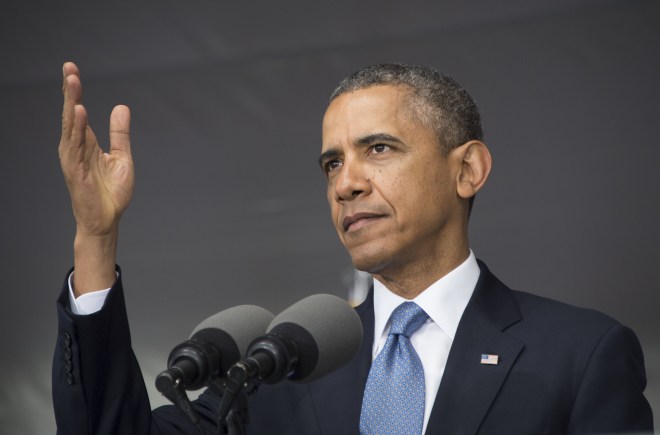
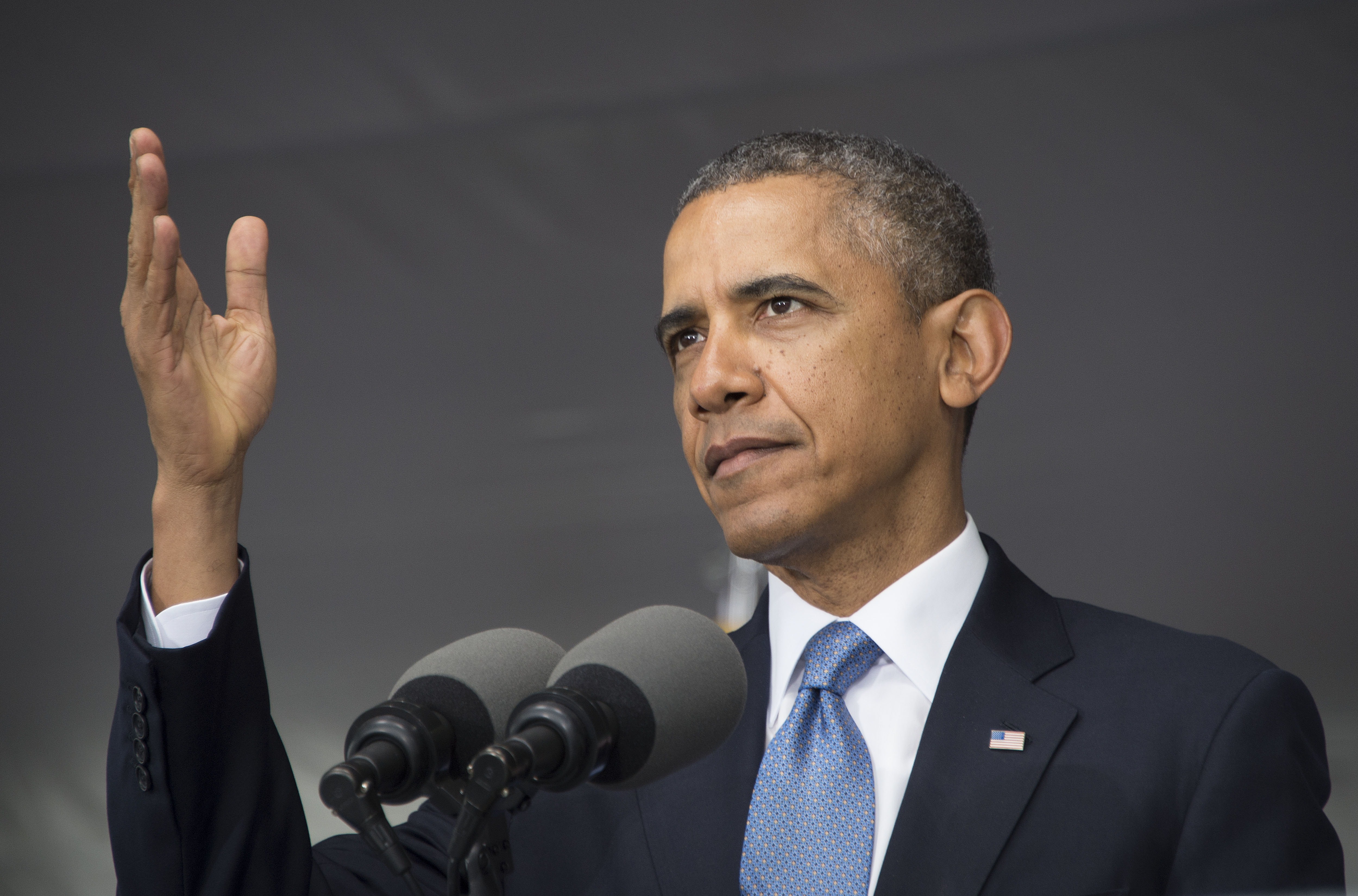
(Photo: US President Barack Obama delivers the commencement address to the 2014 graduating class at the United States Military Academy at West Point, New York, May 28, 2014. By Jim Watson/AFP/Getty Images.)
New York Shitty Update, Ctd

Best tweet ever, Mr Cumstien. I read this, by the way, in a coffee shop in Soho where they don’t have a restroom! Another NYC specialty. From the inevitable backlash from the in-tray:

Oh no!  Overbooked hotels!  Lofts with insufficient drapery!  Cry me a river.

Another:

I am a loyal Dish reader, but I cannot stand your consistent whining about NYC. New York is the only true city in America. It’s diversity, creativity, density, wealth, and knowledge cannot be matched. Even with it’s problems of income inequality, stop and frisk, and a lack of affordable housing, NYC is still one of the greatest engines for social mobility and creativity in the world. The five boroughs of New York represent the American ideal more than any other place in the US. In no other place in this country do you see a welcoming of people, ideas, and the sharing of public space in the way you see it in NYC. New York is an egalitarian city by nature, forcing people to share the streets, subways, and public places. Humanity comes to New York to express itself. If you don’t like New York, you don’t like people.

New York has never been easy, but what good things in life are?

DC is a suburb and a one-industry town. To compare DC – or for that matter any city in the US – to NYC would be like comparing foie gras to dog food; at first glance they may seem the same but in reality they are worlds apart. So as Jimmy Walker said so many years ago, “I’d rather be a lamppost in New York than the Mayor of Chicago” – and let’s face it, Chicago is a better city than DC.

The blog is great. Your views on NYC are suspect.

I’m sorry but my point is simply about the livability of the city. And when people say that NYC is the only true city in America, or that “humanity comes to New York to express itself,” I have to say it sounds like a cult not a judgment. And you do need something of a cult mentality to put up with all the horrendous hassle. Chicago, in my view, is the quintessential American city. You can smoke weed legally in Denver. You could get gay-married in Iowa before NYC. What Los Angeles offers in terms of livability and climate knocks New York into the dust. DC is – especially now – cleaner, more modern, more livable and also culturally rich. San Francisco is far more beautiful; New Orleans far more exotic. New York is an amazing place – but it is a gigantic, chaotic, incompetent mess. Another reader turns the tables:

The last time I stayed in DC, the hotel’s fire alarm went off around 4am. Loud speakers were announcing that the hotel should be evacuated. People were wandering around the halls in their bathrobes looking for an exit. I was standing on the sidewalk outside the hotel when I learned that the evacuation was due to a small, contained, grease fire in a basement kitchen.

You live in DC and don’t stay in its hotels. You know the city and know when a cab driver is going blocks out of the way and you don’t have to rely on Google Maps. And, of course, no such thing would happen in Chicago, Paris, Rome or to anyone visiting DC. Everywhere has its pros and cons.

I love ya. And one of the reasons I do is because you make me want to slap you now and then – no different than the few I hold as close friends.

Another has the right idea:

I can’t wait ’til you get to Provincetown and chill the fuck out for a while.

Update from another:

Your reader is wrong; DC is not a one-industry town. I grew up there and neither of my parents worked for the government. And it’s not a suburb. A suburb to what city? His precious NYC. I might be biased because I grew up in Alexandria, but DC is an amazing city with a lot to offer. And so much of it is free. Yes, it can be argued that it is more of a town than a city, but that’s the best part. You can see the sky, and live in an apartment or condo or house all in the same city. You can have a lawn and be in the city limits. And just like every other American city, there is the depressing economic apartheid, but at least you don’t have to be in your 20s and willing to live in a hole or be super fucking wealthy to enjoy it. Yes, the Beltway fucking blows, but driving on Rock Creek Parkway makes up for it. And when you go into a deli and order breakfast you aren’t snarled at by other patrons for not spitting out your order fast enough. Ordering food as a tourist in NYC is panic inducing.

Another:

Chicago, in my view, is the quintessential American city.”

AMEN. I tell all the foreigners I know who are planning on visiting the US: if you only have one week in America, spend four days in Chicago (and two days at the Grand Canyon.) Chicago is a perfect microcosm of the entire American experience: a big industrial port city with a huge immigrant population and a vibrant African-American community. Somehow it is midwestern, northern, coastal, and a little bit southern (all those Kentucky transplants, plus great soul food) all at the same time. It even feels a little Canadian in places. OK, it lacks the fresh-scrubbed natural beauty of western cities like SLC or Seattle, but you do get a taste of it — Chicago was once at the edge of the frontier, too. Great music scene and global cuisine, but with strong regional roots. Museums and sport stadiums and other touristy stuff up the wazoo.

Importantly: its suburbs sprawl endlessly, as do all American cities, so you get the quintessentially American experience of driving hours across the sprawl to get somewhere (just like LA!) — but with decent trains if you hate driving. Other cities, like Boston, New Orleans, LA, San Francisco and even, yes, NYC are tiny nations unto themselves. Boston is Boston (and New England) before it is America. NYC in particular is a city of the world before it is anything else. But every time you turn around in Chicago, you’ll see AMERICA.

Dissent Of The Day

A reader writes:

Sorry, but not sure you should be calling out Margaret Sullivan’s reading comprehension. You wrote:

But Kinsley is also pretty emphatic about what the press should do: “the process of decision-making — whatever it turns out to be — should openly tilt in favor of publication with minimal delay.” How can anyone read that review and conclude as Sullivan does that…

“What the press should do?” Are you kidding me? You should really re-read that whole paragraph by Kinsley. It says this (italics mine):

The question is who decides. It seems clear, at least to me, that the private companies that own newspapers, and their employees, should not have the final say over the release of government secrets, and a free pass to make them public with no legal consequences. In a democracy (which, pace Greenwald, we still are), that decision must ultimately be made by the government. No doubt the government will usually be overprotective of its secrets, and so the process of decision-making — whatever it turns out to be — should openly tilt in favor of publication with minimal delay. But ultimately you can’t square this circle. Someone gets to decide, and that someone cannot be Glenn Greenwald.

Kinsley is clearly, and I mean CLEARLY saying that the government should have final say over publication of government secrets, NOT the press as you interpret.

I don’t know if it’s your friendship with him that led to your misinterpretation (or you agree with the point), but whatever the case, this is an insane, depraved argument for any journalist to make, and the fact that other journalists (e.g. Alter, Rauch) are cheering Kinsley is disgusting. Governments have a vested interest in covering up embarrassing information, and have an objective record of lawbreaking, dishonesty, corruption, and various other forms of unethical behaviour. Kinsley and his supporters know this, and they know governments would have covered up all kinds of important leaked information over the years had it been up to them.

If you want to understand what is really behind this review, you just need to ask yourself (or Kinsley) why he’s expressing this view about journalism now. Unless I missed something, I don’t recall ever seeing any self-respecting journalist support the notion that the government should have final say over publication of government secrets. So, why now? You don’t think it has anything to do with hating Greenwald and all these other outsiders masquerading as journalists (their view, not mine) who aren’t part of their cherished insider clique, and who have the temerity to constantly criticize the media establishment?

Some things are actually quite straightforward. Journalists are supposed to be the gatecrashers, but in some cases, they’re most concerned about their own little gated community. That Kinsley piece is just another way of saying, if an opinionated activist asshole like Greenwald gets to publish important stuff like this, fuck it all. I’d rather let government make the decision than that guy. Because “that someone cannot be Glenn Greenwald.”

Ms. Sullivan didn’t put it that way in her piece, but she knows what’s going on here and it’s a shame you don’t.

I’ll cop to misreading a complicated sentence. It seems clear – and is reiterated in Kinsley’s riposte today – that, yes, it’s the government that should be releasing secrets with minimal delay, not the press. Apologies. But I would differ from my reader on several points.

The assertion that Mike’s position is born out of some sort of jealousy for or resentment of new bloggers like Glenn couldn’t be more wrong about Mike. I’ve never known a respected DC journalist with as little esteem for the Village, or with a more generous record of supporting new and young and outsider talent. Mike’s position is based on a simple point: yes, the press has a vital role in unearthing government secrets, but the press should not have the final say on whether such unearthing carries legal consequences or not. What is or is not a government secret relies ultimately on the law – which is rightly determined by our elected representatives, not by any blogger, however well-intentioned. That’s the essence of democracy. Money quote from Mike:

I specifically say, and even dwell on the point, that Mr. Greenwald is as entitled as anyone else to call himself a journalist and have all the same rights as Bob Woodward. When Sullivan says, “there clearly is a special role for the press in America’s democracy…and the United States courts have consistently backed up that role,”–and when she offers those vague cliches as serious analysis, she is talking through her hat. The Supreme Court has repeatedly turned down opportunities to create a “journalist’s privilege.” Sullivan may not like this. Heck, I don’t especially like it. But it’s a fact. The First Amendment protects the right to speak. The right not to speak (eg, to protect a source) is more problematic.

So I’m sorry but it isn’t straightforward. Now I should add that in this particular instance, I am closer to Glenn (also a friend) than to Mike. The way the US government has behaved since 9/11 – its outrageous and criminal secret activity – seems to me to tilt the question in favor of the whistle-blower and the journalist, and some legal leniency – certainly for the journalist. But in all times there is a balance between these two contradictory democratic necessities – government secrecy and transparency – and at some point, the rule of law is the rule of law. It’s not perfect, but it’s better than all the alternatives.

Right now, for example, what the public knows and does not know about the NSA is determined by Glenn Greenwald. He has in his possession vast troves of information that he is keeping secret, until he decides it will becomes public. He is picking and choosing what to divulge and doing so over an extended period of time. In that sense, he is close to being an alternative government, but without any internal checks and balances, and with no recourse for the public through the democratic system. What Mike is insisting is that this too is a genuine problem from the point of view of the public interest. Who gets to decide what the public knows? Right now, it’s Glenn. And I bet his security system for his data is extremely strong. He doesn’t want any leaks either, does he?

So quis custodiet ipsos custodes? It’s complicated – much more so than the Savanorolas of transparency would have you believe.

More Readers, Less Revenue

revenue vs views

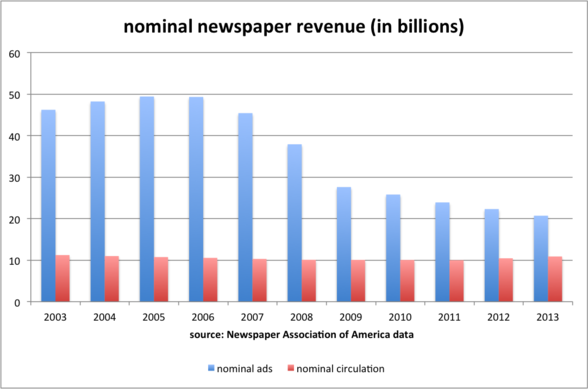
That’s the situation newspapers are facing:

Of course, more people than ever read newspapers now online than they ever did in print (although physical circulation figures don’t account for the fact that multiple people read each copy). The problem is, they spend a fraction of the time they once did on print papers. Somebody who reads a print paper 30 minutes a day is worth vastly more than one who reads the paper’s website 30 minutes a month, which is what the average unique visitor spends.

That’s why newspapers are focusing on core readers—the 5 percent or so of their heaviest users. The core appeal of the meter model is capitalizing on heavy readers while collecting bits of ad revenue from the majority of unique visitors that have little or no loyalty to your site.

Joshua Benton leafs through Mary Meeker’s annual report (pdf) on internet trends. The big picture:

Mobile is eating the world, and most news organizations make only a pittance off it.

Here’s the optimist’s spin for print: Not all forms of media are equally useful for advertising. Mobile, thus far, has been notoriously difficult to monetize through advertising; app purchases and in-app payments are the dominant ways for companies to make money on phones. Display advertising doesn’t work as well on such small screens, and search ad revenue is reduced.

If that’s true, maybe print is just mobile’s opposite: uniquely aligned with an advertising model, with big lush expanses of newsprint aching for a cell phone provider’s printed embrace.

Ryan Tate summarizes the key numbers:

According to [Meeker’s] research, the total number of internet users grew less than 10 percent last year, down from close to 20 percent in 2007 and close to 40 percent in 2002. But mobile internet use is skyrocketing, now constituting 25 percent of all internet traffic, compared with just under 1 percent in 2008. Tablets, she says, are “growing faster than PCs ever did.” Last year, according to her numbers, tablet shipments left notebook and desktop computer shipments in the dust. But it’s smartphone that really suck up our time, accounting for more “screen minutes” than any other device.

And Derek Thompson highlights the dominance of smartphones in the developing world:

The middle classes of the U.S. and Western Europe got rich in the 1950s when TV penetration was screaming past 50 percent. In the 21st century, smartphones are the new TV—the hot new glass that signals the future of attention and entertainment—and the countries that spend the most time on their phones (particularly relative to other products) are countries that only now are joining the global middle class.

Detecting Tweets For Help

According to Michael Slezak, “oversharing on Twitter might prove to be a boon for mental health services”:

Grabbing 750 tweets a second, a new tool can read the emotional state of a region in real time. The idea is to figure out exactly what kinds of events affect people’s moods and tailor mental health treatments accordingly.

Researchers at Australia’s national science agency, the CSIRO, and the Black Dog Institute in Sydney, created an emotional vocabulary of about 600 words and confirmed their meaning by crowdsourcing responses from over 1,200 people. They built an app that filters tweets by location and linguistically analyses their emotional content. The output is an interactive graph of the target region’s mood. It shows how much each of seven emotions are being expressed in that region. “If it works then in the future we can monitor, and eventually predict, where services can be assigned,” says Cécile Paris, a computer scientist at the CSIRO. The plan is to make the app available for researchers anywhere.

On a similar note, researchers in the US have identified a link between suicide-related tweets and actual suicides.

Where Climate Change Will Hit Hardest

Vulnerability To Climate Change

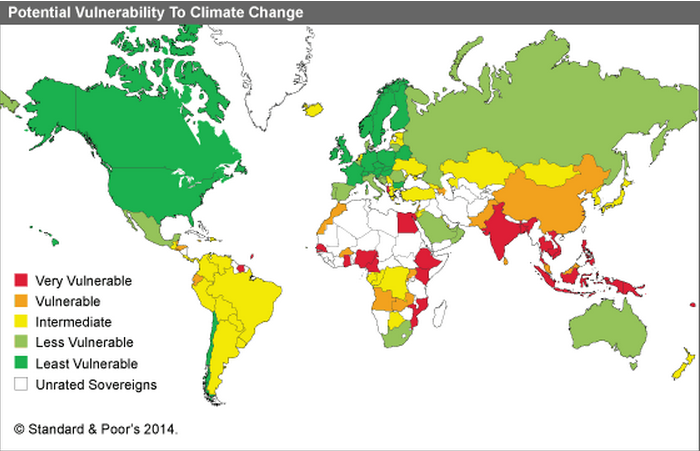
John McDuling notes that credit agencies, at least, seem to be taking climate change seriously:

Over the past week or so, one of the most prominent credit agencies, Standard & Poor’s, has, in a series of reports, attempted to quantify the financial impact of climate changeThe company looked at the impact of changing weather patterns on various industries, including utilities and insurance.

Among other things, the ratings agency ranked nations based on the percentage of their population living below an altitude of 5 meters (about 16 feet), their share of agriculture in total economic output, and their ranking in the GAIN Vulnerability Index, a measure developed by the University of Notre Dame that measures countries’ vulnerability and readiness to deal with climate change.

Stephen Leahy considers the plight of island nations:

The government of [Pacific island nation] Kiribati is hoping to buy thousands of acres on one of Fiji’s islands to relocate its 115,000 residents. While relocation may mean survival, the literal disappearance of their islands risks the overwhelming loss of their culture and identity. When you live on tiny islands in the middle of the enormous Pacific Ocean, land has a very special meaning.

Eric Holthaus and Chris Kirk created an interactive map of country-by-country carbon emissions. The basics:

The world’s top 12 emitters are now China, the United States, India, Russia, Japan, Germany, South Korea, Iran, Canada, Saudi Arabia, Mexico, and the United Kingdom. But it’s not even really close. China now emits more than 20 times what the United Kingdom does, mostly using the same technology that helped England start the Industrial Revolution all those years ago.

The continuing acceleration in global CO2 emissions leads to some crazy numbers: Over the past 10 years, the world has emitted more CO2 than it did from the entire period since the start of the Industrial Revolution up to about 1970. In 2011 alone, the world emitted more than it did in the 30 years between 1850 and 1880. That’s one of the big reasons climate change is such an urgent issue and why we must find a way to stop the trend, and fast: With emissions like these, more than ever, each year matters.

A Wonkish Plan To Prevent Car Accidents

Nicole Gelinas explores Bill de Blasio’s Vision Zero initiative, which aims to end traffic fatalities in New York City:

The inspiration behind the plan, which reinforces and expands on efforts by Michael Bloomberg’s administration, comes from Sweden’s use of innovative road design and smart law enforcement, which has reduced overall traffic fatalities in Stockholm by 45 percent—and pedestrian fatalities by 31 percent—over the last 15 years. When a child runs after a bouncing ball into a residential street and a speeding car strikes and kills him, the Vision Zero philosophy maintains, the death shouldn’t be seen as an unavoidable tragedy but as the result of an error of road design or behavioral reinforcement, or both. We already think this way about mass transit and aviation. These days, a plane crash or a train derailment is never solely explained by human error (a train conductor falling asleep, say); it also is a failure of a system that allowed a mistake to culminate in disaster.

Of course, engineers and regulators can’t eliminate all injuries and deaths; but by applying rigorous, data-based methods, they can cut down on them dramatically. …

New York City has already come a long way in reducing traffic fatalities, it’s important to recognize. Last year, New York suffered 288 crash deaths, including 170 pedestrians. That sounds bad, and it is, but in 1990, New York had 701 traffic deaths, with 366 pedestrians killed. And 20 years before that, the city saw nearly 1,000 traffic deaths in a single year; it wasn’t unusual to lose 500 pedestrians annually. New York’s current traffic-fatality numbers compare favorably with other American big cities. An Atlanta resident is more than three times more likely to die in a traffic crash (adjusted for population); a Los Angeleno faces twice the risk. But New York remains behind—in some cases, far behind—other global cities in this area of public safety: Paris, London, Hong Kong, and Tokyo are all less dangerous. A citizen of Stockholm—the gold-standard metropolis for traffic safety—faces just a third of a New Yorker’s risk in dying by vehicle. Last year, the Swedish city, with a population of 900,000, suffered only six traffic deaths. The Gotham equivalent would be 60 such fatalities—not nearly five times that number.