The Butterflies Of Legend

Screen Shot 2014-05-23 at 1.59.39 PM

Ferris Jabr spoke with Nipam Patel, who studies gynandromorph butterflies, which have both male and female characteristics:

Every now and then he has encountered specimens such as the Heliconius butterfly [see above]. It’s a member of a colorful tribe in which males and females look nearly identical. Patel identified this butterfly as a gynandromorph because the two halves of its abdomen differed subtly in size and structure, one having male genitalia and the other female. Its wings should have been the same, but they weren’t.

Patel realized that, in addition to being doubly sexed, this particular insect might have a mixed identity. The patterns on its wings betrayed underlying genetics that could not be explained solely by a medley of female and male cells. … [T]he two wings had clearly activated different color pattern genes, indicating two entirely different genomes. When gynandromorphs differ in more than their sex characteristics, Patel thinks you could be looking at two animals in one.

How could that happen?

An insect egg cell harbors a smaller sister cell known as a polar body—a leftover from the cell division that created the egg cell. Sometimes two sperm manage to slip inside the egg and fertilize the egg’s nucleus as well as the polar body, creating two embryos that develop more or less like conjoined twins.

The two animals’ cells may not always keep to their own sides, however, which could explain why sometimes a gynandromorph has bilateral asymmetry and sometimes ends up a mosaic, with a splattering of opposite cells across a center line. Although other scientists have previously suggested that double fertilization accounts for some gynandromorphs, Patel has uncovered some of the clearest evidence to date.

Gynandromorphs’ duality calls to mind Plato’s Symposium, in which Aristophanes explains the origin of the sexes with a unique creation myth: In the beginning, he says, there were double-bodied primal humans—man and man, woman and woman, and man and woman—until, angered by their hubris, Zeus split them with bolts of lightning. But such duality is not just the stuff of myth.

Hedwig’s rendition of that myth:

(Image of Heliconius butterfly courtesy of Nipam Patel)
Why Winners Keep Winning

Jay Caspian Kang points to a recent study that “seems to confirm one of gambling’s most ubiquitous and destructive theories: the ‘hot hand‘”:

Juemin Xu and Nigel Harvey, the study’s authors, took a sampling of 569,915 bets taken on an online sports-gambling site and tracked how previous wins and losses affected the probability of wins in the future. Over all, the winning percentage of the bets was somewhere around 48 percent. Xu and Harvey isolated the winners and tracked how they fared in their subsequent bets. In bet two, winners won at a rate of 49 percent. From there, the numbers go haywire. A player who had won two bets in a row won his third bet at a rate of 57 percent. His fourth bet won 67 percent of the time, his fifth bet 72. The best gamblers in Las Vegas expect to win 55 percent of their bets every year. Seventy-two percent verges on omniscience. The hot hand, it appears, is real.

Why would that be? Kang explains:

What the research did find was that gamblers on streaks – good or bad – acted under the influence of the gambler’s fallacy. Winning bettors began placing more prudent bets because they assumed their luck would soon run out. Losers began placing bets with longer odds because they wanted to win big when their luck finally, inevitably changed. What this means is that streaky gamblers who win do so because they expect to lose, and streaky gamblers who lose do so because they expect to win. Or, more simply put, when you’re losing, you’re wrong, but when you’re winning, you’re also wrong.

Venerating Veronese

dish_Veronese

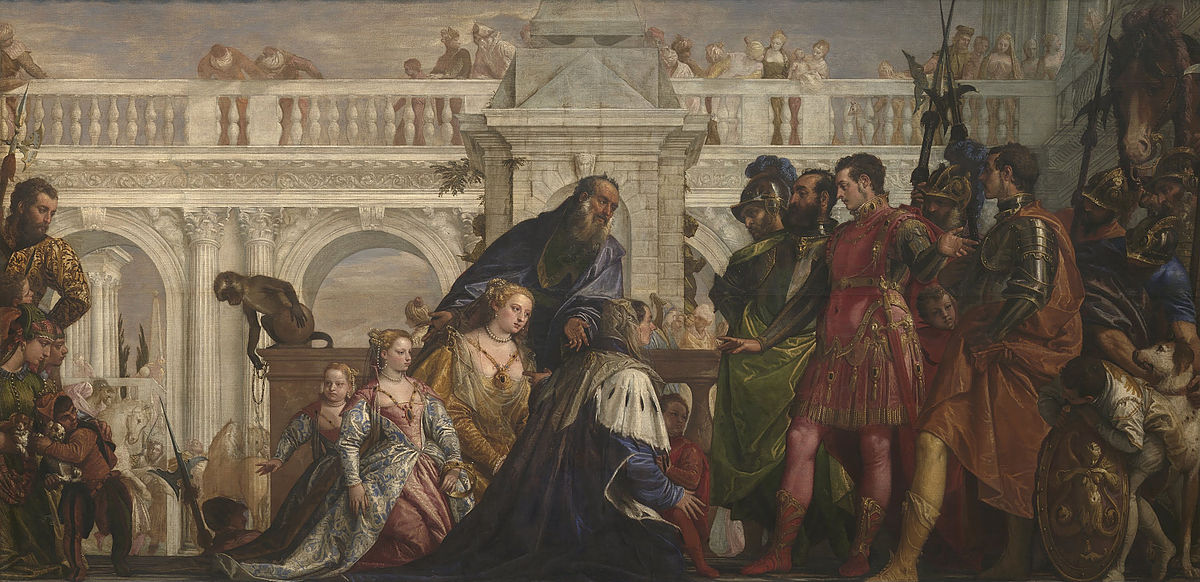
Andrew Butterfield praises “signs of renewed interest” in the art of Paolo Veronese, who, he says, “has often been regarded as a gifted but superficial painter.” He singles out The Family of Darius before Alexander, seen above, as a work “long regarded as among the greatest Venetian paintings”:

The Family of Darius before Alexanderreveals the seriousness of purpose with which Veronese worked. As few other painters of the Renaissance, he sought to make images that drew on the resources of all the arts, not just painting. Veronese had studied sculpture first, and the experience remained fundamental to his approach to image-making. His idea for any picture began with the main figure or figures, which he planned by emphasizing strong motion and forceful disposition in space. Like so many sculptors in the Renaissance, he saw the movements and gestures of the figures, not the expressions on their faces, as the primary means for conveying the emotional content of a scene.

Butterfield goes on to note that Veronese drew inspiration from architecture, theater, and even rhetoric:

Veronese’s style is overtly rhetorical. In the Renaissance, painting was often said to be a form of mute poetry, but Veronese’s first biographer, Carlo Ridolfi, writing in 1646, instead compared his art to oratory. This comment may appear to emphasize the artificial, ceremonial, and unnatural qualities of Veronese’s art. But it was meant as praise:

in the Renaissance, rhetoric was seen as the foundation of the humanities. It is striking to note that in 1557, the year after he published the first Italian edition of his commentary on Vitruvius, Daniele Barbaro also published a treatise about literature and rhetoric calledOn Eloquence. There he praisesgrandezzaas the highest and most sublime style, appropriate for the most elevated topics. The elements he names as the main components ofgrandezza—majesty, vehemence, splendor, vivacity—read almost like a list of the qualities of Veronese’s art. …

Veronese’s prodigious facility, love of magnificence, and untroubled service to the dreams of wealthy clients were all counted against him for much of the twentieth century. Few great artists have seemed less radical or rebellious. But this reaction overlooks his own ambitions as a painter. The show at the National Gallery makes it possible again to see why so many writers were drawn to this artist, and why so many painters, from Annibale Carracci and Giambattista Tiepolo to Delacroix and Cézanne, thought of Veronese as one of the supreme masters of art.

(Image: The Family of Darius before Alexander, 1565–1567, via Wikimedia Commons)

Animal Testing For Animals’ Sake

Is it ethical to conduct experiments on captive chimpanzees to help others survive in the wild? Ed Yong’s take:

In February 2011, a team of scientists led by Peter Walsh at the University of Cambridge injected six captive chimpanzees with an experimental vaccine against the deadly Ebola virus. At first glance, the study looked like a lot of other medical research, in which drugs that are meant for humans are first tested on other animals. But this was different. These scientists were working with chimps to help chimps. The twin threats of poaching and habitat loss are driving the African apes – chimps, bonobos, and gorillas – towards extinction. Diseases are also a problem. Our ape relatives are vulnerable to infections like anthrax, malaria, and respiratory viruses that spill over from human tourists and researchers.

As Yong notes, such studies may soon be a thing of the past:

The era of biomedical research on chimpanzees is drawing to a close. The United States and Gabon are the only countries that still allow this kind of research, and the US may soon leave this short list. In 2011, the Institute of Medicine issued a report saying that “most current use of chimpanzees in biomedical research is unnecessary” – a conclusion that the National Institutes of Health took seriously. In 2013, it announced that all but 50 of its chimps would be retired to sanctuaries. Meanwhile, the US Fish and Wildlife Service has tabled a proposal to list captive chimps under the Endangered Species Act – a move that would ban medical procedures beyond those that “enhance the propagation or survival of the affected species.”

Walsh’s study might still fit the bill but it wouldn’t matter, since labs with the right facilities to house and work with chimps would shut down. That’s a problem, since national park managers in Africa insist that scientists prove the safety of vaccines in captive apes before using them on wild ones (and monkey data won’t suffice). To Walsh, you need captive chimps to test vaccines that would save wild ones from diseases. He’s not just talking about Ebola, either. Vaccines could also protect chimps from HRSV – a human virus that they catch from humans, often with fatal results.

Wake Up And Sketch The Coffee

Paul Gallagher captions the latest video from Boston-based artist Jake Fried:

[He] creates these incredible, trippy, hand-drawn animations, or as he calls them “moving paintings,” by repeatedly layering on top of an original drawing with white-out, gouache, ink and coffee. Each animation shows the drawing process from original sketch lines to finished picture.

The Dish previously featured Fried’s work here. See more of his animations here.

The Inelegant Universe

Phillip Ball questions the notion that “the kind of beauty sought by science has anything to do with the major currents of artistic culture”:

No one has ever shown a correlation between beauty and ‘truth’. But it is worse than that, for sometimes ‘beauty’ in the sense that many scientists prefer – an elegant simplicity, to put it in crude terms – can act as a fake trump card that deflects inquiry. In one little corner of science that I can claim to know reasonably well, an explanation from 1959 for why water-repelling particles attract when immersed in water (that it’s an effect of entropy, there being more disordered water molecules when the particles stick together) was so neat and satisfying that it continues to be peddled today, even though the experimental data show that it is untenable and that the real explanation probably lies in a lot of devilish detail. …

An insistence that the ‘beautiful’ must be true all too easily elides into an empty circularity:

what is true must therefore be beautiful. I see this in the conviction of many chemists that the periodic table, with all its backtracking sequences of electron shells, its positional ambiguities for elements such as hydrogen and unsightly bulges that the flat page can’t constrain, is a thing of loveliness. There, surely, speaks the voice of duty, not genuine feeling. The search for an ideal, perfect Platonic form of the table amid spirals, hypercubes and pyramids has an air of desperation. … I would be rather thrilled if the artist, rather than accepting this unified pursuit of beauty (as Ian McEwan did), were to say instead: ‘No, we’re not even on the same page. This beauty of yours means nothing to me.’

If, on the other hand, we want beauty in science to make contact with aesthetics in art, I believe we should seek it precisely in the human aspect: in ingenious experimental design, elegance of theoretical logic, gentle clarity of exposition, imaginative leaps of reasoning. These things are not vital for a theory that works, an experiment that succeeds, an explanation that enchants and enlightens. But they are rather lovely. Beauty, unlike truth or nature, is something we make ourselves.

The Best Of The Dish Today

photo (3)

If you hoped the HBO Chad Griffin documentary might not be as egregiously wrong and slanted as Jo Becker’s breathless hagiography, it looks like you’ll be disappointed. See the above screen shot of the final moments, just emailed to me. As a factual matter, so far as I know, no lawsuits have been filed in those states based on the Perry decision, while 24 have been filed based on the Windsor/DOMA decision. So both Becker and HBO made a bet on the wrong case – but keep pretending they didn’t. HBO won’t send me a screener – although they did get their PR flak to call me up to see if I was going to be mean about it. I’ll wait and see the thing before passing judgment, but that screenshot made my stomach lurch. And I had to splutter when I saw this correction from the Huffington Post in a review of the trailer:

CORRECTION: A previous version of this post incorrectly stated that the Supreme Court ruled Proposition 8 unconstitutional. The Supreme Court itself ruled that the private parties that appealed the case to the justices did not have standing to do so after the state of California had bowed out.

Somehow, I think Chad Griffin will find a way to get the world to forget that.

By the way, the “Do I Sound Gay?” kickstarter project has two more days to go and hasn’t reached its target, if you want to help out. Read about it here in our thread on the topic.

The most popular post of the day was my New York Shitty Update. Readers are going to let me have it soon enough, but I hope it’s somewhat clear I have my tongue in my cheek a bit on this. I’m not denying New York’s stunning cultural, business, media and financial depth. I’m just pointing out the vast gap between the city’s self-image and what most sane people would think of living here. My piece on Europe’s red-blue divide was runner-up again.

Many of today’s posts were updated with your emails – read them all here.  You can always leave your unfiltered comments at our Facebook page and @sullydish. And today we posted for the first time in a while a poll to “Ask Andrew Anything” – submit your questions and vote on them here. 20 27 more readers became subscribers today. You can join them here for a little as $1.99 month. It’s how we keep this show on the road.

See you in the morning.

Face Of The Day

President Obama Delivers Commencement Address At West Point

Following a West Point tradition, Alan Jones, age 7, gathers caps after graduating cadets threw them in the air at the conclusion of the graduation ceremony at the U.S. Military Academy at West Point on May 28, 2014. U.S. President Barack Obama gave the commencement address at the graduation ceremony. In a highly anticipated speech on foreign policy, the president provided details on his plans for winding down America’s military commitment in Afghanistan and on future military threats to the United States. By Spencer Platt/Getty Images.

Where The Wild Things Could Go

Emma Marris urges national parks to create “nature play areas,” where kids can “go off trail, climb trees, collect specimens, and generally leave as much trace as they want”:

Richard Louv, author of Last Child in the Woods, agrees that parks should make room for kids to play. “If kids don’t have some kind of connection to nature that is hands-on and independent, then they are probably not going to develop the love of nature and vote for parks and the preservation of endangered species,” he says. “Unless you know something you are unlikely to love it.”

There’s some research to back up this intuition. One 2010 study in the journal Children, Youth and Environments found that among people who ended up dedicated to nature and conservation, most had a childhood filled with unstructured play in nature, some of which “was not environmentally sensitive by adult standards; rather, it included manipulation of the environment through war games, fort building, role playing of stories in popular children’s adventure books and movies, and the like.”

Drones That Get Down

Ben Valentine spotlights the work of Eleven Play, a Japanese dance group that incorporates drones into their performances:

Surrounded by an all-white stage, sprinkled with black computer monitors facing the audience, the three dancers and their accompanying drones put on a mesmerizing and eerie display. The result is stunning. … Much like Alexander McQueen’s haunting use of robotics in performance, Eleven Play’s dance is not without a sinister side. At the beginning, the dancers appear in control, or at least in mutual dialogue with the drones. We see the dancers pushing and pulling the drones, as if conducting them. The drones are what one would want in a good dance partner, they follow the music and they’re responsive to your body, they just happen to be flying robots.

Yet at the performance’s 1:56 minute mark, there is a shift, and the drones become menacing and the dancers visibly fearful. Simultaneously, with the projection appears to become the drones’ conductor — a commentary on the problems of control in a largely algorithmic machine. The drones start dancing to their own beat, and the human dancers become superfluous. This is not a hyperbolic point either; the US has already relied on algorithmically determined drone strikes based solely on phone metadata.

Amber Frost is also impressed:

At first the dancers interact cautiously and experimentally with the drones, then the machines become more active and more threatening. With no control over the increasingly volatile technology, the women flee the stage in fear. In the end, the only ones left dancing are the drones themselves. It’s beautiful and dramatic and there’s a trippy light display and flying robots—what more could you want?