I found Pope Francis’ words and acts in Israel and Palestine to be typically finessed. What a contrast with Benedict’s often-clumsy way with public appearances! And the obvious need for two states for two peoples was beautifully reflected in his every move. Of course, this being Israel/Palestine, as Max Fisher observed, few were content to leave his acts as symbols:
Take, for example, the discussion around Pope Francis’s visit to the Israeli wall that runs through the Palestinian city of Bethlehem. This was perhaps the one moment in the trip with real, palpable significance. There was something jarring about seeing the all-white pope standing next to the graffiti-covered wall, which Francis prayed at for four minutes, calling attention to one of the conflict’s most painful features and to the costs of the Israeli occupation. It mattered.
The significance of the moment, so clear on its face, was quickly extrapolated to say much more than it seems certain that Pope Francis meant to say. Some pointed out that Francis was standing near graffiti that read “Free Palestine,” so therefore he must have been giving “symbolic approval to Palestinian hopes for an independent state.” It seems plausible that Francis would support an independent Palestinian state, but it seems unlikely that his proximity to certain graffiti communicates this. At a later meeting with Netanyahu, Francis only nodded politely when Netanyahu said that the barrier was necessary to protect from terrorism, turning down an opportunity to say otherwise. …
Isn’t this the ultimate metaphor for the Israel-Palestine discourse? Pope Francis does something legitimately symbolic, but he is alternatively praised and condemned for things he didn’t say based on over-extrapolative readings of some graffiti that someone else wrote that just happened to be in the area.
It’s important to remember, I think, that one of Saint Francis’ legacies was negotiating peace with a Muslim power in Egypt:
The events of Francis’ later life, particularly his three-week dialogue with Sheikh al-Malik al-Kamel the Sultan of Egypt, had a profound affect on Francis, the Sultan and the Christians and Muslims living then that are still being felt today… Having seen Muslim prayers while in Egypt he declared for his followers: “You should manifest such honour to the Lord among the people 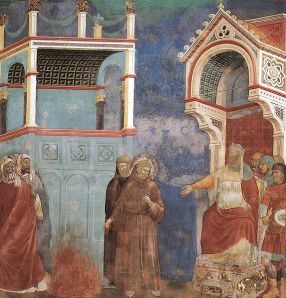 entrusted to you that every evening an announcement be made by a town crier or some other signal that praise and thanks may be given by all people to the all-powerful Lord God.” … And instead of seeking converts among Muslims, in missionary work he charged his followers: “[The brothers] are not to engage in arguments or disputes, but to be subject to (serve) every human creature for God’s sake.” …
And what did knowing St. Francis of Assisi do to Sultan al Malik al Kamel? Ten years later, in 1229, by diplomacy alone and by no act of warfare, he ceded control of Jerusalem, Bethlehem and a corridor from there to the sea to the Christians, saving only the Dome of the Rock and the al-Aqsa Mosque for the Muslims, and the temple area for the Jews.
That kind of breakthrough is unlikely, of course, to say the least. But the power of God’s love is also something I wouldn’t uniformly bet against. Meanwhile, Emma Green stresses that the Pope was in the Middle East to talk about the plight of Christians, not long-standing problems like the Israeli-Palestinian conflict:
[Christians are] the forgotten stakeholders of Jerusalem: People like the nuns who live on the Via Dolorosa, the road Jesus walked to his crucifixion; the Franciscan priests who maintain the Garden of Gethsemane, where Jesus prayed before his death; and, perhaps most importantly, the shrinking number of Arab Christians who live in Israel, the Palestinian Territories, and surrounding countries. On the Vatican-run website dedicated to the pope’s trip, there are several sections about the persecution of Palestinian Christians, emphasizing that they are “faced by an exclusivist Islamic movement that often refuses to recognize Christians as co-citizens with equal rights, equal obligations, and equal opportunities.”
Gershom Gorenberg scores the symbolism contest in favor of the Palestinians, but wonders what good it will do:
Here lay the pilgrim’s dilemma: Israel’s offered symbols of the past to justify current policies. The Palestinian script offered symbols of current suffering as a reason for urgent change. The latter script is more mediagenic. And the pope who has cast himself as champion of the downtrodden was apparently more comfortable with it.
But then, how much is the symbolism worth? Pope Francis’s critics have already raised this problem: For all his gestures of understanding for gays or single mothers and his criticism of capitalism, he hasn’t yet changed the powerful, patriarchal institution that he leads, and offers little indication that he will do so. A similar criticism pertains to Abbas’s diplomatic strategy: Palestine can be recognized by scores of countries, but so what? On the ground, there is no state.
Neocon Caroline Glick does her usual hysterical dance. I welcome Pope Francis to the legions of us who are suddenly deemed “anti-Semitic” because we want a just two-state solution:
Had Francis actually cared about the cause of peace and non-violence he claims to champion, Francis might have averred from stopping at the barrier, recognizing that doing so would defile the memory of the Ohayons and of hundreds of other Israeli Jewish families who were destroyed by Palestinian bloodlust and anti-Semitic depravity. Instead, Francis “spontaneously” got out of his popemobile, walked over to a section of the barrier, and reverentially touched it and kissed it as if it were the Wailing Wall. The graffiti on the section of the barrier Francis stopped at reinforced his anti-Semitic position. One of the slogans called for the embrace of the BDS campaign.
Similarly, Sarah Posner holds that while the visit was unavoidably political, it isn’t likely to make a difference:
The conflicts over Jerusalem’s religious sites are, it’s true, religious. But religion isn’t going to solve those conflicts; the solutions, should they ever come, will be political. Pope Francis knows that: that’s why he prayed at the separation wall. It’s also why he said it was not “his place” to dictate a political outcome for Jerusalem. Political imagery is easy to execute. Political outcomes are difficult (some might say in this case impossible) to negotiate. The choice of venue for praying, as we well know here in America, is very political. The real question isn’t whether Francis was being spiritual or political. It’s whether his spiritual-political overtures can have any discernible impact there at all.
On the other hand, Christopher Hale calls Francis “the world’s best politician” and argues that his gestures in the Holy Land were more than symbolic:
While celebrating an open-air Mass in Bethlehem, Francis unexpectedly invited Israeli President Shimon Peres and Palestinian President Mahmoud Abbas to the Vatican for a June meeting of prayer and dialogue. Within an hour, both had accepted. Francis’s successful overture was especially remarkable considering the failed efforts by the United States earlier this spring to get both sides to the table to begin negotiated peace talks. However, this could be the boost that Secretary of State John Kerry needed to revive this peace process, which has been largely dormant for the past four years. …
[T]o reduce June’s meeting to an act of mere symbolism fails to understand the role religion can and should play in addressing difficult political and ethnic issues. Throughout world history, religious prophets have creatively navigated tense situations to advance peace and justice. Within the past century, Gandhi, Martin Luther King and St. John Paul II showed us that religious witness can win a war without raising a hand.
(Painting: St Francis before the Sultan (Trial by Fire) by Giotto.)



 The Dish