Is It All In Their Heads?

In an excerpt from his new book, The Tale of the Dueling Neurosurgeons, Sam Kean ponders the possible connection between religious experience and brain disturbances, especially epileptic seizures:

All human beings seem to have mental circuits that recognize certain things as sacred and predispose us to feeling a little spiritual. It’s just a feature of our dish_visionsbrains (Richard Dawkins excepted, perhaps). But temporal lobe seizures seem to hypercharge these circuits, and they often leave victims intensely religious, as if God has personally tapped them as witnesses. Even if victims don’t become religious, their personalities often change in predictable ways. They become preoccupied with morality, often losing their sense of humor entirely. (Laugh lines are few and far between in Dostoyevsky.) They become “sticky” and “adhesive” in conversations, refusing to break them off despite pretty strong signs of boredom from the other party. And for whatever reason, many victims start writing compulsively. They might churn out page after page of doggerel or aphorisms, or even copy out song lyrics or food labels. The ones who visit heaven often chronicle their visions in excruciating detail.

Based on these symptoms, especially the rectitude and sudden spiritual awakening, modern doctors have retrodiagnosed certain religious icons as epileptics, including Saint Paul (the blinding light, the stupor near Damascus), Muhammad (the trips to heaven), and Joan of Arc (the visions, the sense of destiny). [Emanuel] Swedenborg also fits the profile.

Ultimately, though, Kean warns against reducing the numinous to the neurological:

Most seizures last a few seconds or minutes, not the hours that some prophets spend immersed in trances. And because a temporal fit can paralyze the hippocampus, which helps form memories, many temporal lobe epileptics can’t remember their visions in much detail afterward. (Even Dostoyevsky lapsed into vague descriptions when recounting their actual content.) Also, while Swedenborg’s trances in particular blended sights, sounds, and smells into a heady, heavenly froth, most epileptics hallucinate with one sense only. Most damningly, most epileptic auras are tedious, producing the same refulgent light, the same chorus of voices, or the same ambrosial smells time and again.

So while epilepsy might well have induced their visions — the idea makes sense — it’s important to remember that Joan of Arc, Swedenborg, Saint Paul, and others also transcended their epilepsy. Probably no one but Joan would have rallied France, no one but Swedenborg would have imagined angels eating butter. As with any neurological tic, temporal lobe epilepsy doesn’t wipe someone’s mental slate clean. It simply molds and reshapes what’s already there.

(Image: Illumination from Liber Scivias, showing Hildegard of Bingen receiving a vision, via Wikimedia Commons)


Is Anyone Beyond Empathy?

In an interview about her new book The Empathy ExamsLeslie Jamison addresses whether it’s wrong to empathize with those who’ve made others suffer:

I think that trying to understand someone’s state of being or feeling doesn’t necessitate condoning or agreeing with their point of view. Getting inside someone’s mind doesn’t mean thinking what they think; it only means realizing what they’re thinking. This gets to another question or distinction that has come up in various conversations I’ve had—with psychologists, neuroscientists, anthropologists—about empathy: should we empathize with sociopaths? With evil? And I think we should try precisely because empathy doesn’t have to catalyze complete agreement or convergence—only an entry and a reckoning. Andrew Solomon’s recent New Yorker profile of Peter Lanza—father of Newtown shooter Adam Lanza—is a perfect illustration of this distinction: he offers his readers the chance to empathize fully with this father and yet—also, improbably—with the figure of this boy, whose actions might seem to place him outside the realm of empathy entirely.

On a related note, Joanna Bourke contemplates how pain fosters connection:

Talking about pain is a way of cementing interpersonal bonds: when people ‘suffer with’ their loved ones, they are bearing testimony to their closeness to that person. Witnesses to pain often find the experience agonising themselves, which can lead them to further intimacy with sufferers. This is what Claire Tisdall alluded to in her memoir based on the First World War. Tisdall, a nurse, admitted she’d been ‘burning with the agony of losing a dearly loved brother at Ypres’ and so her ‘feelings towards them [Germans] were less than Christian’. Nevertheless, one day she was given the job of looking after some German prisoners on their way to the hospital. One ‘very young, ashen-faced boy’ with a leg-wound looked up at her and murmured ‘Pain, pain’, an episode about which Tisdall wrote: ‘a bit of the cold ice of hatred in my heart… softened and melted when that white-faced German boy looked up at me and said his one English word – “Pain”.’

More than half a century earlier, the physician Samuel Henry Dickson in his Essays on Life, Sleep, Pain, Etc (1852) put the case more strongly: ‘Without suffering there could be no sympathies,’ he concluded, ‘and all the finer and more sacred of human ties would cease to exist.’ At the very least, pain exposes our fragile connection to other people and serves as a reminder of our need for those around us.

Meanwhile, in a profile of James Doty – who helped form the Center for Compassion and Altruism Research and Education, or CCARE – Bonnie Tsui describes the science behind “helper’s high”:

When we help someone else or give something valuable away, the pleasure centers of the brain, or mesolimbic reward system, activated by stimuli such as sex, food, or money, provides emotional reinforcement. Functional magnetic resonance imaging studies by the National Institutes of Health have shown that the reward centers are equally active when we watch someone give money to charity and when we receive it ourselves; in addition, giving something valuable away activates the subgenual area, a part of the brain that is key in establishing trust and social attachment in humans and other animals, as well as the anterior prefrontal cortex, which is thought to be highly involved in the complexities of altruistic decision-making. What researchers call the “helper’s high” may be aided by the release of endorphins. By virtually every measure of health we know—reducing blood pressure, anxiety, stress, inflammation, and boosting mood—compassion has been shown to help us. These are some of the ways we are encouraged to establish trust and community, which have long been necessary to human survival.

Previous Dish on Jamison here, here, and here.

A Century In The Flesh

Anatasia_Pottinger_06

Anastasia Pottinger photographs centenarians in the nude:

The series began when a 101-year-old woman volunteered to model nude for Pottinger, under one condition: that she not be identified by name in any of the photographs. “It was merely an exercise in documenting her form in a beautiful way,” Pottinger writes in her artist statement. “She was willing to do anything I asked of her.”

Reviewing the images on her computer later, Pottinger was so moved as to want to continue the project. She says responses to the series have been “remarkable”: “Whether it’s wondering, ‘Is this what I’m going to look like?’ or remembering a loved one, the response seems to be universally emotional on some level,” she writes. Pottinger is currently recruiting willing models who’ve lived into the triple digits on her website.

See more of Pottinger’s work here and here.

A Poem For Sunday

8417748713_cfaf917014_b

More haiku by Yosa Buson (1716-1783):

The bush warbler calls
opening its small
mouth all the way

*

Someone is picking his way
across the shallows in spring
stirring up mud clouds

*

Through the flowering quinces
the crimson face of a pheasant
like another flower

(From Collected Haiku of Yosa Buson, Translated by W.S. Merwin and Takako Lento. Copyright © 2013 by W.S. Merwin and Takako U. Lento. Used by permission of The Wylie Agency, LLC. All rights reserved. Photo of a Japanese bush warbler by James Brennan)

A Literary Refuge

Rachel Kadish shares her experience teaching a creative writing course at Bar Ilan University near Tel Aviv, where her classroom doubled as a bomb shelter. Noting that her 11 students “spanned six nationalities, as well as a range of points along the religious spectrum (some were wholly secular Jews, some Orthodox, some Christian …)”, she announced to the class, “We’re going to offend each other — let’s consider that a given”:

Religious difference, it turned out, was only the beginning of what surfaced in the classroom.

Any writing exercise I assigned — no matter how technical and craft-based — tugged at larger issues. In the weeks that followed, a woman in a head covering wrote a moving piece about childhood memories of terrorist bombings. Another woman — a dancer — wrote a powerful scene about sneaking into a West Bank bathhouse and dancing with Palestinian women there. A Christian woman wrote about her teenage immersion in mosh pit culture in the U.S., and offered the first pages of a harrowing piece about friends who joined neo-Nazi skinhead hate groups. Challenged to rewrite a single paragraph in three different voices, a Swedish student began a nostalgic passage extolling his mother’s baking. By the third iteration of the same paragraph, he ended up revealing that his mother was an Auschwitz survivor, and that this bounty of pies and cakes stood in sharp contrast to her own childhood of starvation. …

I’ve never before written about a workshop. What happens in class stays in class. So when I asked my students whether they’d be comfortable if I wrote about the work we’d done together, their quick assent took me by surprise. “The conversation in this room is different than the conversation on the bus,” one said, to nods. In daring each other to explore literary craft, they’d given each other permission to explore stories many of them had feared to tell. And of course, our weeks together had expanded my point of view as well. When I walked out of that bomb shelter for the final time, it seemed less a metaphor for the threat of war, and more a reminder of how difficult and how essential it is to create shelters like this: safe places where heartfelt argument, human gestures, and the occasional interpretive dance keep the lights on.

A Critical Look At Critical Thinking

Drawing on themes from his new book, Beyond the University:Why Liberal Education Matters, Michael S. Roth pushes back (NYT) against higher education’s valorization of critical thinking, worrying that it results in “creating a class of self-satisfied debunkers”:

In campus cultures where being smart means being a critical unmasker, students may become too good at showing how things can’t possibly make sense. They may close themselves off from their potential to find or create meaning and direction from the books, music and experiments they encounter in the classroom.

Once outside the university, these students may try to score points by displaying the critical prowess for which they were rewarded in school, but those points often come at their own expense. As debunkers, they contribute to a cultural climate that has little tolerance for finding or making meaning — a culture whose intellectuals and cultural commentators get “liked” by showing that somebody else just can’t be believed. But this cynicism is no achievement.

Dreher nods, connecting Roth’s argument to his days as a film critic:

Because of my job, I got into the habit of watching every movie critically. That’s not to say I watched every movie trying to tear it down, but rather every film I saw I watched in an analytical frame of mind, because I knew I was going to have to write a short essay saying what the film’s strengths and weaknesses were. Once you get into that habit, it’s hard to turn it off. I couldn’t watch anything just for fun in those days, even if I wanted to. After I moved to another line of writing, it took a couple of years for me to be able to lose myself in the subjective experience of movie-watching — which is how almost everybody else watches movies. …

To draw out the philosophical point, this suggests that there are some things that cannot be fully known from a critical distance, that is to say, objectively, but rather must be engaged subjectively if they are to be understood. Then again, to know something subjectively is to cease to be able to see it objectively, and that means closing off a dimension of knowledge. If I only know X., the Oscar-winning actress, from her film performances and what others have written about her, I don’t know her as her father does. But then, a father’s eyes are conditioned to see differently, and he almost certainly cannot judge her performative capabilities with anything approaching objectivity.

In an interview about his book, Roth offers a defense of what he calls a “pragmatic liberal education”:

[Y]ou can’t just tell students to go study German literature or philosophy and then figure out how to transfer it once they graduate. That process needs to start earlier. If you’re studying German literature, you should be able to explain to someone in computer science what’s valuable about it. And the computer scientist should be able to do the same thing to the German literature student. I teach Great Books courses, and if students can’t explain why Virginia Woolf or Baudelaire matters in terms relevant to their own lives, I don’t think they understand the book. It gets back to that anti-specialization theme. I don’t think there’s anything “liberal” about specializing in philosophy compared to specializing in business. We don’t want specialists with just technical training. When you have a liberal education, you’re not just a technician. You’re able to move among fields. We don’t want you just to be an academic expert to please a professor. That’s just making believe you’re a mini-professor and you want to grow up to be a big professor.

Sublimating Sorrow

dish_serra

While flipping through Alain de Botton and John Armstrong’s book Art as Therapy, Teri Vlassopoulos rediscovers the curative power of Richard Serra’s sculptures:

I flipped first to the section on sorrow. “One of the unexpectedly important things that art can do for us is teach us how to suffer more successfully,” de Botton writes. I had the nagging suspicion that my current method of dealing with sorrow (crying in the car on my drives to work, playing endless rounds of Candy Crush in bed at 7 p.m.) was not the most dignified way to go about it. …

Serra’s sculpture Fernando Pessoa clarifies his point. “Serra’s work does not deny our troubles; it doesn’t tell us to cheer up. It tells us that sorrow is written in the contract of life. The large scale and overtly monumental character of the work constitute a declaration of the normality of sorrow.” Art, de Botton wants to demonstrate, helps prove the universality of emotions. It’s not so much that there’s a wrong or right way to suffer, but that when you’re deep in it, it’s useful to be reminded that what you’re feeling isn’t unique. Misery loves company, sure, but misery also loves representations of sadness sublimated in a way that gives dignity to the strangeness of the feeling. There’s certainly something somber and resolute about Serra’s sculptures, and about Fernando Pessoa in particular, which is composed of a single rectangular rigid steel plate. It makes sense that his work could be a visual stand-in for the towering, engulfing feelings of sorrow.

(Photo: Detail of Serra’s Fernando Pessoa via Flickr user GanMed64)

An Original Take On Original Sin

Grant Kaplan profiles James Alison, arguing that he “belongs on any short list of the most important living Catholic theologians.” He notes the influence of the French anthropologist René Girard’s theory of “mimetic desire” – the idea that “human desires are learned from others rather than forged within a person, and this results in discontent, rivalries and conflicts” – on Alison’s interpretation of original sin:

If mimetic theory teaches us anything, it is that we do not begin with a blank slate. Further, our larger communities, built on victims hidden from sight, maintain traces of an original violence. Thus our desire, ordained by God as pacifically mimetic and jesus_2.jpgfundamentally good, becomes the conduit for actual sins on account of the sinful communities that donate to us our sense of being. We are far too communal and too inclined to be locked into others to avoid being infected, ontologically, by sin. Throughout his work, Father Alison offers examples both trivial and serious to demonstrate the fundamental, Augustinian truth about our inherited identity and communal sinfulness.

Father Alison also argues that the resurrection of Jesus as the forgiving victim makes the doctrine of original sin possible. It is no surprise that the expulsion from Eden (Genesis 3), though largely ignored in the Old Testament, receives serious attention in the writings of St. Paul. Augustine, the great inheritor of Paul, struggled intensely to understand the relationship between the old Adam and the new Adam. It is only after the salvific revelation of the risen Lord that humans have the capacity to understand how deeply enmeshed they were in the proclivities and systems of violence that led to the death of the sinless second Adam. There is thus no chasm between the development of the Western doctrine of original sin and the message of the Gospel.

Recent Dish on Alison’s work here.

Face Of The Day

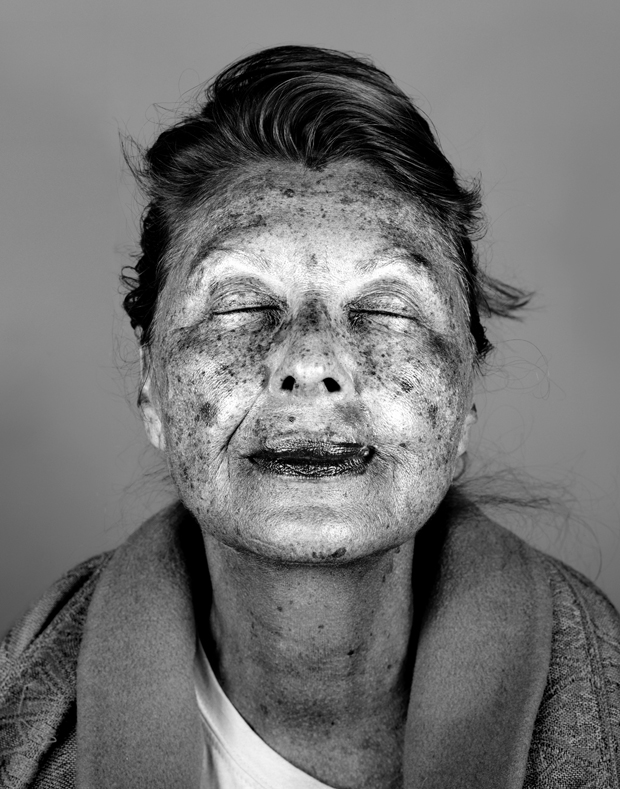
untitled-ultraviolet-60-copy

Cara Phillips’ ultraviolet portraits reveal beauty in blemishes:

When I was doing research for my first body of work, Singular Beauty, a series of interiors of cosmetic surgery offices, I came across B&W images of people with their eyes closed on doctors and medi-spa websites. I was immediately struck by the portraits, and discovered that they were made using a type of medical photography that reveals flaws beneath the skin that is invisible to the human eye.

My first thought was that the images reminded me of early post-mortem/memorial photographs, but they were also a kind of anti-portrait that was new to me. The aim of a portrait, in commercial and vernacular photography, is primarily to hide flaws — to present a two-dimensional “flawless” version of the person. Even before photoshop, photographers would hand paint negatives to enhance or improve the subject’s appearance. But these images’ function was to enhance and reveal flaws. However, the images themselves were beautiful, and I found that dichotomy intriguing and decided to push it even further.

See more of Phillips’s work here.