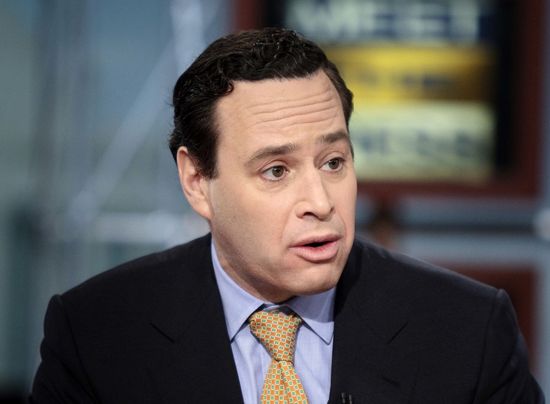
Frum’s Departure From AEI

FRUMBrendanSmialowski:Getty

David tells Politico this:

“There's a lot about the story I don't really understand. But the core of the story is the kind of economic pressure that intellectual conservatives are under. AEI represents the best of the conservative world. [AEI President] Arthur Brooks is a brilliant man, and his books are fantastic. But the elite isn’t leading anymore. It’s trapped. Partly because of the desperate economic situation in the country, what were once the leading institutions of conservatism are constrained. I think Arthur took no pleasure in this. I think he was embarrassed. I think he would have avoided it if he possibly could, but he couldn't.”

Mike Allen adds:

Ask other AEI scholars how they felt about David’s mail and packages piling up outside his office.

Frum, who will be 50 in June, had been on the payroll since leaving the Bush White House in 2003. He acknowledges he was very seldom at the office. But he maintains he developed and spread conservative ideas — AEI’s stated goal — with the 300,000 words a year that he writes for his blog, FrumForum.com; his weekly columns for CNN.com, The Week, and the National Post of Canada; his biweekly offerings for TIME and American Public Media’s “Marketplace”; and his three TV and three radio appearances in a typical week.

But doesn't he get paid by CNN and Time as well, for example?

(Photo: Brendan Smialowski/Getty.)

“The Anger Is Justifiable, But Misdirected”

Phil Lawler qualifies the NYT report on the Milwaukee case:

Should the Vatican have acted faster? Yes. Should the accused priest have been laicized? In all probability, Yes again. Nevertheless, before assigning all blame to the Vatican, consider these factors:

1. The allegations of abuse by Father Lawrence Murphy began in 1955 and continued in 1974, according to the Times account. The Vatican was first notified in 1996: 40 years after Church officials in Wisconsin were first made aware of the problem. Local Church leaders could have taken action in the 1950s. They didn't.

4. Having called the Vatican's attention to Murphy's case, Archbishop Weakland apparently wanted an immediate response, and was unhappy that the CDF took 8 months to respond. But again, the Milwaukee archdiocese had waited decades to take this action. Because the Milwaukee archdiocese had waited so long to take action, the canonical statute of limitations had become an important factor in the Vatican's decision to advise against an ecclesiastical trial.

His bottom line:

This is a story about the abject failure of the Milwaukee archdiocese to discipline a dangerous priest, and the tardy effort by Archbishop Weakland–who would soon become the subject of a major scandal himself–to shift responsibility to Rome.

The Congressional GOP

Its support just sank 7 points in one week – down to a 21 percent favorable rating. The short term impact of healthcare reform seems to be a small but real bump for the Dems and Obama, and a narrowing of the intensity gap between the two parties.

I have no doubt about the anti-incumbent populism out there. But I do doubt the idea of an unstoppable Republican wave. The reforms in healthcare – the ban on pre-existing conditions abuses, universal access to insurance – are popular when broken down as campaign slogans. And it will be very easy for Democrats to say that the Republicans voted against all of them, because their behavior this past year has been so aggressively hostile. If the economy recovers some more … Obama is a good closer.

Protecting The “Free World”

Max Boot is afraid that health reform will make America spend less on defense, like Europe does.

A lot of countries are currently policing sea lanes – including Europe! The U.S. can spend less on defense and still field a capable navy. When it comes to stopping WMD, how large a role is the military really playing here? It was the CIA and other allied intelligence services that uncovered and put a stop to the AQ Khan network. The military clearly has a somewhat larger role to play in stopping terrorism, but if you don't conflate "stopping terrorism" with "nation building" this isn't hugely expensive either. We don't do a large amount of "responding to genocide" in the first place. Rogue states like Iran and North Korea tend to be regional problems with a very limited ability to strike directly at the U.S., and even a decreased defense budget would more than enable us to respond to an act of aggression from third-rate powers.

Google-less

Evan Osnos is in China:

What does it feel like to live in China now that Google has departed? The number of times that I’ve received that query from friends in the U.S. in the past forty-eight hours has startled me. They are the short, concerned missives that I imagine one receives when a cable-news crawl mentions that a tornado has wiped out your hometown. I am getting the sense that, for more than a few people, the mental image of life without Google lies somewhere between a power outage and that apocalypse movie with Will Smith, in which he is avoiding zombies and hunting deer on overgrown Manhattan streets.

More Health Care Tea Leaves, Ctd

Nate Silver reads them. He focuses on the Quinnipiac poll:

Quinnipiac found about a 4-5 point bump in support for the health care bill itself, although a larger bump (8 points) in Obama's handling of the issue. Obama's overall approval rating, on the other hand, was little changed.

What's a bit more surprising is that Quinnipiac also found a decent-sized bump in approval of the Democrats in Congress: from a pathetically low 30 percent to a not-quite-as-awful 36 percent. And most of the bump came from independent voters, among whom approval increased from 19 percent to 33.

That's a big jump from independents. Getting something done matters to them. Now regulate Wall Street and get that debt commission going.