Fired For Being Pushy? Ctd

Ken Auletta talked to the NYT about Abramson’s firing:

Abramson’s attempt to raise the salary issue at a time when tempers were already frayed seemed wrongheaded to [publisher Arthur O.] Sulzberger and [CEO Mark] Thompson, both on its merits and in terms of her approach. Bringing in a lawyer, in particular, seems to have struck them as especially combative. Eileen Murphy, a spokeswoman for the Times, argued that there was no real compensation gap, but conceded to me that “this incident was a contributing factor” to the firing of Abramson, because “it was part of a pattern.” (Update: Murphy wrote to me after this post went up to dispute this. Her quote is accurate and in context, as I’ve confirmed in my notes. However, she now e-mails: “I said to you that the issue of bringing a lawyer in was part of a pattern that caused frustration. I NEVER said that it was part of a pattern that led to her firing because that is just not true.”)

Josh Marshall explains why this piece of reporting matters:

As you see, since I started writing this post, Murphy tried to get Auletta to issue a correction. And for good reason. If someone alleges employment discrimination and then retains a lawyer and you fire them for doing so, that’s big, big trouble. Basically wrongful termination on its face. And compounded if the initial claim is judged valid.

Either Murphy or the Times lawyers must have realized this as soon as they saw the piece. And how big a problem it was. Thus the failed attempt to secure a retraction.

Marcotte reflects on Abramson’s ouster:

This story, particularly in its current state of more-guessing-than-knowing, speaks to the deep, immoveable, and totally realistic fear many women have that there’s nothing they can do to overcome sexism in the workplace.

They worry that they can lean in, do the dance, do the work, calibrate themselves, obsess over reading a room and figuring out the exact dosage of femininity required to work it, and it still won’t matter. Women worry that the single word “pushy” can destroy everything they’ve worked for. Abramson’s story suggests that they may not be paranoid to think it.

Ann Friedman makes related points:

In real time, it’s hard to be sure what’s sexism and what’s you. Abramson exhibited this tension: She was unapologetic about her power and firm about her decisions, but she was also working with a coach to improve her management skills — presumably in response to complaints, such as those aired anonymously in Politico last year, that she was unpopular, unapproachable, condescending, brusque. Even though she and many outsiders recognized the double standards in the article, she later told Newsweek it made her cry.

I’m sure those quotes stung on a personal level, but they were also a grave professional threat. Some of the most successful people in the world profess not to care what others think of them. But for most women, and anyone else who faces scrutiny as the “only one” in the room, not caring is not an option. This is not because all women necessarily have a deep personal need to be liked by their colleagues; it’s because those colleagues’ gut-level opinions matter greatly when it comes to evaluating a woman’s job performance. Women are sometimes advised to keep a low profile and let their work “speak for itself.” But in Abramson’s case, eight Pulitzers did not speak loudly enough. Revenue growth did not speak loudly enough. Successful new digital products did not speak loudly enough.

Hanna Rosin weighs in:

Reports about her from the newsroom have always been mixed, as I reported in an earlier Slate storyMany women were inspired by her. I’ve heard people describe her as honest, exacting, funny, loyal, and very generous. More lately, a word I heard was “depleted,” as if the more harsh, negative sides of her personality were casting a gloom on the newsroom, as if she could not quite carry the stress of the job.

Maybe that’s a good enough reason to fire someone. It would be odd if politics dictated that you weren’t allowed to fire a woman, even if she were the most powerful woman in journalism. But the way it happened makes it hard to read the newspaper’s own front-page story and not see Baquet, Sulzberger, Keller, and all the powerful men in the history of the Times on the inside and one loyal, tattooed soldier now out.

Amanda Hess claims that, “to many women at the New York Times, Jill Abramson was everything”:

The New York Times is a newspaper where mostly male reporters cover industries—politics, media, sports, the military, the courts, the arts—that are also overwhelmingly run by men. With Abramson’s appointment, the Times cemented a female perspective at the top of the masthead for the very first time, and young women on the staff responded instantly.

“Among the women here, there was a deep appreciation that another woman was high up at the Times. It symbolically had an impact,” one young female staffer told me. “We felt possessive and proud of Jill, and [appreciated] her stories about [New Yorker reporter] Jane Mayer and her other female friends in journalism,” said another. “We loved that she had all those tattoos,” she continued, referring to the Times’ T on Abramson’s back. “We were curious about her and how she got to where she was in a way that [we weren’t] about senior male editors. This might have been just my imagination, but I felt like I related to and empathized with her in a way I hadn’t with male editors.” A third put it this way: “Jill leaned in before everyone else, ever. Before Lean In. She’s pre-Sheryl Sheryl, but with more style and more class.”

McArdle joins the conversation:

Most notable of all is the way she was fired. She seems to have been given no opportunity to address the newsroom, no fig leaf to resign, no sinecure consultancy to a department no one cares about. Indeed, management seems to be going out of its way not to say nice things about her. That’s less than Howell Raines got after he presided over the Jayson Blair and Rick Bragg disasters. Which of her offenses was so grave that higher-ups are going to such extraordinary lengths to humiliate her? It’s very hard for me not to suspect an element of masculine umbrage to this, a determination that Abramson should not merely be let go, but also put in her place.

And yet, we’ll never really know, will we? This is what troubles every ambitious woman: You’ll never really know how big a role sexism plays in your setbacks.

Kilgore observes how very often organizations will “go to great lengths to sugar-coat the justified sacking of a senior employee to avoid speculation about the incident”:

Give ‘em a going-away party, let ‘em pretend they left “to pursue other opportunities,” gild that parachute—you probably know the drill. I’ve also seen organizations deal with firings by asking for the employee’s keys in the termination meeting and then making sure a security guard met them at their desk with a box to collect personal items. That generally occurs with poor schmoes whose fate will not generate Twitter wars or consume the national commentariat.

I don’t know if Jill Abramson’s firing was justified or not, but she’s a global celebrity in her profession, and nobody at the Times should be surprised that giving her the bum’s rush would blow up in their faces.

Not In My 后院

China’s so-called “NIMBY” environmental protest movement appears to be gaining steam:

On Saturday, protestors held public demonstrations against the planned construction of a waste CHINA-ENVIRONMENT-POLITICS-PROTESTincineration plant near the city of Hangzhou in Zhejiang province. The Financial Times reported that the planned waste incineration plant would be the largest such plant in Asia, expected to process 3,000 tons of waste each day in its first phase. Protestors reportedly numbering in the thousands joined the march against the incinerator plant, citing environmental and health concerns. Smaller protests had been occurring for weeks before Saturday’s major demonstration, which led to the protestors blocking a major highway. …

Environmental protests such as the one in Hangzhou are not uncommon in China. Earlier this year, protests against a paraxylene (PX) plant in Maoming, Guangzhou also turned violent, with protestors reportedly throwing rocks and even setting police cars on fire. As with the protests near Hangzhou, photos of the protests (including images of bloody protestors clashing with police) were quickly circulated on China’s social media sites. In both Maoming and Hangzhou, local authorities announced that they would not continue the controversial construction projects without public support.

Alexa Olesen has more on the movement:

The Chinese word for NIMBY is “linbi,” a pairing of the characters for “neighbor” and “avoid” that is meant to allude to the original English phrase in both sound and meaning. The word doesn’t show up in most Chinese dictionaries, a sign of just how young the phenomenon is there (though the definition can be found online). Most trace the beginning of the movement to the peaceful strolling protests and banner-waving that happened in the summer of 2007 in the coastal city of Xiamen that brought to a halt plans for a chemical plant in that city. The tenor of those demonstrations, which were largely organized via SMS, was cooperative and upbeat, not antagonistic.

Not all Chinese NIMBY actions have been so tranquil in the years since. It’s not clear whether this reflects a more aggressive response from police in cities where the protests are happening, or if the protestors are instigating the violence, or some combination of both.

(Photo: A damaged police vehicle lies on a road after residents clashed with police during a protest in Hangzhou, east China’s Zhejiang province, on Sunday. At least 39 people were injured on May 10 during a protest against plans to build a waste incinerator in eastern China, state media reported. By STR/AFP/Getty Images.)

Ladylike Electability

A Dartmouth study suggests that women politicians with more feminine features are more likely to win elections than their more butch peers:

In fact, “a female politician’s success was related to how feminine or masculine her face was perceived less than one half-second after its initial exposure, suggesting that the way a face’s gender is rapidly processed may translate into real-world political outcomes,” Jon Freeman, author and assistant professor at Dartmouth, said in the study’s release.

The results got even more interesting when they were broken down by region.

“In conservative areas in particular, the difference in votes between women with more masculine faces and more feminine faces becomes larger and larger as conservatism increases,” says Eric Hehman, lead author and postdoctoral researcher at Dartmouth. In other words, conservatives want their female politicians to look like ladies.

Andrew Prokop points out the study’s limitations:

The study only uses pictures of 80 female politicians, between 1998 and 2010. So the number of politicians who ran in conservative states that we’re looking at is really rather small.

Furthermore, it’s possible that female candidates who are more likely to win will pay more attention to managing their image, and will therefore release more flattering official photos (though this was apparently not the case in liberal states). The study’s authors also write that, though they did try to control for this, the experiment’s participants could have had some vague familiarity with the the images of successful female politicians — which would lead to them more easily recognizing their faces as female.

But Elizabeth Nolan Brown notes that the study squares with previous research:

There have been a bevy of studies looking at how looks play a role in the politicians’s success (see hereherehereherehere, and here). Freeman’s study—published in the journal Social Psychological and Personality Science—echoes a UCLA study published in 2012. In that study, researchers (including two who also collaborators on this recent study) looked at the facial features of women in the U.S. House of Representatives. Those with more stereotypically feminine features were more likely to be Republican, and the correlation increased the more conservative the lawmaker’s voting record. Lady legislators with less traditionally feminine facial features were more likely to be Democrats, fitting with the Dartmouth study finding that feminine faces offer a greater electoral advantage in conservative states.

Tom Jacobs asks what the study implies for male pols:

So why weren’t subtly ambiguous male candidates similarly penalized? While the researchers aren’t sure, they note that, given then the fact that American political leaders have historically been men, “leader-like characteristics may be automatically conferred upon male politicians.” It’s particularly striking that this effect was found “above and beyond the numerous other influences on electoral outcomes,” in the researchers’ words. One might think that voters would grow accustomed to a candidate’s face over the course of a campaign, but this research suggests otherwise.

“Although whether a politician is male or female is certainly established quite quickly, how relatively masculine or feminine his or her face appears persists,” Freeman explained. “Each time an individual encounters that politician’s face, our results suggest a state of subtle uncertainty is triggered.”

Cillizza makes the obvious connection:

It’s hard to avoid viewing this study in light of the potential (likely) candidacy of Hillary Clinton for president in 2016. As we have previously written, Clinton played down her gender — and the historic nature of her candidacy — during the 2008 candidacy, a move that we believe hurt her. She’s not likely to repeat that mistake in 2016 — if her earlier rhetoric is any indication — but the Dartmouth study suggests that what she says may matter less to voters than how she looks, all of which reaffirms that life really is just like high school.

But Jay Newton-Small cautions against reading too much into the study:

Before you start to imagine that every woman elected to higher office is a supermodel, keep in mind that the study doesn’t take into account a lot of factors such as intelligence, party affiliation, incumbency, messaging, pedigree, money, etc. “Although it may be the case that, absent other information, voters consider facial features when selecting candidates, the reality is that the experimental conditions are quite artificial,” says Jennifer Lawless, a professor at American University who studies gender in American politics. “In the contemporary electoral environment in which we see a high degree of party polarization, many scholars have found that even when candidate sex and physical appearance do matter to voters, their influence pales in comparison to incumbency, partisanship, and ideology as principal drivers of election outcomes.”

The New Leader Of The World’s Largest Democracy

BJP's Narendra Modi Becomes India's Prime Minister With Landslide Victory

Narendra Modi, as expected:

According to Reuters, Modi’s Hindu nationalist Bharatiya Janata Party and allies (altogether as the National Democratic Alliance) are leading in races for 337 of 543 available parliamentary seats, more than six times the number of their next [closest] rival. It looks to be the most lopsided election victory in India in more than 30 years.

Meanwhile, Rahul Gandhi, leader of the Congress Party campaign, was leading his race by a slim margin, and a loss there would be particularly embarrassing considering that the seat he is running for has been held by his uncle, father, and mother before him — all former titans of Indian politics. The Economist notes that, “Newspapers report that Rahul Gandhi left the country earlier this week, which looked not only like an admission of defeat but an abdication of responsibility (he has since returned).”

Daniel Berman thinks Modi represents a sea change in Indian politics:

Almost everyone over 45 who I spoke with opposed him; every single person I spoke with under 40 was voting for him. Why? Because Modi this year offered a different narrative, one that is far more attuned to Indian aspirations than the one it has been cast in.

Rather than seeing India as a leader of the developing world and a peer of Brazil, Modi and the BJP portray it as a sleeping developed country, a peer of European and Chinese civilization as one of the three great cultures of world history, condemned by invasion, Arab in the 9th century, not British in the 19th, to weakness and underdevelopment. For Modi and the BJP, Congress by embracing non-alignment and its sequel in the BRIC concept had condemned India to underdevelopment, using its affirmative action programs to turn one of the most effective civil services in the world into one of the world’s least efficient and corrupt.

Chandrahas Choudhury looks back at how India’s democracy has evolved in recent years:

Even five years ago, Indian democracy had hot spots — mainly urban centers and more developed states — as well as black holes, where information from the world did not penetrate and even democracy took on a largely feudal cast. Newspapers and television controlled public discourse, and what they chose to ignore, the country did not debate. Today, a single tweeted picture or YouTube video spreads like wildfire on the Internet, meaning that many more people can participate in the national conversation. Television has flattened the differences between city and village, rich and poor, raising expectations across the board.

It’s a new environment ideal for a presidential-style election in which a party invests all its energies in one candidate: in this case, the Bharatiya Janata Party’s Narendra Modi. Modi himself (Twitter followers: 4 million) is probably the Indian politician who best understands the power of social media and the Internet, and his election machine includes a large Internet force, including, some reports say, a 2 million-strong volunteer squad that fights battles for him online.

But Jayati Ghosh worries about what Modi’s win means for India’s Muslims:

The “communal peace” that has supposedly prevailed in Gujarat since [the pogrom against Muslims during Modi’s time as chief minister] has been achieved at a tremendous cost to the minorities, essentially by terrorising them into submission. Muslim families and individuals are increasingly ghettoised, finding it impossible to buy or rent accommodation in dominantly Hindu areas. Muslim youths are not only discriminated in employment but much more exposed to being picked up, interrogated and even imprisoned on mere suspicion of being terrorists. Bank loans are hard to come by for people from minorities, and intercommunity social mingling, particularly between young men and women, is frowned upon.

That this “peace of the graveyard” may be extended across India is a frightening prospect. … In a speech in West Bengal, Modi declared that only Hindu migrants from Bangladesh were welcome; the others would be repatriated. His henchmen declared in Uttar Pradesh that anyone who did not support Modi should go back to Pakistan, where they belonged. That all this belligerence only seems to have helped them at the polls is alarming.

Max Fisher focuses on Modi’s foreign policy ideas, which are also troubling:

His anti-Muslim rhetoric, and his past accusations that political opponents are “Pakistani spies,” suggests he would worsen rather than improve relations with Pakistan. The two countries are armed with nuclear weapons, have frequent and ongoing disputes, and have fought several wars, most recently a 1999 conflict that got dangerously close to open nuclear warfare.

Modi’s party has already suggested it may revise the country’s “no first use” policy, by which India promises not to launch nuclear weapons except to defend against a nuclear attack. In other words, a Modi-run India would lower its standards for nuking another country.

Adam Taylor points to the other big story of the day, which is the Congress Party’s unprecedented crushing defeat:

Congress Party has long been a mainstay of Indian politics. It was the party that won India its independence, led by men like Mahatma Gandhi and Jawaharlal Nehru, India’s first prime minister. Since 1947, the center-left party has remained the dominant party, and for the last 10 years it had led India under Prime Minister Manmohan Singh.

So what explains this historic defeat? The “WhyCongressLost.In” thinks it knows why: Rahul Gandhi. The Web site is one of those delightful single serving Web sites that has popped up over the past few years. All it does is serve you up random quotes from Gandhi, including such gems as:

People call us an elephant.. We are not an elephant.. we are a beehive.. it’s funny but think about it. Which is more powerful? an elephant or a beehive?

The Bloomberg editors give Modi some free advice on how he should govern:

A good place to start would be to keep an election promise to introduce a combined goods and services tax — something his own party has long opposed because it would force revenue losses on state governments. (Modi should offset some of the losses using central revenues.) He should move to phase out petroleum subsidies. He should give state and local governments much greater flexibility in regulating labor markets, land sales and more. Economic competition among the states — a model that Modi has long advocated — is the best way to push the national economy forward.

True, several of those state governments will be run by political rivals. So much the better. Like any leader claiming a clear mandate, Modi will be tempted to ride roughshod over his weakened opponents. His record in Gujarat is not reassuring in this regard. From Russia’s Vladimir Putin to Turkey’s Recep Tayyip Erdogan, such charismatic figures tend to overreach, weakening their nations in the end. Modi would do better to find common ground. On economic policy, that shouldn’t be impossible.

Michael Schuman considers the monumental task Modi faces in fixing the Indian economy:

What Modi will have to do is no secret. More than two decades after Manmohan Singh (now the outgoing prime minister) began dismantling the web of controls on private enterprise known as the License Raj, the bureaucracy has struck back. The deregulation never went far enough, and that has allowed India’s meddlesome civil servants to impede the progress of critical investments. Many large-scale projects have stalled, while new ones have almost evaporated. Businessmen struggle to acquire land and get environmental approvals and other permits.

The World Bank ranks India a miserable 134th out of 189 countries on its ease of doing business index, which measures the difficulties faced starting a company, dealing with construction permits and other factors ­behind competitors like China or Indonesia. Without a boost to investment, the economy will continue to stagger. That means Modi will have to strip out red tape and streamline bureaucratic procedures to make it less burdensome for companies to invest and create jobs. On top of that, Modi will have to speed along improvements in the country’s strained infrastructure — from roads to ports to power — ­to bring down the costs and enhancing the efficiency of doing business.

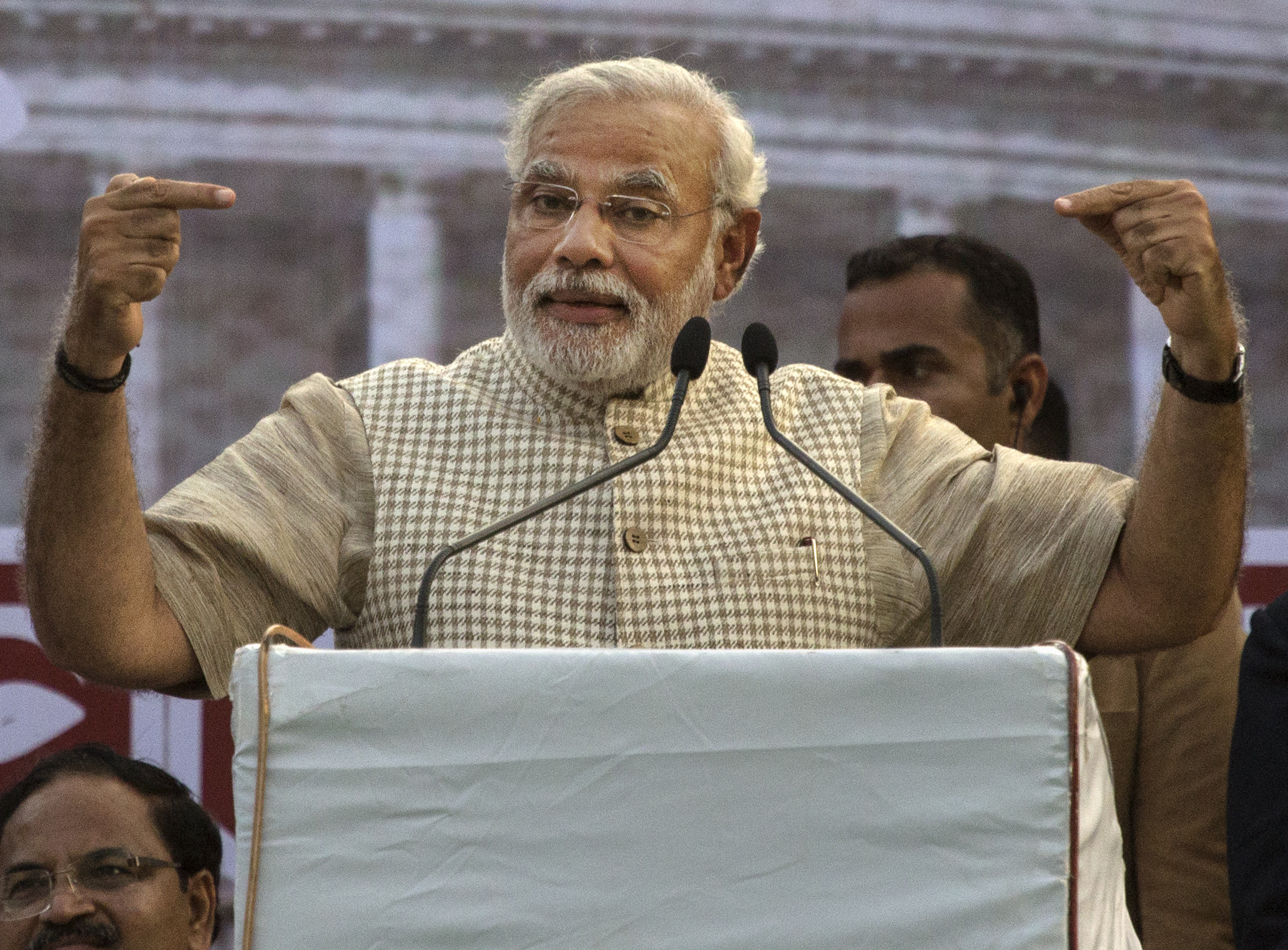
(Photo: BJP leader Narendra Modi gestures as he speaks to supporters after his landslide victory on May 16, 2014 in Vadodara, India. By Kevin Frayer/Getty Images)

What’s A Bisexual Anyway? Ctd

A reader resurrects the thread once again:

I’ve been reading your blog for a long time, but never really felt compelled to write. I’m doing so now to thank you for the ongoing series on bisexuality. Recently our teenage son told us he is bisexual. It was a complete surprise to my husband and me. I knew he was interested in girls, so I just put him in the hetero category and never thought twice about it. We have lots of gay friends, several of whom are like extended family. There has never been any question in our house that a person’s sexuality is no big deal. And it’s not.

But even so, this knowledge rocked my world in ways I didn’t expect, including confronting my own ideas about bisexuality. And I gotta tell ya that my close gay friends were NO HELP when I tried to talk to them about it. Every single one of them has responded to some degree with the same comment: Oh, he’s too young to know what he is yet. My reaction: WTF? That does not jive with the “born this way” message I’ve been hearing like a steady drumbeat.

So, that’s where The Dish has helped tremendously. It’s the only place I’ve been able to hear directly from people who identify as bisexual about their journeys, frustrations and needs. I have read every single post in the series, and I hope you keep it going.

Another keeps it going:

I’m one of those bisexuals you have identified as bisexual and heteroamorous. But I’ve come to believe that my truncated sexual attraction to men, i.e., lacking the emotional dimension, is a result of my internalized homophobia.

I was an intellectually and emotionally precocious child, and at the age of 11, had my first huge crush on a girl in my school.  In the next year, I was sent to an all boys’ boarding school, where I promptly developed a huge crush on a boy a couple of years older than me. Sadly, the crush was discovered by a classmate, who suggested that I was a “fairy”.  In terror, I ruthlessly repressed my homosexual desires into adulthood.

Only in my twenties, did I begin to confront my attraction to men, and even that was for years a deeply confused attraction.  As I told a therapist, I’m bi, but I don’t even like the smell of men.  As for my heterosexuality, I allowed myself the full experience of it, and I am unquestionably both heterosexual and heteroamorous – I’m very happily married to a woman.

But over the years, I’ve worked to overcome my homophobic resistance to my attraction to men, and have reasonably succeeded – I even like the smell of men now, and can engage in homosexual sex without the tyrannizing Masters and Johnson-named observer on the shoulder who destroys all passionate sexual activity.  But I strongly suspect that emotional attachment is the remaining prohibition imposed by my internalized homophobia.  I often wondered who I would have grown up to be, had I not learned a terror of my homosexual attractions at an early age – I might even have grown up to be someone deeply attracted, both sexually and emotionally, to both sexes.  I am saddened that the world allows so little room for that.

Update from a reader, who responds to the mother’s email:

If a gay tells her it’s too soon for your son to know his entire sexual mind, it’s not necessarily insensitive or against the “born this way” message. Many of her close friends may have taken years or decades to fully know themselves. I am gay, so I am going by what I’ve read, and bisexuality can be as you have noted – sexual or amorous – but can also be simultaneous or consecutive, meaning the attraction for both sexes is both at the same time or takes turns. I doubt a young man can know so much about what the rest of his life will be, and surely a woman’s more fluid sexuality should inform her that one’s first self-realizations aren’t forever. It also sounds like the mother will only accept from gays what she wants to hear.

Book Club #2: “On Looking,” Hosted By Maria Popova

[Updated and re-posted from earlier this week]

When I asked Maria Popova of Brain Pickings which book she’d like to pick for our second book, her eyes widened a little. They do that a lot. It didn’t take long for her to settle on Alexandra Horowitz’s On Looking: Eleven Walks with Expert Eyes (alternatively subtitled “A Walker’s Guide to the Art of Observation”). In her work as a professor of cognitive science at Barnard, Horowitz is “currently testing the olfactory acuity of the domestic dog, through experiments in natural settings, and examining dog-human dyadic play behavior.” From the publisher’s description of the book Maria chose:

From the author of the giant #1 New York Times bestseller Inside Of A Dog comes an equally smart, delightful, and startling exploration of how we perceive and discover our world. Alexandra horowitz-onlookingHorowitz’s On Looking: Eleven Walks with Expert Eyes shows us how to see the spectacle of the ordinary—to practice, as Sir Arthur Conan Doyle put it, “the observation of trifles.”

On Looking is structured around a series of eleven walks the author takes, mostly in her Manhattan neighborhood, with experts on a diverse range of subjects, including an urban sociologist, the artist Maira Kalman, a geologist, a physician, and a sound designer. She also walks with a child and a dog to see the world as they perceive it. What they see, how they see it, and why most of us do not see the same things reveal the startling power of human attention and the cognitive aspects of what it means to be an expert observer.

On Looking is nutrition for the considered life, serving as a provocative response to our relentlessly virtual consciousness. So turn off the phone and other electronic devices and be in the real world—where strangers communicate by geometry as they walk toward one another, where sounds reveal shadows, where posture can display humility, and the underside of a leaf unveils a Lilliputian universe—where, indeed, there are worlds within worlds within worlds.

From Maria’s extensively excerpted review:

[Horowitz’s] approach is based on two osmotic human tendencies: our shared capacity to truly see what is in front of us, despite our conditioned concentration that obscures it, and the power of individual bias in perception — or what we call “expertise,” acquired by passion or training or both — in bringing orwell-2attention to elements that elude the rest of us. What follows is a whirlwind of endlessly captivating exercises in attentive bias as Horowitz, with her archetypal New Yorker’s “special fascination with the humming life-form that is an urban street,” and her diverse companions take to the city. …

It is undoubtedly one of the most stimulating books of the year, if not the decade, and the most enchanting thing I’ve read in ages.  In a way, it’s the opposite but equally delightful mirror image of Christoph Niemann’s Abstract City — a concrete, immersive examination of urbanity — blending the mindfulness of Sherlock Holmes with the expansive sensitivity of Thoreau.

It struck all of us as a great book to enter summer with, as we get outside more and try to turn down the digital noise in our heads. Less dense than the Ehrman book, it also covers a whole variety of ways of looking at the world – geology, physics, and the genius of dogs – ways many readers might be interested in or knowledgeable about. And, yes, it’s not about religion. I know that’s a niche topic. This one is literally everything on your block.

We’ll do the second Book Club exactly as we did the first – beginning the reader discussion, guided by Maria, after Memorial Day weekend. As with the Erhman book on early Christianity, the author will also show up at the end of the discussion, like Marshall MacLuhan, to tell us that we know nothing of her work. So buy the book through this link and get cracking. (The public library link is here.) We’ll start the conversation as summer begins.

Update from a reader:

I was very eager to join in the first book club because I adore the Dish community and knew that the discussion would be lively entertaining and I would definitely learn a thing or two. I have to admit I was disappointed by the first choice, How Jesus Became God. As a working mom I have limited time for reading not related to my profession so I couldn’t justify taking the time to read a book that didn’t spark my interest when I have so many waiting in my Kindle queue.

So I am one happy happy girl today because you have picked a book I was planning to read this summer! Thanks, and as a demonstration of my commitment, I am going to start today during recess.

Waitlisted To Death At The VA

German Lopez outlines the scandal that saw Secretary of Veterans Affairs Eric Shinseki questioned before Congress yesterday:

The controversy really began after CNN reported in April that at least 40 US veterans died while waiting for appointments at the Phoenix VA hospital. According to internal emails and CNN’s sources, VA managers in Phoenix created a secret wait list in an attempt to hide that 1,400 to 1,600 sick veterans were forced to wait months to see a doctor. Even worse, top-level management supposedly knew of and defended the practice.

Besides the secret list, the Phoenix VA hospital already provided a different, official wait list to DC that allowed VA higher-ups to verify that patients are being treated in a timely manner (within 14 to 30 days). But Phoenix’s secret wait list supposedly avoided federal oversight with an elaborate scheme in which officials shredded evidence that some patients were taking months to be seen. What’s worse, if someone died while waiting for an appointment due to the secret wait list, Phoenix officials would allegedly discard the name as if the fatal error never happened.

He adds that “there’s also been issues with scheduling practices in at least three other locations.” Shinseki’s testimony didn’t impress veterans groups:

After the hearing, the Iraq and Afghanistan Veterans of America, which has a broad membership base among younger veterans, released a statement that read, “Secretary Shinseki did not restore confidence that VA senior leadership is responding with action and not just concern. Our members are outraged. And we need to see a bold plan to address these allegations.”

None of the veterans’ groups, including the conservative American Legion, which has called for Shinseki to resign, endorsed the idea of replacing centralized, VA-provided care with a private option. Republican senators have repeatedly floated the idea of privatizing the VA’s healthcare system. Veterans’ organizations on the panel endorsed a limited private care option but warned that it shouldn’t take away from the VA’s budget or its mandate to be the primary healthcare provider for veterans. Carl Blake of the Paralyzed Veterans of America argued that veterans with certain chronic injuries and demanding physical condition who now receive care might not be able to find private specialists outside the VA to treat them. The problem, he stressed, was getting the veterans into the VA’s healthcare system.

So will the general get the axe? Mark Thompson wonders:

[Shinseki] has already said he won’t resign. What’s critical is how Congress and veterans react to what he says, and what a VA-wide inspector general’s probe into the problem turns up. Shinseki will survive if he convinces them he was ignorant of such wrongdoing—he has denounced it as “absolutely unacceptable”—and shouldn’t have been expected to detect it on his own.

But anyone who has paid attention to VA data is aware that there have been persistent efforts inside the agency to make vets’ wait times seem shorter than they actually are. One 14-day limit for getting an appointment was ripe for abuse, and critics say such abuse should have been anticipated and eliminated. Shinseki’s defense becomes weaker with every corroborated story of his subordinates gaming the system. If there’s evidence that the problems are systemic, Shinseki’s days are numbered.

Michael Astrue points out that this is not the VA’s only problem:

There is also a risk that the recent focus on breakdowns in the VA hospital system will cause President Obama and Congress to overlook the other huge failing at the VA—a sluggish, error-prone disability system that will never work until it moves completely from paper processes to a state-of-the-art electronic system. VA disability paperwork is so voluminous that the General Services Administration became concerned a few years ago that a building in Virginia would collapse from the sheer weight of its stored VA disability paperwork. Predictably, waiting times for review have slowed to historically sluggish levels; a former soldier, whether injured in Afghanistan or Vietnam, should not have to wait years for a decision on his or her claim.

Jordain Carney and Stacey Kaper explain how the VA has gotten so overloaded in recent years:

The VA is dealing with a sudden influx of Afghanistan and Iraq veterans as the U.S. draws down its troop levels. Nearly 970,000 Iraq and Afghanistan war veterans deployed overseas since 9/11 have filed a disability claim, according to a Freedom of Information Act request released to Veterans for Common Sense this month by the Veterans Benefits Administration.

And due to medical advances, many service members who would have died from their injuries in past wars are now being saved, but they are returning home with more numerous and more complicated injuries. Vietnam veterans typically claimed three or four injuries. Now a single veteran from Iraq or Afghanistan routinely submits a claim with the number of injuries in the double digits. Meanwhile, the Obama administration has also changed the rules to give more benefits to veterans.

A Sign Of The Times

This embed is invalid


Yesterday, Buzzfeed obtained an NYT internal report (embedded above):

A 96-page internal New York Times report, sent to top executives last month by a committee led by the publisher’s son and obtained by BuzzFeed, paints a dark picture of a newsroom struggling more dramatically than is immediately visible to adjust to the digital world, a newsroom that is hampered primarily by its own storied culture.

Joshua Benton is impressed by the document:

I’ve spoken with multiple digital-savvy Times staffers in recent days who described the report with words like “transformative” and “incredibly important” and “a big big moment for the future of the Times.” One admitted crying while reading it because it surfaced so many issues about Times culture that digital types have been struggling to overcome for years.

I confess I didn’t feel anything quite so revelatory when I read last week’s leaked version — which read like an indoor-voice summary, expected and designed to be leaked to the broader world. This fuller version is quite different — it’s raw. (Or at least as raw as digital strategy documents can get.) You can sense the frayed nerves and the frustration at a newsroom that is, for all its digital successes, still in many ways oriented toward an old model. It’s journalists turning their own reporting skills on themselves.

Zachary M. Seward focuses on the NYT’s declining homepage traffic:

Traffic to the New York Times homepage fell by half in the last two years, according to the newspaper’s internal review of its digital strategy … That’s not necessarily a reflection of any problems at the Times but the reality of how news is now distributed on the internet. Homepage traffic is declining at most news sites as readers increasingly find links to news articles from social media, email, and other sources.

He adds that overall “traffic to the Times isn’t falling; it’s just coming in through the ‘side door’ more often.” Ezra complicates this analysis:

Someone has to post an article to Twitter or Facebook. That can be the media brand. It can even be the journalists. But when articles work it’s really coming from the readers. Social media is wonderfully, frustratingly organic. Oftentimes the biggest hits are the ones you never even thought to share.

So the next question is where do those readers — the ones seeding your content, and finding your gems — come from? That turns out to be a very, very hard question to answer. It’s tough to track the chains of social shares. But my experience — and that may not be worth much — is that many of them are coming to your home page.

Both Derek Thompson and Tyler Cowen add their two cents.

Cured By A Virus

Kent Sepkowitz unpacks the news that scientists at the Mayo Clinic “had treated two adults with the blood cancer, multiple myeloma, by injecting them with mega-doses of genetically modified measles virus”:

Both patients had failed all other available therapies; with the new “oncolytic virus” treatment, each responded and one remains in remission nine months later.

In this study, the patients—neither with existing antibody to measles virus—received enormous doses of live measles virus infused directly into their vein—not given as a shot like a vaccine. Both became feverish and ill with the infusion, as expected, and both recovered. The measles virus was derived from the strain used in routine measles vaccine but had been carefully altered by scientists to enhance its tumor killing effects. It was still, however, a measles virus, capable of giving a person a measles-like illness. The choice of measles for the cancer was quite deliberate—this virus is known to seek out and attack a type of white blood cell that myeloma arises from. The investigators simply harnessed measles virus’ natural born killer tendency.

Adrianna McIntyre has more:

Measles isn’t the only virus used for this kind of therapy; different cancers will be more susceptible to different viruses. Usually when this therapy is attempted, the virus is injected at the tumor site. Myeloma isn’t isolated to tumors, though; the cancer also infects bone marrow itself. In this study, the vaccine was injected into the bloodstream, instead of directly into the tumor.

And this isn’t your garden-variety measles vaccine. The vaccine formulation used in this study contained 100 billion infectious units — 10,000 times the standard dose. And compared to cancer treatments that last months, this measles vaccine therapy only requires a one-time dose. “What we’re really excited about with this particular approach is that we believe it can become a single-shot cure,” said Dr. Stephen J. Russell, lead author on the study.

Losing The Ring, Ctd

Ring Diving

Readers can relate:

So you lost your gay wedding ring?  How virtually normal. Sorry for the loss. Hope it turns up, and welcome to the club.

Another member:

I lost my wedding ring too. It was a very cool, custom ring, kind of tubular, 18 karats. Cost quite a bit of money. I think I was eating Taco Bell, and it was cold out, making my fingers slimmer, and when I threw the wrappers in the trash, it just flew off into the trash can. That’s my best theory. What an undignified ending for a wedding ring.

Having blown my shot at a cool custom ring, my wife and I went to the pawn shop, where I bought a goofy, old-school, 14 karat art-carved band for $49. I love that 2nd ring, and it reminds me of a time in my life and the place that I lived in then, when I was a little more careless, but still me. I have had it for 14 years, and it has only grown more meaningful with time.

I guess I am saying that you can love your next ring too. It will remind you of this moment with your husband, him being by your side, recovering from the hospital, and all the warp and woof of life, including the messy, annoying bullshit, like going to a hospital and losing a ring. A new ring for yet another stage of marriage and living. All perfectly, perfectly normal.

A near-member:

I was newly married and newly ringed while enjoying some lap-swimming with a friend.  Shrinkage does occur in other places in a cold pool.  One freestyle stroke later and the ring just slipped off into the large and deep Olympic-sized pool.  I was devastated as I frantically flagged down my friend in the other lane who probably thought I was having a heart attack (somewhat true).  We searched for what seemed a half-hour as we tried to avoid other swimmers who thought we were complete dicks.  As we were about to give up and get out, I noticed a shiny thing in the catchment on the side of the pool.  Eureka.  I was so relieved.

Well, this will make you feel worse perhaps, but I thought we could start a new thread.

The thread continues with many more stories:

If it makes you feel any better, I am on my third ring in four years.

The first was lost on the second day of our honeymoon (the Pacific is cold with strong currents).  The second was lost during a friend’s bachelor party (to this day it’ a mystery, along with most of that night).  And I now have a spare fourth ring after losing and later finding my current one (I wisely go with the $40 plain silver band every time).  Needless to say, I have a very understanding wife. Sounds like Aaron is just as considerate, but if you need a favorable comparison, feel free to show him this email.

Perhaps the most wrenching tale:

My wife and I had one of those crazed screaming matches that ended with me storming out of the house and walking about a mile to cool off. I came to a local school building and sat down on a bench to rest. I took off my wedding ring, pondering my marriage while I fiddled with it.

And then I dropped my wedding ring. And it rolled about 10 feet. Into the sewer. Gone. Forever.

Holy shit, I thought. My wife’s gonna think I threw my wedding ring away in a fit of rage and divorce me! There was only one thing I could do: Tell truth truth, however stupid it may be. I literally ran home and apologized in tears. She was annoyed, but believed me. That was about 10 years ago and we’re on our way to 18th anniversary.

Cheer up, Andrew. You’ll find over time that the pain of losing your wedding ring lessens. It doesn’t fully go away, but you learn to deal with it.

Another sends the above photo:

While snorkeling in the Caribbean, I thrust my left hand down at just the right angle and speed to basically slingshot my ring off of my finger.  I can still see it silently, gently, floating about 20 feet down into the corals, glinting in the sunlight before settling into some dark crevice. It reminded me of a scene from Lord of the Rings (though more tropical). I had no hope of retrieving it (especially after I took my eye off the landing spot to tell everyone what happened).  But, my sister was at least able to take the attached photo of me diving down after it, so I could tell my wife back at the hotel that I made some effort to get it back.  Luckily we were poor when we got married, so the financial hit wasn’t too bad.  And it is a bummer to not have the ring from our wedding, but I did gain a story.

Another photo:

IMG_4838

Two days ago I cleaned house, worked in the yard, did laundry and dishes, went grocery shopping, had lunch at Audrey’s school, and discovered that somewhere along the way I had lost the diamond from my wedding ring. Yesterday I found it on the pavement under our outdoor faucet, where I had detached the hose. A miracle!

Two sentences you’ll only find on the Dish:

Very sorry about the loss of your wedding ring. It brings back a memory of my first colonoscopy.

I was on the table just slipping into unconsciousness when I heard the doctor announce that I had a nipple ring. Then I heard a bb bouncing on the floor. One of the nurses said that she’d get it, and that’s the last I remembered. When I awoke, the ring had been saved for me, but since I had been pierced fairly recently, the hole closed. Getting it done the first time was excruciating. I had to wait months before I could have it redone, and the pain was worse the second time around because I actually knew what to expect.

Not to minimize your loss, but if given a choice, I’d lose my wedding ring over the nipple ring any day. Now you can go shopping, and Aaron will get to place it on your finger all over again. Sounds sweet to me, especially since you’ll most likely get a “happy ending” afterwards.

Another reader:

Years ago we were in a hotel room when my mother realized she had accidentally thrown out her engagement ring.  She had wrapped it in tissue for protection in her suitcase (so, never do this) and then placed the tissue on a counter, later thinking it was trash. It had been my father’s mother’s ring and after a frantic search it became clear it had gone out with the trash and was gone for good. I remember my mother’s devastation.

Years later, after my father died, my mother told me about how my father had not gotten angry or upset, he had simply said “It’s OK. These things happen. I’ll buy you a new one.” It was his family heirloom, and his calmness, his complete absence of blame, did a great deal to calm my mother and alleviate her guilt.  He bought her a new ring and when my mother died I took possession of it.  This new ring says much more to me about love, about my parents’ commitment to each, than the original ring ever could have. I treasure it.

It’s a thing.  It’s not your husband’s love, which will endure regardless of how many rings you go through.

One more:

I am sorry about your wedding ring. But Aaron is right, it is a thing. It is a symbol of your relationship. You don’t lose his love with the ring.

In 1982, I was 39.5 weeks pregnant, 40% dilated, and not in labor. My two year old was having a rough time with our rough time. My husband took her apple picking with his boss and children. He lost his wedding ring in the orchard. Extremely pregnant woman are rather volatile, and I was no exception. A few days later, the baby was born. We replaced the ring. The feisty toddler is herself 34 weeks pregnant now and on medicine to try to keep her from delivering for another two weeks.

Steve and I are still happily married. He collapsed at work yesterday from otherwise silent stomach bleeding. Last night they found a significant tumor, probably a low grade malignancy. He had many CT scans last night to look for true size of the tumor and any sign of spread. We are awaiting a meeting of the experts to formulate a plan. That wedding ring is so unimportant today.