Olga Khazan traces the American tendency to view sleep deprivation as a badge of professional dedication back to Thomas Edison:
Early newspaper accounts touted Edison’s willingness to work “at all hours, night or day,” to frequently rack up more than a hundred hours of work in a week, and his tendency to select his subordinates based largely on their physical endurance. In an 1889 interview with Scientific American, Edison claimed he slept no more than four hours a day, and he apparently enforced the same vigilance among his employees. …
Over time, children’s books and magazines began to promote this type of Edisonian asceticism. “One juvenile motivational text featured a photo of Edison with a group of workers identified as his Insomnia Squad,” [historian Alan] Derickson writes. Early 20th century biographies of Edison featured him interviewing job candidates at 4 a.m. and cat-napping on lab benches between marathon work sessions.
Some short-sleepers might have shrugged and said they were simply biologically lucky. But Edison encouraged all Americans to follow his lead, claiming that sleeping eight hours a night was a waste and even harmful. “There is really no reason why men should go to bed at all,” he said in 1914.
That’s from the Idaho governor’s primary debate – and that biker dude is pretty rad.
Meanwhile, Fox News has a new poll out, and some of the questions deserve this tart riposte from Steve Benen. But it has, for me at least, some interesting data. On the economy, Obama is rebounding in the Fox poll – with an approval rating on that subject higher than at any point since October 2009. On healthcare, support for the ACA is also now the highest Fox has ever found since it became law in 2010. Then these two findings: 63 percent believe that the continuing Republican inquiry into Benghazi is for political gain, rather than seeking the truth; and a whopping 65 percent oppose intervention in the Ukraine.
On another front, a friend forwarded me an old Los Angeles Times story about the debate about marriage equality in the gay community in the mid-1990s. The first two paragraphs tell you a lot:
Elizabeth Birch, head of the Human Rights Campaign Fund in Washington, the nation’s foremost gay lobbying group, believes that the struggle to legalize gay marriage is “one whose time has not yet come. There is no reason that this battle is being played out right now, other than it fits into Republican election strategy.”
On the other hand, Andrew Sullivan, until recently editor and now senior editor at the New Republic and author of the best-selling “Virtually Normal: An Argument About Homosexuality”, says he has “really been surprised by the ferocity of support on this issue. It’s mobilizing the gay community like no other act has done.”
Just a reminder of the history HRC is busy now trying to bury.
Today, we explored the possible ramifications of the abrupt firing of Jill Abramson at the NYT. I didn’t really weigh in much on my long personal experience with Jill, so let me say this: she’s always been an inspiration to me, not least because she never tolerates bullshit, and always tells you what she thinks in that bored-as-hell drone of an accent she has. Whatever the reasons for her departure, she deserved a lot better than this shoddy kicking out the door.
Our new Book Club selection is Alexandra Horowitz’s fascinating insights into the world around us, On Looking, and Maria Popova will be hosting the discussion after Memorial Day. Full details here. You can support the Dish by buying the book through this link. The public library link is here. It’s a great read as summer approaches.
Many posts today were updated with your emails – read all of them here. And you can always leave your unfiltered comments at our Facebook page and @sullydish.
Almost 200 more readers became subscribers over the last couple of days – a surge that came after I sent out a nudging email to those of you who hadn’t gotten around to renewing yet. Yes, you’re still out there. Thanks to everyone who re-upped. Though at least one Founding Member is still procrastinating:
I fucking love your site, I’m just a lazy ass. : ) I promise I’ll get around to renewing, fear not.
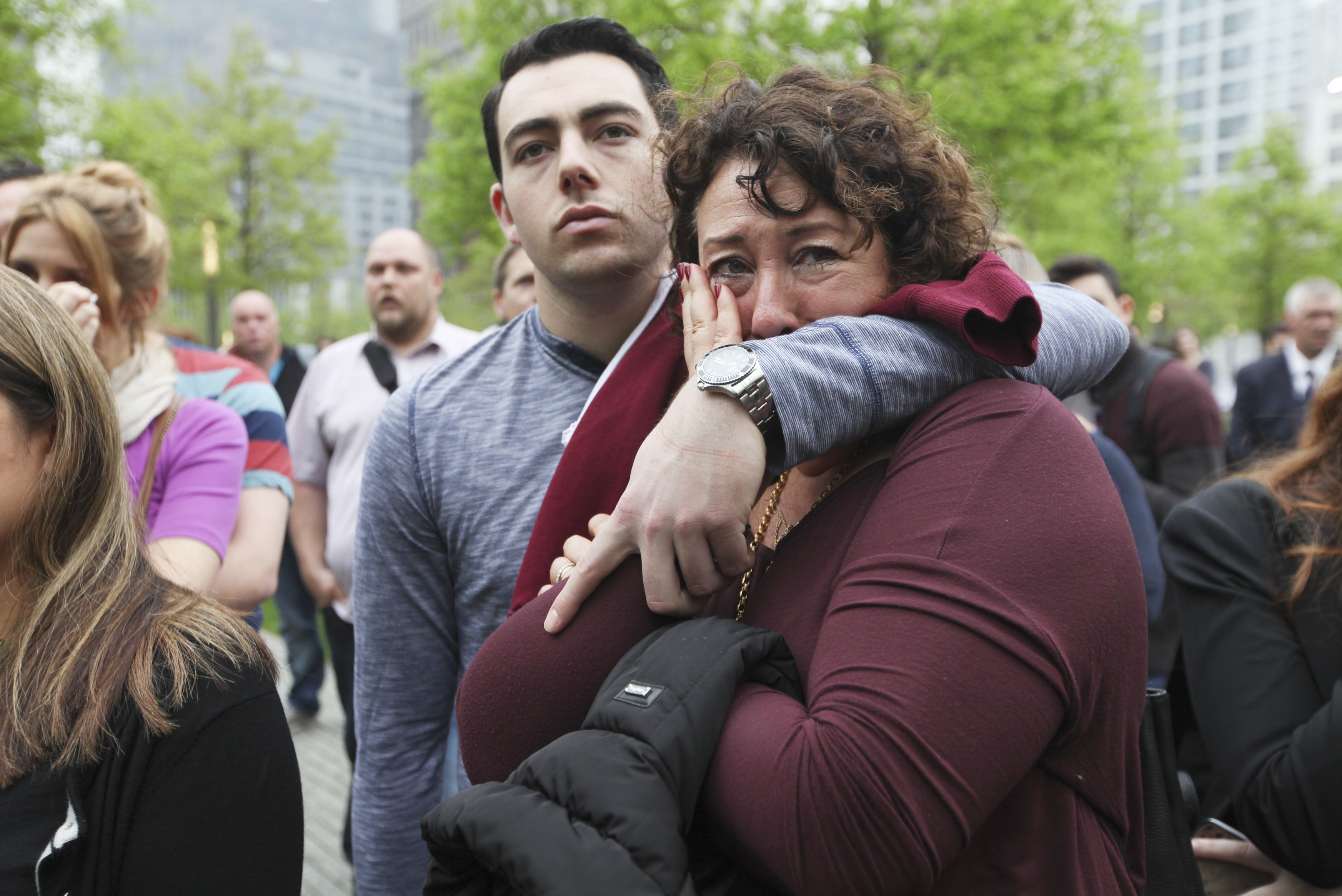
People on the memorial plaza watch a video feed of the opening ceremony for the National September 11 Memorial Museum at Ground Zero on May 15, 2014. The museum spans seven stories, mostly underground, and contains artifacts from the attack on the World Trade Center Towers that include the 80 ft high tridents, the so-called ‘Ground Zero Cross,’ the destroyed remains of Company 21’s New York Fire Department Engine as well as smaller items such as letter that fell from the hijacked plane and posters of missing loved ones projected onto the wall of the museum. The museum will open to the public on May 21. By Allan Tannenbaum-Pool/Getty Images.
Transcendence may be the “most persuasive evidence of God,” but this is not how it operates in the lives of most religious men and women. They do not require evidence of God; their concern is not to defend His existence, but simply to serve Him. Some of them may never even have a “highly personal transcendent experience,” but for those who do, it is less a great and strong wind or an earthquake or fire than a kol d’mamah dakah summoning the believer to go and return to her way.
In Christopher Beha’s astonishing debut novel What Happened to Sophie Wilder (reviewed here), the title character is attending mass at a small parish church when she is invaded by the Holy Spirit—she is taken over by “something outside of herself, something real, not an idea or a conceit or a metaphor”—but rather than pursuing a repetition of the experience, she dedicates herself to caring for her father-in-law as he dies painfully from cancer.
The ordinary religious duties (or what she, as a Catholic, would call humility) are what gives permanence to the moment of transcendence. Neglecting them she might have managed to “hook up” with God, but only briefly and without meaning.
In a follow-up post, Myers turns to a passage from Beha’s second novel, Arts & Entertainment, to warn of what happens when such “ordinary religious duties” aren’t cultivated:
As a ten-year-old altar boy at his family’s parish in Queens, Eddie had experienced a single unforgettable moment of what adults might call transcendence, when his whole body buzzed with the presence of something other than himself, a moment he had never talked about to anyone and didn’t like to think about now, because it still seemed unmistakably real to Eddie and didn’t make any sense to him.
Instead, Eddie tries to find substitutes for the experience in acting (“Something like that feeling had sometimes visited him while he was onstage”), and it remains without religious significance for him: “If asked, he would have said he was Catholic, just as he would have said he was Irish—it was a matter of birth, not of action or belief.”
Everything that happens to Eddie in the sequel is a consequence of his failure to make “that feeling” the basis of action or belief. Like so many of his contemporaries, he prefers the fever to the habit.
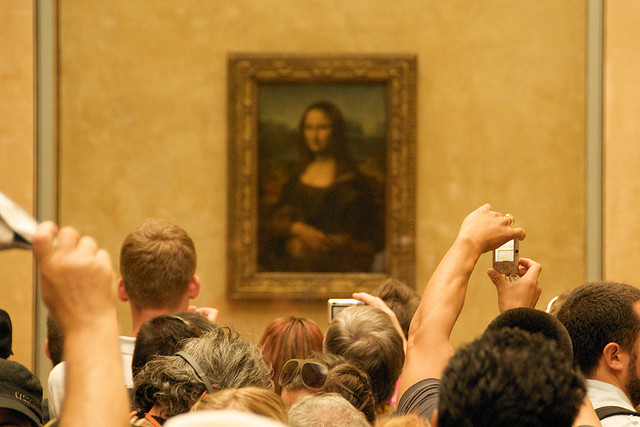
In an essay that explores why some works of art achieve legendary status while others languish in obscurity, Ian Leslie investigates why, exactly, the Mona Lisa became so famous only in the 20th century. It “wasn’t a scholarly re-evaluation,” he explains, “but a burglary”:
In 1911 a maintenance worker at the Louvre walked out of the museum with the “Mona Lisa” hidden under his smock. Parisians were aghast at the theft of a painting to which, until then, they had paid little attention. When the museum reopened, people queued to see the gap where the “Mona Lisa” had once hung in a way they had never done for the painting itself. The police were stumped. At one point, a terrified Pablo Picasso was called in for questioning. But the “Mona Lisa” wasn’t recovered until two years later when the thief, an Italian carpenter called Vincenzo Peruggia, was caught trying to sell it to the Uffizi Gallery in Florence.
The French public was electrified. The Italians hailed Peruggia as a patriot who wanted to return the painting home. Newspapers around the world reproduced it, making it the first work of art to achieve global fame.
From then on, the “Mona Lisa” came to represent Western culture itself. In 1919, when Marcel Duchamp wanted to perform a symbolic defacing of high art, he put a goatee on the “Mona Lisa”, which only reinforced its status in the popular mind as the epitome of great art (or as the critic Kenneth Clark later put it, “the supreme example of perfection”). Throughout the 20th century, musicians, advertisers and film-makers used the painting’s fame for their own purposes, while the painting, in Watts’s words, “used them back”. Peruggia failed to repatriate the “Mona Lisa”, but he succeeded in making it an icon.
Although many have tried, it does seem improbable that the painting’s unique status can be attributed entirely to the quality of its brushstrokes. It has been said that the subject’s eyes follow the viewer around the room. But as the painting’s biographer, Donald Sassoon, drily notes, “In reality the effect can be obtained from any portrait.” [Sociologist] Duncan Watts proposes that the “Mona Lisa” is merely an extreme example of a general rule. Paintings, poems and pop songs are buoyed or sunk by random events or preferences that turn into waves of influence, rippling down the generations.
(Photo of the Mona Lisa in the Louvre by Thomas Ricker)
Reihan Salam wants the vertically challenged to stick up for one another:
As I go through life, I will occasionally say, “well, as a short person …” before making some observation. And I’ve found that my interlocutor will often interject something to the effect of, “Hey, you’re not that short,” as if to reassure me. But why would this be reassuring if there were nothing wrong with being short? This is the root of the problem. I come from a long line of fierce and proud short people, who proved resilient in the face of all manner of natural calamity. My ancestors had small bodies that were tailor-made for sweating, which allowed them to work long hours in sweltering heat in South Asia’s swampy marshlands. The notion that being short is something to be ashamed of strikes me as deeply wrongheaded.
His call for unity:
To the short men among you, I’d like to ask:
Have you ever poked fun at someone for their size? Have you done so to delight your taller friends, and to establish that you are truly one of them? If so, I’d like you to think hard about the place in hell that is reserved for your ilk. If you have no fear of hell, consider this: Do you think that your chums respect you more or less for selling out one of your own?
It is those men who hover within spitting distance of the average height who have a special obligation to stick up for short men as a whole. When other short men are getting pushed around, it is these men who must speak up. Is someone making fun of “midgets”? Now is the time to get in their face. When presented with the opportunity to seamlessly blend in with average-sized or tall people, it is these men who must reject it, and to assert the importance of treating all people fairly and humanely, regardless of their size. And if the time comes when discrimination against short people intensifies, it is these men who must join the general strike that will bring the entire architecture of anti-short-people oppression to its knees. My credo is simple: Stay short. Stay strong. And when you see a short brother in need, do something about it.
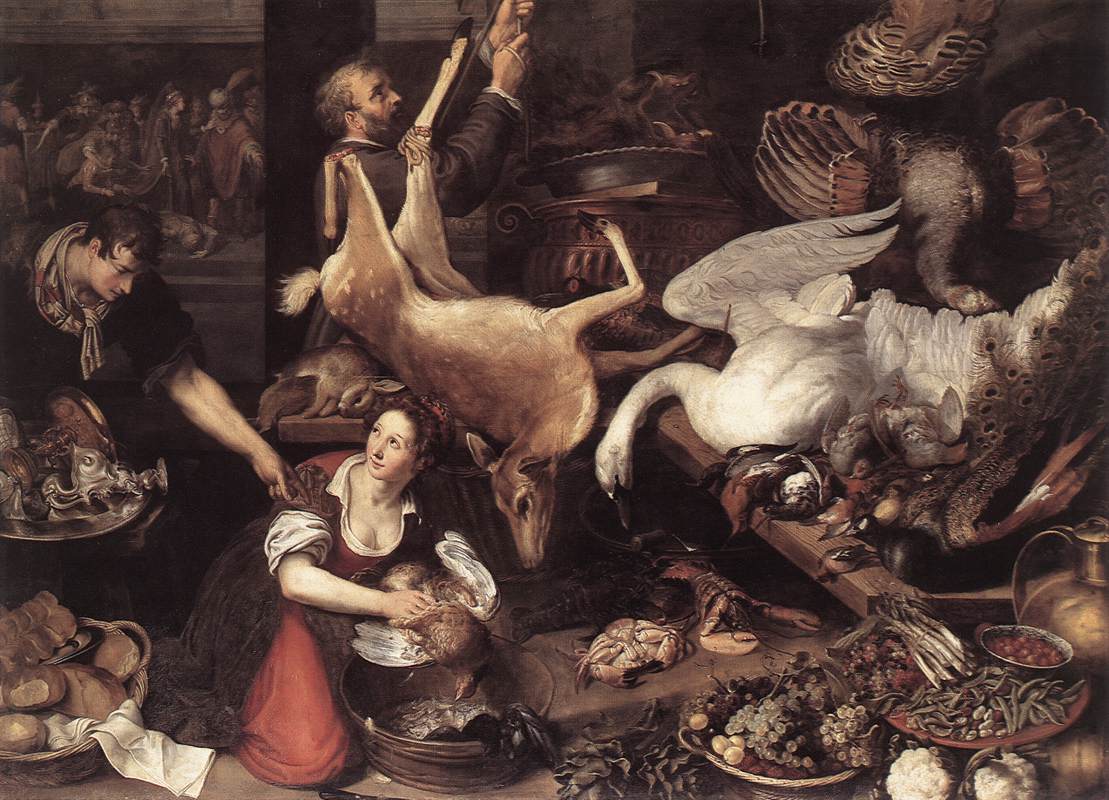
Monica Kim wonders if roast swan will ever make a comeback – particularly in Michigan, where the birds are nearly three times as common as they were a decade ago:
Often served at feasts, roast swan was a favored dish in the courts of Henry VIII and Elizabeth I, particularly when skinned and redressed in its feathers and served with a yellow pepper sauce; others preferred to stuff the bird with a series of increasingly smaller birds, in the style of a turducken. … Great Britain’s royals are still allowed to eat swan, as are the fellows of St. John’s College of Cambridge, but to the best of our knowledge, they no longer do. Thanks to stories like Leda and the Swan and Lohengrin, the birds appear almost mythical; a restaurant on the Baltic island of Ruegen had swan on their menu for a short time, before protests began and it was swiftly removed.
In Michigan, however, which has the highest population of mute swans in North America, the creatures are considered pests.
According to the Michigan Department of Natural Resources, the statewide breeding population increased from about 5,700 to more than 15,000 in just 10 years. The birds attack people in the water and on shore, particularly children that wander too close to their nests. … The cultural reluctance to hunt swan (let alone eat it) is powerful, but the government’s desire to control overpopulation is equally strong.
Update from a reader, who makes a distinction:
Mute Swans do not do anything to “other” native species in the US, as Ms. Kim suggests, because Mute Swans are not native to the US. They were deliberately introduced from the Old World to “grace the ponds of parks and estates” and are an invasive species here (like Starlings and English Sparrows). Our native swans include Tundra and Trumpeter Swans, and Mute Swans are not kind to them either. Mute Swans should be considered highly edible in the New World.
(Image: Adriaen van Nieulandt the Younger’s Kitchen Scene (1616) via Wikimedia Commons)
Jamelle Bouie asks Republicans: “If raising the minimum wage destroys jobs and prevents employment, then lowering it would do the opposite. And if you gain from lowering the minimum wage, then why have one at all?” Ramesh Ponnuru answers:
For one thing, it’s not just opponents of a higher minimum wage who think it would destroy jobs while a lower one would create some. Almost everyone who has thought about this question believes these claims are true. Most proponents of a higher minimum wage think the trade-off is worth it because the job loss will be small and the benefits to people who will receive the higher wage large.
Opponents of an increase sometimes say to the proponents, “If $10.10 is such a good idea, why not $25?” This is not a great argument, because the proponents can reasonably say that the trade-off in that case would be much worse. But if it’s logically possible to favor a $10.10 minimum wage but not a $25 one, then it’s also possible to favor a $7.25 one and not a $10.10 one. (Tim Pawlenty, one of the Republicans Bouie mentions, wants one somewhere in between $7.25 and $10.10.) So an opponent of raising the minimum wage to $10.10 could answer Bouie’s question as follows: Yes, raising the minimum wage destroys jobs, as nearly everyone understands. I think it is an especially bad idea when the increase is nearly of 40 percent and it’s in the middle of a persistently weak labor market.
But Jordan Weissmann points out that abolishing the minimum wage wouldn’t necessarily lead to full employment:
It’s easy to think up reasons why nixing the minimum wage might not lead to a flood of new career opportunities for the unskilled. Because we have minimum wages today, businesses are required to work at a certain level of efficiency. Unless a business is understaffed, adding a new worker, even a cheaper one, might not be particularly profitable.
Or take technology.
Minimum-wage skeptics often point out that when employing a real live human being becomes too expensive, companies start buying computers and machinery instead. In a post-minimum-wage world, it seems unlikely that businesses would suddenly throw their profitable business models into reverse, and start scooping up cheap workers to handle tasks they had already purchased fancy new equipment to accomplish. Your local McDonald’s, for instance, wouldn’t suddenly return the fancy new soda machine that lets customers fill their own cups with umpteen variations on Diet Coke, just so that it could hire another person to work behind the counter for $4 an hour.
Of course, there’s another big question to answer: If we ripped up the wage floor, would pay for low-skill workers actually fall all that much? It’s hard to say. First, many low-wage businesses still offer their workers more than the absolute minimum. Second, wages tend to be “sticky,” meaning that once they go up, they tend not to come down. The reason why is still a bit of a mystery, but it likely has a lot to do with the fact that making your employees take a pay cut is a) emotionally unpleasant for both parties and b) a good way to sap their motivation on the job.
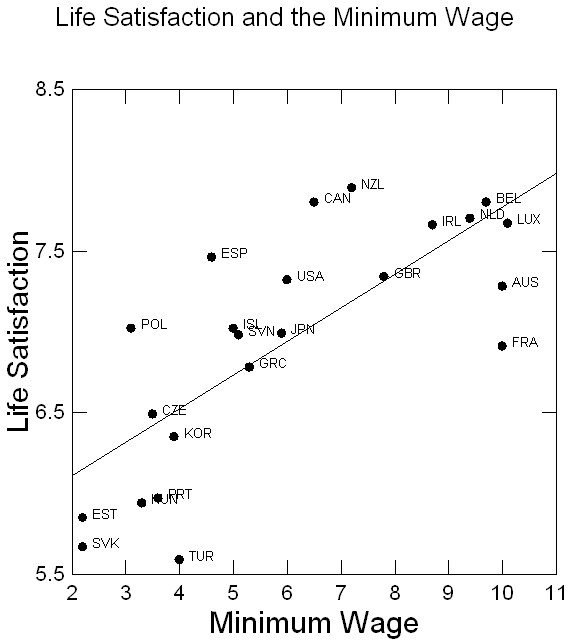
The minimum wage also has non-economic benefits, such as a clear correlation with happiness:
Can one approach be empirically demonstrated to contribute to greater levels of human well-being? The following graph is at least highly suggestive of an answer. It plots the mean level of life satisfaction in a nation against its minimum wage (for those industrial democracies that have a minimum wage). As is apparent, the slope relating wages to satisfaction is positive (and statistically significant at the .01 level), meaning that average levels of life satisfaction increase as minimum wage increases. …
The relationship is dramatic and clear: As the minimum wage increases, people are in general more satisfied with their lives. To be sure that this result is not an artifact of failing to consider alternative explanations, we note that the same positive relationship continues to obtain if we add statistical controls for other factors, including as a country’s level of economic development (GDP per capita, again in purchasing power parity), which may affect both its level of happiness and the level of its minimum wage, and (simultaneously) short-term economic performance (the unemployment rate).
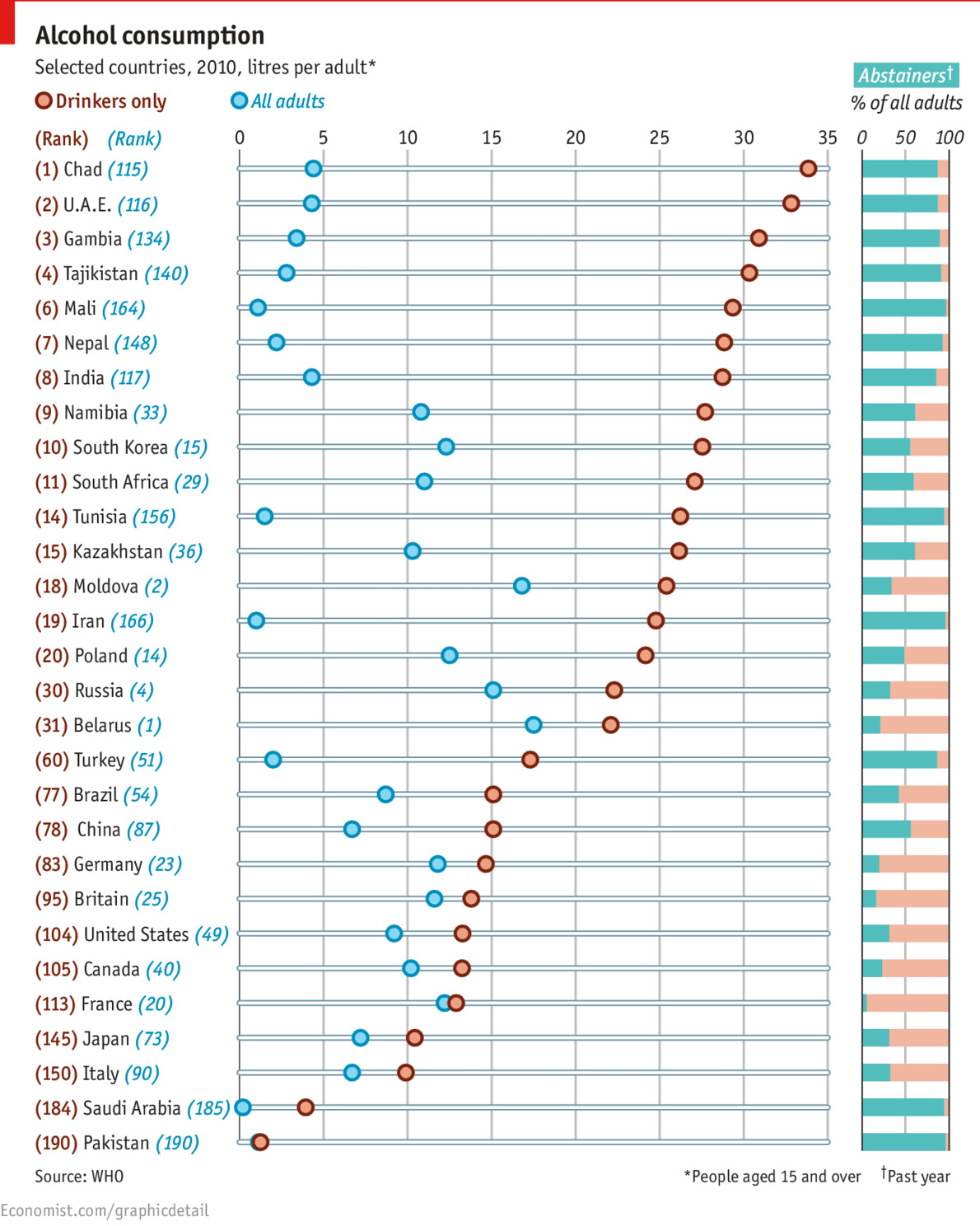
The average adult drinks 1.64 gallons of pure alcohol each year, according to a new World Health Organization report (pdf) covering more than 190 countries. But as Kate Kelland points out, that may be understating the case:
Less than half the population – 38.3 percent – drinks, so those who do drink on average 17 liters (4.49 gallons) of pure alcohol a year. “We found that worldwide about 16 percent of drinkers engage in heavy episodic drinking – often referred to as ‘binge-drinking’ – which is the most harmful to health,” said Shekhar Saxena, director for mental health and substance abuse at WHO.
Globally, Europe consumes the most alcohol per person, with some countries there having particularly high rates of harmful drinking. A study published earlier this year found that a quarter of all Russian men die before they reach their mid-fifties, largely from drinking to excess. Some men in that study reported drinking three or more bottles of vodka a week. WHO said global trend analyses showed that drinking has been stable over the last five years in Europe, Africa and the Americas – but is growing in Southeast Asia and the Western Pacific.
And as The Economistnotes, “when abstainers are excluded, the national averages look extremely different”:
By this measure, it is in Africa, Asia and even the Middle East where actual drinkers quaff the most. In Chad almost nine in ten adults abstain, yet its 780,000 drinkers put away almost 34 liters of alcohol each. On the usual ranking, it would come 115th out of 190 countries. France drinks a lot, but because it has one of the lowest rate of abstainers at just 5 percent, it ranks 113th compared with 20th.
Globally, the WHO expects the average to continue to rise, though they’ll be some regional differences here as well. The biggest increase, say researchers, will be found in the Western Pacific region and China. The biggest decrease will most likely be seen in Europe, though even with that decrease, they are still expected to keep the highest average overall.
Joseph Stromberg observes that one “reason many doctors are especially concerned about the risks of playing football is the mounting evidence that mild, routine hits — which present no immediate symptoms and are generally categorized as sub-concussions, rather than concussions — might lead to [chronic traumatic encephalopathy (CTE)] as well.” He highlights a new study that supports this theory:
In it, doctors studied 25 college football players who’d previously suffered concussions, 25 who’d never been diagnosed with concussions, and 25 non-football participants of similar ages. Using MRI scans, they looked at the sizes of each person’s hippocampus — a brain region heavily involved in memory. This is important because people with CTE often have dramatically shrunken hippocampi by the time they’re diagnosed.
They found that previously concussed players had smaller hippocampi than non-concussed players — but, disturbingly, both groups had smaller hippocampi than the non-players. Within both groups, the more years of playing time a player had, the smaller his hippocampus.

 The Dish
_-_Kitchen_Scene_-_WGA16570.jpg)