Piketty Saw This One Coming

David Katz takes stock of the boom in the butler industry:

Thirty-five years ago, there were only a few hundred butlers left in Britain; today there are roughly 10,000, plus thousands more abroad, including the fastest-growing butler market of them all, China.

“For the Chinese, it’s a status thing,” says Sara Vestin Rahmini, who founded Bespoke Bureau. “They’re like, ‘Just send us somebody who looks British, who looks European.’” … Gary Williams, a London-based staffing agent who himself was a butler for 15 years, credits much of China’s butler demand to Downton Abbey. Watched by millions of Chinese, it’s one of the biggest British TV imports ever. The show is more than just a soapy diversion, he says; it’s a guidebook for living in a stratified society. “The Chinese aren’t even really sure what a British butler should do,” says Williams. “It will take them 10 to 15 years to really understand that.”

But they’ll pay – and pay well – to find out. A new butler willing to go east, to Shanghai or Dubai or anywhere else suffering an Anglo-servant shortage, can start at $60,000 a year and run his employer’s estate from the start. In the West, where standards are higher and the competition more fierce, a rookie typically apprentices for a few years and earns a starting salary of maybe $40,000. A butler in either market should hit six figures within five to six years – sooner if he learns a few dirty secrets or gets poached by one of his boss’s billionaire friends.

Russian Jews Know Fear

Ioffe tracks a rising tide of anti-Semitic incidents in Russia:

The Russian Jewish Congress, for instance, issued a report saying that there has been a marked increase in anti-Semitism in Russia in the first four months of 2014. Though there were no physical attacks on Jews, there were some minor incidents—everything from cemetery attacks to Russian nationalist thugs chanting anti-Semitic slogans. But most of this rise, the Congress reports, “was manifested first and foremost in public anti-Semitic statements, the number of which has increased dramatically.”

The report notes public statements from politicians, like the member of Putin’s United Russia party in Kaliningrad who accused his opponents of being “Jews, hiding among the opposition” and destroying the country. Dmitry Kiselev, who has threatened to turn the U.S. “into radioactive ash,” was called out for pointedly pointing out the Jewish names of some opposition writers and saying that they should be wary of comparing the Sochi and 1936 Berlin Olympics because, in Germany, they wouldn’t have been allowed to write, let alone live. The columnist of one state-friendly Russian newsletter listed Jewish members of the Russian opposition, saying that “they have no homeland because of their political beliefs.”

Yet at the same time, Putin is claiming that his intervention in Ukraine is saving the country from fascists and anti-Semites. Josh Cohen looks into how Ukrainian Jews feel about that:

Despite the substantial presence of right wing nationalists on the Maidan during the revolution, many in Ukraine’s Jewish community resent being used by Putin in his propaganda war. …

On March 5, 21 leaders of Ukraine’s Jewish community signed an open letter to Putin excoriating the Russian president for using Ukraine’s Jewish community to bash the interim government — and insisting that the real threat to Ukraine’s Jews emanated from Russia: “We know that the political opposition consists of various groups, including some that are nationalistic. But even the most marginal of them do not demonstrate anti-Semitism or other forms of xenophobia. And we certainly know that our very few nationalists are well-controlled by civil society and the new Ukrainian government — which is more than can be said for the Russian neo-Nazis, who are encouraged by your security services.”

This letter to Putin brought forth an important point: namely, that much of the real anti-Semitism directed at Ukrainian Jews is actually coming from Russia.

Previous Dish on Jews in Ukraine here.

Losing The Ring

Well, the procedure went well yesterday and I’m a little sore but fine. What’s not so fine is that they lost my wedding ring. I’d already changed into my OR clothes when a nurse noticed my ring was still on my finger. She asked to take it with my cellphone and said she’d put it in the bag in my locker. In the understandably woozy aftermath, as I prepared to leave, I found my phone in the bag but not the ring. I’ve been told they weddingaislewould have been together in a plastic ziplock bag inside the bigger clothes bag, but I only remember finding my phone loose among my clothes. I wasn’t fully altogether so forgive myself for not checking for the ring before I left. But last night, halfway through the Daily Show, I got that panicked feeling as I reached almost instinctively for my ring and it wasn’t there. Today, after searches and several phone calls, the ring has not been found. It was probably thrown out in the empty big bag I left behind.

I truly feel ill about this. I’m not at all a possessions-freak; in fact, I am wildly indifferent to things in general. But that little band of gold? After a lifetime of struggle for the right to marry and the blessing of finding my other half? I’m genuinely bereft. Yes, I’ll try and replicate it and get a new one. But knowing that that piece of metal had been on my finger continuously since the day I got married was, well, priceless. And every few minutes, I get this sudden sinking lurch in my gut when I remember what I’ve just lost.

It’s just a thing, Aaron reassures me. But this time, that ‘just’ seems inadequate. It keeps stinging.

A Poem For Thursday

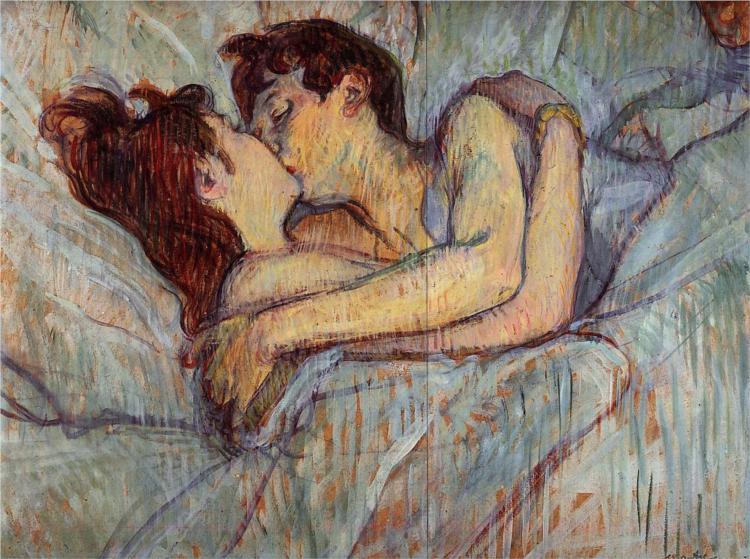
in-bed-the-kiss-1892.jpg!Large

“The Ledger” by J.D. McClatchy:

Love is injustice, said Camus.
We want to be loved. What’s still more true?
Each wants most to be preferred,
And listens for those redeeming words
Better than X, more than Y—
Enough to quiet the child’s cry,
The bridegroom’s nerves, the patient’s
Reluctant belief in providence.
Break what you can, hurt whom you will,
Humiliate the others until
Someone takes a long, hard look.
Oh Love, put down your balance book.

(From Plundered Hearts: New and Selected Poems © 2014 by J.D. McClatchy. Used by permission of Alfred A. Knopf, Inc. Henri de Toulouse-Lautrec’s In Bed: The Kiss, 1892, via WikiPaintings)

Hard Times For The Ego

Ben Richmond flags a study on how coming of age during an economic recession lowers narcissism:

Published in the journal Psychological Science , the team from Emory University examined survey data from over 1,500 American adults, and found that participants who entered adulthood during a worse economic climate—when average unemployment was at 7.7 percent—scored 2.35 points lower on a 40-point narcissism scale than those who graduated in more prosperous times, when average unemployment was 4.3 percent. Better economic conditions later in life didn’t put the narcissism back on, either. It’s those formative “Best Top Ramen-Eating” years of your life that really do a number on you.

Recessions also impact CEOs’ narcissism:

A separate study in the paper analyzed the salaries of CEOs from more than 2,000 publicly traded companies. The researchers discovered that the CEOs who were 18 to 25 during sunnier economic climates paid themselves 2.26 times as much as the next most well-paid executive; compare that to CEOs who came of age during bleaker economic times, who paid themselves just 1.69 times as much (recent research has suggested that CEOs who pay themselves considerably more than colleagues immediately below them show higher rates of narcissism).

Julie Beck ponders what this all means:

It seems that the humbling experience of struggling through a recession shapes people, leaving them less narcissistic than they might have been had they found success in a thriving economy. However, the study notes that this could be both good and bad for the humbler children of recessions. “Narcissists are often well-liked in initial interactions and are effective at claiming resources for themselves,” Bianchi writes. “In this regard, the present results could help explain why entering the workforce in an economic boom continues to confer advantages even decades into people’s careers.”

The Earth We Hold In Our Hands

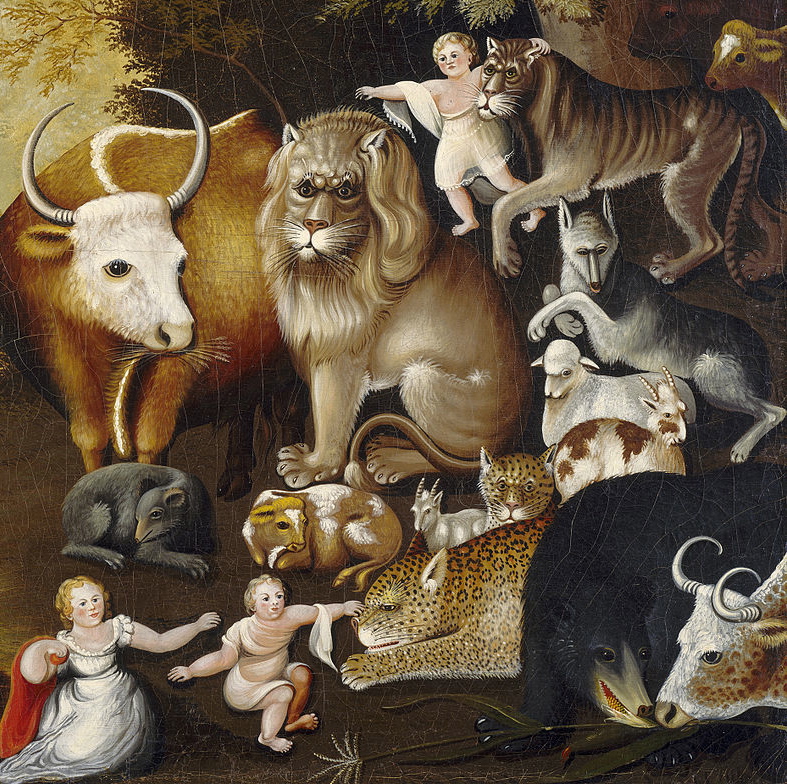
Edward_Hicks_-_Peaceable_Kingdom 2

Justin E.H. Smith considers the theology underlying a certain strain of environmentalism:

Ironically, much conservationist thinking involves an implicitly mythological conception of species diversity that agrees in its essentials with the creation account offered in Genesis. In the scriptural tradition, God looked upon his work and deemed it good, and what ensued was a stable order of fixed, discrete, and well-bounded kinds, with no relations of descent among them. The best metaphor for conceptualizing biodiversity in this view is Noah’s ark, where each kind can be neatly separated from the others in its own compartment. The conservationist view generally leaves the creator out of the picture, yet the creatures are still deemed good, intrinsically good, and if they do not remain fixed and unchanging, then we may conclude that something is out of order – or “unnatural,” to use [Elizabeth] Kolbert’s term.

Darwinism, properly understood, is the opposite of this mythological outlook. It tells us that no particular arrangement of biodiversity is good in itself, and that no species has any absolute reason to exist. … The point here is not to relativize the current ecological crisis, or to call for an approach to mass extinction that simply says, que será, será. Rather, it is to suggest that conservationism might do well to acknowledge the endurance and the strength of the mythopoetical conception of nature, the one that sees our fellow creatures not only as more or less well adapted, but also as good, truly good.

The indifference to specific species is indeed one of Darwin’s great revelations. The whole planet is a teeming mass of DNA attempting to advance itself through various environmental challenges and changes. The death of one species is as integral as the birth of another. And so it will surely be with climate change. And at some point, I’ll wager, as the reality seeps through our consciousness, I’m sure we’ll begin rationalizing it. Species are always dying out, we’ll say to ourselves; weather has always changed, hasn’t it?; climate is never fixed, etc. The difference this time, of course, is that we humans have managed to change the climate in unprecedented ways. We have never reached this abyss before in all 200,000 years of struggle and survival. We are gods in that respect in planetary terms. And like the Greek gods, we are fickle, unpredictable and occasionally catastrophic.

A different theological account of environmentalism would not seek to set in stone every single species on the planet or resist any changes that occur because of some pristine present.

It would not construct a religion of Gaia, or be actively hostile to technology and science. But it would understand that we are but one species on this earth, even though we are easily the most powerful, and that our self-awareness bestows on us a responsibility unknown to other species. My view is that nature changes all the time and there’s nothing sacrosanct about this era in the millions of years that the earth has existed. But equally, one species’ knowing decision to destroy countless others, to shift the patterns of climate in potentially dramatic ways, and to up-end the ways of life of so much else on earth is an unprecedented global crime. To have dominion over the earth means a responsibility to be a worthy steward. We can use and exploit its resources – but only to the extent that we do not irreversibly alter its diversity.

You do not have to worship earth above humans to be an environmentalist. You merely have to respect the earth and better understand how all its inhabitants are connected through evolution. When you do that, the kind of wanton vandalism humanity is now wreaking is horrifying to any objective eyes. What a tragedy that the smartest species began as a territorial, murderous primate. And what spiritual revolution will be necessary to prevent this ongoing assault on nature?

(Detail of Edward Hicks’ Peaceable Kingdom, ca. 1834, via Wikimedia Commons)

Why Was Geithner So Easy On Wall Street?

Neil Irwin mulls the question:

Mr. Geithner spent his youth largely abroad and his early adulthood working on international trade and economics in the United States Treasury Department. Only starting in 2003 did he have much of anything to do with the financial industry, and that was as its overseer at the helm of the Federal Reserve Bank of New York. He is now the president of Warburg Pincus, a private equity firm, but he has held that job for all of 10 weeks. He was never an investment banker like his predecessors Hank Paulson and Robert Rubin, or even a hedge fund consultant like Larry Summers.

As far back as college, as he puts it in his new memoir, “I had never thought of finance as a particularly special or prestigious profession.” All of which makes the fact that he earned a reputation as a tool of big financial interests that much more intriguing. After covering Mr. Geithner for the better part of a decade and reading the memoir, I think here’s the best way to make sense of him: Timothy Geithner isn’t captured by Wall Street. He’s captured by working within systems as they exist.

Sheiber puts forward a different theory:

What always bothered me about Geithner, and which Sorkin’s piece draws out, is that he often seemed more dedicated to the banks than the bankers were to their own cause. While reporting my book about Obama’s economic team, plenty of bankers confided to me that the bailouts were shockingly generous. Many of them tended to take a “these f—king guys” view of their colleagues and puzzled over how Geithner could be so deferential. It made me suspect Geithner would have been much more of a hard-ass had he spent a few years toiling on Wall Street before joining government.

Instead, as Geithner tells Sorkin, “My jobs mostly exposed me to talented senior bankers, and selection bias probably gave me an impression that the U.S. financial sector was more capable and ethical than it really was.” Bummer for the rest us. But I guess that means at least one good thing may come out of Geithner’s recent move to Wall Street: He’ll actually get to know the place this time.

Andrew Huszar wishes that Geithner had more strongly reformed the financial services industry:

[L]ooking out at the U.S. economy little more than five years after Mr. Geithner’s becoming U.S. Treasury Secretary, what do we see? The more things are said to have changed, the more they’ve stayed the same. Nursed back to health by massive government support, the U.S. financial sector is once again America’s largest enterprise, accounting for more than 30 percent of the nation’s corporate profits. Moreover, Wall Street’s six biggest banks—the so-called “too big to fail” ones—have gotten 37 percent bigger.

More Than A Billion Holocaust Deniers?

a7437851c

Digging into the Anti-Defamation League’s global survey, which identified a quarter of the world’s population as anti-Semites, Emma Green notices another troubling finding, that “two-thirds of the world’s population don’t know the Holocaust happened—or they deny it”:

These beliefs follow some unexpected patterns, too. The Middle East and North Africa had the largest percentage of doubters, with only 8 percent of respondents reporting that they had heard of the genocide and believed descriptions of it were accurate. But only 12 percent of respondents in sub-Saharan Africa said the same, and only 23 percent in Asia. People in these groups were likely to say they believed the number of deaths has been exaggerated—just over half of Middle Easterners and a third of Asians and Africans think the body count has been distorted over time.

When the data is sliced by religious groups, the results are even more surprising: Hindus were most likely to believe that the number of Holocaust deaths has been exaggerated. Muslims followed closely, and those two groups were distantly trailed by Christians, Buddhists, and those with no religion. In no coincidence, Hindus and Muslims were also significantly less likely to have heard of the Holocaust.

In almost every religious group, people younger than 65 were much more likely to say they believe that facts about the Holocaust have been distorted, and they were less likely to know what the Holocaust is.