Sure, But What About the Senate Funkadelicarian?

by Jonathan Bernstein

Health care reform junkies: you're probably wondering right now…so, what's the deal with the Senate parliamentarian?  Should I trust Republicans who are telling me that the parliamentarian is just a partisan arm of the majority party?  Or should I trust Democrats that the parliamentarian is neutral?  Isn't there some unbiased source that can help me out here?  And, what is wrong with me that I'm actually thinking about — actually concerned about — the United States Senate parliamentarian?

Can't help you out with the last question, but for the first ones, see this item at the Monkey Cage for the abstract to a new paper by Tony Madonna.  I skimmed the paper so I can't really comment in depth on it but I can tell you that the opening paragraph has an anecdote that features John Randolph, John Quincy Adams, and John Calhoun, and other stories he tells within the paper feature a lot of other interesting, famous (or infamous) Senators, although I'm afraid to say that there's no appearance by Vice President George Clinton as a presiding officer.  Short story: since the Senate hired a parliamentarian, the rulings of the chair have stopped being partisan.

I should add, however, that for the most part this is really a red herring.  The parliamentarian would matter a lot if the Democrats were trying to put the entire bill through reconciliation, but they're not.  I'm not sure what's going to be in the bill and what isn't, but the most difficult issue of which I'm aware are lifetime caps (I don't think it was actually in the Senate bill, and if that's correct I'd think it would be in the patch bill)…do the Republicans really want a vote on that one?  More generally, as I've said before, the actual reconciliation bill is almost all ice cream, no spinach, and even if the Republicans do manage to knock out a couple of items it's not clear to me that it will make much difference in the grand scheme of things, although of course any provision in any law may have serious substantive effects on some people.
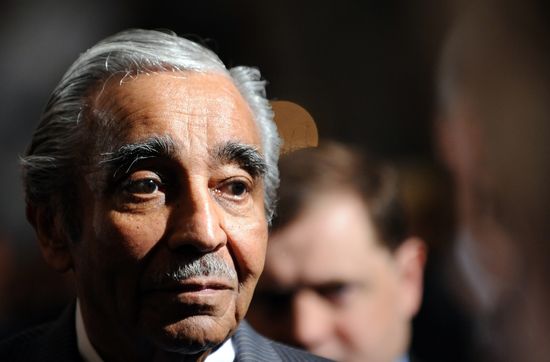
Face Of The Day

97404484

Rep. Charles Rangel, D-NY, attends a memorial service for the late Pennsylvania Rep. John Murtha in Statuary Hall on Capitol Hill in Washington, DC, on March 3, 2010. Rangel, a powerful Democratic lawmaker and strong ally of President Barack Obama, announced on March 3 that he was temporarily stepping down from his committee chairmanship pending the results of an ethics probe. Rangel, who was publicly admonished by the House ethics committee this week for taking corporate-funded travel, said he did not want to be a hindrance ahead of the November mid-term elections to decide control of congress. By Jewel Samad/AFP/Getty Images.

Tasting the Socket

by Graeme Wood

An LRB essay on Clive James twice mentions the great man's long interest in the culture that is Japan.  For his television show, James recognized early that Japanese game shows are one long string of high-quality Mental Health Breaks.  And James saw why they're so appealing:

It was in a London Weekend Television office at Sea Containers House that he and his production team first got hold of the syndicated footage, assembled and posted by ‘our Japanese-speaking stringer in Tokyo’. Editors trimmed it down to an hour, ‘so that we could taste it. It was like tasting an electric light socket … One of the milder images I made notes on was of young men hanging near naked upside down over a well-populated snake-pit while their plastic underpants were shovelled full of live cockroaches.’ It was ‘sure-fire material’, sure enough. ‘Instantly’, though, James decoded the spectacle:

This was theatre, and it was formed on the ruins of a sadistic militarist tradition that had richly merited being ruined. As I made my first notes, I was forming something too: the beginnings of a theme that I would pursue for the rest of my career, even into the present day. Civilisation doesn’t eliminate human impulses: it tames them, through changing their means of expression. That, I decided straight away, would have to be the serious story under the paragraphs that tied the clips together: otherwise the commentary would be doomed never to rise above the level of condescension.

James speaks vaguely of writing a "Japanese-Australian War and Peace" that will take "a decade to prepare before I even begin to write."  James has been slow-curing his lungs with cigarette smoke for many years now, so I am not optimistic about my chances of getting to read this book.  But there is plenty of great James shorter work to enjoy in the meantime.  (See "Bring me the Sweat of Gabriela Sabatini.")

Obama’s Final Push

by Patrick Appel

Cohn describes Obama's health care speech today. Full text of the speech here. Ezra Klein adds his thoughts:

What's important about this speech is that it didn't leave any paths open. It attacked the Republican bills, the arguments for piecemeal reform, and the idea that procedural impediments are sufficient to excuse the further delay of a verdict. This is the end of the line. There's not a magic alternative behind the curtain or a hard reset that will lead to a harmonious bipartisan process. It all just is what it is. And now it's time for a vote. It's time for health-care reform to either pass or fail.

Health Care: Done Deal? Ctd

by Patrick Appel

Chait responds to Jonathan Bernstein:

I'm not quite this optimistic. You're still talking about the Democratic Party. Some small thing could go wrong and make them all start panicking again. Even if everything goes right, it's going to be a tight vote, the votes aren't there, and the party might not be organized or cohesive enough to overcome its collective action problem (every member has a strong interest in reform passing, but they can't figure out which members switch from No to Yes to allow that to happen.)

McArdle is amazed at the conservative and liberal divide on whether health care is likely to pass.

Change or Die

by Alex Massie

Tory party chairman Eric Pickles, who, reassuringly, is as rotundly, incurably English as his name might suggest, speaking at a Young Britons' Foundation rally today:

"There is no magic button we can press, no sword we can pull out of the stone to bring back all those thousands of people who voted for us in the 80's and 90's. We can't. They're all dead."

Nicely put. You might win protest votes or triumph in exceptional circumstances but otherwise, all things being equal, if you remain beholden to the household gods of years past then you're putting yourself at a disadvantage. Eventually, one supposes that the Republican party will appreciate this. But not yet, not yet at all.

(Hat-tip: Tory Bear)

Quote For The Day II

by Chris Bodenner

"I studied journalism, my college degree there in communications. And now I am back there wanting to build some trust back in our media. I think the mainstream media is quite broken and I think there needs to be the fairness, the balance in there — that’s why I joined Fox. Fair and balanced, yes. You know because, Jay, those years a go that I studied journalism it was all about the who, what, when, where, and why, it was not so much the opinion interjected in hard news stories," – FNC pundit Sarah Palin.

“Black Dialect”

by Patrick Appel

Hendrik Hertzberg defends his criticism of Limbaugh. He quotes a reader over at Mark Liberman’s place:

I don’t know whether Limbaugh is a racist, and I’m not sure what he says on his show is necessarily good evidence on that issue. It is clear, however, that he panders to the racism of his audience, and that he does it intentionally and repeatedly.