Risky Business

James Surowiecki finds that entrepreneurs have a hard time identifying a bad bet:

The 18th-century Irish-French economist Richard Cantillon, who coined the term “entrepreneur,” defined it as a “bearer of risk.” And in 1921 the economist Frank Knight argued that the function of entrepreneurs was to “specialize in risk-taking.” Yet studies of entrepreneurs find that, in general, they’re as risk-averse as everyone else. Only when it comes to starting a business are they daring.

And that’s because the fundamental characteristic of entrepreneurs isn’t risk-seeking; it’s self-confidence. A 1997 study in the Journal of Business Venturing found that entrepreneurs are overconfident about their ability to prevent bad outcomes. They’re also overconfident about the prospects of their business. A 1988 study in the same journal of some 3,000 entrepreneurs found that 81 percent thought their businesses had at least a 70-percent chance of success, and a third thought there was no chance they would fail – numbers that bear no relation to reality. A recent paper called “Living Forever” notes that entrepreneurs are more likely than other people to overestimate their life spans.

A Tree Grows In Africa

But really, just one tree. Or so it would seem from this roundup of book covers from Africa Is A Country:

Book Covers

Michael Silverberg explains:

The texts of the books were as diverse as the geography they covered: Nigeria, Zimbabwe, South Africa, Botswana, Zambia, Mozambique. They were written in wildly divergent styles, by writers that included several Nobel Prize winners. Yet all of books’ covers featured an acacia tree, an orange sunset over the veld, or both. …

I asked Peter Mendelsund—who is an associate art director of Knopf, a gifted cover designer, and the author of a forthcoming book on the complex alliances between image and text—to help me understand how the publishing industry got to a place where these crude visual stereotypes are recycled ad nauseam. (Again and again, that acacia tree!)

He points first to “laziness, both individual or institutionalized.” Like most Americans, book designers tend not to know all that much about the rest of the world, and since they don’t always have the time to respond to a book on its own terms, they resort to visual cliches. Meanwhile, editors sometimes forget what made a manuscript unique to begin with. In the case of non-Western novels, they often fall back on framing it with “a vague, Orientalist sense of place,” Mendelsund says, and they’re enabled by risk-averse marketing departments.

The Gender Divide On Elder Care

Kathleen Geier addresses it:

[W]omen are the majority of those who provide unpaid care for ill, disabled, or elderly friends and relatives. The burden of unpaid care work that women continue to shoulder plays a major role in women’s persistent economic inequality. Directly, there is the opportunity cost that comes when women cut back hours or drop out of the paid labor force to provide care; economist Nancy Folbre has referred to this cost as the “care penalty.” Indirectly, unpaid care work affects women’s compensation in the paid labor market. Research has shown that a portion of the gender pay gap is attributable to the fact that women with children are, on average, paid less than their otherwise identical counterparts. Another study found that working in a caregiving occupation is associated with a 5- to 10-percent wage penalty, even when skill levels, education, industry, and other observable factors are controlled for.

She calls the push for paid family leave occurring in several states “grossly underreported, even in the feminist media that you’d think would be most interested in them”:

Feminist issues around the body, reproductive rights, rape culture, and so on are always going to be sexier, and easier to sell to mainstream media outlets, than feminist issues around work. The carnivalesque appeal of a feminist demonstration like “Slutwalk” is obvious – but a “Shitwork Walk,” if one were to be organized, not so much. … Even within the spectrum of feminist care issues, care for the elderly tends to be neglected. Child care tends to be a happier burden; you’re nurturing someone at the beginning of life and seeing them grow and develop. But care for an elderly person occurs at the end of that person’s life. Instead of seeing them develop their abilities, you often witness them losing those abilities – a difficult and lonely process.

Previous Dish on the wage gap hereherehere, and here.

Reality Check

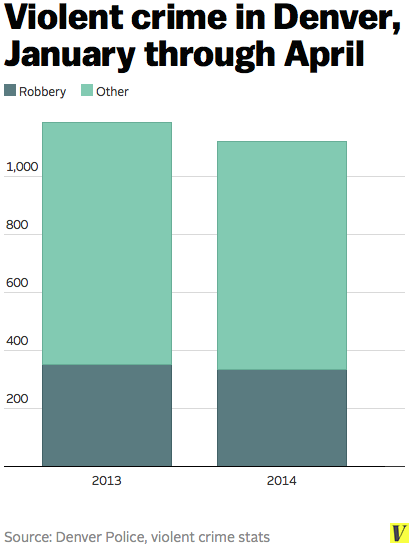
The sky still hasn’t fallen in Colorado:

The Denver Police Department’s crime data shows that violent crime from January through April dropped by 5.6 percent compared to the violent_crimesame time period last year, and robberies in particular fell by 4.8 percent. Major property crimes also dropped by 11.4 percent, with burglaries falling by 4.7 percent, compared to the same time last year. …

All of that is despite warnings from law enforcement officials that crime, particularly robberies and burglaries, would rise following legalization. Two months back, Denver District Attorney Mitch Morrissey told me that legal marijuana was already causing more crimes. But if that’s the case, it’s not showing up in the city’s crime statistics.

History Isn’t A Straight Line

That’s one lesson drawn from Steven Hahn’s review of David Brion Davis’ The Problem of Slavery in the Age of Emancipation:

Rather than portraying the age of emancipation as an inevitable process once it commenced, Davis suggests that the Haitian Revolution and the British emancipation may have steeled the resistance of American slaveholders, who came to regard abolition as a fatal blow to the world they knew. That resistance, in turn, worsened tensions in national politics over the future of slavery, and led slaveholders to demand greater protection for their property and greater power in the federal government. They had been especially exercised by abolitionists aiding fugitives from slavery and driving off slave-catchers who came to retrieve them. As a consequence, slaveholders pushed a new Fugitive Slave Law through Congress in 1850 that both strengthened their hands and increased the vulnerabilities of all people of African descent, whether or not they were enslaved. Growing numbers of white Northerners – not just abolitionists – saw in this a fundamental attack on religious principles and civil rights.

How To Woo A Spider

Bring her a gift:

The scientists collected 53 male spiders from the wild who were found to be carrying gifts for females. Amazingly, 70% of these males were holding worthless gifts such as prey leftovers, presumably after having eaten the prey themselves. … The researchers then brought all of these spiders (both the ones holding worthless gifts and what I like to think of as the more earnest males carrying genuine gifts) into the lab. The male spiders were then given either a real gift to give to a female spider (a big juicy housefly), a worthless gift (an insect skeleton), or no gift at all.

So how did the females react?

Females were equally likely to mate with males who carried real gifts as those who carried leftovers from their dinners. This is not surprising, given that since the gift was cleverly wrapped by the male, the female may not have been able to tell what the package contained before ‘agreeing’ to mate with her male suitor. Instead, females much preferred to mate with males in good body condition rather than skinny, underfed males. Therefore, those males that ate their gifts were actually the ‘smart’ ones (whether they knew this or not) as it was better to be in good shape having had a full meal, but courting the female with the equivalent of an empty box of chocolates than to court her looking wan but holding the equivalent of a roast dinner. The well-fed males not only had a higher chance of mating a female, but females also let them mate with them sooner and for a longer period of time.

More surprisingly, females also didn’t seem to care about whether males even carried a gift at all. They were actually as likely to mate with males without a gift as males with a gift (as long as their bodies were in good condition).

Make Dark Money Darker? Ctd

A reader suspects that anonymizing political donations wouldn’t do much good:

Ayers’ and Ackerman’s proposal on campaign financing makes sense on its face, but it would be pretty easy to exploit. Quoting Dylan Matthews on the plan:

It sounds batty until you realize the authors’ key insight: for a quid pro quo to work, the paid-off party doesn’t just have to receive a kickback. They have to know they’ve received a kickback.

Hiding who made the donation might work if there was no other way to determine who the donor was. If you have a conversation with a potential donor and they say they are going to send you $100,000 tomorrow, and then you get $100,000, it’s pretty obvious where it came from. Worse, it’s more obvious the larger the donor. Sure, any given $20 donation would get lost in the shuffle. But big money would be quite clear.

Even for smaller amounts, there’s been a long running practice of adding cents at the end of a donation to indicate the source. So if a group tries to put together a big money bomb for a candidate, they could tell donors to add .02 at the end of each donation to indicate where it came from.

Another adds:

It’s not going to help when the “quid pro quo” benefits an entire sector instead of just a handful of company. For example, the coal industry and the oil industry will donate to carbon-friendly groups or PACs, and they will in turn help elect respective politicians that would help further assistance for their particular industry. Do you honestly think it’d make a difference if the Koch Brothers’ money becomes even darker? The grand purpose is still served to help benefit and enrich them. The only thing that they might not get is an ambassadorship from a GOP president.

Update from a reader:

I obviously don’t expect you to embed the entire Dylan Matthews piece on Ayers’ and Ackerman’s proposal, but it does appear as if the readers you quoted expressing skepticism about the idea didn’t click through to get the full picture. Ayers and Ackerman have anticipated the concerns raised by your readers and their plan includes two key provisions to address them.

The first is to distribute donation funds to candidates on a periodic basis (weekly for example) rather than passing them through immediately as they come in.  That process would happen based on:

an algorithm which would smooth out sudden spikes in donations in a given week or month (or whatever other interval at which donations are released to campaigns), so they don’t appear to be spikes to campaigns. “We could just have a randomization algorithm, so that if a huge amount kicks in, you get it over 14 weeks,” Ackerman says.

So no one’s getting a check that says “$100,000.22 Love the Koch Brothers.”

The second idea is basically to use public financing to dilute the proportional influence of private campaign contributions:

every registered voter in America gets $50 per election cycle to give to candidates for federal offices, whether they’re running for president, the Senate or the House. Ackerman and Ayres call these vouchers “Patriot Dollars.”

The goal is for federal elections to be roughly two thirds financed by public dollars, with those funds allocated at the discretion of individual voters.

I’d encourage people to read the whole Matthews piece, because I have to say the idea is pretty damn elegant.  Obviously it won’t fix every problem we’re facing due to money in politics, but the fund distribution algorithm combined with the dilution of private money’s proportional influence would stand a good chance, it seems to me, of meaningfully altering the landscape of campaign finance.

The Best Of The Dish Today

Well, that wasn’t so bad. One polyp, apparently, and not too close in appearance to Leon Wieseltier. No Lemmiwinks. RIP.

Meanwhile, Butters gave a commencement speech! Well, not Butters Stotch as such but Eric Stough, the Colorado University grad on whom the South Park character was roughly based. Stough is a producer and animation director of the show. Life lesson:

Stough described an episode in which Butters experiences a “beautiful sadness” after being dumped. “But how could sadness be beautiful?” he said. “In order to feel something really sad, he had to experience something as equally happy. The key to a great life isn’t just happiness. It would be a boring life if it were.”

Also: don’t forget to bring a towel.

Today, we discovered that “the people of Holland have one of the lowest indexes of anti-Semitic attitudes (5 percent) in the world while also harboring great hostility to Israel.” Plus: Iranians are less anti-Semitic than other Middle Easterners. And Bibi Netanyahu’s head just exploded. We visited the white-hot center of the marijuana revolution – Uruguay –  where fully legal weed is imminent thanks in part to one of the more charming populists on the planet. Oh – and how margarine affects the divorce rate.

The most popular posts of the day: this map; and this monologue. Many posts today were updated with your emails – read all of them here. And you can leave your unfiltered comments at our Facebook page and @sullydish.

See you in the morning.

Poetry In Motion

Colin Marshall captions:

The poetry of Charles Bukowski deeply inspires many of its readers. Sometimes it just inspires them to lead the dissolute lifestyle they think they see glorified in it, but other times it leads them to create something compelling of their own. The quality and variety of the Bukowski-inspired animation now available on the internet, for instance, has certainly surprised me. At the top of the post, we have Jonathan Hodgson’s adaptation of “The Man with the Beautiful Eyes,” which puts vivid, colorful imagery to Bukowski’s late poem that draws from his childhood memories of a mysterious, untamed young man in a run-down house whose very existence reminded him “that nobody wanted anybody to be strong and beautiful like that, that others would never allow it.”

Check out other Bukowski animations here and here. Previous Dish on Bukowski here and here.

Iran: Still Not A Free Country

Sune Engel Rasmussen looks at the state of censorship in Hassan Rouhani’s Iran and finds that, while the restrictive policies of former president Mahmoud Ahmadinejad have been rolled back, much remains the same as always:

Authorities continue to close media outlets with the stroke of a pen. Social media is banned, and millions of websites are still blocked. Scores of political prisoners including the aging Mir-Hossein Mousavi and Mehdi Karroubi, who inspired the 2009 Green Movement, remain locked up. In the first two months of 2014 alone, Iran executed almost 100 people.

The government is not solely to blame.

Executions are administered by the judiciary, which answers to Supreme Leader Ali Khamenei. The same goes for freedom of the press, as [culture minister Ali] Jannati pointed out after the closure of the popular reformist weekly Aseman: “Shutting down the newspapers is out of our hands.” As for opening wide the gates to the internet, the president needs to maneuver the 22-man Supreme Council for Cyberspace, which is dominated by conservatives.

Although it is possible for the government to challenge other pillars of power, Rouhani may gauge that he doesn’t have the political capital to do so, given domestic opposition to the nuclear negotiations. Everyone remembers President Mohammad Khatami’s failed attempts at reform in the late 1990s. Yet, some don’t believe Rouhani had real intentions in the first place. There’s a Persian saying, “The yellow dog is the brother of the jackal,” which means: One ruler is just as bad as the next one.