Better Not To Get HIV In America, Ctd

In contrast with the US, some good news out of Canada:

Once labelled absurd, the idea of mass testing of adults for HIV and AIDS is now part of the routine in British Columbia, proving the province is showing the world how to control and defeat the cruel disease, says the doctor leading the program. The B.C. government announced Monday it will become the first jurisdiction in Canada to introduce guidelines for health-care providers to encourage all adult British Columbians to get tested for HIV.

A Canadian reader just got some personal news:

I was told this April 25 by my GP that I had tested positive for HIV.

On April 29 I had my first appointment at the infectious diseases clinic; my doctor is medical director of the county-level Infection Prevention and Control. That day I also had bloodwork and a baseline chest x-ray. On May 2 I had my second appointment with the ID doctor. He had my T-cell count but was a little upset that the viral load readings were not back yet. My next appointment is June 3, by which time I’ll have been vaccinated for pneumonia and Hepatitis B. I’ll also have been tested for tuberculosis.

Today I applied for the provincial drug program that will help pay for the inevitable cocktail it appears I’ll be on this summer. There’s an income-based deductable, for me it’s about $150 a month.

I am ashamed that I have the virus, and I feel like I’m adrift in a dark strange river, loosened from humanity. I cannot imagine how I’ll tell family and friends when it’s time. But I am being cared for. I will not lose everything I have in order to stay alive as long as science will allow. Society and state are acting with compassion and alacrity and foresight.

I am positive.

P.S. Your accounts of treatment and life with HIV pretty much helped me avoid a freakout a couple weeks ago.

Spurious Correlations

Correlation

That’s the name of Tyler Vigen’s site. How he describes it:

I created this website as a fun way to look at correlations and to think about data. Empirical research is interesting, and I love to wonder about how variables work together. The charts on this site aren’t meant to imply causation nor are they meant to create a distrust for research or even correlative data. Rather, I hope this projects fosters interest in statistics and numerical research.

Adi Robertson examines the many graphs:

Sift through its data sets, and you’ll find all sorts of statistics that can be mapped onto each other — margarine consumption and the divorce rate, crude oil imports and number of train collision deaths, bee colony growth and the marriage rate. If you ever need to demonstrate that two things can appear connected purely by chance or some entirely separate factor, this is your site.

Nathan Yau highlights his favorites:

Some of the gems include: the divorce rate in Maine versus per capita consumption of margarinemarriage rate in Alabama versus whole milk consumption per capita, and honey produced in bee colonies versus labor political action committees. Many things correlate with cheese consumption.

Dylan Matthews joins the conversation:

Those all have correlation coefficients in excess of 0.99! That is very very high! By comparison, Alan Abramowitz’s extremely accurate “Time for Change” model of presidential elections (it predicted Obama would get 52.2 percent of the two-party vote; he got 51.4) has a correlation coefficient of 0.97, which Abramowitz correctly calls “extraordinary.” The point is that a strong correlation isn’t nearly enough to make strong conclusions about how two phenomena are related to each other. Abramowitz’s model is worth trusting not just because of its high correlation but because it predicts presidential elections based on factors that logically should matter to voters, like the state of the economy and what party currently controls the White House. That gives it theoretical plausibility, which a theory in which, say, US whole milk consumption is driven by the marital status of Mississippians, lacks.

Michael Byrne adds:

Humans love correlation. We love correlation because we love stories, narratives: this happened, leading to this, and next should be this other thing. We look for the forms of stories in the world, and a story is roughly the opposite of coincidence, which is things just happening together because time is just a substance of many layers, a stack of happenings.

Update from a reader:

Notice the icon of the site – it’s a small picture of the number 42. I emailed Tyler Vigen yesterday because my colleague and I had a guess of why ’42’? He confirmed that it’s a reference to The Answer to the Ultimate Question of Life, The Universe, and Everything from The Hitchhiker’s Guide to the Galaxy.

Neat :)

Which Party Will Fix Obamacare?

Laszewski believes the ACA’s big problem is that not “enough people are signing up for it to be sustainable in the long-term because the products it offers are unattractive”:

The polls and the market’s response to Obamacare are all consistent: The program is not attractive and needs some serious fixing but it isn’t going to be repealed. Republicans can continue to exploit this issue only if they understand this. And, Democrats can win the issue back, or at least neutralize it, if they can get beyond their current euphoria over “eight million” and get real about how unhappy people are with the program and the plans it offers––and come up with a plan to fix Obamacare.

I feel like I’m watching a football game here. The ball (Obamacare) has been fumbled. It’s bouncing down the field up for grabs. The Republicans are saying they don’t have to chase the fumble because, “We’re are so far ahead we’re going to win the game anyway.” The Democrats are saying, “What fumble?” They’ve got “eight million reasons why the ball hasn’t been fumbled.”

Relatedly, Cohn reads a McKinsey report that sheds light on the uninsured population:

About half of the people who McKinsey surveyed did not end up buying insurance—either because they shopped and found nothing they liked, or because they didn’t shop at all. When asked to explain these decisions, the majority of these people said they thought coverage would cost too much. But two-thirds of these people said they didn’t know they could get financial assistance. In other words, they assumed they would have to pay the sticker price for coverage, even though federal tax credits would have lowered the price by hundreds or thousands of dollars a year.

With a little education and outreach, many of these people will discover that insurance costs less than they thought. When next year’s open enrollment period begins, they are more likely to get coverage. But the idea was to help more of those people this year. And if the administration deserves some blame for this shortfall, its adversaries deserve more. Republicans and their allies did their best to taint the law—and, where possible, to undermine efforts to promote it. Without such obstruction, even more uninsured people would probably be getting coverage right now.

In other Obamacare opining, McArdle wonders why the administration encouraged small states to set up their own exchanges:

I understand the argument for having state-based exchanges as an option. One of the nifty things about federalism is that states can be little laboratories, finding stuff that works that other states can then copy. I also understand the political argument that this appeased moderate Democrats, who were uncomfortable with the idea of a giant federal exchange taking over such an important economic function.

But the administration went far beyond “option”: It aggressively pushed state exchanges, repeatedly extending the deadline to decide until long after it was too late for anyone, state or federal, to do a good job building one. I can understand why they’d push big states such as Texas and Florida to build exchanges. But why encourage the District of Columbia, Hawaii and Rhode Island to follow suit? Arithmetically, it was unlikely that any of them would insure enough people to become financially viable — and certainly not in the time frame called for by the law. Why not quietly point out the terrible math and suggest they go federal?

Everybody Do The Idaho Stop, Ctd

A reader takes stock of the discussion thus far:

I hate to add fuel to the ever-burning fire that is the cyclists-vs-drivers online debate, but I cannot help but point out that few of the reader rebuttals to the Idaho Stop post address the actual law in question. A quick recap of reader concerns that have nothing to do with the Idaho Stop law:

  • In San Fran, a reader is justifiably upset with cyclists that blow through stops when their car is present. Under the Idaho Stop Law, this would still be illegal.
  • In Louisiana, a reader begrudgingly shares his lane with cyclists but is frustrated when they pass him at stop signs. Passing a car at stop signs is called lane splitting. It is not part of the Idaho Stop law, and in most places it is already legal for cyclists to pass cars that are stopped at intersections.
  • In NYC and elsewhere, readers are upset with cyclists who endanger pedestrians in intersections. The Idaho Stop law would require cyclists to stop for pedestrians at intersections, so it would not affect the legality of the scenarios described – the cyclists endangering pedestrians would still be ticket-able.

The Idaho Stop law is something like the “if a tree falls in a forest and no one’s around” riddle: it only really changes what is legal when no one else is around (or, I suppose, if you are stopped at a red light). It would have negligible impact on drivers’ and pedestrians’ experiences, and that is the beauty of the law.

Another notes:

I was both amused and disappointed to see all the readers pushing back against the Idaho Stop, not one of whom referenced the data that you linked to in your initial post:

Public health researcher Jason Meggs found that after Idaho started allowing bikers to do this in 1982, injuries resulting from bicycle accidents dropped. When he compared recent census data from Boise to Bakersfield and Sacramento, California — relatively similar-sized cities with comparable percentages of bikers, topographies, precipitation patterns, and street layouts — he found that Sacramento had 30.5 percent more accidents per bike commuter and Bakersfield had 150 percent more.

That datapoint ought to inform this discussion, no? Indeed, I would argue that that fact ought to END this discussion.

But many readers keep it going:

I’m sorry you opened the giant can of worms that is cycling vs. motorists.

I’m clearly biased as a city dweller who relies on my bicycle for 80% of trips. However, one thing I always find amusing in these “clutch-your-pearls-think-of-the-children” stories of out of control cyclists: you’re all frickin’ alive! Cyclists rolling a stop sign are such a giant threat to personal safety, and yet most of your readers only discuss near-misses, and those that claim they’ve been hit have lived to bitch about it. Cars kill people; cyclists don’t (insert handful of cases here). That’s the reality.

Another writes from the state in question:

I am a daily bike rider in Boise. The “Idaho stop” works well because Boise is a small city/large town with limited traffic and low congestion. It would be an excellent system for other places that I have lived, including Austin, Portland (OR), and Davis, CA.  But it wouldn’t necessarily work well in larger cities such as SF or Seattle that have heavier traffic.

I suspect that it also works because bike riders in Boise and Idaho know that cars have the “real” right of way.  The right to the road is contested in places like SF and Seattle but it is not contested in Boise and Idaho. Cars own the roads. Because of a fluke in the law, we have great bike rules. Bikers are a minority and act based on self-preservation rather than acting as if they own the road.

From another part of the country:

In response to your reader who has never seen a cyclist get a ticket, it actually happens a lot, particularly to cyclists who have just been the victims of accidents. D.C. has a serious problem with this issue. Maybe codifying the Idaho stop can reverse this.

And another:

I can’t speak to your readers’ experiences outside of New York, but the midtown Manhattan reader can bugger off with his/her sanctimony about cyclists riding the wrong way or not obeying traffic in the city. I commute to work by bicycle in Midtown. I use the bike lanes – one of Bloomberg’s best accomplishments – because they alow me to ride without fear of getting plowed into by traffic. But every single day, at morning and afternoon rush hour, it is virtually impossible to use the bike lanes because pedestrians treat them as sidewalk extensions. Every day of the week, pedestrians swarm the bike lanes – and no amount of bell-ringing or screaming dissuades them.

Bottom line: it’s useless to complain in Manhattan. Pedestrians and drivers complain about cyclists flaunting of traffic laws (in addition to complaining about each other), while at the same time not respecting cyclists right to the road. And admittedly, many cyclists don’t respect the laws of traffic, so it’s a bit rich for them to complain about drivers and pedestrians too.

To quote one of my favorite films, “Forget it, Jake. It’s Chinatown.”

Another:

Slightly tangential – but as a hiker in the Santa Monica mountains north of LA, I can’t tell you how many times I’ve almost been clipped by mountain bikers cruising down the trail at 5 or 6 times walking speed. I know it sounds like I’m whining but it’s chaotic, really dangerous and nobody is doing anything about it.

One more comments:

And now your blog has devolved into the comments section from any cycling-related news story. Here’s how it plays out:

Comment 1: “Waaah waaah, a cyclist acted like an asshat one time and now I hate all cyclists because they think they’re entitled jerks.”

Comment 2: “No, you saw one person doing something stupid; most cyclists are perfectly law abiding. Since when did all drivers go the speed limit, not run red lights, come to complete stops at stop signs, etc.?”

Comment 3: “I’ll respect cyclists once every one of them follows ALL laws without exception!”

See this story from Monday’s WaPo if you don’t believe me.

Previous Dish spats between cyclists and drivers here and here.

An Online Right To Be Forgotten?

Victoria Turk outlines the ruling handed down by the EU Court of Justice yesterday, requiring Google to comply with a request to remove personal information from its search data:

The case in question was referred to the European Union Court of Justice after being upheld by one of Spain’s top courts: In 2010, Spanish national Mario Costeja González brought a complaint against Google regarding the information that appeared when people searched for his name. Specifically, googlers would be referred to pages from local newspaper La Vanguardia from 1998, which revealed that González had had his home repossessed. The Spanish data protection agency AEPD ruled that Google had to remove those results as they were no longer relevant. Unsurprisingly, Google refused and a legal tussle ensued—but the decision has been upheld.

Henry Farrell emphasizes that the ruling “doesn’t assert a right to be forgotten as such”:

Its most important consequences are buried in the legal technicalities. First, it holds that Google (and, presumably, other search engines) are “data controllers” engaged in data processing each time they serve up a search result. Translated from legalese, this means that Google’s search engine results are fully subject to European data privacy law, which has many requirements beyond this new ‘right to be forgotten.’

This is new – and important.

Google and Microsoft’s European lawyers are facing into a series of very long nights as they figure out the implications of this ruling for their search business. Furthermore, the court ruled that because Google has an advertising subsidiary in Spain, it is subject to the control of Spanish data protection officials who want to protect the interests of Spanish citizens. This ruling immediately makes it more difficult for Google (and other web giants) to take advantage of regulatory differences in the European Union.

Yglesias adds:

Another, equally important aspect, as noted by European Union Justice Commissioner Viviane Reding, is the ECJ’s assertion that European law applies to services offered by US-based companies operating off US-based servers. In her words “companies can no longer hide behind their servers being based in California or anywhere else in the world.” From a multinational technology company’s viewpoint, this means that no longer can a single service be offered globally since it will be subjected to a fragmented regulatory landscape.

Andrew Orlowski yawns at the news:

You won’t be able to “censor Google” just because you don’t like something. Nor will asking Google get something deleted. There’s no new “right to be forgotten”. There’s nothing new today that need worry publishers and journalists – Lord Leveson’s Whingers’ Charter has far more of a chilling effect on news operations, especially smaller ones. And Google can say no to complaints. The courts ultimately decide whether a complaint has merits or not. In short, power hasn’t shifted dramatically one way or another. It hasn’t really shifted at all. All the ruling did was make Google subject to European laws.

Keating expects the decision to have unintended consequences:

I sympathize with people in cases like this and I completely understand that in EU countries, many of which have fairly recent experience of life under authoritarian governments, the right to privacy is interpreted more broadly. But while this case has pitted European privacy advocates, fired up in the wake of Edward Snowden’s revelations about the NSA, against Internet behemoths like Google, I suspect that the ironic result of the decision will be to empower governments and corporations at the expense of individual users.

The Bloomberg editors disagree with the court:

There’s no shortage of legitimate worries about this approach. It threatens free speech. Airbrushing history, even with the best of intentions, is almost always a very bad idea. It will place an arbitrary and costly imposition on search-engine companies. And such a sweeping new right is sure to have unintended consequences — for starters, by potentially depriving the public of useful information.

Moreover, the administrative complexities — where exactly does the ruling apply? To whom? How will disputes be arbitrated? — are deeply confounding. The costs to companies and governments of making such a policy work are incalculable. The consequences of censoring search results could quickly become perverse. And so on.

Matt Ford asks if the court’s decision will also require Google to scrub coverage of the case:

Ultimately, the ECJ’s ruling also demonstrates the quixotic nature of Internet censorship. González filed his lawsuit so people wouldn’t know that his home had been repossessed and put up for auction in 1998 because of his mounting social-security debts. Now, thanks to the court’s ruling, that information will be published in newspapers and on websites around the world—including this one. Will this article soon be unsearchable in Europe, too?

Another potential problem with the legal precedent is abuse. “[Hypothetically], I can demand takedown and the burden, once again, is on the third party to prove that it falls within the exception for journalistic, artistic, or literary exception,” [law professor Jeffrey] Rosen warned in 2012, when EU commissioners proposed the right to be forgotten. “This could transform Google, for example, into a censor-in-chief for the European Union, rather than a neutral platform.” Failure to comply with the restrictions could result in heavy fines, he explained, while compliance would mean “a far less open Internet.”

And Victor Luckerson explains why such a decision would never fly in the US:

First, Europe’s new ruling is difficult to reconcile with the First Amendment, which grants citizens the right to free speech. A U.S. law that compelled a company like Google to limit the type of content it shows in search results likely wouldn’t pass muster in American courts, experts say, because it could be construed as a form of censorship. “The First Amendment really does prevent this kind of widespread unpublishing of data,” says Danny O’Brien, international director at the Electronic Frontier Foundation. “In the U.S., free speech sort of trumps privacy.”

Rand Paul’s Latest Heresy

Senators Gather To Caucus Over Hagel Nomination

Last week, the Senator from Kentucky suggested (NYT) that Republicans might want to dial down their rhetoric on voter ID laws in order to stop alienating black voters. However, after a predictable firestorm of criticism, his spokesman walked it back on Monday, stressing that Paul had never come out against voter ID as a matter of policy. Chait doesn’t see what all the fuss is about:

Paul’s original heterodoxy didn’t take him very far out on a limb. What he told the Times was, “Everybody’s gone completely crazy on this voter ID thing. I think it’s wrong for Republicans to go too crazy on this issue because it’s offending people.” Paul was not arguing against vote suppression on moral grounds but practical grounds (“it’s offending people”). He wasn’t asking Republicans to stop engaging in vote suppression altogether. Taken literally, he wasn’t even asking them to stop being crazy about vote suppression. He was just asking them not to be too crazy.

But James Poulos calls Paul’s recent comments on race “the most important development of the nascent presidential campaign”:

Our ambitious activists of all stripes have just about sucked the last drop of pathos out of “raising awareness.” But for years, the GOP’s establishmentarian leaders have come to think of Hispanics and minority outreach as virtual synonyms. Despite the occasional Condi Rice, Herman Cain, or Michael Steele, the fact is that Republicans have all but written off black Americans. They are on the verge of giving up on them, of trying to forget they exist.

For the men and women who seem invisible to the GOP, what Rand Paul is doing may or may not be a canny effort to outflank his party’s complacent elite and its cantankerous base. (Paul’s counsel is to cool it on Voter ID, not oppose it.) What it is, no matter what else, is genuine awareness.

Yes, this is a relatively new look for Paul. Yes, it has taken a while for him to find his footing. But his approach is working.

Weigel thinks everyone is missing the big picture, which is that Paul wants to restore voting rights to felons:

The irony is that Paul’s felon-voting stance is plenty radical all by itself. Go back to the stories of felon-voting laws from after the 2000 election. The reaction to the 1970s/1980s crime waves have a long tail, turning plenty of minor-looking crimes (listening in to a police radio in Florida, for example) into felonies. This ended up being a net benefit to Republicans, and, being in the business of winning elections, few hurried to change the laws. As recently as 2012, Mitt Romney could run ads scorching Rick Santorum for daring to support felon voter restoration. Paul didn’t “evolve” on voter ID, but he really has developed a daring policy change after talking extensively to black voters and leaders.

Allahpundit muses on Paul’s strategy here:

Above all, righties want someone in office whom they can trust will defend their values. The more Paul takes positions like this one — let’s be for voter ID but not talk about it — the harder that is. But now I wonder if maybe I’m missing the point of what he’s trying to do. All along, I’ve thought his chief appeal was as a man of principle — libertarian on many issues, conservative on a few, but unafraid to buck either side to defend his beliefs. I thought that’s how he’d run in 2016, precisely because he’s interested in showing righties that he’ll defend their values relentlessly in office. Maybe, though, he’s starting to re-position himself the same way that Rubio’s re-positioning as an establishment candidate. Maybe Paul’s new brand is less about standing on principle than about (as strange as it is to say it for a member of the Paul family) electability, forging an unorthodox new right-wing platform that supposedly gives the GOP its best chance in the general.

(Photo by Alex Wong/Getty Images)

The Pot President

US-URUGUAY-POLITICS-OBAMA

Last week, Uruguay released the details of its legalization program:

Uruguayans will be allowed to buy enough marijuana to roll about 20 joints a week at a price well below the black market rate, the government said on Tuesday as it detailed a new law legalizing the cannabis trade. … It says Uruguayans will be able to buy up to 10 grams of marijuana a week at between $0.85 and $1 dollar a gram, a low price designed to compete with black-market cannabis that mostly comes from Paraguay. Activists who have backed the measure said legalized marijuana would be high-grade and affordable.

In a profile of President Jose Mujica, who also goes by “Pepe,” Krishna Andavolu found the 78-year-old former guerrilla to be both charming and politically savvy – and fine with lighting up:

I asked Pepe whether he minded if I smoked a joint. I fully understood the implications of smoking weed in front of a head of state, but of all presidents, I thought, he’d be game. After my translator relayed my request, Pepe smiled broadly and exclaimed, “Por favor!” I sparked up a joint, and Pepe shrugged and smiled. “I have no prejudice,” he said, “but let me give you something juicier to smoke.”

He got up, went back into his house, and emerged with a cigar. “This is a cigar given to me by Fidel Castro.” His wife, Lucía, followed behind and showed me a portable humidor, a large box shaped like a house filled with Castro-length Cohibas. …

To be clear, Uruguay’s legalization is not aimed at allowing bozos like me to get high indiscriminately. It’s a serious legislative experiment designed to dismantle what pretty much everyone agrees is a horrid failure of public policy: the war on drugs. And while Pepe has an almost too-good-to-be-true avuncular charm, he’s a carefully calculating statesman with a keen sense of how to capture the limelight. A small country of 3.4 million legalizing weed is, on the global scale, a tiny occurrence, but it might just be that crucial example, the hiding-in-plain-sight truth, that all it takes is bold decisions and bold leadership to turn ideas into action.

Mujica had little to say about marijuana when he met with Obama on Monday, but he had some harsh words for American tobacco companies:

“In the world per year, 8 million people are dying from smoking. And that is more than – worth more than World War I or II. It is murder! We are in an arduous fight, very arduous. And we must fight against very strong interests. Governments must not be involved in private litigation, but here we are fighting for life,” said Mujica.

In 2006, Uruguay became the first Latin American country to enact a ban on smoking in enclosed public places. The South American nation requires large health warnings on tobacco packages.  But US tobacco giant Philip Morris is suing Uruguay over the rules for $25 million at the World Bank’s International Center for Settlement of Investment Disputes.

Alfonso Serrano has more:

The world’s largest tobacco company argues that a 2009 Uruguayan anti-tobacco law – which requires that graphic health warnings cover 80 percent of cigarette packets – violates its intellectual property rights. The Uruguayan daily El País last week stated that Philip Morris’s goal is to make the tiny nation a “test case” to keep other countries – the company is also suing Australia and Thailand – from implementing restrictive tobacco policy.

Previous Dish on Uruguay herehere, and here.

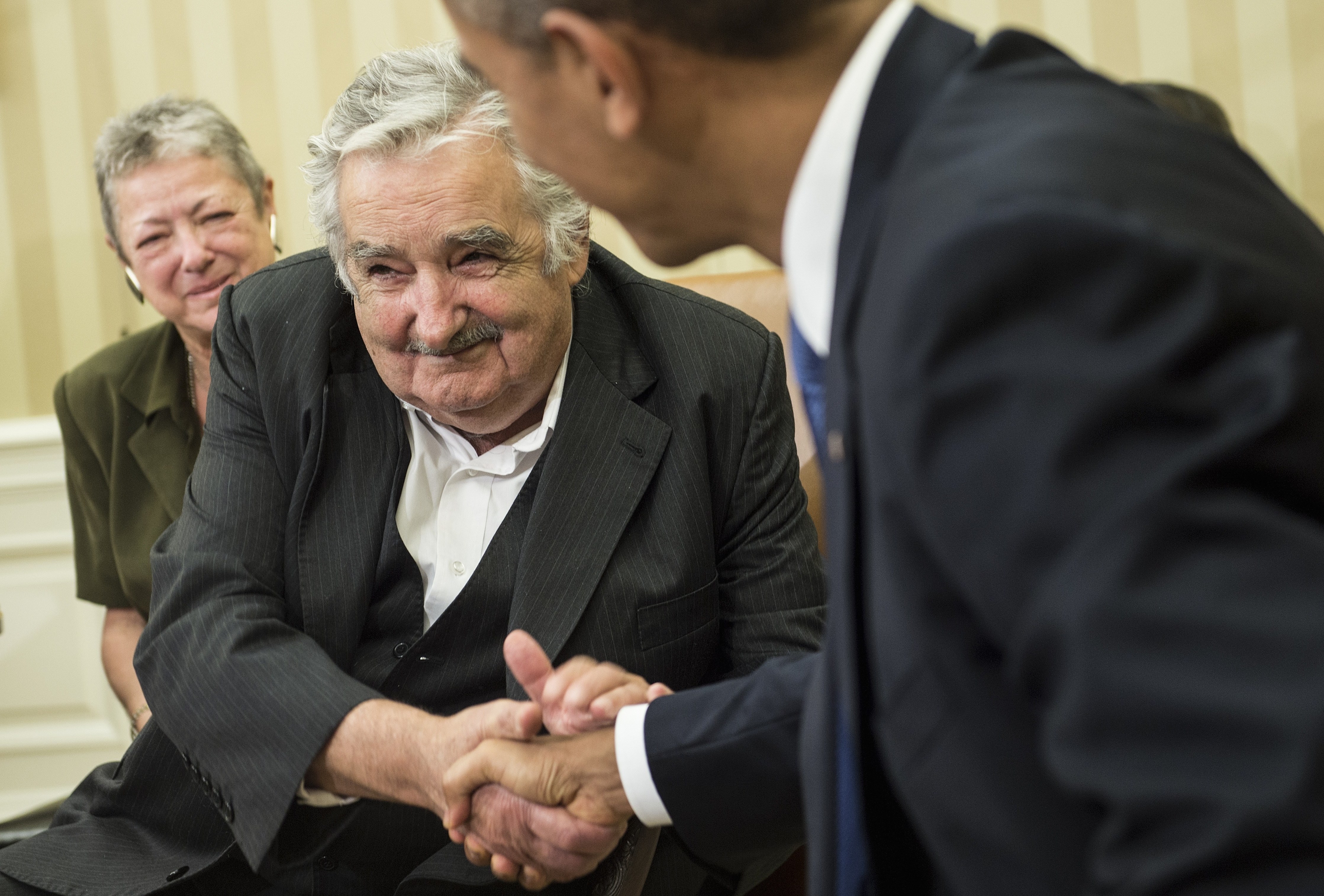
(Photo: US President Barack Obama (R) shakes the hand of Uruguay President Jose Mujica Cordano before a meeting in the Oval Office of the White House May 12, 2014. By Brendan Smialowski/AFP/Getty Images)

Will We Intervene In Nigeria?

USinvolvementAll

Congress is considering authorizing the deployment of special forces to help rescue the kidnapped schoolgirls:

President Barack Obama has sent in an intelligence, logistics and communications team that includes 16 military personnel. On Monday, National Security Council and Pentagon officials told TIME that that the U.S. has begun sharing commercial satellite imagery with the Nigerians and is flying manned aircraft over Nigeria with the government’s permission for intelligence purposes.

The top ranking Senators on the Intelligence Committee, Dianne Feinstein (D-Calif.) and Saxby Chambliss (R-Ga.) told TIME that they would support sending in special forces under certain conditions: Feinstein would send in the additional assistance only if Nigeria requests it, and Chambliss would do so with our allies. Retired General Chuck Wald, former deputy commander of the U.S. European Command, said that America would need to send “several hundred” Special Operations troops “to get it done right.”

John McCain, true to form, wants to send in the troops whether Nigeria asks for help or not. To which Allahpundit sighs:

So McCain’s now fully embracing the “Uncle Sam, world cop” vision, huh?

Intervention anywhere, with or without the governing regime’s permission, with or without any compelling U.S. national-security interest at stake, with no authorization needed beyond the assertion that a crime against humanity is taking place. (Somewhere right now, Putin’s conferring with his inner circle about “crimes against humanity” being committed against ethnic Russians in Kiev.) I’m tempted to ask whether he’d at least require the president to get an AUMF from Congress, but we all know the answer — of course not. That would only impede the mission. In a sense, all he’s doing here is extending the drone philosophy a few steps further: If we can blow up Boko Haram from the sky with the permission of the Nigerian government, we shouldn’t let the regime’s cowardice or corruption stop us from blowing them up without permission. And if we can blow them up without permission, why couldn’t we blow them up from the ground by sending in U.S. troops with grenades?

Larison declares that this idea is “unduly reckless even by McCain’s low standards”:

It takes a great deal for granted to assume that the mission would be successful with minimal loss of life for the captives and U.S. forces. Obviously nothing would be gained from a botched or failed raid, especially if it resulted in the deaths of many of the innocents held captive. Even a successful raid would carry substantial risks, and those risks would be even greater if this were done without the Nigerian government’s cooperation.

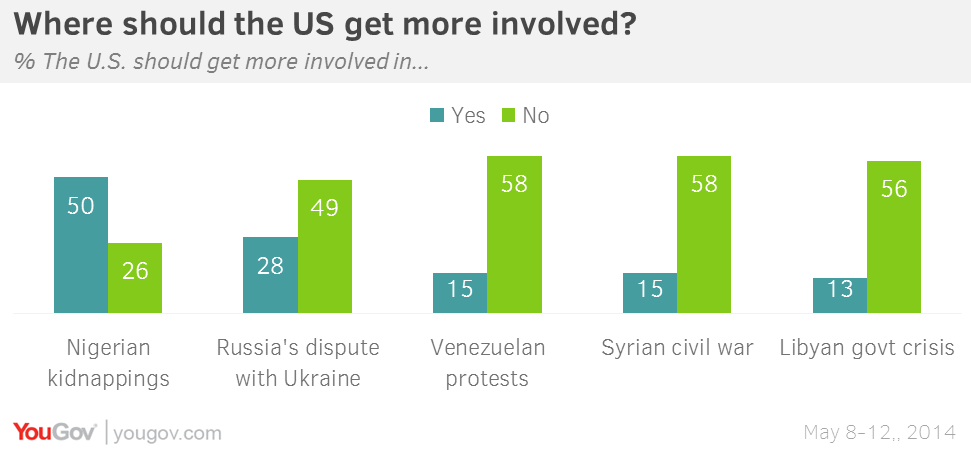
But the American public, as the chart above indicates, are relatively willing to get involved:

Support for involvement in the Nigerian kidnappings is greatest among Democrats. Nearly two-thirds (63%) of Democrats support greater US involvement in rescue efforts, compared to 41% of Republicans and 45% of Independents. Nevertheless, however, every group is more likely to support rather than oppose great US involvement in Nigeria.

Worth pointing out: the poll didn’t ask how Americans would like to “get more involved.” Doug Bandow wants the US to stay the hell out:

So far Boko Haram has restricted its murderous activities to Nigeria. Active U.S. involvement, however, risks turning the conflict into one of international jihad, when Boko Haram may broaden its attacks to Americans. Finally, what is the end point for American involvement?  What if the girls aren’t located? With failure almost inevitable, there will be pressure on the U.S. to do more, even enter the conflict directly.  Secretary of State John Kerry already has talked of doing “everything possible to counter the menace of Boko Haram.”

Sarah Margon focuses on the unsavory record of the Nigerian military with which we’d be cooperating:

The tactics of the government security forces are barely more palatable than those of the militants themselves. Nigerian security forces are known for raiding local communities, executing men in front of their families, arbitrarily arresting and beating people, burning residential property and stealing money while searching homes. Nigerian authorities also routinely hold suspects incommunicado without charge or trial in secret detention facilities and abuse and torture them. Unsurprisingly, due process rights for detainees are often absent.

Keating points out that such rescue operations often fail, although the alternative—negotiating with Boko Haram—isn’t very attractive either:

The best outcome would be for government forces—now working with military assistance from the U.S. and other countries—to rescue the girls. But these operations don’t have a great track record of getting the prisoners back alive. In 2012, for instance, when the Nigerian military aided by British special operations forces attempted to rescue a Briton and Italian being held hostage by Boko Haram, both were killed by their captors before they could be rescued. A rescue operation in the case carries the very real risk that not all of the girls will survive. On the other hand, a French family of seven kidnapped by the group in Cameroon in 2013 was released unharmed after a $3 million ransom was paid by unknown parties.

But negotiating with the group after a crime this dramatic sets a very bad precedent and could encourage more acts like this in the future. Taking a cynical political view, it would also make Jonathan’s government look extremely weak at a time when it’s already under intense domestic and international scrutiny for having failed to prevent the kidnapping.

The latest Dish on Nigeria here, here, here, and here.

Maybe Red Wine Isn’t So Good For You

Resveratrol, an ingredient in red wine, might not be as healthy as advertised:

Initially, resveratrol was identified as a possible explanation for the “French paradox”— the surprising fact that, despite consuming high amounts of saturated fat, French people have much lower rates of heart disease than Americans. Soon, resveratrol was being hailed as a magic bullet against heart disease, cancer and aging, and is now sold as a concentrated supplement in health stores across the land.

But the first study on the long-term effects of resveratol on people was just published in the Journal of American Medicine, and its findings are pretty damning. After tracking 783 older Italians over the course of 11 years, researchers found that resveratrol consumption had absolutely no positive impact on rates of heart disease, cancer, or mortality.

Virginia Hughes criticizes how this study has been covered in the media:

So I read that study and thought, this is important: My readers who buy or are thinking of buying resveratrol might appreciate knowing that its benefits haven’t panned out in people, at least not yet. Sure, a future study in people might report some benefit of resveratrol, but for now all I can do is offer the current state of knowledge. And that’s better than nothing, right?

But then…maybe it’s not. Take a look at those headlines again. I suspect a general reader is not coming away from those saying, “Gee whiz, look at the long and bumpy road to scientific progress!” They’re more likely to be saying, “When will those scientists get their act together?” Or worse, “Why do we keep dumping money into this capricious discipline?”

What’s Rove’s Game?

Yesterday, Karl Rove defended his recent comments that suggested Hillary Clinton could have brain damage:

Chotiner expects the attack to backfire:

Rove has always been overrated as a strategist. (If the Florida recount had gone the other way, Bush’s decision to campaign in New Jersey and California in the week before the 2000 election would have gone down as one of the great blunders in campaign history.) But, as with Rand Paul’s comments about Monica Lewinsky, Republicans seem completely confused as to how to run against Hillary Clinton. The two times Clinton has been most popular or politically robust were during the Lewinsky mess and parts of the 2008 campaign, when she came to be seen as a victim of media sexism. Perhaps Rove is so Machiavellian that for some reason he wants Clinton to win in 2016, thus ensuring…who knows what? Either that or his comments are simply dumb as well as nasty.

Beinart isn’t so sure:

Why does Rove allegedly smear his opponents this way? Because it works.

Consider the Clinton “brain damage” story. Right now, the press is slamming Rove for his vicious, outlandish comments. But they’re also talking about Clinton’s health problems as secretary of state, disrupting the story she wants to tell about her time in Foggy Bottom in her forthcoming memoir.

Assuming she runs for president, the press will investigate Clinton’s medical history and age no matter what Rove says. But he’s now planted questions—about the December 2012 blood clot that forced her into the hospital, and about her mental condition as she ages—that will lurk in journalists’ minds as they do that reporting. If she has a moment of Rick Perry-like forgetfulness sometime between now and the fall of 2016, Rove’s comments make it more likely that voters will wonder whether she’s still with it mentally.

Kleiman makes related points:

My high-school biology textbook told me that the paramecium is the lowest form of animal life. Obviously, the author of that textbook had never encountered Karl Rove. He knows how to play the media like a violin, half-saying things he can later deny, getting a story each time that plants a nasty suspicion about an opponent, and reporters don’t know how to resist.

Waldman weighs in:

Here’s one way to understand Rove’s comments: They might be a way of testing how allegations about Clinton’s health — or about anything else — play out in the press. Will the news media pick them up and run with them? How far can Republicans go in making unsubstantiated charges? What kind of blowback will there be, and would it outweigh the benefits to Republicans of making Clinton answer uncomfortable questions? After all, while Rove may not be quite the political genius many believe, he doesn’t make statements like that without a reason.

Cillizza adds:

Rove is not exactly the ideal messenger to carry the “Is Hillary healthy enough to be president?” argument. “Having Karl Rove lead the charge will only solidify Democratic support behind Hillary, and risks alienating independents who think personal attacks are out-of-bounds,” said one Democratic consultant granted anonymity to speak candidly about the political impact from Rove’s comments.

In the end, Clinton’s health and age will only be an issue if there is a re-occurrence (or some new occurrence) of a medical problem that suggests she may not be able to carry out the duties of the office. If Clinton is actively moving around the country — speaking, raising money and, eventually, campaigning — without incident, the age and health questions will likely disappear.