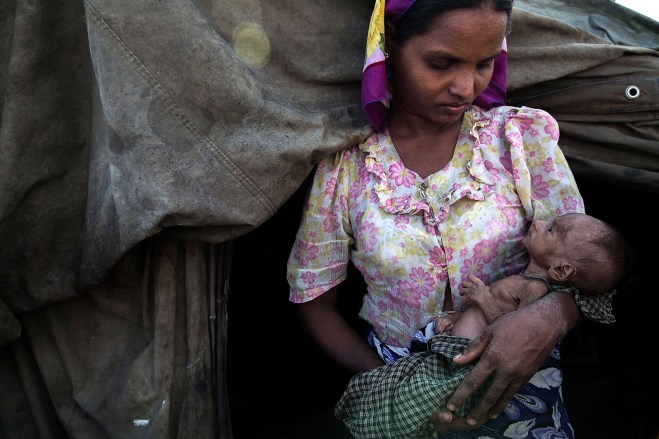
Earlier this month, Jane Perlez reported (NYT) on the mounting crisis facing Burma’s Rohingya Muslim minority, who are being denied access to lifesaving aid as they languish in displaced persons camps and face sporadic pogroms carried out by radical Buddhists:
The crisis began with the government’s expulsion of Doctors Without Borders, one of the world’s premier humanitarian aid groups and the lifeline to health care for more than a million Rohingya increasingly denied those services by their own government. But the situation has grown more dire in recent weeks, as local Buddhist officials began severely restricting other humanitarian aid to the camps and the rest of Rakhine State, where tuberculosis, waterborne illnesses and malnutrition are endemic. Some aid workers fear they are being kept away so there are fewer witnesses to rampant mistreatment and occasional bloodletting; the doctor’s group was expelled from Rakhine State after caring for victims of a violent assault on a Rohingya village that the government denies ever happened.
Sir Geoffrey Nice and Francis Wade warn that all signs point to genocide:
The situation has been allowed to fester — and actively encouraged — for too long. What were once horrible but sporadic bursts of violence have become sustained and deeply sinister.
The government has done little to help and much to harm the conditions in Rakhine state. It has rendered the Rohingya stateless, impeded aid, failed to punish perpetrators of violence and hate-speech, and thereby created an environment that allows violence to flourish. But all the while, it maintains the pretense that the mobs are operating on their own whim, and that the violence is purely communal. The tactic is familiar to state crime scholars: Policies are devised by leaders at the top, and delivered by those on the ground, with the puppeteer’s strings rarely visible. Now tensions are at a point where even small disputes are erupting into mass violence, with attacks on Rohingya occurring because of who they are, and not what they have done. All leaders in Burma must know that this is the mental state that enables genocide. And they also must know that once the genocidal mindset is free to act, it is rarely possible to stop, save by another greater force.
Previous Dish on the plight of the Rohingya here and here.
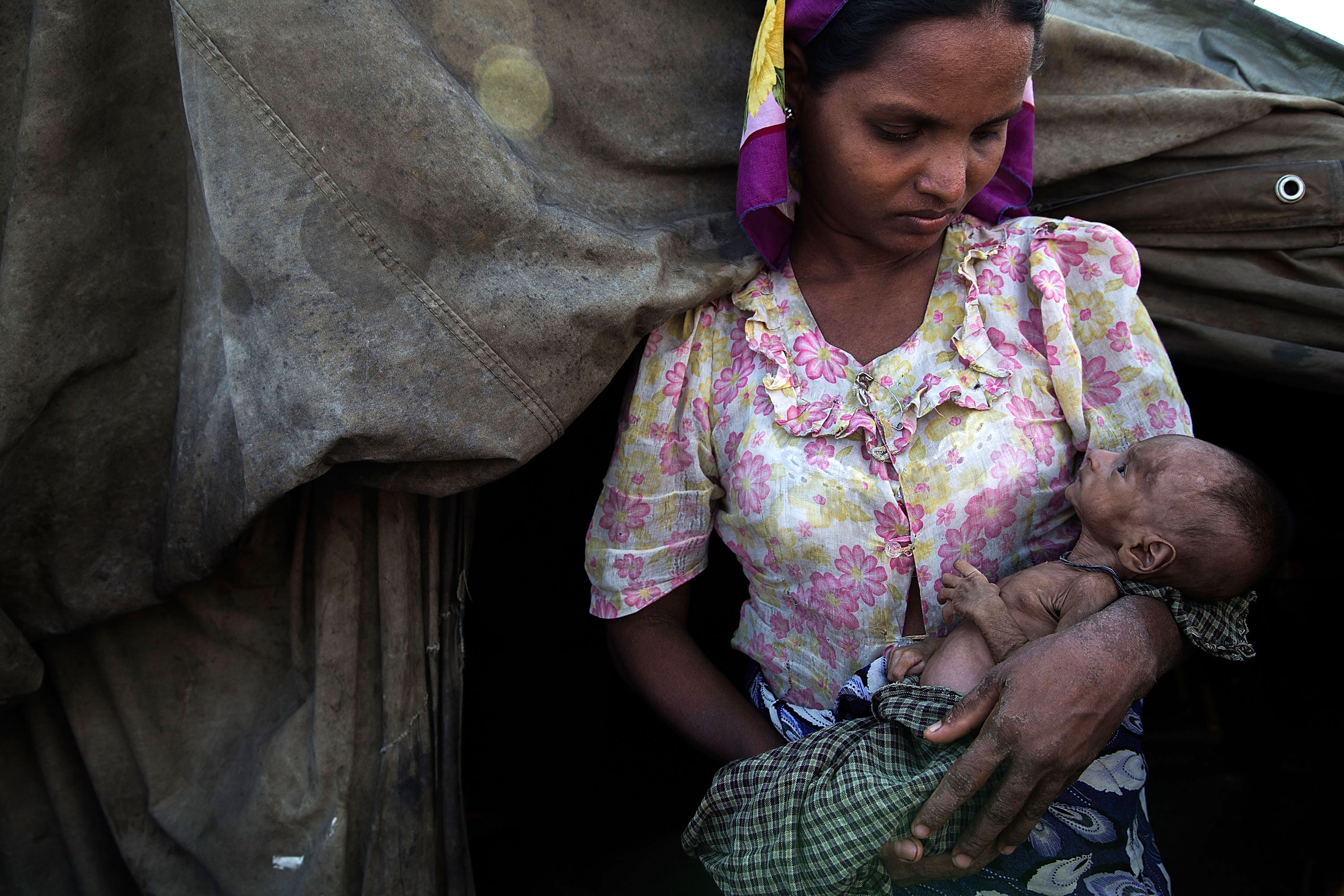
(Photo: Rosheda Bagoung holds her malnourished child outside a tent at Dar Paing refugees camp on May 10, 2014 in Sittwe, Burma. 150,000 Rohingya IDP (internally displaced people) are currently imprisoned in refugee camps outside of Sittwe in Rakhine State in Western Myanmar. Medecins Sans Frontieres (MSF), the primary supplier of medical care within the camps, was banned in March by the Myanmar government. Follow up attacks by Buddhist mobs on the homes of aid workers in Sittwe put an end to NGO operations in the camps. Though some NGOs are beginning to resume work, MSF remains banned and little to no healthcare is being provided to most Rohingya IDPs. One Rohingya doctor is servicing 150,000 refugees with limited medication. Several Rakhine volunteer doctors sporadically enter the camps for two hours a day. Births are the most complicated procedures successfully carried out in the camps. Requests to visit Yangon or Sittwe hospitals for life threatening situations require lengthy applications and are routinely denied. Malnutrition and diarrhea are the most widespread issues, but more serious diseases like tuberculosis are going untreated and could lead to the rise of drug resistant tuberculosis. By Lam Yik Fei/Getty Images)
 of commercial farming. The book juxtaposes portrait studies of farm workers, many pictured at the site of their labour, either harvesting or gathering industrial crops such as tobacco, maize or banana, alongside descriptive landscape studies, typically of open fields and enclosed sites of cultivation. The sequencing of these photographs is however more important than the genre they belong to: Terrain makes no distinction between ethnicity and geography; it erases very real linguistic, cultural, economic and political differences. It is a risky strategy. Although sometimes overstated for effect, there is a common-held perception in the global north of Africa as a vast undifferentiated space.
 The Dish