“I hope you can see, dear Neil, that it isn’t just that there are more things in heaven and earth than are dreamt of in our philosophy, but also that there is more active, vigorous, interesting, and intellectually respectable philosophy to be explored than you and some of your colleagues have been able to dream of so far. Please, keep that in mind the next time someone asks you about it. Or ask them to give me a call,” – Massimo Pigliucci, a biologist and philosopher at the City University of New York, and a friend of Neil DeGrasse Tyson.
Author: Andrew Sullivan
Joy To The World
Charles Kenny observes that global happiness – as measured by the most recent World Values Survey – is on the rise:
Among the global sample whose data goes back to the early 1980s, the proportion saying they are rather happy or very happy climbed from 71 percent to 84 percent. In the larger sample using data from the early 2000s, the global average reporting happiness
climbed from 75 percent to 83 percent.
There are unsurprising exceptions: The percentage of Egyptians who reported themselves happy nosedived from 2001 to 2012 – from 89 percent to 26 percent – as the country descended into political chaos. But only six of the 28 countries experienced declines, and many emerging economies reported considerably increasing happiness. The proportion of Russians willing to acknowledge being rather happy or very happy climbed from 47 percent to 74 percent over the decade. Respondents in China, Iraq, Kyrgyzstan, Mexico, Peru, and Zimbabwe all reported double-digit increases as well.

He points to possible reasons why:
There are lots of good reasons why there should be a general trend toward global happiness, especially in the developing world. Low and middle income economies as a group have experienced a climb in average incomes of 130 percent since 1981. The number of children who die before the age of five has halved worldwide since 1990. Violence appears to be declining, while democracy has been on the rise.
At the same time, the link between greater reported happiness and improvements in health, income or civil rights isn’t as strong as one might expect, even in poor countries. … Brookings Institution researcher Carol Graham surveyed Afghans about their happiness and found that – with the country near the bottom of rankings on most quality-of-life measures – Afghans in 2009 said they were happier than the average respondent in Latin America had reported in 2000.
Quote For The Day
“God will have a bit of explaining to do to me if I ever see Him,” – Jackie Kennedy, 1963.
The View From Your Window
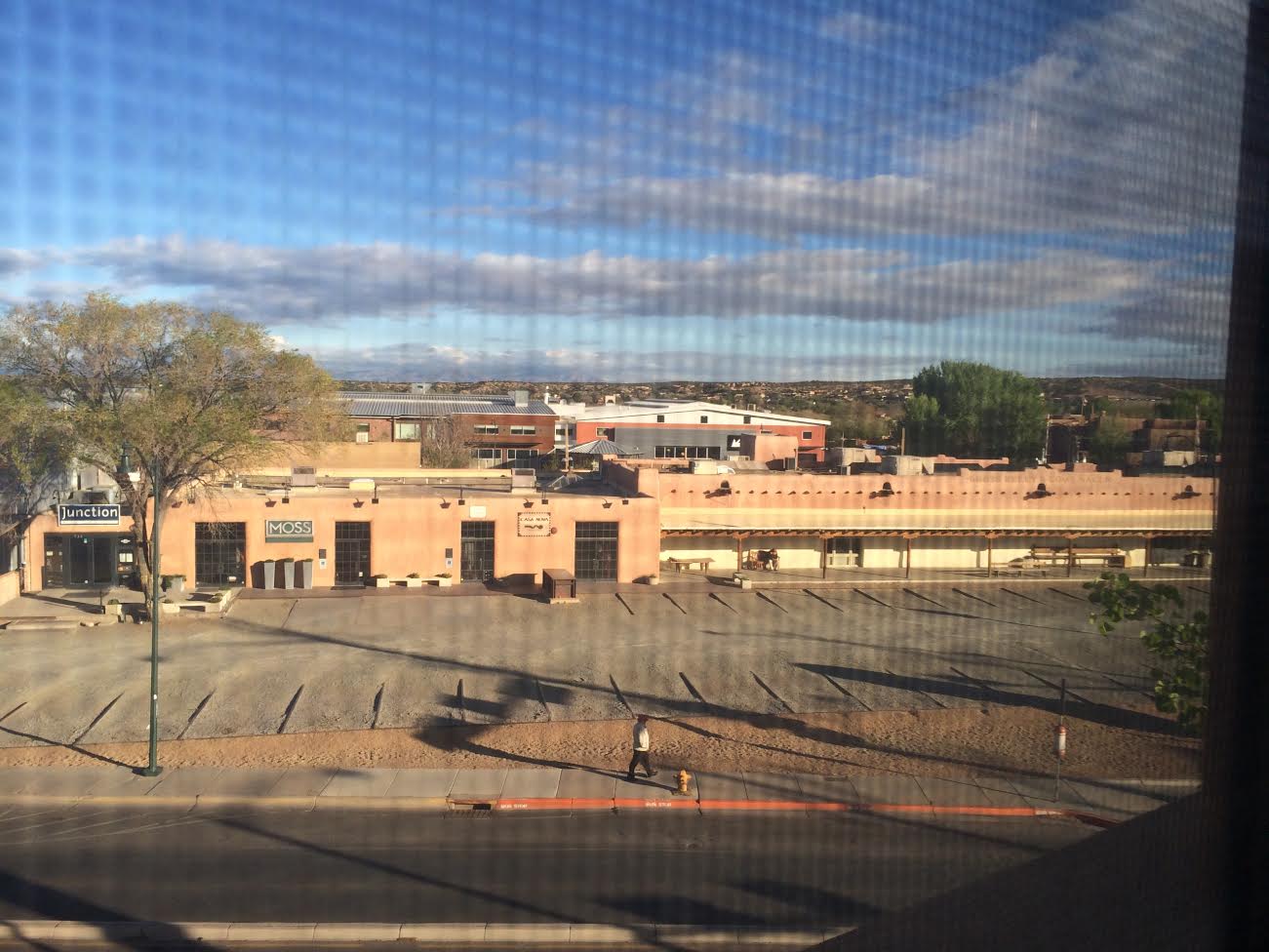
Santa Fe, New Mexico, 7.15 am
Make Dark Money Darker?
Dylan Matthews proposes a counterintuitive solution to dark money:
Maybe the problem isn’t too little information about donors and donations, but too much. That’s the argument of Yale law professors Ian Ayres and Bruce Ackerman. They’ve been arguing for a decade that the key to fixing the campaign finance system isn’t to strengthen mandatory disclosure rules but to abandon them in favor of a system where all donations are secret — especially to the recipients.
It sounds batty until you realize the authors’ key insight: for a quid pro quo to work, the paid-off party doesn’t just have to receive a kickback. They have to know they’ve received a kickback. In the current system, where you donate to campaigns by giving them your name and credit card number, or sending them a check with your name and signature, that’s trivially easy to figure out. It only takes a few keystrokes for Barack Obama to find out that Hollywood producer and Democratic super-donor Jeffrey Katzenberg maxed out to him in the 2012 primary and general elections.
But if we were to make donations secret, that link would be broken. Katzenberg could tell Obama that he donated, but there’d be no way he could prove it.
Preserving Her Purity
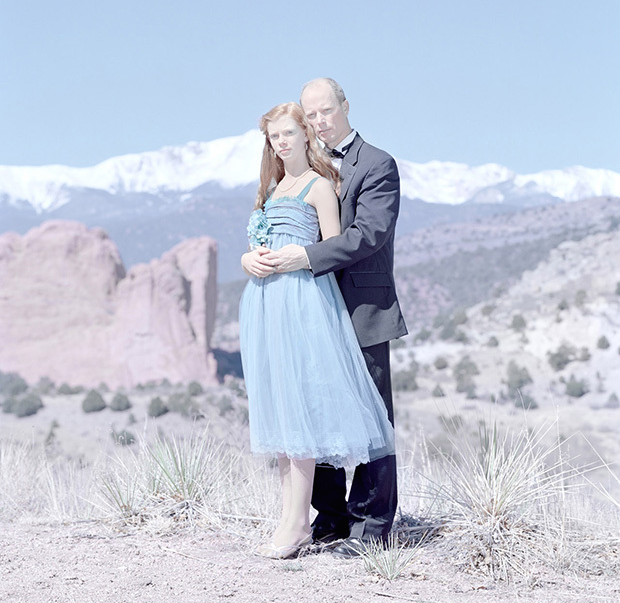
The Swedish photographer David Magnusson captures the emerging American tradition of “purity balls,” which he describes in the introduction to his new book, Purity:
A Purity Ball is a formal event where girls or young women and their fathers participate in a ceremony. The daughters dress up in ball gowns and the evening usually consists of dinner, a keynote speech, ballroom dancing, and a vow by fathers and daughters. The girls make a pledge to ‘remain pure and live pure lives before God,’ to stay sexually abstinent until marriage. Their fathers sign a commitment undertaking to protect their daughter’s purity.
Jessica Valenti praises the pictures but questions the practice:
The images … are beautiful, disturbing and tell a distinctly American story – a story wherein a girl’s virginity is held up as a moral ideal above all else, a story in which the most important characteristic of a young woman is whether or not she is sexually active.
This narrative of good girls and bad girls, pure girls and dirty girls, is one that follows young women throughout their lives. Purity balls simply lay that dichotomy bare. In a clip from a Nightline Prime episode on these disconcerting events, a father tells his braces-clad daughter, “You are married to the Lord, and your father is your boyfriend.”…
I have no doubt that families who participate in purity balls are doing what they think is best for their children – but that doesn’t make them any less wrong. When we teach girls that their virginity makes them special and valuable, we’re sending the simultaneous message that without their virginity they are tainted and damaged.
But Magnusson doesn’t want viewers to take away a particular message:
Though going into the project with one feeling about the balls, Magnusson felt something quite different after photographing many of the father-daughter pairs, whose poses were chosen by themselves and were not explicitly directed by Magnusson. What struck him “…when looking back at a year of photographing in the USA is how loving and responsible the fathers were. And at the same time, it is clear that the girls—in many cases, young women—are independent, strong, and insightful.” Ultimately, writes Magnusson, his “purpose hasn’t been either to belittle or glorify the ceremonies—the interpretation is all up to the eye of the viewer.”
Update from a reader:
I am getting so sick of artists taking this chickenshit out when presenting potentially controversial work: “I want the viewer to decide; I don’t have an opinion.” This is transparent BS. They only got interested because they knew their audience would gape at this subculture with fascination and/or horror, and while they may have genuine empathy for their subjects, I don’t buy for a minute they aren’t judging their subjects or lack an opinion. Just because their view might be nuanced doesn’t make it likely it is this vapid and vague. They just don’t want to lose access to either their subjects or their audience (which expressing their real and honest opinions would likely lead to). We’re supposed to buy that an artist/journalist spent months working on this and doesn’t have a point of view? So why maintain this pretense?
Another reader:
Isn’t is striking that here’s no equivalent for young sons? Where’s the ritual that has father supporting their young sons promise to remain pure until marriage? After all, if boys were successfully supported in such pledge, girls would have a lot less to worry about.
But of course, a purity ball for fathers and sons is laughable on its face: first, because the force of male libido is not only assumed, but often (if tacitly) encouraged; and – more importantly, I think – purity balls are based on the assumption that male sexuality is inherently corrupting. This is doubtless based on the shame men feel over fighting so hard for (and, so often, winning so little) control over our sexual impulses: still, even though there’s no question that the virginity burden in every society falls more heavily in women than on men, I wonder why we don’t think more about the disgust for male sexuality that underlies the assumption that penetration is pollution.
(Photo by David Magnusson)
Everybody Do The Idaho Stop, Ctd
A reader writes:
This Idaho law is how I’ve always ridden my bike – safely, but within reason. It takes a lot of effort to get a bike started from a dead stop – far more than a car – and so often there’s no reason to have stopped (no traffic). I am teaching my eight year old the same method of slow, look, listen, verify – then go, if all is clear. I think that not only does it promote independent thinking (vs. “I must stop at every single red octagon”), it keeps you more aware of your surroundings and focused on the moment. And it’s for this same reason that I prefer the roundabout intersections in my town; you can’t interact with Twitter, email, Facebook, IMs or other distractions in a roundabout situation.
But most of the reader responses were critical of the Idaho stop:
Oh, bullshit. Living in the heart of San Francisco, where bikes are rampant, and the de facto reality is the Idaho stop, I can tell you that the utopian formula you support – “a stop sign is a yield, a red light is a stop sign” – is utter bullshit in practice. In reality, your formula actually means “blow through any stop sign at full speed as if you owned the road, whether there are cars or pedestrians there or not, but slow down slightly for red lights, stopping only if absolutely necessary.”
I can’t tell you the number of times as pedestrians we’ve almost been run down, or the number of times as drivers we’ve been forced to stand on the brakes after entering an intersection only to have a cyclist blow through out of nowhere at 30 mph. Perhaps things are more highly evolved back there in DC, but out here in SF it’s open religious warfare: bikers vs motorists. Motorists, you see, are evil:
carbon-crunching troglodytes from a dead and dying past; they deserve neither courtesy nor consideration. Whereas bikers are holy: righteous riders of the low-carbon future – and as such, immune not only from the laws of man, but of fate as well – Sure! Drag that baby through heavy down-town traffic behind your bike in that darling little bike trailer! The little orange flag will protect her! That, and your pristine holiness. It. Is. Insane.
Don’t get me wrong: Bikes are the future. Cars aren’t. But Idaho is not SF, or DC. It’s the fourteenth largest state geographically, at 83,570 square miles, but has only 1.5 million people – less than a fifth of the Bay Area population. What works in Idaho doesn’t translate trouble-free into SF, and I doubt it would into DC either.
From another part of the country:
Ugh, this “Idaho stop” is just legitimizing my biggest annoyance with sharing the road with bicycles. I really try to be respectful of bicycles on the road. I recognize their right to be there, and the fact that they are very exposed and certain to get the worst of any collision with my car. The state law down here in Louisiana says that if you’re passing a biker, you need to give them a three-foot cushion, which makes plenty of sense. But the reality of that law, especially in a dense urban setting like New Orleans, is that quite often I’m stuck behind a bicycle for long stretches going seven miles per hour because there isn’t enough room to pass. Eventually there will a break in traffic or parked cars or whatever, enough that the biker can veer over a bit and/or I can get around them, but it’s really frustrating to be stuck moving so slowly.
And this Idaho stop thing just means that even if I manage to pass them (legally), at the next red light they’re going to pass me, and I’m going to be stuck behind them all over again. This already happens reasonably often, since plenty of bikers happily ignore the current laws, but making it legal and more common is just going to aggravate drivers even more. I know some bike riders are all for aggravating drivers, since they see this whole thing as some sort of holy war, but I don’t think this world needs any extra road rage.
Another shows a little bit of rage:
I work in midtown Manhattan, and I can’t cross the street during the day without swiveling my head around like Linda Blair in “The Exorcist” because a deliveryman on a bicycle is going the wrong way up a one-way street, running a red light, and would plow into me if I weren’t paying enough attention for the two of us. This happens literally every day, often multiple times (and I understand these guys are underpaid, but if they were being paid more, I think they’d still do it just because they could).
From my perspective, “Idaho stops” send exactly the wrong message because a lot of bicyclists already think they’re above the law, and softening it specifically for them only reinforces their sense of entitlement. Red lights and stop signs are already optional for too many of them, and one-way streets apparently are for the little people. And, by the way, I’ve never seen one of them ticketed, ever.
A pedestrian’s view:
I walk almost everywhere, or use mass transit. I’ve been clipped at least a half dozen times by cyclists who just don’t care to watch for pedestrians. Once, my 3-year-old daughter was knocked to the ground by a cyclist running through a stop sign. My pedestrian friends can add dozens of similar stories of cyclists paying them no mind. I am unconvinced that an Idaho stop is safer or reasonable when considering cars. Until, as a class, cyclists actually start respecting pedestrians in our city, I am utterly convinced that an Idaho stop will just allow the already militant cyclists in our city to further ignore pedestrians and run us down.
Another introduces another type of vehicle:
I must respectfully disagree about the changing rules for bicyclists when it comes to stop signs and lights. Certainly, bikes have greater fields of view than most cars, but then so do motorcycles. Should motorcycles be allowed to glide through stop signs? My current car, a Scion, has worse visibility than my old one, an old Ford Escort station wagon. Should I have to stop for longer in one car than the other?
Nope. Because uniform rules of the road are the safest for ALL the people using the roads. If cyclists want to share the road (and based on all the complaining I hear from cyclists friends, they do), they have to follow the rules we put on vehicles. Period.
A different view to balance things out a little:
For the drivers who might complain that bicycles should adhere to the same laws as cars, I should note that less than 1% of the drivers I encounter at four-way stops actually come to a complete stop. And they are still going faster when they “pause” on through than I am when I slow down on my bike. This isn’t to excuse the cyclists who fly right through them – they’re assholes and they should be ticketed. They give law-abiding cyclists a bad name and they’re doing something both stupid and incredibly dangerous. Last year I nearly creamed some idiot flying through a stop sign (while he was taking a left, because YOLO I guess) after I had come to a complete stop.
Anyway, in addition to adjusting the cycling laws, a little more mutual respect between bikers and drivers could make a huge difference and save lives.
Another reader brings philosophy into the discussion:
In a college ethics course years ago, taught by a Jesuit, a similar situation was discussed – crossing against the light. He explained that, if a cop stopped us for that, we might justify ourselves with the principle of epikaia: “Epikeia says that a general rule must be applied to a particular situation … taking into consideration all circumstances” and, “For the great canonists of the Middle Ages, epikaia was justice sweetened with mercy.”
In other words, the purpose of this particular law is to regulate traffic so as to avoid collisions. If there’s no oncoming traffic, you can go ahead and cross against the light.
Another brings in some humor:
Seems to me that people driving cars could use some similar rules. A friend of mine told a good story. One day in San Francisco, he rolled through a stop sign, albeit in a car. A cop stopped him and was going to give him a ticket when my friend said, “Officer, I swear that stop sign was green when I went through it.” The cop laughed and let him off.
The Highway Trust Fund Is Running Low
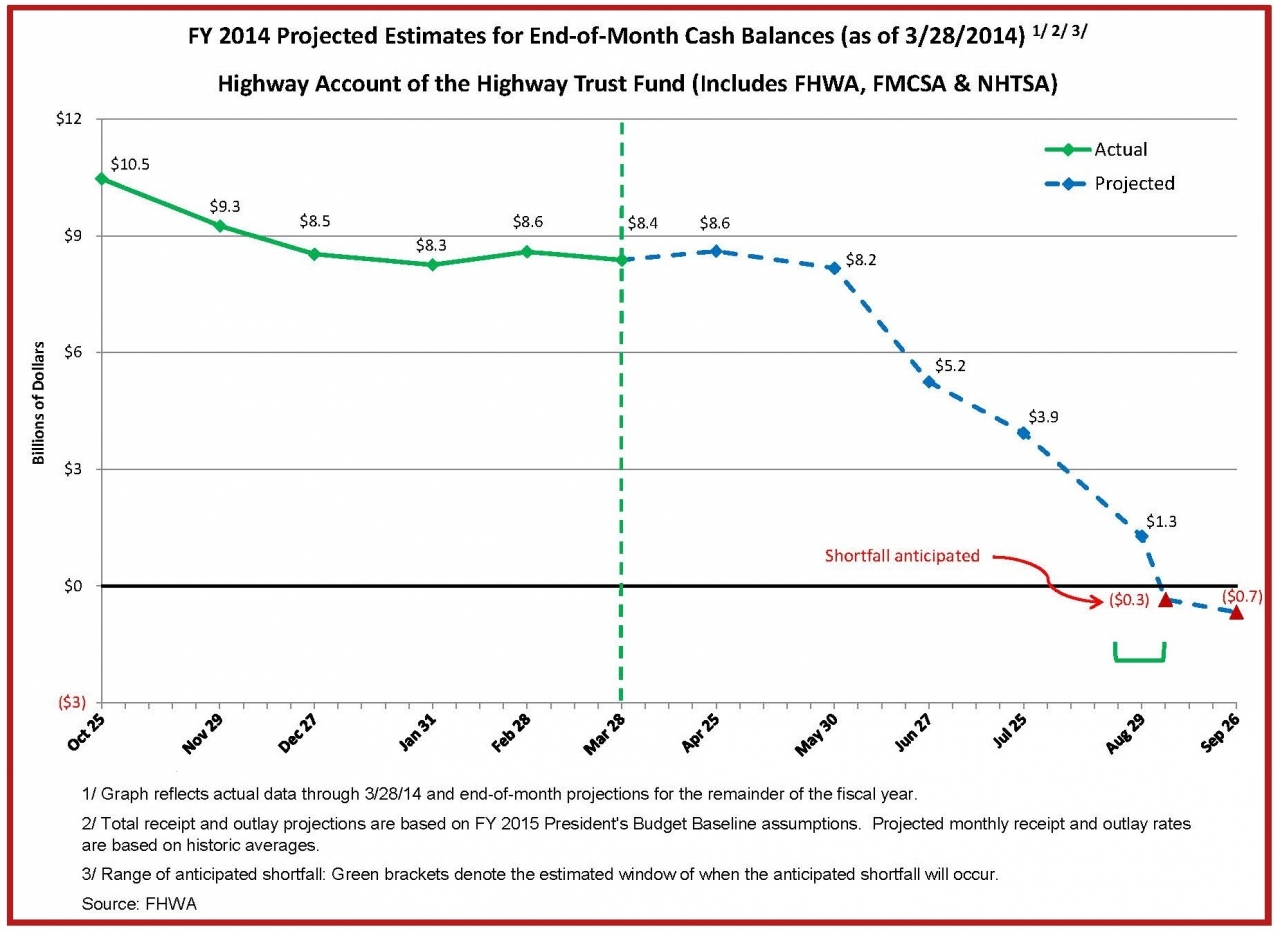
Lydia DePillis explains why the federal fund for transportation infrastructure projects is going broke. Most of the money comes from gas taxes:
Americans are actually using less gas than they used to — both because they aren’t driving as much, and cars are getting more efficient. Meanwhile, Congress hasn’t raised the gas tax from 18.4 cents per gallon since 1994, which is now far behind what it was then when you take inflation into account. Consequently, revenues have started to sputter in recent years … Congress has been aware of this problem for a while now. Instead of raising the gas tax, or finding some other funding mechanism, it’s simply plugged the hole with multi-billion-dollar transfers from the general fund. The last authorization, a $19.5 billion chunk granted in 2012, expires at the end of this September — at which point, unless Congress acts, the federal contribution for hundreds of state projects will drop to zero.
Eric Jaffe looks at how Obama proposes to fix the problem:
It’s too soon to scrutinize the details of the bills, but one element of Obama’s plan seems likely to endure.
That’s an idea to let states place tolls on their free interstate highways. Right now, states can only toll an interstate highway to pay for the construction of new lanes. The new plan would let states create tolls to pay for maintenance of a crumbling highway they have no plans to expand at all. (Three states already have such permission through a federal pilot program — Missouri, North Carolina, and Virginia — but none has acted on it.)
The idea has a little something for everyone. It shifts power to the states, which conservatives tend to like. It makes drivers pay for road use more directly than the gas tax does, which economists like; in fact, the free-market Reason Foundation recently proposed a similar plan. And it lets politicians avoid the unpopular move of raising the gas tax during an election year, which every party likes. For the record, the C.B.O. recommends a 10 to 15 cent per gallon hike.
Ben Adler advocates the simplest solution – raising the gas tax:
The simple thing to do here would be to raise the gas tax. It would guarantee a revenue stream, and it would have the positive environmental side effect of discouraging gasoline consumption. But Obama is afraid to propose that, since it polls poorly and Republicans would reflexively oppose it. Republicans have blocked every effort to raise the gas tax since they took over Congress after the 1994 midterm elections. Rep. Earl Blumenauer (D-Ore.), a leader on smart growth and transportation policy, introduced a bill last December that would double the gas tax. The chair of the House Transportation Committee, Rep. Bill Shuster (R-Penn.), flatly rejected any gas tax increase in February. “Economically, it’s not the time,” Shuster said, as if there ever were a good time in his mind.
But Pethokoukis prefers to get rid of the tax altogether:
Oh, you wouldn’t have to do all at once. You could phase it out over several years. Meanwhile, states and cities could start calculating what their infrastructure needs really are — repairing existing roads vs. building new ones — and the best way to pay for them, such as state gas taxes, broader sales taxes, tolls, or advanced congestion pricing. …
With added flexibility, AEI’s Richard Geddes thinks state and local governments could consider “investment public-private partnerships” or IP3s. In return for a large, upfront payment, a government would lease a highway to a private entity to operate and collect toll revenue. That initial payment would go into a fund, which would then issue an annual dividend to citizens based on the fund’s investment earnings much like Alaska’s Permanent Fund or Norway’s sovereign wealth fund. A recent AEI analysis performed using data from Columbus, Ohio, suggests that annual payments could be as high as $1,800.
The Bloomberg editors like Congressman Steve Israel’s idea:
Israel, a New York Democrat, suggests allowing companies holding large cash stockpiles abroad for tax reasons to bring their profits home at a preferential rate — on the condition that they spend about 10 percent of the repatriated income on a new kind of infrastructure bond.
The idea is modeled on Build America Bonds — which is good, because that program, started in 2009, performed quite well. With a direct subsidy to issuers, it supported more than $180 billion in public works, and saved state and local governments an average of 0.84 percentage point on interest costs for 30-year loans.
Randal O’Toole, however, questions the entire premise of this debate:
For several years, there has been an almost continuous drumbeat about “crumbling infrastructure” which naturally carries over into the Highway Trust Fund debate. “Nearly one in four of America’s bridges [are] either structurally deficient or functionally obsolete,” says the Washington Post.
In fact, state highways are in excellent condition. The number of bridges that are “structurally deficient,” meaning worn out and requiring extra maintenance, has steadily declined from nearly 119,000 in 1992 to less than 67,000 in 2012, and now stands at less than 11 percent of the total. “Functionally obsolete” bridges represent the other 14 percent of the Post’s “one in four,” but these are simply bridges that have lower clearances, narrower lanes, or other issues that might slow traffic but not create serious problems. As for the 11 percent that are structurally deficient, few are in any danger of falling down: the recent bridge collapses in Minnesota and Washington states were due to design flaws, not maintenance failures.
A disproportionate share of the structurally deficient bridges are locally owned, not state owned. While states pay for most of their roads out of gas taxes, tolls, and other user fees, local governments rely heavily on sales taxes, property taxes, and other general funds. This underscores the importance of funding transportation out of user fees, not general funds.
Shocking Dreams
Scientists may be able to induce lucid dreaming using mild electric zaps:
For decades, people have been manipulating the brain using chemical means – drugs. But in recent years, researchers have begun to use electricity, as well. For example, there’s FDA-approved electrical brain implant that treats tremors associated with Parkinson’s disease.
The new dream study, which was published May 11 in Nature Neuroscience, used a far less invasive method: electrodes temporarily placed at strategic locations on the scalp. The research involved 24 volunteers with no history of lucid dreaming. The subjects went to sleep and eventually dreamed. Then, researchers turned on a 30-second-long electrical signal and then woke them up and asked them about their experiences. It turned out that a 40 Hz stimulation induced lucid dreams 77 percent of the time.
As Helen Thomson notes, the research could ultimately be used to help people with PTSD:
The team suggests that brain stimulation might help people with post-traumatic stress disorder who have recurring nightmares. Perhaps by triggering lucid dreaming, people with PTSD can take control of their dreams and make them less frightening. “That’s what we are looking at now,” says Voss, although the results are not yet available. It is a promising suggestion, says Michael Schredl, who works in the sleep laboratory at Heidelberg University, Germany. He says it will be difficult to expand the applications to help treat mental disorders, but “the idea of studying patients with nightmares or PTSD would be very interesting”.
The Best Of The Dish Today

The cascading evidence of climate change that has been presented in various reports in the last few weeks crested today with news that the melting of the Western Antarctica ice sheet is now underway. And it’s a done deal:
“This is really happening,” said Thomas P. Wagner, who runs NASA’s programs on polar ice and helped oversee some of the research. “There’s nothing to stop it now. But you are still limited by the physics of how fast the ice can flow.”
So this was the perfect moment, of course, for Marco Rubio to come out as a proud denialist – even though Miami may be one of the cities most affected by the rising sea levels the Antarctic melt will bring. The Senator is not the brightest bulb in the GOP – his asinine foreign policy feels like a 1980s music video without the charm. But this latest pandering – as well as the ludicrous idea that he has the skills to be president of the US – marks a new low:
“I do not believe that human activity is causing these dramatic changes to our climate the way these scientists are portraying it,” the first term senator said Sunday on ABC “This Week,” after being asked by ABC News’ Jon Karl whether humans were contributing to the heating up of the planet. “I do not believe that the laws that they propose we pass will do anything about it, except it will destroy our economy.”
And what is the scientific basis for that “belief”? So far as I can see: zippo. Here’s his version of this for CNN:
I think severe weather has been a fact of life on earth since man started recording history. I understand that there’s a vast consensus of scientists that are saying that human activity is what’s contributing to changes in our climate. I think it’s an enormous stretch to say that every weather incident that we read about or the majority of them are attributable to human activity.
So straw men proliferate as well. And when intelligent, educated right-of-center intellectuals engage in absurdity on the subject, it’s hard to blame the somewhat dim member at the back of the class. I guess it’s worth re-stating. For me, climate change is a baseline test. Are Republicans capable of rationality or are they still busy creating reality?
Today, I explained why a kiss is still a kiss – even if it’s an inter-racial gay NFL one. Putin kept playing his usual war-not-war games, as some of his countrymen whipped themselves up into a full-scale gay panic. (I’m with PJ O’Rourke on the ultimate fate of the little big man in Russian history.) And, for some reason, West Virginians have started naming their daughters “Brooklyn“.
The most popular posts of the day were two on The Gay Sonic Boom – here and here.
Many of today’s posts were updated with reader commentary – read all of them in one convenient place. And you can leave your unfiltered comments at our Facebook page and @sullydish.
19 readers became subscribers today. You can join them here. One sends the above photo:
Hope you had a good weekend. I want to share a view from my parents’ window in Oakland. On the right is the Mother’s Day gift I gave to my mom today: a framed print-out of the note I sent to you in January in which I wrote about how she had mailed me copies of The Dish while I was in basic training in Ft. Benning, GA in 2002. The Dish is a gift that keeps on giving.
See you in the morning.
 The Dish