 In a phrase: AIPAC’s foreign policy, with Cheney’s torture regime in place, to back it up. She has already stated that she wants more Israeli settlements and more Israelis in the West Bank, and is now hinting that she would also like a full-scale war with Iran:
WALLACE: How hard do you think President Obama would be to defeat in 2012? PALIN: It depends on a few things, say he played — I got this from Buchanan — say he played the war card. Say he decided to declare war on Iran or decide to really come out and do whatever he could to support Israel–which I would like him to do. That changes the dynamics of what we can assume will happen between now and three years. Because I think if the election were today, Obama would not be elected. WALLACE: You’re not suggesting that Obama would cynically play the war card?
PALIN: I’m not suggesting that, I’m saying if he did, things would dramatically change if he decided to toughen up and do all that he can to secure our nation and secure our allies. I think people would shift their thinking a bit.
When she was first asked about foreign policy – before she was Kristolized by Randy Scheuneman – she said she wanted an exit plan for Iraq and had only heard about the “surge” “on the news.” Now she is a paid-up neocon fanatic. Notice that in her view, Obama is not actually supporting Israel at the moment.
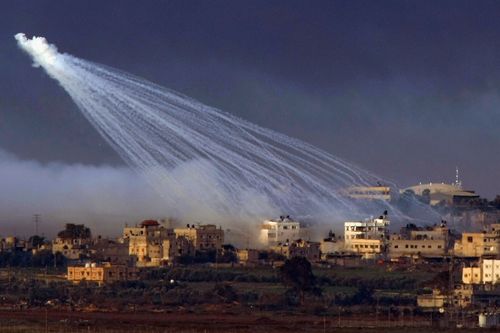
And yet Israel pre-emptively tried to kill Obama’s attempt to reach out to the Muslim world by the brutal, polarizing Gaza campaign, has adamantly refused to freeze all settlements on the West Bank, and has done its usual brilliant job of lobbying the US Congress to prevent any leverage over the country. In Jerusalem, recently, two US senators, John McCain and Joe Lieberman, openly told the Israelis that they had the power to prevent Obama from conducting foreign policy with respect to Israel, if it conflicted with the agenda of the Israeli government. Obama’s clearest failure, in fact, in his first year is in trying to budge Israel from its suicidal path.
Notice also that the only “tough” position for Palin is war and the threat of war. And remember this statement from earlier this year:
I believe that the Jewish settlements should be allowed to be expanded upon, because that population of Israel is, is going to grow. More and more Jewish people will be flocking to Israel in the days and weeks and months ahead. And I don’t think that the Obama administration has any right to tell Israel that the Jewish settlements cannot expand.
The American president has no right to pressure Israel to advance America’s interests. No right! No wonder Kristol is so in love.
(Photo: Gaza under Israeli aerial bombardment a year ago. By David Silverman/Getty)
 The Dish