Yes, A Carbon Tax Would Be Better

Frum criticizes the administration's energy policy:

Here’s the crazy thing about energy policy: If you want off oil, the only way to preserve free markets is by raising energy taxes. If you seek to quit oil without raising taxes, you plunge into a welter of subsidies and special favors. And that, sorry to say, is the course the Obama administration has chosen.

I'm with David on this one. But getting a carbon tax through Congress isn't just a matter of Presidential priorities. David knows as well as I do that the real obstacle to this is not Obama but the GOP and the usual weak-kneed Dems. The GOP would demagogue a carbon tax to death and the Dems would curl into a ball and die. Dave Roberts goes through the administration's energy and environmental policy in more detail.

The Old Shoes Of Political Activism, Ctd

Haitidebtnew Annie Lowrey counters David Roodman:

I think Roodman underplays the impact of debt payments on Haitian government spending. Sure, aid and remittances will dwarf debt payments next year. But why should the country have to worry about them at all — ever, even 10 years from now, when Haiti will likely be stable and poor?

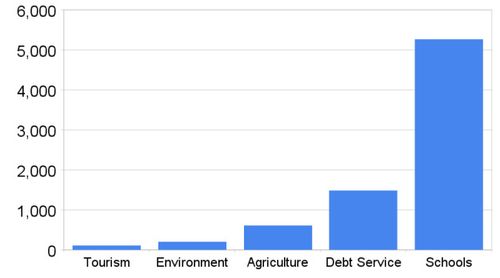
I made another chart from data from Haiti’s budget. (The Port-au-Prince government, it turns out, posts its budget documents online.) Last year, it shows, Haiti spent around $37 million servicing its debt. (I looked up the numbers in Haitian Gourdes, and performed a current-day currency conversion — note that the currency has cratered recently.) That’s more than the government spent, say, on agriculture — despite the fact that a massive proportion of Haitians are subsistence farmers. It’s more than it spent on its ministry of tourism, despite the fact that tourists once posed the best way for Haiti to bolster its economy in the short term. Had Haiti not had to repay external debt, it could have boosted its education budget by nearly a third.

Chart Of The Day

Forecasts

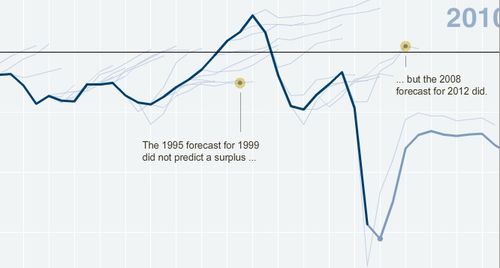
The New York Times has an interactive chart (screen-grab above) showing how rarely budget forecasts correspond with reality. Ezra:

The dark line is the deficit, while the silver threads shooting are forecasts. As you can see, what forecasters do is extend the current trends. When something happens to break that trend — a massive financial crisis, say — they're generally caught unawares. Which is as you'd expect. If they knew a crash was coming, they'd be making money betting against the market, not running budget models.

And the reverse is also true as well. Beyond a certain point, you can get surprised on the upside as well. And we still don't know the future of this recovery for sure.

“Starving And Stunted Dwarves”

Hitch reviews B.R. Myers' The Cleanest Race: How North Koreans See Themselves and Why It Matters:

[A] North Korean is on average six inches shorter than a South Korean. You may care to imagine how much surplus value has been wrung out of such a slave, and for how long, in order to feed and sustain the militarized crime family that completely owns both the country and its people. But this is what proves Myers right. Unlike previous racist dictatorships, the North Korean one has actually succeeded in producing a sort of new species. Starving and stunted dwarves, living in the dark, kept in perpetual ignorance and fear, brainwashed into the hatred of others, regimented and coerced and inculcated with a death cult: This horror show is in our future, and is so ghastly that our own darling leaders dare not face it and can only peep through their fingers at what is coming.

The Empty Threat

Gautham Nagesh points out an inconvenient truth for proponents of DADT:

[A] Military Times poll in December 2008 found that 58 percent of U.S. troops do not want gays to serve openly in the armed forces. Ten percent of respondents said they would leave the armed forces if the ban were lifted and 14 percent said they would consider doing so. Polls of soldiers in the United Kingdom similarly found that as many as two-thirds of soldiers said they would consider leaving the service if gays were allowed in, but the British military reported that very few soldiers actually chose to depart when the ban was lifted in 2000.

And just as few gay soldiers actually came out in the ranks. The closet will remain the norm for a while – but without the threat of persecution and the taint of dishonesty as a condition for service.

This, in my view, is the ultimate reality behind all this: when the ban is lifted, it will be the biggest non-event you can imagine.

Marriage Equality At The Supreme Court?

Law professor Vikram David Amar questions whether the Prop 8 trial will make it that far:

[This case is] destined for the Ninth Circuit. But whether it goes any farther depends on what the Ninth Circuit does. If the Ninth Circuit (either through a three-judge panel or the whole court sitting en banc) rules in favor of the plaintiffs and invalidates Proposition 8, then the Supreme Court may very well feel it must take the case, since same-sex marriage would be a federal right west of Rockies but not in most other parts of the country. But if the Ninth Circuit rejects the plaintiffs’ claims, don’t expect the Supreme Court to take the up the issue of same-sex marriage anytime soon. Still, when the Justices do address some future anti-same-sex-marriage measure enacted into law by a state — and down the road, they may have to do so — they’ll have the benefit of the trial record in the Proposition 8 case, as well the opinions and/or evidence from other cases that will have been decided in the interim.

Brian Leubitz agrees. I believe the great merit of the trial was educational, rather than legal.

I think the complete evisceration of the arguments of the anti-marriage equality crowd and exposure of their motivations were the key things. it would have been much better televised. But I feel about it the way I felt about Obama's Q and A with the GOP last Friday. When you can get the arguments directly in contact with one another, the overwhelming logic of marriage equality wins. That's why I was delighted to include in my own anthology the best critiques of the reform – because by showing that even the best arguments of the other side are weaker than ours, we move the ball forward.

Of course, we have a minority full of passionate intensity which so often overwhelms reason. But after a while, even they have to relent. As they did on inter-racial marriage which they opposed at the time with even more intensity.
Mommy, Where Do Abortions Come From?

Michelle Cottle, as a "protective parent," wishes the Tebow ad wouldn't air:

[I]f many Americans indeed hold to this notion of the Super Bowl as more-or-less family-friendly, then it really isn’t an appropriate venue for any ad that talks about abortion—or any other seriously sexual topic. Not date rape. Not child porn. Not international sex trafficking. Grading on a curve, a split-second peek at [Janet Jackson]’s boob, while utterly tasteless, isn’t that hard to wave off with kids in the room; an ad that specifically aims to provoke discussion by focusing, no matter how cheerily, on a woman’s high-stakes decision about whether or not to terminate her pregnancy opens up a darker, more complicated can of worms.