Mother’s Day Without Mom

John Dickerson reflects on the death of his mother, and what her absence has come to mean as he himself ages:

My mother died when I was 29, and though it has been 17 years, I still have the instinct to call her. She was also a journalist, so there’s the news to talk about, and there are the anniversaries of big events that she covered, and now that I have kids, there’s the larger set of conversations we could have about ambition, faith, fear, and generally trying to keep it all together.

He offers this advice to parents: “Write to your children now for when they’re older. Leave them some writing for after you’re gone.” For him, his mother’s words have proved invaluable:

I have [my mother’s] childhood journals, her letters to her parents when she was just starting out, and her journals as an adult. There was so much in what she left after her death, I had to write a book to figure out what it all meant. In those artifacts I’ve learned about grace during times of struggle and self-doubt. I’ve seen examples of a joyful spirit alive in each day. This window into her inner life offers a more global lesson: People are always more complicated than they seem. Your guesses about what motivates them are often wrong. This is both true about her and true about the people she judged. Not all the lessons I’ve learned from these papers are behaviors I’d emulate.

Mom also kept letters she wrote to me…. I don’t remember getting them when they were originally sent (“I get the feeling you don’t read my letters,” she wrote to me, saying it was a line her mother wrote to her), but they’re full of wisdom as I reread them. And instruction: “always keep smiling and making people happy,” she wrote on my copy of her letter about her will. This kind of thing reminds you of yourself later in life when maybe you need to be put back on course.

Why Atheists Need To Come Out, Ctd

Atheists

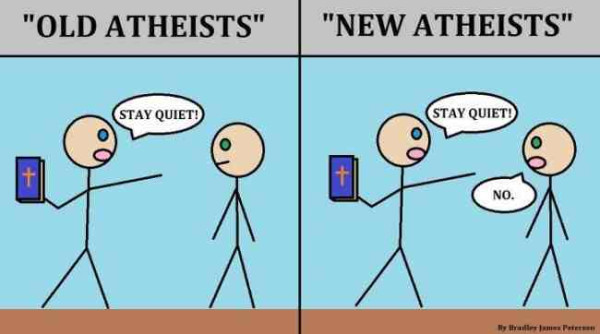
A reader shares the above image via GSpellchecker, adding, “I think this just about sums it up.” Another reader would agree:

The problem is that atheism by its nature is silent. You tend not to talk about something you don’t believe in unless it specifically comes up as a topic. If you’re in a group of friends and you want to indicate you’re a Christian, you can mention something about church. How do I casually indicate my status as an atheist? Mention that I’d like to go mountain climbing but I don’t want to risk death because I don’t believe in an afterlife?

The joy of Dawkins is that he comes out and tells us we’re not the only ones, that there are lots of other really smart and sane people out there who realize that the entire religion thing is completely ridiculous.

Another:

In the discussion of atheists “coming out,” I’m surprised no one has mentioned The Out Campaign promoted by – wait for it – The Richard Dawkins Foundation for Reason and Science. (There is a similar project for closeted atheist clergy.) In my opinion, the New Atheists are trailblazing in the culture wars, pushing the so-called Overton window for religious opinions. They are also alerting closeted atheists that there are more like-minded people out there than they may realize. This all makes it possible for mild-mannered atheists to simply come out in their own boring way.

Another argues that militancy is more than justified:

The accusation of the strident atheist is similar to the “angry black man” trope in that it is designed to get people to shut up and disenfranchise people who are saying things that the accuser does not like.

The irony is that the worst Dawkins, Dennett, Maher, and Hitchens say about religion is quite mild in comparison to what the religious say about atheists. The core belief of Christianity and Islam is that atheists will be tortured in hell for eternity. This is not some Old Testament throwaway line but is integral to belief itself.

I would remind the reader who wrote about their grandmother who lost a son and uses the promise of heaven as a coping mechanism that she is saying in the same sentence that you (an atheist) are going to hell to be tortured for all eternity. You can’t have the kingdom of heaven without the damnation of hell; that’s an implicit bargain.

But a few readers suggest that strategy might backfire:

I’m as secular-lefty as they come (hell, I’m a professor of social theory; it’s practically a professional requirement), but the tone-deaf pompousness, the lack of regard for nuance, and the circular arguments that the New Atheists sometimes display have pushed me towards a much more sympathetic regard for religion – what it does for societies, and what it does for individuals. From someone who was unthinkingly a little scornful by default of religious belief, I’ve found myself becoming more understanding of the meaning it can have in people’s lives. And in large part that was due to dismay at some of those New Atheist writings – they served as a kind of reductio ad absurdum of my original position, and so forced me to move away from it.

Another:

While I’m a fan of Bill Maher, Richard Dawkins, Sam Harris, and of course, The Hitch, it always bothered me that the most prominent and vocal representatives of atheism were these bright, oratorial, privileged, condescending, caustic, and sarcastic middle-aged white men who have publicly (and quite literally) sneered at people with the audacity to believe in God. I don’t think they realize how poorly they actually represent their cause, or the majority of moderate, more inclusive non-believers out there. They certainly don’t appeal to most women or minorities. It’s as though their target demographic is a Redditor.

Where’s the Ellen Degeneres of atheism? Where’s the easy-going, non-threatening, relentlessly charming atheist who realizes that atheism isn’t a very big deal at all? Where’s the happy-go-lucky personality on TV that casually confirms, “Yes, I’m an atheist. Now, tell me what you’ve been up to lately …”

Well, as far as minorities like African-Americans, they simply “outrank every other group where piety and religiosity are concerned,” so of course there are fewer outspoken black atheists – a subject the Dish has covered quite a bit. Regarding female atheists, there’s a thread for that, and the Dish has also given an Ask Anything platform to one of the most prominent female atheists, Jennifer Michael Hecht, author of Doubt: A History: The Great Doubters and Their Legacy of Innovation from Socrates and Jesus to Thomas Jefferson and Emily Dickinson. Of the three “doubters” she praises in the following video, two are women:

Previous Dish on the need for atheists to come out hereherehere and here.

One Nation, Under Gods

In a review of Jeff Sharlet’s Radiant Truths, an anthology of literary journalism about American religion that ranges from Walt Whitman to Occupy Wall Street, Jonathan Fitzgerald praises the book for what it tells us about our culture:

Having these stories gathered into one eminently readable anthology makes Radiant Truths an important book. I know people say that a lot about all kinds of books, but this one really is important, particularly if you take into account a couple influential trends in American culture. The first, the broader trend, is that American religious identity, which has always been more fragmented than some like to believe, is becoming even more so. That is, religion has always been important to Americans, but it used to be possible to pretend that the United States was a “Christian nation.” But, as Sharlet and Peter Manseau showed in their 2004 religious travelogue Killing the Buddha: A Heretic’s Bible—an excerpt of which appears in this collection—it is completely ridiculous to talk in singular terms about American religion.

The other trend perhaps has a narrower reach; it has to do with changes within journalism in the age of the Internet. Though a decade ago everyone seemed certain that the nature of reading news online would all but guarantee that reportage would become shorter and shallower, in many ways, the opposite has been true. Of course, there are plenty examples of the short and shallow, but we are also seeing a trend toward “long reads,” in-depth literary journalism-type pieces published online and read and shared far beyond the reach of the print magazines who used to be the only place to find such writing. As was the case in the 1800s, it is precisely the changes in the medium through which journalism is delivered that contribute to these trends. In the 19th century, it was the proliferation of the penny press and today it has a lot to do with the ubiquity of mobile devices. But Sharlet takes us back to 1863 in a piece by Walt Whitman, who, along with Thoreau (the second author in the collection) Sharlet sees as forming the “hybrid creation of modern literary journalism.”

Jonathan Kirsch walks us through some of the collection’s essays:

The first selection is a fragment from Walt Whitman’s Specimen Days, an account of a Civil War battle that took place at Chancellorsville in 1863. After describing the grim carnage of the battlefield, Whitman allows us to witness his encounter with a young soldier named Oscar, “low with chronic diarrhoea, and a bad wound also,” who asks Whitman to read aloud the account of the crucifixion and resurrection from the New Testament. The dying soldier “ask’d me if I enjoy’d religion,” to which Whitman answers: “Perhaps not, my dear, in the way you mean, and yet, may-be, it is the same thing.” Yet the visit ends in what may or may not be a moment of agape: “He behaved very manly and affectionate,” writes Whitman. “The kiss I gave him as I was about leaving he return’d fourfold.”

The irony that pervades Whitman’s encounter with a dying soldier can be traced throughout the collection, which includes the work of such famous curmudgeons as Mark Twain, whose rollicking Innocents Abroad is briefly excerpted (but, curiously, omitting Twain’s most sharply sarcastic passages), and H. L. Mencken, who contributes a piece written from the scene of the Scopes trial: “An Episcopalian down here in the Coca-Cola belt is regarded as an atheist,” writes Mencken, although the final piece by Francine Prose is as close as we get to old-fashioned witnessing. Sharlet himself contributes “Heartland, Kansas” (co-written with Peter Manseau), an account of “the Heartland Pagan Festival,” which they describe as a “campout for witches and assorted other heathens in rural Kansas,” in which he now detects his own “nervous giggles” and “the gentle absurdity inherent to the documentation of things unseen.”

In an excerpt from his introduction to the anthology, Sharlet explains the questions that shaped his approach to the project:

If you write about religious people, even your friends may start making certain assumptions about the state of your soul. That is, they’ll imagine that you’re either a scholar or a seeker. That you write about religion for the sake of scientific inquiry or that you write about religion because you’re searching for one. That you’re devising a theory, or pursuing a process of elimination. That, sooner or later, you’ll arrive at an answer.

I prefer the questions posed by anthropologist Angela Zito. “What does the term ‘religion,’ when actually used by people, out loud, authorize in the production of social life?” she asks in an essay called “Religion Is Media.” The production of social life—that’s the kind of phrase anthropologists use to draw attention to the ways in which we compose “the stories we tell ourselves in order to live,” as literary journalist Joan Didion famously wrote in The White Album. We are so busy living these stories that we rarely consider their fabrication, a term I use literally: Every story is “made up,” to the extent that stories exist only if we make them. … What do we set in motion when we say religion, out loud? “What acts can then possibly be performed?” Zito asks. “What stories can be told?”

The Death Of Sundays?

Ryan Jacobs, noting that Sundays increasingly “look more and more like just another day of the work week,” fears that the day of rest is dying off:

Behaviorally, at least, the data support the theory that Sundays, once Western civilization’s weekly beacons of idleness, are becoming ever-more harried. … This radical Sunday transformation may have significant philosophical implications. Emile Durkheim, according to [leisure studies professor Jiri] Zuzanek, believed that the distinction between weekends and weekdays was a significant one. It allows us to separate the “ordinary and the extraordinary, the sacred and the profane.” Or, in other words, it’s difficult to tolerate the dreary stream of TPS reports, tchotchkes, and general malaise without anticipation of any keg parties, computer smashing, money laundering, or whatever other dark weekend occupation you deem appropriate. As Zuzanek notes, Russian sociologist Pitirim Sorokin advanced Durkheim’s work further: “If there were neither the names of the days nor the weeks, we would be liable to be lost in an endless series of days – as grey as fog – and confuse one day with another.” How do we know what to do when it’s all the same? We could soon be witnessing a rip in the fibers of the “socio-cultural” time space continuum.

Face Of The Day

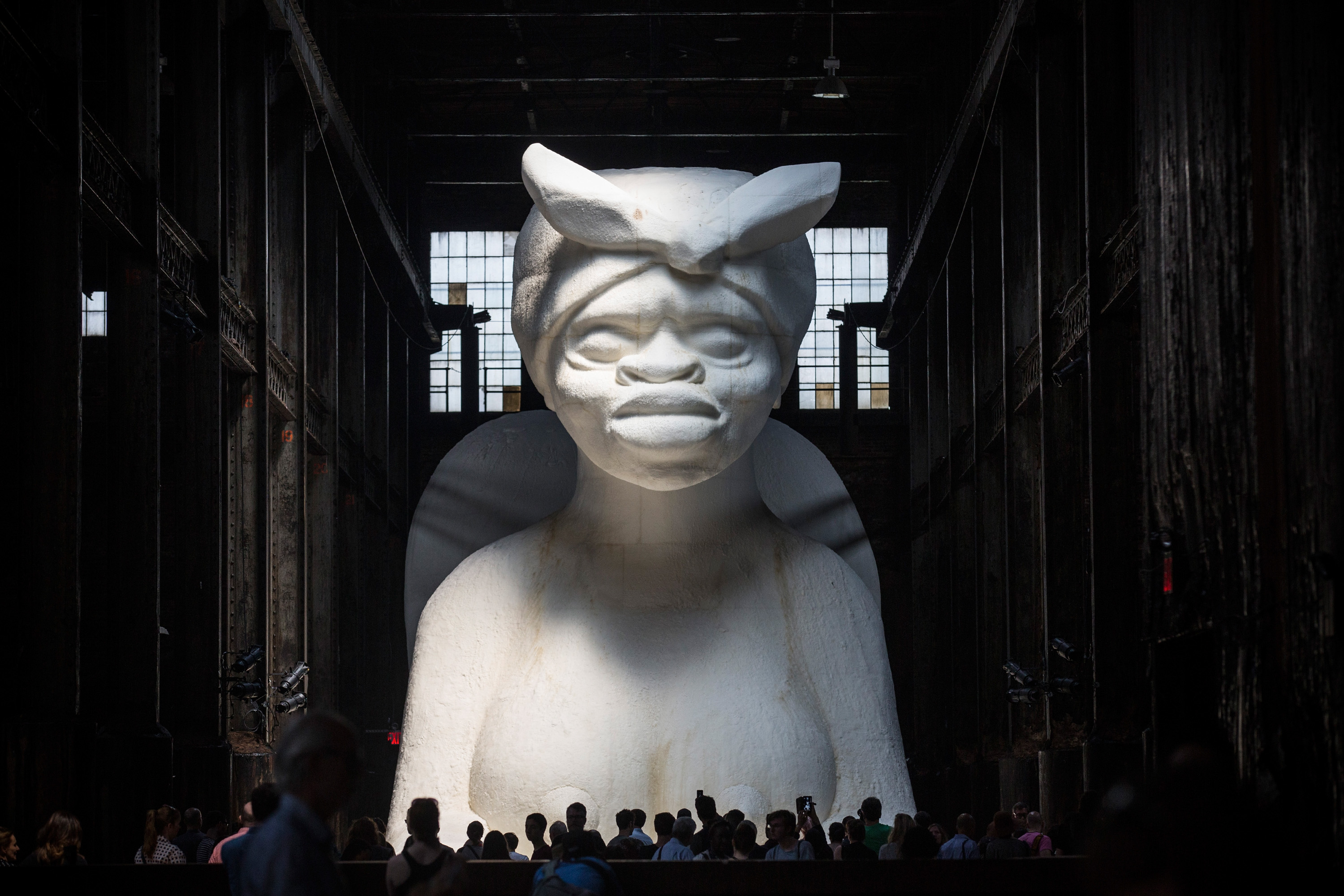
Large Scale Sugar-Coated Sculpture Displayed In Brooklyn's Former Domino Sugar Refinery

Kara Walker, whose work often deals with racial stereotypes, explains the thought process behind her 75-foot-long sugar sphinx, which is on display at the former Domino Sugar Refinery in Brooklyn:

I started with a lot of sketches; each sketch went from very minimal gestures to this maximal output with all kinds of moving parts. It came to embody something I would never want to see, something that was about slavery and industry and sugar and fat and wastelessness. It was a kind of finger-wagging gloom-and-doom kind of sketch that embodied all of the themes about industrialization that the space contains: post-industrial America, the grandiose gesture of the industrialists, and sugar as the first kind of agro-business.

For example, you can’t get sugar without heavy-duty processing; you don’t get refined sugar, you get other things. This desire for refined sugar and what it means to turn sugar from brown to white and how that dovetails into becoming an American were fascinating to me. Sugar is loaded with meaning, with stories about meaning.

Charlotte Burns provides more background on the artwork and significance of its location:

At its peak, the factory was the largest sugar refinery in the world. By 1870, it was producing more than half the sugar consumed in America, and in 1896, the American Sugar Refining Company, which operated the plant, was one of the first 12 companies listed on the Dow Jones.

The sugar trade created a triangular economy: slaves were sold from Africa to the Americas; sugar to New England; and then rum made from molasses was sold back to Africa. “Sugar brought about a new kind of world structure: diets changed, the way business was done changed, there was a rise of the importation of enslaved Africans,” Walker says. The full title of the installation makes this history explicit: A Subtlety, or the Marvelous Sugar Baby, an Homage to the unpaid and overworked Artisans who have refined our Sweet tastes from the cane fields to the Kitchens of the New World on the Occasion of the demolition of the Domino Sugar Refining Plant.

More images of the sculpture and how it was built here.

(Photo: People view Kara Walker’s ‘A Subtlety,’ a sphinx made partially of bleached sugar on display at the former Domino Sugar Refinery in the Williamsburg neighborhood of the Brooklyn on May 10, 2014. The show opened Saturday, is free to the public, and will run until July 6. By Andrew Burton/Getty Images)

The Compulsion To Create

Rebecca Mead, author of My Life in Middlemarch, considers why George Eliot may have chosen artistic creation over biological motherhood:

Eliot sometimes referred to her books as her children, and the writing of them as a form of parturition. She once wrote in a letter of the experience of completing a novel: “the sense that the work has been produced within one, like offspring, developing and growing by some force of which one’s life has served as a vehicle, and that what is left of oneself is only a poor husk.” The image of a new mother as dried out and used up is one of the few places where Eliot’s comprehension strikes me as limited. There are doubtless many new mothers who do feel this way, but it seems to me that a more typical experience might be that which combines utter exhaustion with an unprecedented sense of vitality. (Nothing has ever made me feel so alive as actually producing a new life.) Perhaps this image of being devoured or despoiled by a voracious, needy infant helps explain why Eliot did not follow a conventional course of motherhood. The way she describes it doesn’t sound particularly appealing. Eliot may have decided that she could meet the needs of only one incessantly demanding voice, and that was the voice of her inner creativity.

Divine Wonders And Horrors

dish_bookofmiracles2

Marina Warner reviews The Book of Miracles, which collects 15th- and 16th-century images of “pious episodes from the Bible … mixed with dazzling, bold paintings that could have come from a scientific treatise on astronomy”:

The Book of Miracles unfolds in chronological order divine wonders and horrors, from Noah’s Ark and the Flood at the beginning to the fall of Babylon the Great Harlot at the end; in between this grand narrative of providence lavish pages illustrate meteorological events of the sixteenth century. In 123 folios with 23 inserts, each page fully illuminated, one astonishing, delicious, supersaturated picture follows another. Vivid with cobalt, aquamarine, verdigris, orpiment, and scarlet pigment, they depict numerous phantasmagoria: clouds of warriors and angels, showers of giant locusts, cities toppling in earthquakes, thunder and lightning. Against dense, richly painted backgrounds, the artist or artists’ delicate brushwork touches in fleecy clouds and the fiery streaming tails of comets. There are monstrous births, plagues, fire and brimstone, stars falling from heaven, double suns, multiple rainbows, meteor showers, rains of blood, snow in summer.

Warner highlights the image seen above:

This tremendous picture of a hailstorm on May 17, 1552, over the town of Dordrecht, gives a terminus post quem for the manuscript, as it is the last dated wonder reproduced in the book. The subsequent pages depict scenes of divine retribution from Revelation; in this way reports of strange phenomena are firmly bookended by scripture, and the possibly profane appetite for bizarre and singular occurrences acquires a degree of legitimacy, being directed at the acts of all-seeing and all-powerful providence, and not at the marvelous vagaries of nature.

Previous Dish on the book here.

(Image courtesy of Taschen)

Taking Notes On The Good Book

For Mother’s Day, Byliner has made available to Dish readers Walter Kirn’s My Mother’s Bible, his commentary on the first two books of the Bible, Genesis and Exodus, which was prompted by the discovery of his mother’s annotated King James Bible after her death. Here Kirn describes his surprise at what he found:

Aside from a brief experiment with Mormonism thrust upon her by my father in his attempt to finesse a fierce depression that afflicted him in the 1970s, my mother wasn’t religious as far as I knew. She was, however, immoderately literate. Between her annual rereadings of her favorite masterworks by Gibbon, Dickens, Tolstoy, Goethe, and Shakespeare, she managed over the years to teach herself at least three modern languages and one ancient one. She also kept abreast of the bestseller lists and the more talked-about novels and biographies in the leading book reviews. The Bible, though? I’d never seen her touch it. It must have been a pastime pursued in private, perhaps in her bedroom after her evening gulp of codeine-laced cough syrup, her pet relaxant. (Perhaps this explained her high tolerance for morphine.) I wished I knew where in her house I’d found the volume. A shelf? Her nightstand? Hidden or in the open?

One night about two months after she died, as I entered that manic stage of grief when even rationalists hire mediums, I opened my mother’s Bible to a blank page on which were copied out thirty or forty passages, most of them from the Old Testament. I knew a few of them verbatim and many others in paraphrase, but some, such as this one, were new to me: “For a bird of the air shall carry the voice, and that which hath wings shall tell the matter” (Eccl 10:20). Why had my mother found this image remarkable? Seeking an answer, perhaps even a sign, I turned at random to a verse in Genesis that she’d underlined and starred. It spoke of two more birds, a raven and a dove, which Noah released from the ark to find dry land. I remembered the dove—it flew back with an olive leaf—but I’d forgotten about the raven “which went forth to and fro” and never returned. How had the raven managed to stay aloft so long, with water still covering even the mountaintops?

For the next day, you can read the rest here. Purchase it as a Kindle Single here. Previous Dish on My Mother’s Bible here and here.