The Deaths At Gitmo

Conor Friedersdorf disagrees with Joe Carter's dismissal of the Gitmo "suicides" and acceptance of the official investigations. Carter has a spirited back and forth in the American Scene comment section. Carter:

Let’s be clear: [The guards Scott Horton talked to] can’t prove: (a) the existence of any CIA black site, (b) that any prisoners were moved at all that night, (c ) that the prisoners who died that night were the prisoners they claimed to have seen, (d) that the prisoners were not carried to the medical facility.

The fact is that they have no firsthand knowledge of any of the events that deal directly with the prisoners. They also did not feel it worth coming forward for three years to claim that the official narrative was wrong.

In contrast, 52 guards and medical personnel gave sworn statements within days of the deaths. These statements are quite detailed about what occurred that night (the Seton Hall reports agrees that there is no question the dead prisoners were transported from the cells to the medical facility).

What motive would these 52 men and women have for lying? And assuming they were, how were they able to get their stories so similar to pull off such a massive cover-up?

From commenter "Chet," who refutes Carter repeatedly:

[L]et’s take a look at the report in the light of your claim that “52 guards and medical staff were eyewitnesses to the suicide.” (One wonders how so many people could have personally eyewitnessed the discovery of these hanging corpses. Did they sell tickets?)

Let’s start with the first interviewee: “b3b6 advised that he was not present at Camp Delta when these suicides took place. b3b6 stated that he had no information to provide…b3b6 stated that he learned of the hangings by talking to people.” Oops! Not an eyewitness, then. (51 “eyewitnesses” left!) The next interviewee? The nurse who found the suicide note explains that on the night in question, he was “wrapping up the body of ISN 0093 for shipment” in the Detainee Acute Care Unit and “felt something he assumed was paper in the inside shirt pocket.” This was the suicide note, but notice that it was found on the body, not at the scene of the hanging. So scratch another eyewitness; the bodies had already been “cut down” when this individual discovered the note. (50).

Next (I’m just going down the pages until I find the next interviewee report), the Master Chief at Arms, who testifies that after hearing the alarm raised over radio, ran to Alpha block and saw “two guards holding 0093’s hands and feet. 0093 was lying on the deck in his cell and his eyes were rolled back.” Later, when the second body (588) was discovered, he arrived at that cell, only to find the body already lying on the deck as well. As well, when he arrived at the cell of 693, that body was also lying on the deck, not hanging from the noose.

So, another one of Joe’s “eyewitnesses” proves to never have actually seen any of the victims hanging from a noose. He did, however, see the first one with the rag stuffed down his throat. (49!)

The next interviewee? Informed that one of the detainees had “tried” to hang himself, didn’t actually observe the bodies until they were being carried out of the cell. (48!) The next is finally the first individual who personally testifies to the discovery of 0093 actually hanging by his neck, and the very next page after the record of his testimony is his notification of his legal rights and that he is “suspected of False Official Statements, UCMJ Article 107.) That’s pages 188-189, if you’re trying to follow my work. On the next page, apparently in response to suspicion of perjury, he amends his testimony to note that he at first did not see the detainee in the cell, but when another guard shouted “he’s hanging”, came into the cell to find that guard and the hanging body, with a surgical mask over the mouth and a rag in the throat. (How would a detainee get a surgical mask? How would a hands-bound man stuff a rag down his own throat and don a surgical mask, and why would a suicide need to do so?)

The next testimony is of another guard who only saw the bodies after they had been “cut down.” (47.) The next, the same. (46.) The next observed the bodies being carried out. (45.) The next concerns a guard not on duty at the time of the deaths who searched Alpha block and found nothing in the cells a detainee could hang himself with. (44.)

I’d go on all the way down the list but I think I’ve made my point. Joe’s disingenuous “52 eyewitnesses” claim is nothing but a mirage that evaporates on any kind of inspection. At the end of the day you have a great many guards and medical staff who were told that the detainees had hung themselves, and only 2 or 3 who actually testify to that fact, all of whom were notified of being under suspicion of giving false statements to investigators.
Debating Trauma, Ctd

A reader writes:

I am still thinking over the interview with Susan Clancy. I was sexually abused over a number of years. At first I did not know it was wrong. I was told it was punishment and, for a time, I accepted that. Over time I realized more and more that what was happening was wrong. As this realization increased so did the trauma (for lack of a better word). At that point I was not only a victim but, because of my acquiescing to abuse when it began, I felt that I bore some blame.

To say that there is no trauma is to define trauma as only being the psychological effect at the time of the act. From my experience it is more progressive.

As time progressed and I matured as a human the trauma was slowly revealed or uncovered. It became as oppressive as any trauma suffered by an adult who was fully aware of the wrongness of rape as it happened. Long before the abuse ended I suffered from nightmares and oppressive fear. Those continue 40 years later.

In short, it seems that Clancy is making a narrow definition of trauma, basically a semantic argument, the focus of her book. I fail to see how that helps me and other survivors of sexual abuse.

Another writes:

I experienced childhood sexual abuse (at the hands of a stepfather, until age 7) and two separate, unrelated traumas (being trapped in a burning building at age 5 and an attempted stranger-kidnapping at age 9). I was raised by a Christianist mother who prayed for me instead of getting me a counselor when the results of the latter two traumas showed themselves (night terrors, irrational fears, flashbacks); thus, it was only when I got a secular therapist at age 18 that I really experienced healing and resolution of these things.

I can say without hesitation that the latter two experiences were more traumatic, in that I never had nightmares, flashbacks, etc., related to the molestation.

However, the sexual abuse was far more insidious and difficult to heal from.  It messed with my mind and made me feel guilty, because while I never wanted to be molested, I did enjoy the attention, the feeling that I was special, and the physical closeness and affection that were part of it.  It was confusing beyond anything I can make words describe.  I never blamed myself for getting stuck in the fire or for the pervert who tried to get me into his car.  I blamed myself for decades for getting molested and, to a very small degree, still have my doubts.  My abuser is only marginally more intelligent than the Forest Gump character.  If he could tell that, in some ways, I enjoyed at least aspects of it, like being hugged and paid attention to, doesn't that make me partially responsible?  No, of course not, says my rational, adult self.  The child inside is still, at times, confused.

I read the Salon piece, and I can definitely see where someone who was sexually abused but did NOT grow up in a Christianist religion, with all its inherent guilt-producing nonsense, would find the whole thing confusing but not an especially big deal.  The guilt-production mechanism installed by my early childhood religious training was by far my biggest obstacle in healing.

Dissent Of The Day

A reader writes:

With all due respect I believe that you and Jon Rauch are missing the point. The latest version of the health care bill is not a path to sanity because it has caved to the biggest problem in government – selling out to special interests. Rauch of all people should understand that having written the definitive book on the subject. It is selling out to special interests, and especially to greed and the total lack of character in the way that the government is run which is the problem. That is an even bigger problem than health care.

I have been with you all along on the need to reform health care and fix the many problems, but the bill just got worse and worse and worse. It lost my support when Obama and the Democrats gave in to the unions over so called "cadillac" health plans. Why should they not have to pay a tax when others at the same income level would have to pay the tax? It is blatant special interest politics on top of a whole series of them and that is what has brought this thing down, along with the cost. It is all just too much.

The idea that public employees make less than those in the private sector is a myth that needs to die. Most already have cadillac plans and in most places their salaries are ahead of private workers whose taxes go pay for their income. On top of that they get much better benefits and pensions, so to let them out of a tax that private industry workers will have to pay who work at the same income level is a slap in the face. Our system cannot work if the government employees earn more than the private industry workers earn who are supporting them.

The health plan did not go down because people like me are too dumb to get it or Obama didn't communicate it right. It went down because it had so many straws of costs and special favors to everyone up and down the street that they broke the camel's back.

Obama attacking now, attacking voters who don't get it, attacking the banks, insurance companies, etc, is not going to work. Stop attacking and start doing something about it, that is what people want. Say no to the special interests and make it fair and people will support it. And for God's sake stop blaming voters for being dumb and not getting it, it is the Democrats who are not getting it at this point.

If this kind of good-government purism is necessary for passage of legislation this big and this complex, affecting so many interests and groups, then no bill will ever be passed in the real world.  I don't disagree with my reader on the merits of these specifics. But the urgency of the task, the uniqueness of this moment, and the capacity for further reform puts me in the opposite camp.

Pass. The. Damn. Bill.

Jon Cohn explains why there are plenty of things in it for nervous Democrats to sell this fall:

The people who constructed this reform plan aren’t stupid. They knew voters would be anxious to see results. And they designed the reform plan to produce such results. Health reform is full of what wonks call “deliverables”–tangible benefits scheduled to take effect mere months after the bill becomes law. Among them: Seniors will see the Medicare “donut hole” start to shrink.

Families will get to keep kids on their policies past high school, until the kids are 26.

Preventative services will have "first-dollar" coverage, meaning you'll pay nothing out-of-pocket–that's right, nada, zilch–when you get a regular checkup.

People who are uninsurable because of high medical risks will get access to catastrophic policies, as a stopgap until full coverage becomes available in a few years.

The government will set up a website with information about different insurance plans, letting people compare benefits in standardized, plain English terms.

It will also make investments in the health care workforce–spending money to train or hire new primary care doctors, nurses, and direct care workers.

Insurers will have to fess up about how much money they divert from patient care to overhead and profits–and to set up systems for appealing coverage denials.

People will have the right to go to the emergency room–and women the right to see an obstetrician/gynecologist–without prior approval.

The list goes on.

Pass. The. Damn. Bill.

Jonathan Bernstein makes good points about the Republican attack reflex and gun-shy Democrats:

Republicans are attacking Democrats for taking away people's guns, even though the Democrats basically surrendered on that issue fifteen years ago.  They are attacking Democrats for cutting Medicare and for allowing Medicare to grow so fast that it'll bankrupt the nation — sometimes in the very same speech (I've seen it in the same paragraph).  Republicans have, repeatedly, attacked Barack Obama for not using a word he uses all the time.  Last I heard, they were still attacking the Democrats for bringing back the Fairness Doctrine, something that as far as I know not a single elected Democrat has any interest in doing.  No, it didn't make sense, but if they don't have attacks ready that make sense, they'll use ones that don't.

…don't back off of [the health care bill] because you think it will open you up to attacks; you're wide open right now, and you'll remain wide open regardless of what you do. 

Pass. The. Damn. Bill.

HealthcareBrokenOut

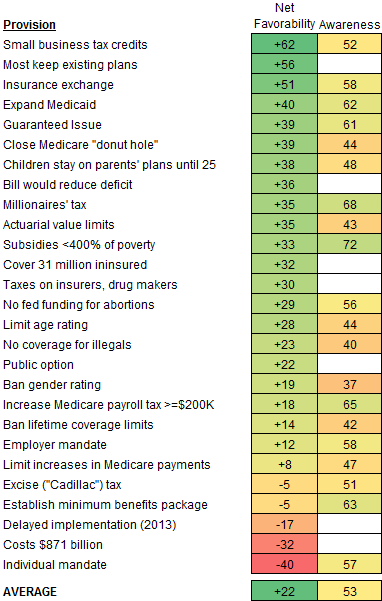
Nate Silver shows that most of the individual parts of health insurance reform are very popular:

What we see is that most individual components of the bill are popular — in some cases, quite popular. But awareness lags behind. Only 61 percent are aware that the bill bans denials of coverage for pre-existing conditions. Only 42 percent know that it bans lifetime coverage limits. Only 58 percent are aware that it set up insurance exchanges. Just 44 percent know that it closes the Medicare donut hole — and so on and so forth.