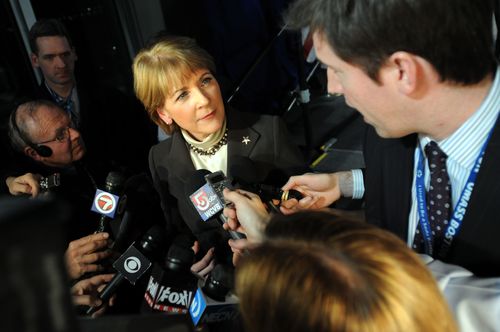
“Yes it sucks. Yes you have to vote Coakley.”

COAKLEYDarrenMcCollester:Getty There is the general political environment that has made the Massachusetts Senate race so tight. There is the money-bomb from the GOP trying to turn this into the death-knell for health insurance reform. There is the effort made by Scott Brown. But then, as in every race, there’s the candidate, Martha Coakley: a classic, insider, Democratic party machine hack with little talent and every single irritating aspect of the presumptious Massachusetts liberal. Think John Kerry. And then lower your standards a few thousand feet. 

Barely campaigning, avoiding the press, courting out-of-state donors, and relying on activists and union organizers to get people to the polls, she responded to a reporter who challenged her strategy thus:

“As opposed to standing outside Fenway Park? In the cold? Shaking hands? This is a special election. And I know that I have the support of Kim Driscoll. And I now know the members of the [Salem] School Committee, who know far more people than I could ever meet.’

 Blue Mass Group sums up much of the sentiment on the bloggy left:

Yes it sucks. Yes you have to vote Coakley.

Even the Globe, which endorsed her, has called her out for refusing to debate Brown one-on-one.

Rather than make a strong case for her own policies, she called Brown’s surge in the polls frightening. Then she did what this kind of liberal does and lashed out at Brown with a series of negative ads that compared him to Bush and painted him as pro-life (his record is pro-choice).

Then there are the recent rhetorical blunders: Stating that al Qaeda is no longer in Afghanistan, airing an ad that misspelled “Massachusetts,” citing Republican “stalkers” in response to the assault of a Weekly Standard reporter by one of her staffers. And behind all this is a long history of questionable decisions that her opponents in both the primary and general elections have barely touched: her lax prosecution of a horrific rape case, her cutting a deal with a pedophile who molested again, her role in keeping an innocent man locked up, her incompetence in arguing a key Supreme Court case, her reluctance to pursue the Menino email scandal, her questionable use of campaign funds.

Brown hasn’t even directly exploited much of this. But Massachusetts voters know it. If the Dems lose next Tuesday, they will deserve to.

(Photo: Darren McCollester/Getty.)
Making His Case

Emily Bazelon brings us the latest on the Tiller trial:

[O]n Tuesday, the judge trying Scott Roeder, Tiller’s accused killer, left dangling the possibility that Roeder can show that he committed not murder but voluntary manslaughter. To show this, Roeder will be allowed to argue that he was justified in shooting Tiller because he was trying to “protect the unborn.”

She closes:

Scott Roeder will get to put on testimony about why he thought he was justified in killing Tiller. He will have a show trial in which he can present himself as a martyr to the cause of the unborn. Judge Wilbert has repeatedly insisted that he won’t let this trial become a trial about abortion. But that’s exactly where his ruling is taking us.

Are The Tea-Partiers Mellowing? Ctd

Larison wonders:

Tea Party activists in the Northeast are backing a viable candidate in Massachusetts to seize the opportunity of competing for an open Senate seat. This should make clear that the nature of the Tea Party agenda is going to depend on the region where the activists are operating, and it should also emphasize how relatively unimportant social conservative issues are to the Tea Party agenda, whose focus is heavily fiscal and economic. The willingness to acknowledge regional political differences is an encouraging sign that these activists could combine their anti-establishment populists instincts with attention to local political conditions and grievances. That shows the flexibility needed to rebuild a national political coalition.

Scott Brown’s Mindless Op-Ed

His Globe piece is presumably a good way to assess his platform. And it highlights all the bankruptcy of the current conservative establishment. Take a couple of issues. He starts by listing national problems:

Public debt has reached $12 trillion and counting, and Washington politicians want to borrow trillions more.

His solution?

My plan for the economy is simple: an across-the-board tax cut – in the tradition of John F. Kennedy – for families and businesses that will increase investment and lead to immediate new job growth. More tax increases will hurt our recovery. That’s why I have taken a no-new-tax pledge. My opponent will raise taxes.

Does anyone see the contradiction here? Without any tax increases, indeed with more tax cuts, the spending reductions required to reduce the debt will be fantastic: massive cuts in Medicare, Medicaid, and defense. Where does he outline these spending measures? Nowhere. Fiscally, he's as fraudulent as Bush.

More absurdity here:

It’s time to admit that while the $787 billion stimulus had the best of intentions, it failed to create one new job.

Even if you believe that stimuli are wasteful or inefficient, I know of no sane economist who believes that $800 billion did not create one new job.

Then he's in favor of the Massachusetts universal health insurance reform, on which Obama's is based, but for some reason against the one for the country. Why?

But the healthcare bill under discussion in Washington is not good. It will raise taxes and increase spending. If you are a senior on Medicare, it will lead to a half trillion dollars in cuts to your care.

So Brown supports health care exchanges, a mandate, and universal care … but opposes healthcare exhcanges, a mandate and universal care. He is worried about the debt but actually opposes the proposed cuts in Medicare that can make universal insurance affordable – let alone the cuts necessary to bring us back from the fiscal abyss.

He is, in other words, a parody of the brainless bush Republican, mixed with Romney-like cynicism.

Chart Of The Day

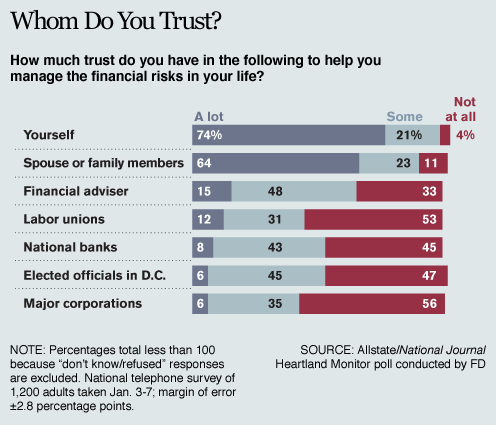
Trust
Blumenthal responds to an earlier Dish post:

Watching a clip of Glenn Beck interviewing Sarah Palin, Andrew Sullivan catches this comment from Beck: "I don't know yet if [Palin's] strong enough, if she's well-enough advised, or if she knows she can no longer trust anyone." Sullivan goes on to comment that "distrust of everything in politics, of every politician, of the 'system' that has been co-opted by mysterious and menacing elites, and a sense of total beleaguerment in the modern world" has become a familiar theme from "the far right."

For what it's worth, "distrust of everything" was also a prominent theme of a briefing I attended [yesterday] morning on the new Allstate/National Journal poll. As my colleague Ron Brownstein put it [yesterday] morning, in an economy where they are "more directly exposed to financial risk than earlier generations," Americans "don't have much confidence that any institution, government, business or the financial sector is doing much right now to help them" deal with that risk.

The Coming Democratic Freakouts?

John Henke peers into his crystal ball:

The first Democratic freak out will be an internal Congressional fight in 2010 over whether to (1) move big and fast while they still have the votes, or (2) slow down and preserve as many seats as they can. The second Democratic freak out is going to occur in 2011 and beyond, when Democrats try to figure out what the lesson of the 2010 elections really is.

The Prop 8 Trial: Day Four, Ctd

Paul Hogarth tries to understand why Edwin Egan was called to give testimony on the economic benefits of marriage equality:

Olson and Boies are probably bringing in all this evidence to cover their bases, because it’s harder to bring in evidence later.  If — and it’s a big if — the federal courts recognize gays as a “suspect class,” then it’s a whole new ballgame.  In that case, Prop 8 would only be constitutional if it’s justified by a compelling public interest, narrowly tailored through its least restrictive means.  All of a sudden, the economic downsides of repealing gay marriage are very on point — because now Prop 8 can be thrown out for not being “narrowly tailored.”