The GOP’s Latest Obamacare Mistake

German Lopez highlights it:

About 80 to 90 percent of Obamacare enrollees are paying their insurance premiums, major health insurers testified before Congress on Wednesday. The insurers’ testimony undercut a report from House Republicans that found only 67 percent of enrollees on Obamacare’s federal exchanges had paid their premiums. Insurers only start coverage after they have received a first month’s premium payment from an enrollee, making the percent paid an important metric to gauge how many people will actually gain coverage.

House Republicans’ report, insurers explained, got that metric wrong.

Allahpundit wonders why the House Republicans rushed to issue that 67 percent number:

Theory one: Stupidity. If and when the final payment numbers are released and it’s confirmed that 10-20 percent of new enrollees, a.k.a. 800,000 to 1.6 million people, will be tossed from the rolls, the White House now has some handy spin. “Once again Republicans underestimated ObamaCare,” they’ll say. “They thought we’d top out at 67 percent payment and we made it to 80 percent. Another victory!” Always a bad idea to lower expectations for your opponent. Theory two: Cynicism. Maybe the committee suspects (correctly) that most people don’t follow the news consistently but get it in bits and pieces at irregular times, especially when it comes to a subject as complex and long-running as ObamaCare. As such, they may have decided to float the 67 percent figure knowing/assuming it was bogus but confident that some low-information voters would notice it and conclude that O-Care was underperforming in yet another metric. Some of those voters will miss today’s news and the White House crowing to come about the correct figure and remain convinced that fully a third of new enrollees haven’t paid.

Suderman puts a negative spin on the new numbers:

The House GOP report was too early, ignored deadline issues, and turned out to be problematic as a result. But based on insurer testimony, the administration’s much-touted total of 8 million sign-ups is likely to be reduced by a million or more when converted into paid enrollments. In other words, the administration’s figures were too rosy by quite a bit—just not as much as House Republicans suggested.

Cohn frames the story very differently:

“What you have here is very solid first year enrollment, no matter how you slice it,” Dan Mendelson, president of Avalere Health, told Bloomberg’s Alex Wayne.

If an account of Wednesday’s hearings by The Hill‘s Elise Viebeck is accurate—I didn’t see them—the testimony from insurers didn’t sit too well with members of the House majority. “Republicans were visibly exasperated,” Viebeck reported, “as insurers failed to confirm certain assumptions about Obamacare.” Republicans have had plenty of chances to embarrass Democrats over Obamcare and, given the law’s very real shortcomings, they’ll be sure to have plenty more. But on Wednesday, it seems, Republicans mostly succeeded in embarrassing themselves.

Dissents Of The Day

Many readers are protesting along these lines:

Did you actually listen to the context of what they were discussing? If you don’t have the time to actually listen to a few minutes worth of what you’re passing on as “The Closed Mind of Neil DeGrasse Tyson“, then you probably don’t have the time think about the meaning of the word “meaning”.

Another goes after Damon Linker:

Rather than calling Linker’s hatchet-job a “must-read”, go and listen to what Neil DeGrasse Tyson actually said. Linker completely misrepresents him.

Yes, I did listen to the context and now I have listened to much more of it. Tyson reeks of scientism and rank condescension to philosophy and to philosophy’s role in humanity’s understanding of itself and the whole. The more I listened the more the philistinism deepened, the more the sophomoric cliches about philosophy proliferated – you “can’t cross a street”, for Pete’s sake, if you’re concerned with the ultimate questions! I’ve heard freshmen with sharper insights at 3am. Most troubling to me is the notion that all human thinking must somehow have some “productive” end or is worthless. One thing that distinguishes human beings from other animals is our self-consciousness, and all the questions that raises. But Tyson “doesn’t have time for that.” Another reader elaborates on the dissent:

I’ve listened to the clip, and I call bullshit on Linker’s hyperventilation over Tyson’s comments. Tyson was pretty clearly talking about the diminishing practical returns on philosophical debate, and he has a great goddamned point that many a liberal arts major should consider.

At what point does a person’s philosophizing cease to provide positive societal value, and become, in essence intellectual masturbation? At what point would society as a whole benefit from focusing more on the practicalities of modern science versus the arcane twaddle of modern philosophy? Tyson clearly believes that recent “discoveries” in philosophy are more masturbatory than helpful, and that we should focus our energies more productively.

Were his comments glib? Sure. (Although, Tyson and his fellow podcasters had just finished riffing on comparisons between Newton’s development of calculus and reality programming on TMZ, so the tongue-in-cheek nature of his comments is hardly out of line.) But that comment does not make Tyson “every bit as anti-intellectual as a corporate middle manager or used-car salesman.” It makes him a sarcastic SOB who thinks the world would have been better off if your six years of philosophy study at Whitman College had been spent studying electrical engineering at MIT. And its hard to argue that he is wrong.

Actually, it’s very easy to argue that he is wrong. If humanity had always had that perspective the very concepts of math and science would not exist. Another reader:

Tyson was referring to thinking big in the sophomoric, pseudo-intellectual way of someone taking their first philosophy class as an undergraduate. “What if we’re all brains in vats, man?” “What if I am all that exists?” “All of life is chemical reactions, so how do I know what is even real?”

These are all totally unanswerable questions that don’t lead anywhere. They don’t further knowledge in any meaningful sense. They just lead you into a cul de sac of admiring your own cleverness. It’s like the old bit from Gilbert and Sullivan: “If this young man expresses himself / In terms too deep for me, / Why, what a very singularly deep young man / This deep young man must be.”

Another who listened to the podcast:

It is my understanding that for philosophy to be effective, it needs to be rooted in logic. Which is why listeners need to start their assessment of Tyson’s point back to to at least 15:00, where Dr. Tyson states:

I don’t have a problem with these philosophical questions, just give me a way to test it. Math is about getting finite answers to infinite regressions. It it is measurable whether you like it or not. If you are distracted by your questions, you are being productive and not contributing to the real world.

As in, why is a pound a pound? What does the answer to that contribute to anything? Linker starts his rant on the Giordano Bruno overblown kerfuffle, to which I say, “What’s your point”? I find it laughable that Linker equates Tyson’s comments as derogatory to Plato, Aristotle, Aquinas, Hume, Kant, Hegel, Nietzsche, Heidegger, or Wittgenstein, as the latter references Aristotle in Cosmos as one of the great thinkers and that many of his ideas were proven once the logic and results of calculus was applied. In short, Damon Linker is quite thin-skinned.

I’d say my readers are. Look: I understand why DeGrasse Tyson is so popular (I’m not engaging in our long twilight struggle as to who will win the final battle for the most appearances on Colbert) and I’m a big believer in better and wider understanding of science. But when he responds to first order questions of meaning by demanding how he can test them, he is simply engaging in an irrelevance. The ways to test one school of thought is not the same as for another. Tyson is asserting that only science’s methods are valid as a search for truth. My view is that it is one way of seeking a particular truth – but that humanity, over the millennia, has developed others, just as relevant to the human condition, but with different forms of logic and understanding. In glibly dismissing any such claims, Tyson is, I believe, in this podcast, as Damon describes him.

Update from a reader:

I want to respond to your reader who claimed that “the world would have been better off if your six years of philosophy study at Whitman College had been spent studying electrical engineering at MIT.” I’m a senior web developer working on very large, complicated site builds. My undergrad degree focussed on oil painting, and my postgrad degree is an MFA in creative writing. A good friend of mine, one of the most talented network architects in the NY area (who is likely responsible for your NY readers being able to access your blog reliably), has an undergrad degree in philosophy and no formal training in his field. An informal poll of my colleagues reveals that almost none of them have an engineering or comp sci degree. As much as I appreciate your reader’s advice on our educational choices, I think we’re doing fine for ourselves. The dirty secret of engineering is that experience matters more than education, and knowing how to think and solve problems trumps all.

America’s Game Of Thrones

This embed is invalid


It is the elephant in the room as we approach 2016. Not that the issues of dynasties and oligarchies are not being aired. They are, relentlessly. But have we truly absorbed the sheer national embarrassment that out of a country of more than 300 million people, the two likeliest presidential nominees for the two major parties will be the wife of a former president and the brother and son of two former presidents? It’s impossible to think of any developed Western democracy that could even begin to match this pathetic, incestuous indictment of a democratic system.

Britain – that repository of privilege and class and monarchy? Well, two Miliband brothers did vie to become leader of the opposition quite recently, I suppose. But after that: not so much. France? Well, there is Marine le Pen. Canada? Germany? I’m sure readers can turn up some other dynastic impulses in other Western countries. But I can’t believe they can rival the concentration of family power in the US.

Now of course the US has long been dynastic in its politics. From the Adamses to the Roosevelts and the Tafts to the Kennedys, America’s robust capitalist economy has thrown up wealthy, connected families who have brought entire family trees into office. And it’s not all bad. Some have been motivated by more than power – some even dedicated to noblesse oblige. And the last two elections – in which a previously obscure son of a single mother managed to prevent a dynastic coronation in his own party and then defeated another family political dynasty, the Romneys – show that we’re not Rome yet.

But surely, our new emperors are looking more Roman by the day. The names themselves – like Caesar or Tudor – become brands. The brands create large, sprawling networks of hangers-on, former elected officials, fundraisers, media stars, and all the corporate synergy something like the Clinton Foundation can muster up. Politics becomes at times about daddy issues, or fidelity questions, or succession crises – like the monarchies of old. And outsiders have fewer chances of breaking through the celebrity-pol chatter – because the sheer cost of politics has become so astonishing in an era where there are close to no limits on campaign finance.

Is there anything to be done? Vote for Rand Paul … oh, wait a minute.

He only has his job because of his father as well. When even the mavericks are dynasts, you begin to see the scope of the problem. And what’s striking about American dynasticism is its relative indifference to criticism. In fact, dynasty is often embraced as an advantage. I can’t believe that George W. Bush would have been elected without his family name, for example, and the early fundraising prowess it bestowed on him. It gave him a leg-up in Texas and then the dynasty reassured those who were worried about his, let us say, jejune qualities, that there was a responsible family business to back up the new entrepreneur. And so Cheney was the back-stop. And we know where that ended up. The idea that the dauphin would retain one of the last king’s advisers is so … old Europe. By which I mean circa 1500 – 1900.

And to watch Dubya wax lyrical about his brother without even a trace of embarrassment at the open dynasticism of it all is almost as disturbing as the Clinton family’s prepping of Chelsea for heir apparent. Both the Bushes and the Clintons are shameless about this. Hillary will clasp Bill to her side as an asset for her future administration, just as Jeb could invoke the increasingly fond memories of his father. And no one really protests the fetid privilege and undemocratic spirit of the entire enterprise. I guess it’s just one of those American quirks that keeps getting quirkier.

But one thing I don’t think we’ve really thought through is how this picture of late-American oligarchy and dynasticism affects America’s stature in the world. America’s preaching about equality of opportunity and democratic virtues cannot but be etiolated by the sense that it’s all a scam, that America is one big oligarchy perpetuating its incestuous elites in a manner far more similar to a declining monarchy than a rising, robust democracy. That weakens the soft power America can wield, and undermines the ideals America has previously stood for. All Americans are equal, but a tiny few, by virtue of birth, are far, far more equal than others. I just want to utter a sharp protest – before we forget about it all, all over again.

Alma Mater Doesn’t Matter

According to a recent study, graduates of prestigious colleges are no happier than graduates of less-celebrated institutions:

Researchers found that attending a public or private school, whether it was elite or less selective, had little bearing on one’s feeling of well-being or how engaged graduates were with their post-college work. Gallup defined well being based on measures of social, financial, and physical status, as well as how the survey’s 30,000 respondents rated their sense of community and purpose. The type of school graduates attended had little impact on whether they reported high levels of well-being more or less across the board.

What did affect well-being for graduates were factors such as having professors and mentors who cared about them, winning a relevant internship, participating in extracurricular activities, completing long term projects, and feeling supported by their school. Although graduates of prestigious schools may earn more, money didn’t translate to a greater sense of well being.

And debt matters:

At a time when parents, graduates and lawmakers are increasingly concerned about the crippling impact of student loan debt on recent graduates, this report’s findings confirm that the issue is critical to their overall well-being. The data are clear and dramatic: 14 percent of graduates with no debt reported thriving in all areas of their lives, compared with just 4 percent of graduates with $20,000 to $40,000 in student loan debt and 2 percent of graduates with more than $40,000 in debt. According to the survey, “the higher the loan amount, the worse the well-being.”

Caitlin Emma reviews more of the study’s findings:

On the whole, 51 percent of 30,000 college graduates surveyed said they’re not engaged or “actively disengaged” in the workplace. But about half of graduates said they’re thriving when it comes to their sense of purpose, community and social lives. Forty-two percent said they’re thriving in financial management and 35 percent said the same of their physical health. In one “inspiring” finding, Gallup Education Executive Director Brandon Busteed told Morning Education that minority and first-generation students are just as likely to feel like they’re thriving post-graduation, even though they’re statistically less likely to graduate.

Bullied Kids Up In Arms

Screen_Shot_2014-05-05_at_5.16.19_PM

A new study finds that kids who are bullied are more likely to bring a weapon, such a gun, a knife, or a club, to school with them. German Lopez compiles the findings into the chart seen above:

The results aren’t very surprising, given years of warnings from anti-bullying advocates. As Mother Jones points outStopBullying.gov previously indicated that 12 of 15 school shootings in the 1990s involved perpetrators with a history of being bullied. It’s worth mentioning, however, that the data shows correlation, not causation. It’s possible, for example, that people who carry weapons are more likely to fall into conflicts that lead to bullying. In those circumstances, weapons might not be carried for protection as much as aggression.

The data also doesn’t exclude other risk factors, such as mental illness or easy access to guns, from playing a role in school shootings. It’s unexplained in the study, for instance, how these students obtained weapons in the first place.

Scott Shackford fears that this finding will be used to justify more oppressive school policies:

Researchers estimate based on the poll that 200,000 teens being bullied are bringing weapons to school. … But if all these students are carrying weapons and yet there aren’t hundreds of thousands of incidences of school violence by bullying victims every day, what is the actual extent of the problem versus the fearmongering? Schools already have their terrible zero tolerance rules that have resulted in all sorts of twisted outcomes for stupid reasons. It’s easy to imagine misguided, indifferent school administrators responding to the study by exposing the bullied students to increased scrutiny, all in the guise of protecting student safety. That could have the additional impact of causing students to be even less likely to report harassment.

Ranting On The Phone At Starbucks

That’s what I did yesterday when Digiday called me up to ask about sponsored content. The resulting interview is here. Money quote:

Brian Braiker: Digiday runs sponsored content.

AS: You’re whoring yourself as well, but at least you’re covering the whoring! They’ve fired all their brothel reporters and started hiring them as brothel greeters.

Or something like that. I can get worked up after a tall, wet cappuccino.

Update from a reader:

As someone who does a lot of development of large media sites (my company specializes in this), I’m responsible for the technical implementation of many of these sponsored content schemes.

I agree with you. These publications are trashing their own credibility, and they will suffer in the long term.

That being said, I’m of a generation that doesn’t see the media as an institution in the same light that you do, so to me these are just businesses that are paying my company to torpedo their long-term viability. Which now that I think about it is pretty much what every media company we work with is doing in a number of different ways. There’s a real stink of desperation coming off of all of these guys, and they’re often very unpleasant to work with, as their stress and panic inevitably rolls downhill onto me. (It’s better than working for startups though, at least some of these companies still manage to make money.)

I’m happy to keep getting my news from you, and I’m also happy to pay for it. I think the patronage model is a better, more honest approach for both journalism and art (I refuse to refer to it as “content”), and your blog is proof that it can work. I don’t ever need to worry about you selling me stuff. If you ever have any questions about the nuts and bolts of how Google watches everything you do and then tells anyone who will pay, I’d be happy to answer them.

Nuclear Is Better Than The Alternative, Ctd

A reader agrees with me:

Yes, the left is blind on this issue. As an environmental engineer, I’m always puzzled by the reaction of so-called environmentalists who immediately reject nuclear. But the right isn’t any better. Neither political party will implement reprocessing. One, because they reject nuclear in general, and both, because terrorists.

We as a nation do not reprocess our fuel, thus we have massive amounts of fuel that must be stored. The Yucca Mountain depository was inadequate by the time it was built, with more spent fuel than capacity. In the 1970s, reprocessing was banned out of fear of terrorists getting their hands on plutonium. There are downsides to reprocessing – namely the process does create some very toxic waste streams (much more so than normal spent fuel) and potentially weapons-grade plutonium. However, France has reprocessed for decades and we’ve figured out techniques to avoid weapons grade fuel.

People don’t understand nuclear power and are needlessly scared of it because of Chernobyl and poor education on the topic (even in college). Having worked in refineries, coal plants, hydroelectric dams, and nuclear power plants, I would rather live inside a nuclear plant than within 10 miles of the others.

From an attorney who focuses on energy policy:

The basic thrust of your point is well-taken: environmentalists must be strategic about how we deal with nuclear energy, and forcing the immediate closure of nuclear plants is a counterproductive strategy, especially in parts of the country (such as the Northeast) where resources are already stretched to capacity and grid reliability is a pressing issue.

However, there are two things that you miss in your post.

First, increased reliance on nuclear energy would do essentially nothing to disentangle us from the Middle East. That part of the world supplies us with, of course, a significant amount of oil. But in the US, oil is consumed primarily for vehicle fuel, for industrial uses (i.e., plastics), and for home and industrial heating (among various other things); only a tiny fraction of it is user for electricity generation. In fact, only about 1 percent of our current electricity derives from burning oil at power plants, and no new oil-fired units are predicted in the near future. Nuclear fission, on the other hand, has only really only one major civilian application: generating electricity. (Of course, there are also various military uses for it, including weapons material and powering large ships and submarines.) There simply isn’t much overlap between oil and nuclear, and shifting our dispatch significantly to electricity generated from nuclear plants won’t help us much extricate ourselves from the Middle East.

Second, there’s economics. Let’s put aside for a moment all the other problems related with nuclear, such as safety, localized health impacts (which are  highly uncertain), proliferation risks, and the perpetual problem of waste storage and disposal. Nuclear electricity generation is, at the heart of it, just a damn expensive way to boil water. Even disregarding the generous public subsidies that nuclear energy enjoys, its overall cost per megawatt-hour is still more than that of various renewable energy sources, such as onshore wind and geothermal, and is comparable with that of solar (both rooftop solar and larger-scale generation). Moreover, the cost of solar is diminishing rapidly, and can be expected to do so on into the future; nuclear, not so much. Yes, many of these sources receive subsidies as well, but the rapid cost-saving innovations that are occurring as we speak more than justify that from an economic standpoint (to say nothing of the environmental benefits).

In short, while nuclear power plays a role in our current generation mix, it’s not the long-term solution to our electricity needs. Increasing our reliance on renewables and maximizing our opportunities for energy efficiency are.

Another reader speculates:

While I agree that there are many in the environmental movement who are on the wrong side of nuclear power, I think your previous post is too quick to label it as an ideological issue. Rather, I think it’s generational. I know that I and many others in my age range (born in the mid-’80s) are pretty agnostic when it comes to nuclear power. Our parents, however, lived through Three-Mile Island, through Chernobyl, or May 1953, when Chicago was pummeled with rain carrying radioactive dust. These were serious errors caused by either a lack of understanding or a lack of thorough oversight in nuclear power. My generation has never lived through these. The closest we have is Fukushima, and it’s hard to relate to a place that is that far away.

Another is less blasé about the dangers:

Just as you need to calculate the health and environmental effects into the electric cost of fossil fuel plants, you have to calculate the cost not only of waste disposal, safety, and security precautions, but the risk – however low – of having to evacuate and abandon an area in case of an incident like Fukushima and Chernobyl. What do you figure the cost per kilowatt hour at Fukushima was after adding in the still ongoing and fraught cleanup process there?

Every few decades nature seems to remind us that it is very hard to engineer a structure to account for every possibility. I am all for an everything-is-on-the-table approach to combat global warming and don’t discount the possibility that we will need to build more nuclear power production. But the burden is certainly on the industry and the government to convince the public that our existing plants are safe, nuclear waste is being responsibly taken care of, and future plants are prepared as they can be for “unpredictable” events.

Cleaning Up After Your Adult Kids

Living At Home

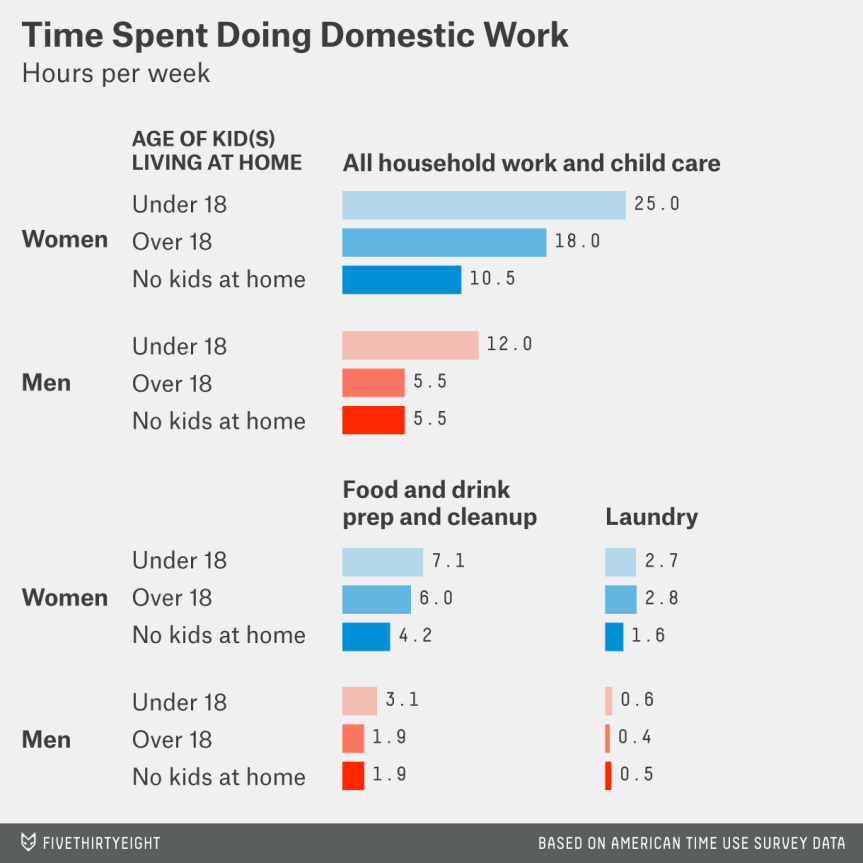
Heather Krause considers the impact that young adults living at home have on their parents:

According to an analysis of data from the American Time Use Survey, which asks a nationally representative sample of people to record how they spend their time every day, parents with 18- to 31-old children living at home are spending at least eight hours per week caring for them. That’s causing real shifts in the time they spend relaxing. (Their sex lives are also being affected.) And women are spending significantly more time taking care of these young adult children than men are. It’s not news that women do more work around the house than men, or that women have less leisure time than men. What’s new is that the period of care is getting longer, even if it’s mitigated by the increased responsibility and independence of these adult children.

The Enigma Of Authorship

Novelist Tim Parks contemplates the personal questions writers get from the readers who gather to hear them speak:

“Do you think your move to Italy altered the way you think and write?”

“Has it been useful for you as an author to translate as well?”

“Does your wife read your books and if so what does she think of them?”

None of these questions are directly addressed to the novel you are presenting. Yet one has to grant that if only one knew the answers, something would be learned. … Who are you, to be producing this stuff? That’s what they’re asking. The irony perhaps is that what’s mysterious to them is even more mysterious to you. Yet even as you try and inevitably fail to answer their questions you are probably telling them more, in your perplexity and frustration, or your wryness and charm, than you ever could have by explaining your book.