The Closed Mind Of Neil DeGrasse Tyson

A must-read from Damon Linker:

Go ahead, listen for yourself, beginning at 20:19 — and behold the spectacle of an otherwise intelligent man and gifted teacher sounding every bit as anti-intellectual as a corporate middle manager or used-car salesman. He proudly proclaims his irritation with “asking deep questions” that lead to a “pointless delay in your progress” in tackling “this whole big world of unknowns out there.” When a scientist encounters someone inclined to think philosophically, his response should be to say, “I’m moving on, I’m leaving you behind, and you can’t even cross the street because you’re distracted by deep questions you’ve asked of yourself. I don’t have time for that.”

“I don’t have time for that.”

Chart Of The Day

Global Poverty

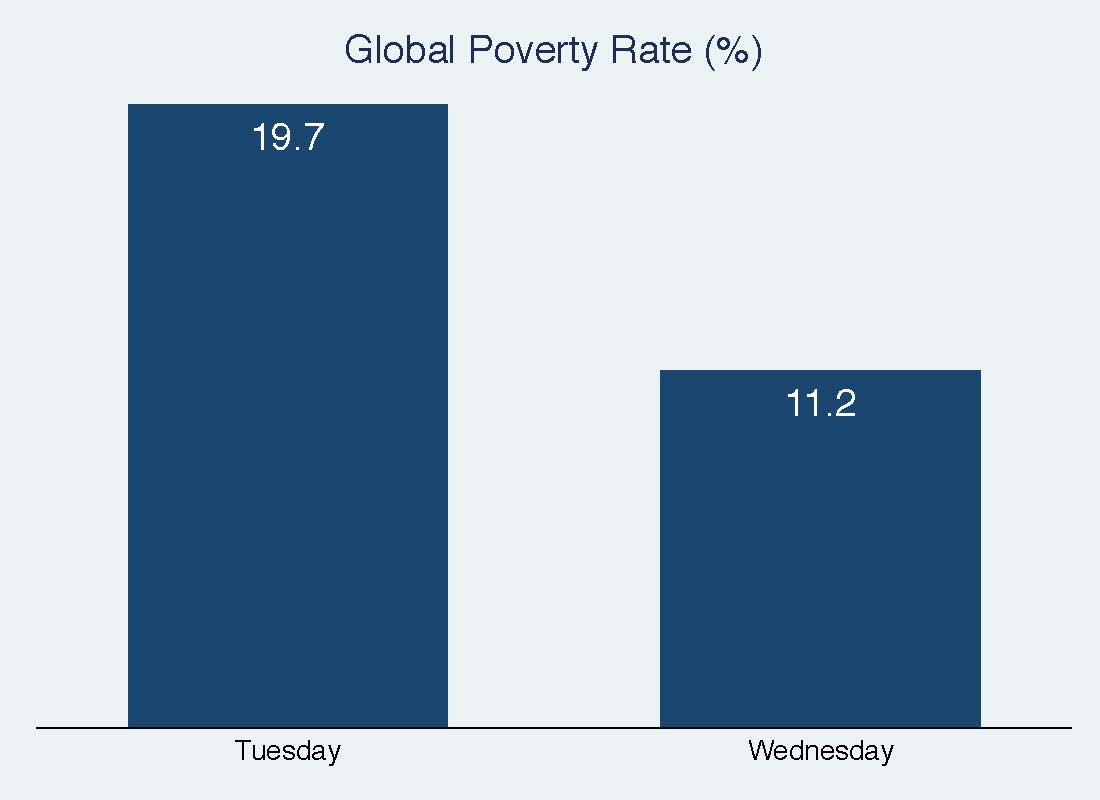
Sarah Dykstra, Charles Kenny and Justin Sandefur explain the overnight change in global poverty levels:

Global poverty numbers involve two sets of data: national income and consumption surveys (collated in the World Bank’s PovcalNet) and international data about prices around the world.   The [International Comparison Program (ICP)] is in charge of this second set of data.  It compares what people buy and at what local currency price they buy those things to come up with a ‘purchasing power parity’ exchange rate, a ratio that is designed to equalize the power of a rupee to buy what Indians buy with the power of a dollar to buy what an American buys.  Tuesday [last week], the ICP released their estimates for what those purchasing power exchange rates looked like in 2011.

In short, the new PPP numbers suggest a lot of poor countries are richer than we thought.

China’s improved PPP numbers got the most attention last week, but the change is much bigger than that:

India’s 2011 current GDP PPP per capita from the World Bank World Development Indicators is $3,677.  The new ICP number: $4,735.  Bangladesh’s 2011 GDP PPP per capita according to the WDI is $1,733; the ICP suggests that number should be $2,800. Nigeria goes from $2,485 to $3,146.

Dylan Matthews takes a closer look at the data:

The reasons the rate fell so dramatically are fairly technical. To figure out what $1.25 a day means in different countries, economists generally compare the price of a “basket” of goods across those countries. The results they get are thus pretty sensitive to the point in time when you compare baskets. The old data used a comparison from 2005; the new one is from 2011.

Basically, the World Bank found that prices of goods included in the basket were lower than the extrapolation from 2005 data had predicted they would be.

He adds some caveats about the quality of this data. Another important point:

[T]he biggest reason not to get too excited is that the 8.5 percent of the world that’s no longer counted as poor by this metric is still, by any objective measure, not faring well at all. “The people who have just been classified as ‘not absolutely poor’ don’t actually have any more money than they did yesterday, and will still struggle in terms of getting a decent job,” Dykstra, Kenny, and Sandefur note, “Many still face grim daily tradeoffs between buying school supplies or ensuring their kids are well nourished.”

Tweet Of The Day

Screen Shot 2014-05-07 at 6.38.28 PM

Thanks to Weingarten for joining me in the punch bowl.

Bringing A Smart Gun To A Dumb Fight

Emily Bobrow looks at the lengths gun rights activists are going to—including intimidation and outright threats of violence—to keep “smart guns” out of the US:

As it happens, guns that work only when they are in the hands of their legal owners do indeed exist. Armatrix, a German company that makes a .22-calibre “smart gun”, had plans recently to begin selling them in America. But then something odd happened: the very people who were trying to bring these guns to market began receiving threats from gun enthusiasts. Belinda Padilla, the head of the American division of Armatix, no longer picks up the phone if she doesn’t recognise the caller, having fielded too many scary calls. Andy Raymond, a gun-dealer in Maryland, decided not to sell the Armatrix guns after receiving death threats. Both Ms Padilla and Mr Raymond are pro-gun; they simply believe there is room in the market for some with safety mechanisms. But aggressive and antagonistic campaigns from gun-lovers have ensured that not a single American gun-dealer will risk selling Armatrix smart guns.

This is remarkable. It is one thing for gun-rights advocates to quibble over a few paternalistic whistles and bells on some guns for sale; it is quite another for them to prevent these guns from ever reaching store shelves. Gun-lovers argue that the smart guns could pave the way for a host of new safety regulations. These fears are apparently heavy enough to justify manipulating the market.

As it turns out, all the fuss comes down to a law in New Jersey. Adrianne Jeffries explains:

There has been renewed interest in smart guns since the Newtown school shooting, which reinvigorated the gun-control debate. However, there is immense pressure not to be the first to sell them. That’s because of a New Jersey law passed in 2002 known as the Childproof Handgun Law, which says that all guns sold in New Jersey must be state-approved smart guns within three years of a smart gun being sold anywhere in the country.

The goal was to make smart guns mandatory as soon as the technology existed. Officially, no smart gun has been sold in the US yet — meaning if Raymond had sold one, it would have triggered the clause in New Jersey. … Smart-gun advocates say the technology will stop kids from shooting themselves with their parents’ guns, undermine the market for stolen guns, and protect law enforcement from having their guns used against them. “We need the iPhone of guns,” said Ron Conway, a Silicon Valley investor, referring to the phone’s fingerprint unlock. Conway is backing a $1 million contest for smart-gun technology. “We want gun owners to feel like they are dinosaurs if they aren’t using smart guns,” he told the Washington Post.

But David Kopel lays out the arguments against smart guns:

There is an inherent difficulty in making a computer chip, which is supposed to read a radio wave, a palmprint, or some other identifier, function with perfect reliability in an environment a few inches from frequent gunpowder explosions, along with gasses and particles of lead debris.

Persons who own firearms for self-defense (the core of the Second Amendment, according to Heller) would be especially wary, since a gun which works 99.5% of the time is not sufficiently reliable for self-defense. Most people who have experience with fingerprint readers, magnetic key cards, etc., know that these devices are often convenient, but they are not reliable enough to bet one’s life on them. This is one reason why there has been zero adoption of personalized guns by law enforcement, even though the initial impetus for personalized gun research was for law enforcement use. Indeed, the New Jersey law exempts law enforcement; the exemption is an admission that personalized guns are insufficiently reliable for lawful defense of self and others. A recent article on the website of American Rifleman (a NRA member publication) details some potential problems with hacking or jamming of computer-dependent guns.

America Is Getting Old

Population Over 65

Derek Thompson examines the latest numbers:

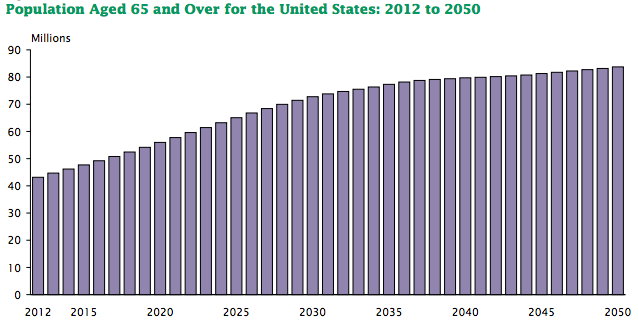
Today, one in seven Americans is over 65. In 15 years, one in five Americans will be over 65. The gray boom is inevitable and it’s happening for two simple reasons. The first reason is that all Americans are living longer (except, for mysterious reasons, poor women). The second reason is that every living member of the baby boomer generation, the largest adult generation in U.S. history (there are actually more Millennials, born between the early 1980s and late 1990s), will be older than 65 in the year 2030. Here, from a new Census report, is a look at the steady growth of 65+ Americans—a population that will double in the next four decades.

Drum shrugs:

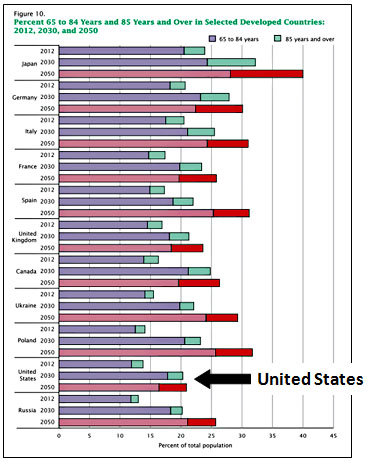
Take a look at the red bars in the chart on the right. They show the projected size of the elderly population in various developed countries in 2050, and the United dependencyStates is in by far the best shape. Our elderly population stabilizes in 2030 at about 21 percent of the total population, a number that’s significantly lower than even the second-best country (Britain, at 24 percent). Most other countries not only have elderly populations that are far larger, but their elderly populations are growing. These countries have demographic problems.

It’s worth driving this point home: America doesn’t really have a huge aging problem. We have a very moderate aging problem, which could be handled in the federal budget with fairly modest changes to Social Security and Medicare. What we do have is a health care problem. But that’s a problem for us all.

Ben Casselman joins the conversation:

One reason the U.S. is in better shape is its comparatively high rate of immigration. Since people tend to migrate when they are younger, immigrants tend to bring down the age of the population as a whole. Moreover, at least in the U.S., immigrants tend to have a higher birth rate than the native-born population, although the gap has narrowed somewhatin recent years. The future direction of immigration, therefore, makes a big difference to the age breakdown of the U.S. population. The Census Bureau’s demographic estimates are based on a middle-of-the-road projection of future immigration, but the bureau also publishes alternative scenarios. In the “high immigration” scenario, the U.S. has nearly 22 million more working-age residents in 2050 than in the “low immigration” case.

Lydia DePillis adds:

Even as the elderly population increases, the younger population decreases in relative terms, which leaves the overall dependency ratio relatively stable. In 2050, it’ll even be substantially lower than it was in the roaring 1960s … Of course, youth dependency and old age dependency carry different kinds of burdens — older people require more medical care, while young people carry more educational costs. So the economy will still have to adapt to take care of the shifting load of non-working people. But overall, the picture is a lot less alarming when you know America has borne something similar in the past.

Working Without A Lunch Break

Lizzie Widdicombe tried out the food-substitute Soylent. What living on it felt like:

As [Soylent creator Rob] Rhinehart puts it, you “cruise” through the day. If you’re in a groove at your computer, and feel a hunger pang, you don’t have to stop for lunch. Your energy levels stay consistent: “There’s no afternoon crash, no post-burrito coma.” Afternoons can be just as productive as mornings.

But that is Soylent’s downside, too.

You begin to realize how much of your day revolves around food. Meals provide punctuation to our lives: we’re constantly recovering from them, anticipating them, riding the emotional ups and downs of a good or a bad sandwich. With a bottle of Soylent on your desk, time stretches before you, featureless and a little sad. On Saturday, I woke up and sipped a glass of Soylent. What to do? Breakfast wasn’t an issue. Neither was lunch. I had work to do, but I didn’t want to do it, so I went out for coffee. On the way there, I passed my neighborhood bagel place, where I saw someone ordering my usual breakfast: a bagel with butter. I watched with envy. I wasn’t hungry, and I knew that I was better off than the bagel eater: the Soylent was cheaper, and it had provided me with fewer empty calories and much better nutrition. Buttered bagels aren’t even that great; I shouldn’t be eating them. But Soylent makes you realize how many daily indulgences we allow ourselves in the name of sustenance.

Previous Dish on Soylent here and here.

What Climate Change Will Mean For Us

White House Climate Maps

Brad Plumer features maps from the National Climate Assessment, which was released this week:

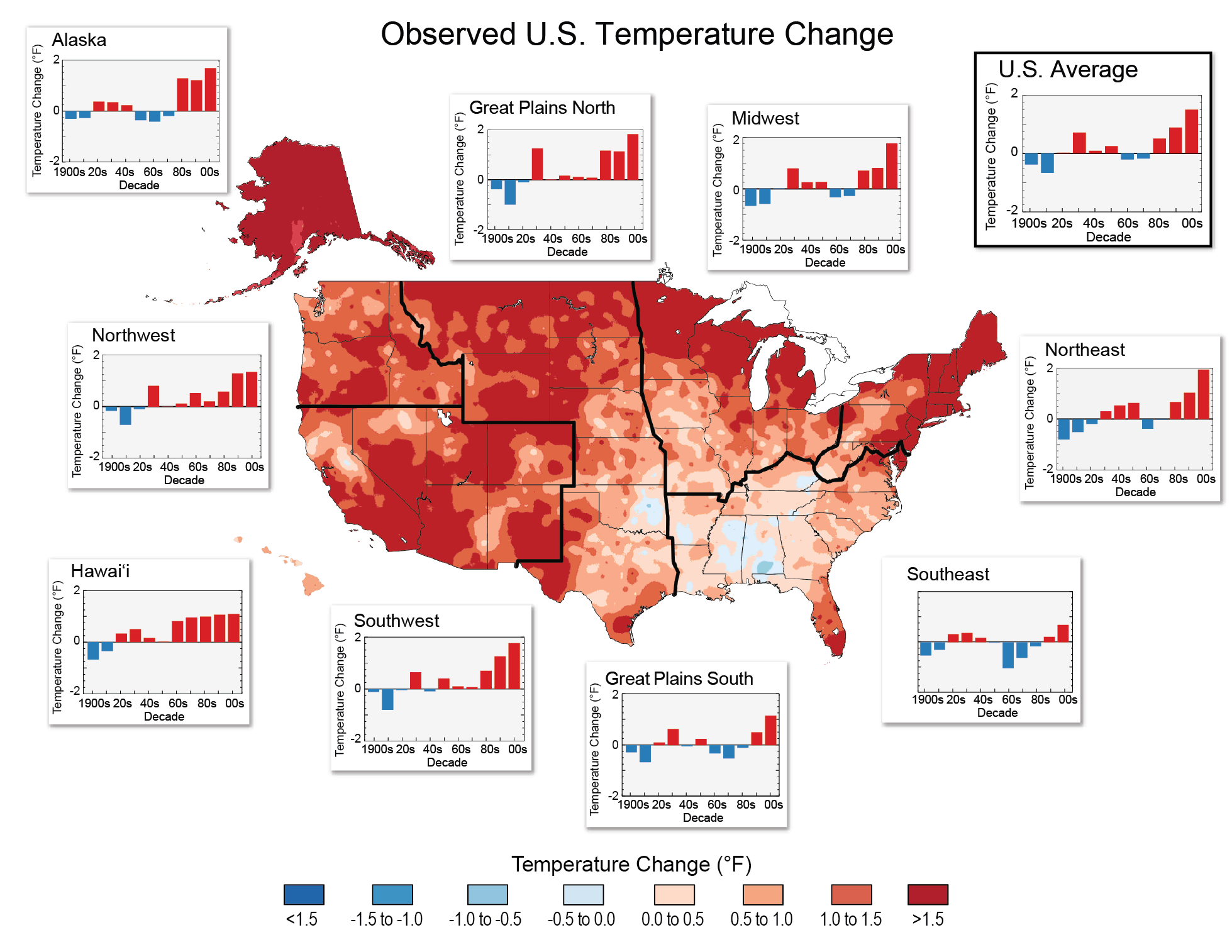
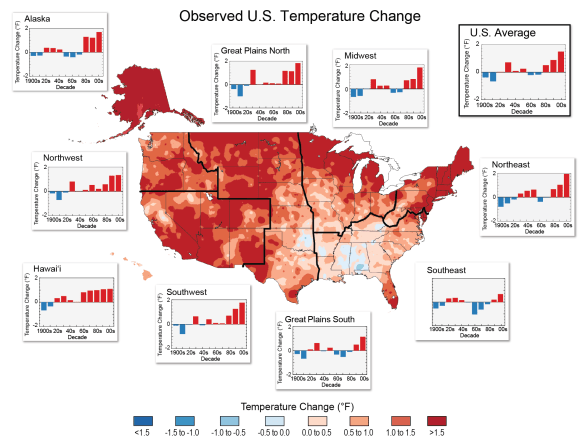
This map is the simplest way to see global warming in action. Since the 19th century, average US temperatures have risen by 1.3°F to 1.9°F. (Note, though, there have been some fluctuations here and there: in the 1960s and 1970s, temperatures dipped, partly due to the cooling effect of sulfate pollution that was eventually cleaned up.)

Recent decades have been even hotter: since 1991, every region in the United States has been warming, with the biggest temperature increases occurring in the winter and spring.

Peter Coy observes how the report “tries to shake people awake by making climate change up close, personal, and present, rather than abstract and in the future”:

The risk of this up-close-and-personal approach is that it could make some fence-sitters on climate change feel manipulated. The atmosphere is a complex system, and scientists don’t know enough about it to trace every regional variation in climate straight back to global warming.

The benefit is that there’s a strong scientific consensus that on the whole, climate change is causing an increase in extreme weather. The authors of the National Climate Assessment are betting that people will be more impressed by shoreline scouring in the Great Lakes than by the latest prediction regarding average sea temperatures in the western Pacific a century from now.

Chris Mooney looks at specifics:

According to the assessment, the Western drought of recent years “represents the driest conditions in 800 years.” Some of the worst consequences were in Texas and Oklahoma in 2011 and 2012, where the total cost to agriculture amounted to $10 billion. The rate of loss of water in these states was “double the long-term average,” reports the assessment. And of course, future trends augur more of the same, or worse, with the Southwest to be particularly hard hit. As seen in the image at right, projected “snow water equivalent,” or water held in snowpack, will decline dramatically across this area over the course of the century.

And then there is Alaska:

Nowhere is global warming more stark than in our only Arctic state. Temperatures there have increased much more than the national average: 3 degrees Fahrenheit since 1949, or “double the rest of the country.” The state has the United States’ biggest and most dramatic glaciers—and it is losing them rapidly. Meanwhile, storms batter coasts that used to be insulated by now-vanished sea ice.

Ben Adler provides more highlights:

“Heat kills people, and it sends thousands of people to emergency rooms because climate change fuels longer and more severe heat waves,” says Kim Knowlton, a scientist with NRDC’s health and environment program and an author of the Human Health chapter of the NCA. “There will be 10 more days over 100 degrees for the entire country on average from 2021 to 2050,” notes Liz Perera, a federal climate policy analyst at the Sierra Club. “The interesting thing there is that regionally there’s actually quite a distribution difference. It will be worst in the Southwest, Southeast, and Great Plains.” Those, of course, are already the places with the harshest summers. The U.S. has recently seen its worst heat waves in history, and increasing casualties as a result. A study published in the journal Epidemiology found, for example, that in July 2006, “California experienced a heat wave of unprecedented magnitude and geographic extent … Coroners attributed 140 deaths to hyperthermia, and it has been estimated from vital statistics data that in excess of 600 heat-related deaths may have occurred over a 17-day period.” The study also found that climate change is causing worse humidity to accompany heat waves, making them more unpleasant and dangerous.
Who Should Pay For Culture?

Astra Taylor, author of The People’s Platform: Taking Back Power and Culture in the Digital Age, explains why she sees the rise of sponsored content as part of a larger economic problem:

[W]hen people aren’t being funded to create work by publishers or labels or whatever, then advertisers end up filling in that gap. Advertisers are happy to see the stuff they’ve branded out there for free, they don’t care about scarcity, they want any message they’re invested in to be shared and to be abundant and to be passed along. One thing that struck me about going to … tech conferences was all the enthusiasm for free culture, and remixing, and social media, but people’s greatest ambition was to be sponsored by Chipotle or something equivalent to that. It was this weird mix of collaborative, utopian claims and this total acquiescence to commercial imperatives. I think that overall, ultimately the impact of advertisers calling the shots is a more cloying, complacent culture.

Evegeny Morozov finds that one of the most important messages in Taylor’s book is that “web-enabled innovations like crowdfunding make for wonderful add-ons to, but very poor substitutes for, existing cultural institutions”:

[W]hat does it mean to democratize culture? To some, it means getting rid of gatekeepers such as the National Endowment for the Arts and replacing them with some kind of direct democracy, in which citizens can simply cast their votes for or against particular films or books. But this is definitely not how Taylor sees it. “Democratizing culture,” she writes, “means choosing, as a society, to invest in work that is not obviously popular or marketable or easy to understand. It means supporting diverse populations to devote themselves to critical, creative work and then elevating their efforts so they can compete on a platform that is anything but equal.”

But Tom Chivers argues that both Taylor and Morozov are a bit too black-and-white in their thinking:

Taylor’s book, it strikes me, is not so much directed against the internet – even though that is the “people’s platform” of her ironic title – but against the free-market purists who are in charge of so much of it. The cheerleaders she quotes regularly suggest that what the public is interested in is exactly the same as what is in the public interest: so long-lens shots of bathing celebrities, or lists of funny pictures of cats, are just as worthy as the best 14,000-word New Yorker investigative feature. The invisible hand of the free market will always create the best of all possible worlds, they say.

Meanwhile, Ann Friedman is eager for solutions:

Yes, some of the best technical minds of our generation are being used to create ad software. But there are also plenty of people who want to use their engineering skills to fix the very social problems Taylor describes. How can we support this type of entrepreneur? After all, I can’t choose a more artist-friendly alternative to Spotify if it doesn’t exist.

I wish [Taylor] had devoted two or three chapters to such possible solutions rather than merely referenced them in her conclusion. The problems she explains in convincing detail are of the looming, complex variety that have vexed activists for generations. If the Internet really does pose new slants on these old problems, as she argues, it must also present new opportunities for remedying them.

Previous Dish on The People’s Platform here.