Will Rafsanjani Finally Get Off The Fence?

Masoud discusses the widening gulf between conservatives and Khamenei in the wake of Ashura:

If Rafsanjani decides to take the unprecedented step of coming out against Khamenei, which is not as outlandish of a possibility as it once was prior to Karoubi’s blatant condemnation of the regime last night, it would undoubtedly be a game-changer. Simply put, it would openly signal political abandonment of the regime by the country’s second most powerful figure. If Rafsanjani remains quiet, however, questions will surely begin to be raised as to where his true allegiances lie. Consequently, as the demands of a galvanized and broadening opposition grow, he will arguably be less and less able to hedge his bets.

Khamenei The Uniter

Meir Javedanfar insists that the Supreme Leader has brought an "intifada" upon himself:

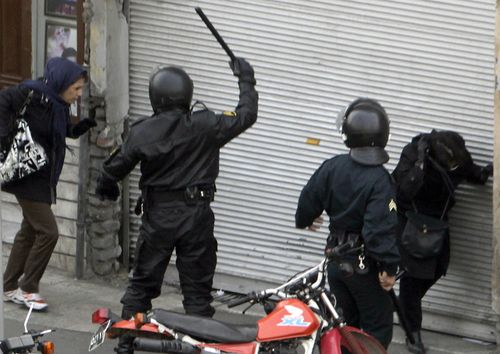
His decision to allow the Basij to mount an attack on mourners at Ayatollah Montazeri's funeral was one factor leading to the spread of opposition in rural areas, faster and more efficiently than any campaign the reformist camp could have orchestrated. Yes, members of the opposition tried to take advantage of the mayhem, but also many genuine mourners had come to pay homage to a Grand Ayatollah. […]

If the Shah had committed such an affront, one could have attributed it to his brute dictatorial secularism. But for the Supreme Leader of an Islamic Republic to order violence against Islamic institutions means turning against the very establishment that formed the foundation — or the very DNA — of the current regime.

Letting The Regime Collapse

Stephen Walt reiterates the restraint he believes the US government should have towards the Iranian protestors:

If you’re looking for a useful historical analogy, think back to the "velvet revolutions" in Eastern Europe. Neoconservatives used to argue that the rapid and mostly peaceful collapse of communism proved that rapid democratic transformations were possible in unlikely settings, and they used that argument to justify trying the same thing in Iraq. (We all know how well that turned out.) In fact, the velvet revolutions were a triumph of slow and patient engagement from a position of strength. The upheavals in Eastern Europe were an indigenous phenomenon and the product of containment, diplomatic engagement, and the slow-but-steady spread of democratic ideals through the Helsinki process and other mechanisms. And the first Bush administration was smart enough to keep its hands off until the demise of communism was irreversible, which is precisely the approach we ought to take toward Iran today.

The Assassination Of Ali Mousavi

Ali-mousavi

More details emerge:

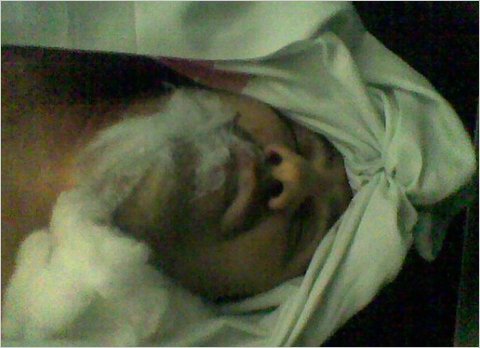
Unlike the other protesters reported killed on Sunday, Ali Moussavi appears to have been assassinated in a political gesture aimed at his uncle, according to Mohsen Makhmalbaf, an opposition figure based in Paris with close ties to the Moussavi family. Mr. Moussavi was first run over by a sport utility vehicle outside his home, Mr. Makhmalbaf wrote on his Web site. Five men then emerged from the car, and one of them shot Mr. Moussavi. Government officials took the body late Sunday and warned the family not to hold a funeral, Mr. Makhmalbaf wrote.

Juan Cole adds some punch to what we already know about Ali:

Killing a sayyid is a blot on any Iranian government. Doing so on Ashura, the day of morning for the martyred grandson of the Prophet, Imam Husayn, borders on insanity.

Targeting Banks

Juan Cole notices an underemphasized detail from yesterday's protests:

The report of attacks on banks makes me think that there is an economic dimension to this uprising. President Mahmoud Ahmadinejad's profligate spending had provoked very high inflation last year, up to nearly 30%. Although the government maintains that inflation is now running 15%, that is still a hit that average families are taking, on top of the high prices of last year. And, many economists suspect that the true rate is higher than the government admits.

Inflation hurts people on fixed incomes or people who cannot easily raise the price for the services they offer. Since much of the economy is locked up in government-owned companies or semi-public 'foundations' (bonyads), some controlled by the Iranian Revolutionary Guards and others by elite pro-regime clerics, there may be a monopoly effect operating from the huge public sector that limits private merchants' and entrepreneurs ability to raise prices. Being 15-20 percent poorer every year would make a person angry.

Moving On The Leadership

Enduring America is up and live-blogging:

0930 GMT: Rah-e-Sabz has more [link] on what appears to be a Government raid on the offices of the Assembly of Teachers and Researchers of Qom. Earlier it was reported that Hossein Mousavi Tabrizi, the head of the Assembly, was arrested.

0845 GMT: The Regime (Tries to) Strike Back. Unconfirmed reports that, in addition to the arrest of prominent reformist Ebrahim Yazdi, Iranian authorities have detained Mir Hossein Mousavi’s advisors Mohammad Baghriyan and Ghorban Behzadian-Nejad.

Not Lying Down

95442865

Josh Shahryar wrestles with the retaliatory violence displayed yesterday:

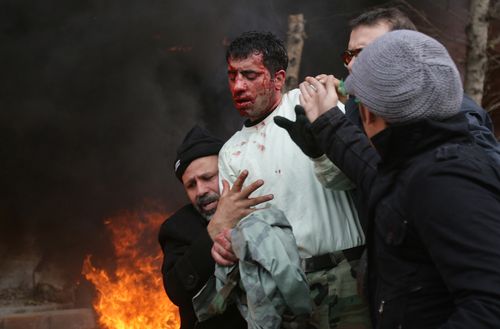
For the first time in 200 days, the Iranian people decided that enough was enough. If the government was going to send goons, then they were going to deal with them the way goons are dealt with. We had seen burning homes, bleeding protesters and protesters being dragged across streets. This time around, we saw burning police cars, bleeding Basijis and riot police being dragged and beaten.

As a human rights activist and an admirer of Mahatma Gandhi, the Rev. Martin Luther King Jr. and Nelson Mandela, I am strictly opposed to violence. What went on in Iran yesterday was anything but peaceful. Protesters fought back and they fought back hard. The level of violence against protesters may have been high, but it was answered – maybe not as violently, but clearly it was.

This prompted many of my friends and colleagues to question their support for the Green Movement. After all, we were expecting a non-violent revolution – one spurred by peaceful protests.

But let us not forget. There is a difference between unprovoked acts of violence against individuals and self-defense. Did we really expect the Iranian people to just sit back and allow the government to kill, maim and arrest people ad infinitum? What would I or you do if someone used violence against us for six months over and over and over again? Are we going to go out and present ourselves as living targets for shooting practice?

(Photo: An Iranian police officer is taken away by people after allegedly being beaten by opposition supporters during an anti-government protest in Tehran on December 27, 2009.  -/AFP/Getty Images)