As Ladies’ Home Journal shifts from a monthly to a quarterly publication, Harold Pollack looks back on the serious journalism that occasionally graced its pages over the past 130 years, and highlights the role women’s magazines have played in bringing important issues to light:
Recent journalism in women’s magazines has explored surrogacy, use of anti-depressants during pregnancy, sexual harassment in higher education, Bill Clinton’s newfound role as a political spouse, even insurers’ unethical rescission of health coverage. My brilliant dissertation advisor Richard Zeckhauser told me to read Ann Landers and Dear Abby with special care. I found much good material there. When the moment is right, women’s magazines could contribute something more, too. One such moment occurred on May 1, 1950, when Ladies Home Journal printed a taboo-breaking article by Pearl Buck called “The child who never grew.” Buck recounted her gradual discovery of her daughter Caroline’s intellectual disability, and describes her painful decision to institutionalize Caroline at the age of nine within the Training School at Vineland, New Jersey.
You think I’m taking the Lewinsky bait? Glad she’s been able to survive what was a traumatizing experience. But Graydon Carter won’t get a subscription from me. I am, of course, eagerly awaiting Darrell Issa’s inquiry into Lewinsky’s previously concealed role in the Benghazi conspiracy.
There are now 28,560 subscribers. There are also 37,000 of you who have used up all your free read-ons and still haven’t subscribed. If you’re in the Dish that deep, $1.99 is a pretty small price to pay for the site you read so much. If even a tenth of you subscribed, we’d be past 30,000 subs. So take the plunge tonight (it takes a couple minutes max) and help this model of reader-supported web journalism thrive against the onslaught of sponsored content and constant advertising noise. Update from a reader:
You finally got me. Not only do I never pay for web content but I’m so philosophically opposed that I’ve published essays against the disappearance of the old free and universal web. Well, you got me. I subscribed today. What pushed me over the edge? Your post about your seasonal allergies in Washington, DC. I am a DC native and those two miserable weeks every spring nearly kill me. It’s much less of a problem where I live now (Maine). For one split second I imagined your allergies killed you. I realized the Dish has become a ritual for me, like reading the newspaper used to be. It’s the sort of ritual of community affirmation Benedict Anderson describes in Imagined Communities. And if your allergies ever did put you in the Big Sleep, I’d have a real hole in my life. Ugh, you finally got me you bastard.
(Photo: The Crimea travel poster produced by the USSR’s state tourist agency Интурист (Intourist), 1965 (indianriverposterco.com) via the great Eric Baker.)
My old friends at The Economist have their nickers in a twist (look it up) about the loss of American “credibility” because there has been no military response to Ukraine, little follow-up in Libya, and a crossed red line in Syria. The leader (look it up) makes some vague and confusing statements along the way. It argues that “international norms, such as freedom of navigation, will be weakened,” if the US doesn’t somehow throw its weight around more, while simultaneously acknowledging that “America towers above all others in military spending and experience.” They concede that on Ukraine, military force would be insane and Germany and Britain have made stronger sanctions impossible as of now; they also misstate what happened in Syria. They claim that “The Syrian dictator [used chemical weapons], and Mr Obama did nothing.” Nothing? So how is it that Syria has now peacefully relinquished almost all of its chemical stockpile? And wasn’t resolving that question – and not the broader problem of Syria’s sectarian implosion – the entire point of the threatened strike? Are we supposed to prefer an option that would have dragged the US into the Syrian vortex and not guaranteed any actual success to a policy that kept us out but largely solved the problem?
The first thing to say about this is that The Economist is fundamentally a British paper. It has a vast US readership, but its DNA is British. And being British for the past several decades has meant being reliant on the US to protect its security. Of course the Brits want the US policing every nook and cranny of the world. They don’t have to pay for it; yet they get to enjoy its fruits. They argue, of course, that these are fruits for America as well. And so they are. And if anyone were even thinking of reducing America’s maintenance of international trade routes, for example, they might have a point. But policing the world with the US military is not cost-free at all – either fiscally or in more basic human terms.
Think of the Vietnam War and the Iraq War – both conceived under the influence of the hubristic fumes and the idiocy of the “credibility argument: (see Peter Beinart’s take on that particular fallacy here). Look at the country’s debt – a huge amount of which can be traced to the military-industrial complex that Eisenhower warned us so presciently about, and one that went on steroids in the first decade of this century. And look at average living standards – stagnant for three decades at least in some part because of globalization. You can argue that the US should not withdraw from the world (and I would) – but withdrawal from the world is not the same thing as prudent and sensible recalibration of resources in a debt-racked, over-extended and thereby less effective country on the world stage.
We are not, paceThe Economist, still living in the post-Cold War era, when the US ran a surplus. We are living in a post-post-Cold War era where America owes inconceivable sums to China, a soon-to-be-bigger economic power. And if you want to see American influence really decline, then the best way to do that is to maintain unsustainable over-reach. You’d think Brits would have taken this lesson to heart, since that was one core reason they lost their empire as well. And history is littered with the demise of other over-stretched powers, like the Soviet Union or Imperial Spain. The future is littered with other potential over-reach victims, the most obvious of which is Greater Israel, run by many of the same neocons who drove the US into a ditch only a few years ago.
More to the point, it seems increasingly clear to me that this post-post-Cold War era is one destined to last for the foreseeable future. And the fundamentals of that era are increasingly opposed to the concept of American global hegemony. No one can police the world today as the US did in the 20th Century. The rationale of the world’s policeman has thus radically changed. As Millman notes in a superb piece:
The rise of Japan was followed by the rise of smaller east Asian states and now the rise of the Asian mega-states, China and India. Latin America and the Muslim Middle East have grown into substantial regions, demographically and economically, and are no longer obviously under Western control (or even influence). Africa’s demographic momentum, meanwhile, will carry that continent to far greater prominence by the end of the century than it has ever achieved before.
Not only are these other powers much stronger relative to the US – an inevitable function of the success of US foreign policy in the past – but they don’t accept America’s right to dictate the contours of the global order. Russia is the most obvious example, right now. But that was the deepest lesson of the Iraq catastrophe: the Iraqis didn’t actually want the things that Americans (including me) reflexively thought they wanted. They live by different values and different priorities. The [indigenous] sect beats the [imperial] nation every time; and authoritarianism trumps democracy every time. And our attempt to force them to be live by Bill Kristol’s values only guaranteed the failure.
America’s reflexive belief that its way of the world is superior to everyone else is also increasingly, tragically, attenuated.
It will take decades to recover from the state-authorized torture and detention policies of the Bush administration and the Obama administration’s refusal to adhere to the Geneva Conventions. American democracy is widely seen across the world (and not without reason) as an oligarchy of the super-rich; its Republican hinterlands are regarded as a repository of know-nothingness; its virulent opposition to providing access to healthcare for all is seen a psychosis; its NSA is viewed as a threat to allies; its police-state airport borders the sign of a society less free than many in Western Europe. And there is no Soviet Union to point to when America is challenged on these grounds. The alternative is not obviously much worse.
Now you can go on pretending that this hasn’t happened – and isn’t still happening – as the Economist and the Beltway hand-wringers do. You can topple the Libyan regime on humanitarian grounds, just as in the olden days (except Reagan was much less interventionist). But you’ll leave a nest of Jihadists in your wake. But all this has happened – and America’s collapsing infrastructure has become an emblem of a polity in steep decline. Obama has mitigated this to a heroic extent – but the underlying reality remains. We have to let go of control; we have to stop seeing every crisis in the world as one that America has to resolve; we have to tend to ourselves before we lecture to anyone else. And this the American people understand, as poll after poll tells us. And without the American people squarely behind it, no American foreign policy can succeed.
In the Ukraine crisis you see this most vividly. We supported the Maidan revolution but its practical effect has been to render order and peace throughout the country close to non-existent. Ukraine’s reformers have some responsibility for their predicament. They pissed away the post-Soviet era in rampant corruption, military decline, and economic stagnation. They removed a democratically elected government by violence, something inimical to any hope for democratic reform. They have no coherent plan for resisting Putin’s foul expansionism. Like Morgan Stanley, they expect to be bailed out – and that helped create this crisis. I’m far from exonerating Putin. But if we fail to see the arguments behind the propaganda of the other side, we will fail.
Of course, this process of letting go will be anxiety-producing. Relative decline is never easy for a hegemon, especially one drunk on the fumes of its own self-love. There will be a backlash. But you’ll notice how few of the current critics of Obama’s vastly under-rated foreign policy don’t actually have much to say specifically about how they would better defuse these myriad ructions across the globe (and they are mere ructions compared to the past, it’s worth remembering). At some point they will begin to see that their lack of alternatives is a function of something other than their nemesis in the White House. And at some point, one can only hope, they’ll grow up.
In the study looking at how MDMA could treat PTSD, the drug was given in conjunction with talk therapy. Patients lay down in a therapist’s office and listened to soothing music with headphones, wearing eyeshades.
They had the option of talking about what they were experiencing, and received counseling before and afterwards to integrate what happened to them while on the drug into their everyday lives. According to [research organization Multidisciplinary Association for Psychedelic Studies (MAPS)], 83 percent of the 19 people treated in a recent group had breakthroughs in this MDMA-assisted therapy and showed significant improvement in their PTSD symptoms.
“The MDMA allowed me to be my very, very, very best self, and I got to take care of my most broken self with my best self,” says Rachel Hope, a sexual-abuse survivor who participated in the study. MAPS’ results from this study were encouraging enough to the FDA that it was able to expand its efforts into what’s known in drug-trial parlance as “Phase 2 studies.” It’s now doing the same study with four new groups of patients in South Carolina, Colorado, Israel, and Vancouver.
Previous Dish on the therapeutic promise of MDMA here, here, here, and here.
Michael Shermer takes a look at the work of Just Babies author Paul Bloom, who studies how infants and toddlers approach morality:
In Bloom’s laboratory, a one-year-old baby watched puppets enact a morality play. One puppet rolled a ball to a second puppet, who passed the ball back. The first puppet then rolled the ball to a different puppet, who ran off with the ball. The baby was next given a choice between taking a treat away from the “nice” puppet or the “naughty” one. As Bloom predicted, the infant removed the treat from the naughty puppet—which is what most babies do in this experiment. But for this little moralist, removing a positive reinforcement (the treat) was not enough. “The boy then leaned over and smacked this puppet on the head,” Bloom recounts. In his inchoate moral mind, punishment was called for.
There are numerous permutations on this research paradigm—such as a puppet trying to roll a ball up a ramp, for which another puppet either helps or hinders it. Time and again, the moral sense of right (preferring helping puppets) and wrong (abjuring hurting puppets) emerges in people between three and 10 months of age, far too early to attribute to learning and culture. Morality, Bloom concludes, “entails certain feelings and motivations, such as a desire to help others in need, compassion for those in pain, anger toward the cruel, and guilt and pride about our own shameful and kind actions….” Society’s laws and customs can turn the moral dials up or down, of course, but nature endowed us with the dials in the first place. This is why the constitutions of our nations should be grounded in the constitution of our nature.
An Israeli boy plays with an M-16 rifle during a traditional military weapon display to mark the 66th anniversary of Israel’s Independence at the West Bank settlement of Efrat near the biblical city of Bethlehem on May 6, 2014. By Gali Tibbon/AFP/Getty Images. Update from a reader:
People have probably already told you this, but that’s not an M-16 the boy is holding. It appears to be an M-4 (note the retractable stock) with an M-203 grenade launcher attached.
As our first book club discussion winds down, Bart Ehrman has graciously agreed to answer your questions about the book. This book club has its Marshall McLuhan Woody Allen moment – we can summon the author to resolve any remaining issues. So have at it. What would you like to ask Bart? Submit your questions via the survey below (if you are reading on a mobile device, click here). We’ll email your best to Ehrman and await his responses. Avanti:
That’s Matt Zoller Seitz’s advice to young people entering the field of TV and film criticism:
I believe that ninety percent of writer’s block is not the fault of the writer. It’s the fault of the writer’s wrongheaded educational conditioning. We’re taught to write via a 20th century industrial model that’s boringly linear and predictable: What’s your topic sentence? What are your sections? What’s your conclusion? Nobody wants to read a piece that’s structured that way. Even if they did, the form would be more a hindrance than a help to the writing process, because it makes the writer settle on a thesis before he or she has had a chance to wade around in the ideas and inspect them. So to Hell with the outline. Just puke on the page, knowing that you can clean it up and make it structurally sound later. Your mind is a babbling lunatic. It’s Dennis Hopper, jumping all over the place, free associating, digressing, doubling back, exploding in profanity and absurdity and nonsense. Stop ordering it to calm down and speak clearly. Listen closely and take dictation. Be a stenographer for your subconscious. Then rewrite and edit.
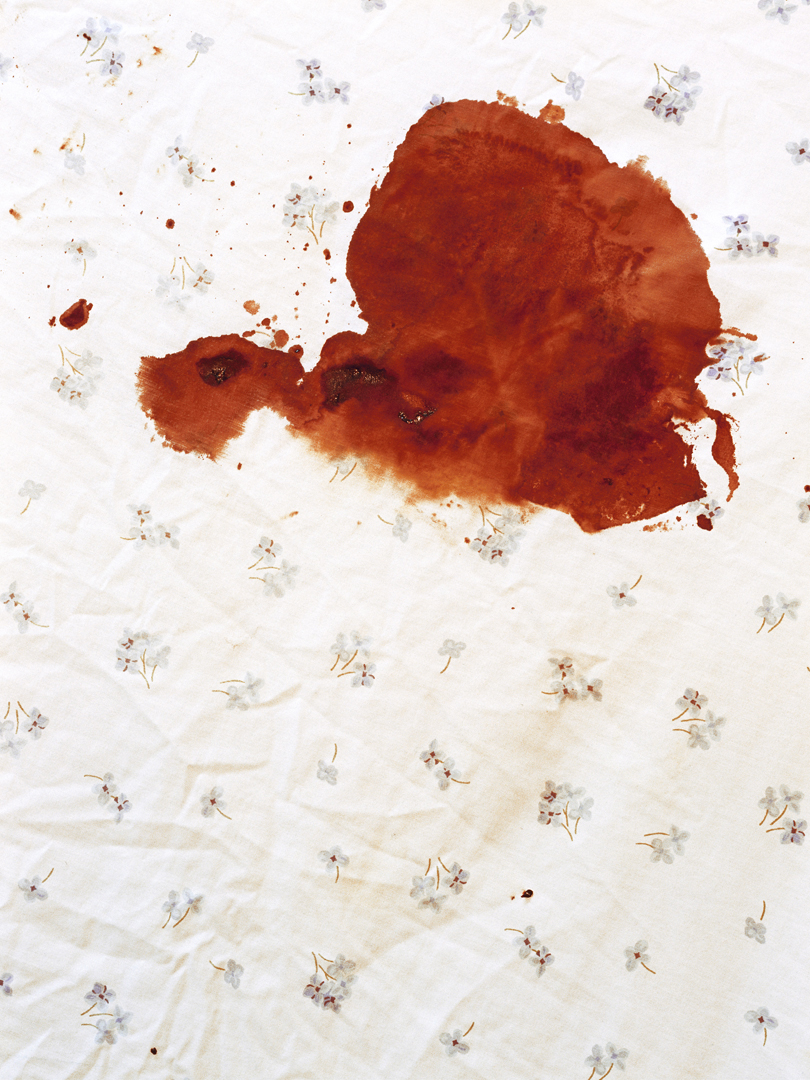
Ellyn Ruddick-Sunstein shares the haunting work of photographer Sarah Sudhoff:
[She] traces the physical, bodily evidence left by the dead; for her project At the Hour of Our Death, she gives form to death and the unknown, shooting fabrics stained by the blood and fluids of the victims of murder, suicide, and illness. She follows these material reminders of dead, contaminated and removed from the scene, to a warehouse, where they wait to be disposed of; she knows not the names or [identities] of the dead, constructing strange and poignant narratives with only the colors and shapes left by their passing.
Sudhoff spoke to Alison Zavos about her process in 2011:
You’ve mentioned that you feel deeply saddened when photographing the remains of a persons death. How do you mentally prepare before a shoot and how do you cope afterwards?
I don’t think there is anything someone can do to mentally prepare for dealing with death. Each shoot I have to push myself physically and emotionally to even make the call to see if new material is in. On one hand I dread finding out what jobs the crew is working on yet on the other hand I can’t help but be intrigued by the possibilities. …
Each time I leave a shoot I have a long drive ahead of me. I’ve started taking a change of clothes with me so I don’t have to drive and sit in the outfit I shot the material in. I am usually very careful to cover up and wear gloves however its more of a peace of mind to remove even the possibility of something on me. I typically stop at a gas station to scrub down my arms and face before hitting the road. As soon as I get home, I take a long hot shower and wash all my clothes from the shoot.
See more of Sudhoff’s work here. Watch a short film about the project here.
This month the World Health Organization (WHO) will meet to decide whether or not to destroy the last living strains of the variola virus, which causes smallpox. Since the WHO declared the disease eradicated in 1979, the scientific community has debated whether or not to destroy live virus samples, which have been consolidated to laboratories in Russia and at the U. S. Centers for Disease Control and Prevention (CDC) in Atlanta. Small frozen test tubes preserve the surviving strains, and most were collected around the time of eradication, though some date to the early 1930s.
Inger Damon, who leads the poxvirus and rabies branch at the CDC, and her colleagues argue in an editorial in PLoS Pathogens … to save the virus from full extinction. According to Damon, retaining the live samples will allow researchers to delve into unanswered questions about the variola virus and to test better vaccines, diagnostics, and drugs. “There is more work to be done before the international community can be confident that it possesses sufficient protection against any future smallpox threats,” they write.
Alex B. Berezow lists other reasons to keep the virus samples. Among other arguments:
[E]very once in a while, there is a smallpox scare from historical samples. What was thought to be a 135-year-old smallpox scab turned up in a museum in 2011. It ended up not being smallpox (but possibly a related virus known as Vaccinia). Still, the possibility of smallpox viruses surviving in old human tissue samples is a real enough threat. In an e-mail interview with RealClearScience, Dr. Inger Damon, the lead author of the PLoS Pathogens article, wrote, “The virus is highly stable when frozen; periodically the question of viable virus existing in corpses buried in the northern permafrost is posed, but remains unanswered.”



 The Dish