The Return Of The Germans

One of the more insightful pieces I have yet read on the tragedy of Ukraine is this one by Clemens Wergen on the German reaction. I’ve been struck by Germany’s muted response to an invasion of an Eastern European state like Ukraine. It’s easily the biggest obstacle to a serious Western attempt to leverage Russia’s oil exports to curtail Putin’s neo-fascist experiment. Wergen helps explain it:

We have come to think of Germany as a Western European country, but that is largely a product of Cold War alliances. Before then it occupied a precarious middle between east and west. Twenty-five years after the end of the Cold War, German society may well be drifting away from the West again. In a poll last month by Infratest/dimap, 49 percent of Germans said they wanted their country to take a middle position between the West and Russia in the Ukraine crisis, and only 45 percent wanted to be firmly in the Western camp.

But there are some who also actively sympathize with Russia. To wit:

Europe’s populist right, which agrees with Russia’s propaganda that Europe has become too gay, too tolerant, too permissive in its morals and too un-Christian, and which welcomes an authoritarian leader challenging Europe’s fuzzy multilateralism. In Germany, you can find this current best represented by the new anti-euro Alternative für Deutschland Party. They take up a conservative strain of German thinking dating back to the 19th century, which harbors a resentment toward Western civilization and romanticizes a Russia seemingly uncorrupted by Western values and free-market capitalism.

Along with this, of course, is the German economy’s energy connection with Russia, symbolized by former chancellor Gerhard Shroeder’s seat on the board of Gazprom. What I infer from this – and from the staggering incompetence of Ukraine’s interim government in holding on to its territorial integrity – is that the Ukraine crisis cannot easily be forced into a Cold War template. Russia is not an ideological rival in any deep sense, as it was under Communism. It’s ambitions are not to control the globe, but to police and control its near-abroad by any means necessary – masked warfare, energy blackmail, military intimidation, constant propaganda. And Germany is not West Germany any more.

At some point, the neoconservative Cold War nostalgics may wake up to see an emerging new world order in the 21st Century. My fear is that they will try to wrest it back to the 20th – and fail.

Convincing Creationists Of Climate Change

Climate Change 6000 Years

It can be done:

[W]hen it comes to talking to evangelical audiences about climate change, [climate scientist and evangelical Christian Katharine] Hayhoe doesn’t emphasize the age of the Earth, simply because, she says, there’s no need. “When I talk to Christian audiences, I only show ice core data and other proxy data going back 6,000 years,” says Hayhoe, “because I believe that you can make an even stronger case, for the massive way in which humans have interfered with the natural system, by only looking at a shorter period of time.”

“In terms of addressing the climate issue,” says Hayhoe, “we don’t have time for everybody to get on the same page regarding the age of the universe.”

Hard Times On J Street

Last week, J Street’s bid to join the Conference of Presidents of Major American Jewish Organizations was rejected. Michael Scherer argues that this illustrates how American Jews still think about Israel in starker, more existential terms than Israelis themselves do:

J Street … has as its mission an effort to “expand the very concept of what it means to be pro-Israel.” In practice, this means J Street is more closely aligned with the Israeli Labor party than the Likud Party; that it supports greater Israeli concessions to bring about a two-state solution; that it is more critical of Israeli history than most American Zionists; and that it does not share Prime Minister Benjamin Netanyahu’s hawkish views on Iran.

By a vote of 22 to 17, the American Jewish community’s largest umbrella group has decided that these views, which are widely debated in Israel, should not be allowed as a part of mainstream American Jewish identity. In short, the American Jewish community is still not ready to embrace the messiness of a real Democratic debate. To disagree over the best policies for Israel is, for a slight majority of American Jewish institutions, still an act of opposition to the nation itself.

You might imagine that some would see the entrenchment of apartheid-like rule on the West Bank, the dead end of the peace process, the potential rapprochement with Iran and the growing strength of the BDS movement, especially in Europe, as requiring a re-think with respect to blind support of anything Israel does. But you would be wrong. Yehuda Kurtzer calls the decision “an attempt to sustain a polity that no longer exists, and to imagine a firm dividing line between internal community dissent and external public debates”:

The fact that J Street wanted in to the establishment meant that in spite of policy differences with many of its members, they were ostensibly willing to try to belong to and perhaps even help sustain the declining Jewish consensus; the fact that they are kept out, essentially told to keep doing their work outside the framework of the normative community, actually reinforces the very breakdown of the communal structure from which Conference of Presidents is now a relic.

If once upon a time Jews held a line not to hang our dirty laundry in public, the American public square has become a Jewish Laundromat – all with the tacit endorsement of what was once the community’s mouthpiece and most influential instrument.

Joe Klein laments what he terms “a decidedly un-Jewish development”:

Where I come from–the outer boroughs of New York City–Jews were known for, and entertained ourselves by, arguing about everything. Nothing was ever off the table. But I’ve noticed a tendency of the neo-conservative Jews to denigrate those who disagree with their extreme right-wing positions. They bully. They refuse to engage in a serious debate. They have a cult-like devotion to the party line. They call groups like J Street “anti-Israel,” when it’s possible, perhaps even probable, that COPOMJAO’s hard line will compromise Israel’s ability to thrive in the future.

The CPOMJAO rejection will work well for J Street. It will be “good” publicity, especially among those Jews who have been dismayed by those who claim to Judaism’s official leaders in America. COPOMJAO, meanwhile, seems as silly as its name. It needs reform, including a new identity: I would suggest The Jew Crew as a replacement, but that would imply a lack of self-righteousness and openness to diverse opinions that COPOMJAO doesn’t seem to have.

But Jonathan Tobin argues that J Street, not the conference, is the divisive one:

The Conference was created to provide a way for a diverse and cantankerous Jewish community a single structure with which it could deal with the U.S. government. The point was, though its members have often disagreed and true consensus between left and right is often impossible, the Conference still provides Congress and the executive branch an address through which they can reach a broad and diverse coalition of Jewish organizations. Adding one more on the left wouldn’t have changed that but unlike other left-leaning groups, J Street has never had any interest in playing ball with rivals or allies. Its purpose is not to enrich and broaden that consensus but to destroy it. And that was something that groups that had no real ideological fight with J Street rightly feared.

Reality Check

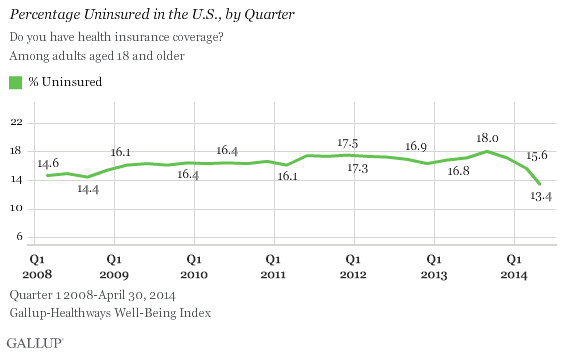
Gallup finds “the lowest monthly uninsured rate recorded since Gallup and Healthways began tracking it in January 2008“:

Uninsured Rate

Jonathan Cohn wants Republicans to face facts:

Republicans and other critics of the health care law keep saying the law isn’t having much impact on the number of uninsured Americans. A few even suggest it’s having no impact at all. These arguments are just not credible anymore.

At this point, the trend in the Gallup polling clearly isn’t a blip. It points in the same direction as previous surveys, from the Rand Corporation and the Urban Institute. And it’s consistent with evidence about the raw number of people who have signed up for insurance through the new marketplaces—and, yes, who have paid their premiums.

It seems to me that the ACA is doing what it was intended to do. And can we have a moment of actual moral clarity here? Is it not simply better – better for the human beings involved, better for the economy, better for productivity, better for the deficit – if more people are insured. The more that have access to regular care, the fewer highly expensive emergency room visits in the future; the better the health of our fellow citizens, the more able they are to contribute to our common weal; and this is not to speak of the categorical moral advantage of simply giving someone their health back. We have become obsessed with process – and much of that obsession is good. It matters whether premiums are paid and what price they are and what the age mix is.

But none of this seems to me to be the real issue. Maybe it’s my Catholicism coming through, but isn’t providing for the sick a core moral task? And finding a way to harness the private sector to do so more efficiently is win-win. Which brings up a question: why aren’t the Catholic bishops doing more to support and celebrate this huge advance? It cannot be because of contraception can it? Even if you concede that point, the moral gain of this law compared with a small moral loss is undeniable. It seems to me that the bishops – including the bishop of Rome – could make that case much more emphatically than they have.

Kliff highlights details from the poll:

The gains of insurance coverage have been especially large among lower-income Americans – the people who qualify for Medicaid or insurance subsidies under the Affordable Care Act. There’s been a 5.2 percentage-point drop in the uninsured rate, for Americans who have a household income lower than $36,000 since the end of 2013.

Minorities and younger Americans have also seen steeper declines; the uninsured rate for African Americans has fallen by 7.7 percentage-points over the last four months.

Jason Millman adds:

Now that Obamacare open enrollment is over, where does the uninsured rate go from here? Gallup says the number could tick back up if some newly insured don’t pay their premiums, though evidence suggests that from 80 percent to 90 percent of those signing up for private coverage have paid at least for the first month. It’s also possible that people could gain new coverage through special enrollment periods triggered by certain life events.

Medicaid enrollment also goes all year, and a previous Rand Corp. survey showed tha temployer coverage has played a major part in driving down the uninsured rate.

Meanwhile, Pew reports that opinions of the ACA have barely budged:

Public views of the 2010 health care law have changed little over the past several months. Currently, 55% disapprove of the Affordable Care Act and 41% approve. In September, before the launch of the online health care exchanges, 53% disapproved and 42% approved.

Republicans continue to be largely united in their opposition of the health care law — 88% disapprove and 10% approve of it. Among Democrats, about three-in-four (73%) approve, while roughly one-in-four (24%) disapprove of the law. Independents remain mostly opposed to the law, with 57% disapproving and about four-in-ten (39%) approving of it.


Nuclear Is Better Than The Alternative

Brad Plumer explains why recent nuclear power plant closings should alarm environmentalists:

So what happens when a nuclear power plant gets retired? It depends on the region. But one recent study of a shuttered nuclear plant in California found that greenhouse-gas emissions surged, as the nuclear plant got replaced by fossil fuels.

Back in February 2012, Southern California Edison shut off two nuclear reactors at the San Onofre plant after finding cracks in the steam generator system. (A year later, the company announced that it would retire the reactors for good, deciding it the repair and licensing process would take too long and involve too many lawsuits.)

That plant was massive, providing about 8 percent of California’s electricity. So the state went on a frenzy of construction, building mostly new natural gas units and some wind units. In the end, however, fossil fuels were the easiest to deploy. Overall carbon-dioxide emissions in the region rose by 9.2 million tons in the following year — equivalent to putting an extra 2 million cars on the road.

And look at the result of Germany’s decision to revoke nuclear: they’re not just hurting the planet but also enabling Putin. Sigh. To my mind, nuclear is an imperfect but real solution to disentangling ourselves from the Middle East and saving the planet. And yet the liberal coalition that should support it is AWOL – a victim largely of ideology.

How The East Was Lost

RUSSIA-UKRAINE-POLITICS-CRISIS-OSCE

Keating points out that Putin doesn’t need to invade eastern Ukraine in order to conquer it:

As long as the separatists, almost certainly acting under the backing if not the outright direction of Russian special operaions forces, can continue to withstand the tentative offensives launched against them, Kiev’s loss of control over Donetsk and Luhansk will become an established fact on the ground. As Interpreter editor James Miller points out in a commentary for Vice, the key player in this is not the military but the Russian government’s well-oiled propaganda machine, which has been operating at full force in eastern Ukraine, convincing many pro-Russian locals that “Ukraine is being overrun by ultranationalist Nazis who are building concentration camps for ethnic Russians and regularly lynching Russian sympathizers.”

Tens of thousands of Russian troops are still massed on the Ukrainian border, and there’s little sign that they’re leaving, but at the moment Russia can simply leave them in place as a warning of what would happen in Ukraine launched a full-scale assault to retake the contested areas—a campaign that would almost certainly involve large numbers of civilian casualties.

This map from the WaPo gives a detailed picture of the forces Russia has committed to threatening Ukraine. Berman thinks Friday’s violence in Odessa, in which 31 Russian demonstrators died in a fire, could be the pretext for an old-school invasion Putin was waiting for:

Beyond the human nature of the tragedy, which is obvious, lies the political one that now faces the Ukrainian government. If, as has been assumed by most observers, the Russian troops who have spent the last six weeks massed on Ukraine’s borders have been waiting for an excuse to intervene in order to either “restore order” or “protect Russian citizens” from “fascists” this tragedy would seem to be it.

Not only does it provide the requisite death toll, but the manner of the victims’ passing pushes all sorts of historical buttons, not just in Russia, but also in the West, where dozens of victims being burned alive in a locked building brings flashbacks to earlier pogroms.

Lucian Kim situates the turmoil in Donetsk and other eastern regions within Putin’s general strategy:

The illusion of a conflict is crucial for Putin’s plan to polarize Ukraine and prevent it from achieving the political stability needed to ward off economic collapse. If a few more pro-Russian regions break off as separatist republics, so much the better. Although the violence in the Donetsk region is very localized, images of icon-carrying villagers blocking Ukrainian troops in armored personnel carriers serve the narrative of a beleaguered Russian population under assault. Kremlin-controlled Russian TV presents a parallel reality where the United States is doing its best to split Ukraine; the Kiev government broke the Geneva agreement to defuse the crisis; and foreign mercenaries are backing up Ukrainian forces in Slovyansk.

Never mind that the supposed people’s uprising in Donetsk is a caricature of the Maidan, which was an explosion of citizens’ anger. For a Soviet man and former KGB agent like Putin, the concept of civic activism—ordinary people acting without instructions or payment—is incomprehensible.

The Dish covered recent violence in Ukraine here.

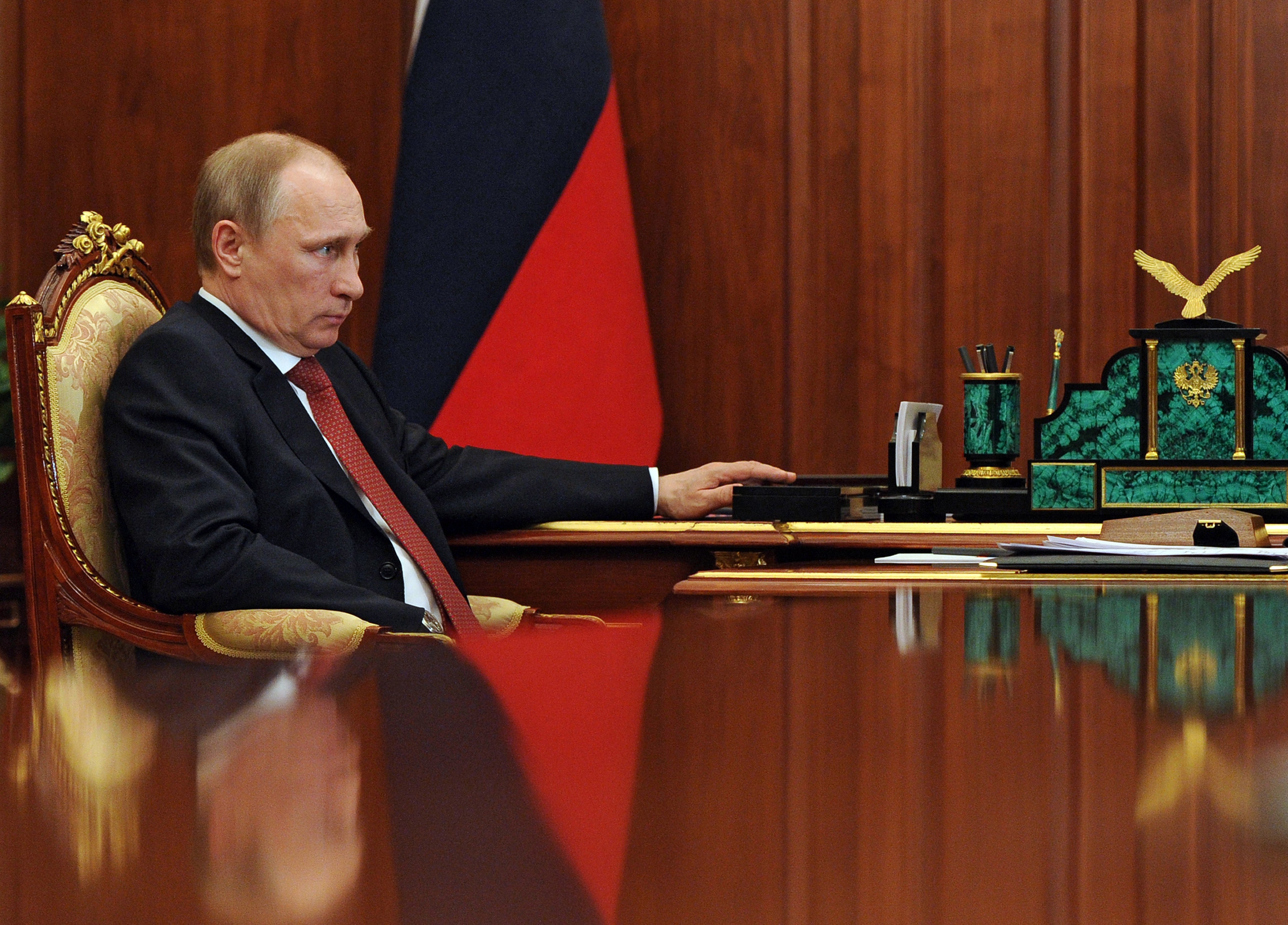
(Photo: Russia’s President Vladimir Putin attends a meeting in the Kremlin in Moscow, on May 5, 2014. German Chancellor Angela Merkel said yesterday Putin and OSCE head Didier Burkhalter are expected to discuss establishing a ‘national dialogue’ in Ukraine ahead of elections when they meet in Moscow on May 7. By Mikhail Klimentyev/AFP/Getty Images.)

The View From Your Obamacare: Women’s Health

A female reader writes:

I saw this thread and how timely it is! Last night I went to the lady doctor (that’s my euphemism for President Obama Visits Boston To Talk About Health Caregynecologist) for the first time in over a year, just for my annual check up.

Cost of annual check up: $0
Cost of three-month supply of birth control: $0
The feeling of getting free birth control for the first time in my life (that wasn’t a bunch of condoms): PRICELESS.

I’m still on cloud nine from it 24 hours later. It’s the little things, ya know? Those three packs, in the past, have cost me anywhere from $60 to $100. On average, $20/pack/month, for a yearly savings of at least $240! You don’t have to be ill to benefit form the ACA, healthy people are helped too. Obamacare FTW!

Another:

Obamacare changed absolutely nothing about my (employer-based) insurance coverage except for one thing: free birth control. The previous copay was in no way burdensome, but it regularly makes me appreciate the impact on the high school students I teach and how much I appreciate the law making it easier for them to graduate sans-baby. However, the numerical impact of the law doesn’t take into account the relief I get from knowing that I don’t have to worry about how getting tests done to see if a lump is benign or cancerous (benign, thankfully) will look to an insurance company if I ever do strike out on my own. Or my relief that a close friend with multiple pre-existing conditions doesn’t have to worry about coverage. Changes in healthcare affect far more than the people who show up in the statistics.

Another:

The reader who told of his PTSD and need for mental health coverage, which he is finally able to receive thanks to Obamacare, reminded me of my biggest complaint about the program.

It ought to have included dental care instead of elective contraception coverage. Some years ago, I experienced significant dental issues but possessed only medical insurance. Had I allowed my condition to deteriorate such that I could no longer eat, perhaps then medical coverage would kick-in, at great expense and after great suffering.

It baffles me still that medical, dental, and mental health are handled as separate segments in the overall health care system. Need I point out the obvious that each individual is a whole person with a single body?

Access to medical, dental, and mental health care are true human needs. Obamacare should have focused on meeting all those needs, including the mental and dental coverage that too many employers had failed to make available, instead of opting to cover the pill. Except for it palliative uses, the pill is not a form of health care.

(Photo by Yoon S. Byun/The Boston Globe via Getty Images)

“It’s A News Report … Except It’s Also An Ad!”

My rather lonely crusade against sponsored content – advertising disguised as journalism – looks lonelier by the day. The desperate need for profit has trumped every other value in the online writing business. That’s a defense, in some respects, of course. If the price of ethics is extinction, it’s too high for business. And maybe this disturbing abandonment of the integrity of journalism will simply be a passing fad, a sign of desperate economic straits, until the market finally sorts itself out, and readers start to wise up to the deception intrinsic the whole thing. I sure hope so.

But that rather optimistic scenario has always missed an important piece of the puzzle, it seems to me. My fear is that once advertising has its foot in the door of journalism proper – i.e. is fully integrated within journalism and increasingly indistinguishable from it – the door will soon be flung wide open and never shut again. Increasingly, companies seeking to advertise will dispense with intermediary sites like Buzzfeed altogether, and create their own sites in which advertising and journalism are completely fused. And how will “journalism” respond then? What happens when Unilever is the host company and the Guardian is merely its branding vehicle? Why not get rid of the journalistic middleman when you can flood the Interwebs with your own propaganda, paid-tweets, and sponsored posts? On the other side of the fence, “news” sites will see the advantages in surrendering more and more to advertising, since the revenues are so much more lucrative than any subscriptions or regular ads could ever be, and as news sites compete with each other for more and more ad dollars. In that market – where there are no journalistic ethics to speak of any more – my bet is that the most craven will win.

Well, here’s a harbinger of sorts: a seemingly journalistic inquiry by Vice into the future of warfare – fused with an ad for a video game, Call Of Duty. New York Times journalists and other serious sources are in the video – but the video is also an ad. Money quote:

In the trailer, which Vice says is only a taste of a longer investigation into private military contractors, Thomas reads a series of alarming statements about the rise of military contractors as grainy shots of gun-toting men scroll in the background. Snippets of interviews with private contractors are played, and for one sequence, Thomas is strapped up with a bulletproof vest and rushed through an apparent simulation of an evacuation mission before the video comes to an end. “The next generation of Call of Duty is coming,” reads the final frame. And apparently, the next generation of branded content isn’t far behind.

Will The Economy Protect Democrats?

Pew’s latest makes it seem unlikely:

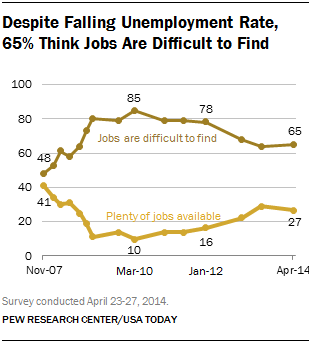
From the public’s point of view, jobs remain scarce: 65% say jobs in their community are difficult to find while 27% say there are 5-5-14-5plenty of jobs available. Since the recession, perceptions of the job market have become less negative as the unemployment rate has declined. However, there has been virtually no change in these views since last June (64% jobs hard to find), although the jobless rate has fallen by more than a percentage point (from 7.5% to 6.3%) since then.

Moreover, there has been no increase in economic optimism. About as many say that economic conditions will be worse (24%) as better (25%) a year from now, with 49% predicting little change. Asked to describe the economic recovery, 66% say the economy is recovering but not so strongly, 26% say the economy isn’t recovering at all, while just 6% think the economy is recovering strongly.

Jonathan Bernstein is skeptical the better jobs numbers will mean much for the upcoming elections:

When Ronald Reagan’s approval turned around in 1983, for example, his strong rally still didn’t much exceed one percentage point of approval a month. And that occurred as the economy moved from a deep recession to a solid recovery, a different set of circumstances from the mild improvements that might be happening now. President Barack Obama’s approval rating is around 44 percent. A return to 50 percent by election day is a best-case scenario, and even that wouldn’t cause a dramatic tilt in the electoral playing field. Given how closely contested Senate control appears to be, a small nudge could be very important – but it’s a small nudge, nevertheless.

A far more realistic outcome is that good economic news just keeps Obama on the very mild upward path he’s been on since the Affordable Care Act exchanges were fixed.

Waldman spotlights the Democrats’ rhetorical dilemma:

Democrats have been spending a lot of time lately talking about inequality, which is not a function of what happened this month or last month, but the result of forces and trends that have evolved over the last thirty years. That’s an important discussion to have, and an argument that resonates with voters, particularly when Republicans are inclined to deny inequality exists, or that it matters if it does. But when you’ve been saying that we have a profound and deep-seated inequality problem that was three decades in the making, it’s awfully hard to turn around on the evidence of a month or two of job growth and say, “Things are going much better now!”

That doesn’t mean Democrats can’t argue, as they surely will, that the Obama administration’s policies are helping the economy pull out of the long and painful period of difficulty we’ve had since the Great Recession. And of course, they can also say that things would have been much worse had the other guys been in charge. But because they’ve begun to talk about how the system is rigged, they can’t sing “Happy Days Are Here Again.”