Not To Miss A Beat

Megan Keeling profiles Elise Cowen, a female Beat poet who wrote in a community in which “only a few women were recognized as artists, and most were not deemed to possess the talent or creative soul required to produce art”:

Today she is most famous for being Alan Ginsberg’s experiment in heterosexuality, and the typist of his poem “Kaddish.” Beat scholars place her as the footnote in the Legend of Ginsberg: a devoted follower of the poet who lived in his intellectual shadow. Others have written her as a tragic-women-poet figure (she suffered from mental illness most of her life, and committed suicide at the age of 27.) But there is more to her story than that. Her surviving poetry shows a unique perspective on the rigid cultural conformity of the 1950s and also the fringe artistic community of the Beat Generation.

I took the heads of corpses
to do my reading by
I found my name on every page
and every word a lie. …

After her death, Cowen’s family destroyed much of her poetry and writings, describing them as “filthy.” Her poems cover much of the same topics as the male Beats- spirituality, homosexuality, drug use and madness, among many other things. However, as a woman (and a queer one at that) she was too far on the margins even for the Beats. [Author Joyce] Johnson writes: “I’d show her the stories I was writing, but [Elise would] never show me her poems.  ‘I’m mediocre,’ she told me, pronouncing the word in an odd hollow French way.” When her poetry was published, it was largely due to the efforts of her friends, especially Leo Skir, after her death. The first collection of her poems will be published this year.

Previous Dish on Beat literature here, here, here, and here.

What Is The Ulysses Of Romance Novels?

Noah Berlatsky calls for the creation of a “romance canon,” arguing that “the genre is so culturally maligned that there has been no concerted effort to codify it”:

I’ve poked around online to find “best of” lists or other recommendations, but it soon became clear that Sweet-Disorder-300x449there wasn’t even a provisional consensus on which books were the best or essential romance novels. Jane Austen showed up consistently, as did Gone With the Wind, but there was nothing that gave me a sense that certain books were clearly central, or respected, or worth reading. The genre is so culturally maligned that there has been no concerted effort to codify it. There is, in short, no romance canon.

I’ve always been a little leery of canons. Listing the “best” books or movies or music is always going to be an arbitrary, not to mention hubristic, endeavor. … Looking around desperately and in vain for some sort of consensus “best of” lists for romance novels, though, I realized that such lists are, or can be, unexpectedly important. Canons are a way to solidify, or demonstrate, critical bona fides. Pop music and comics may not have the same cachet as great novels or gallery art, but institutionally codifying the “greatest” is an important way to assert that there is a “greatest” – that there is some group of experts who considers these works in particular, and the genre or medium in general, to be capable of greatness. Romance novels don’t have that.

(Image: From Berlatsky’s list of canon contenders)

A Short Story For Saturday

Kate Chopin’s “The Story of an Hour” can be read in just a few minutes – and you’ll want to make it all the way to the end. Here are its opening paragraphs:

Knowing that Mrs. Mallard was afflicted with a heart trouble, great care was taken to break to her as gently as possible the news of her husband’s death.

It was her sister Josephine who told her, in broken sentences; veiled hints that revealed in half concealing. Her husband’s friend Richards was there, too, near her. It was he who had been in the newspaper office when intelligence of the railroad disaster was received, with Brently Mallard’s name leading the list of “killed.” He had only taken the time to assure himself of its truth by a second telegram, and had hastened to forestall any less careful, less tender friend in bearing the sad message.

She did not hear the story as many women have heard the same, with a paralyzed inability to accept its significance. She wept at once, with sudden, wild abandonment, in her sister’s arms. When the storm of grief had spent itself she went away to her room alone. She would have no one follow her.

Read the rest here. For more of Chopin’s work, check out her Complete Novels and Stories. Previous SSFSs here.

The View From Your Window Contest

VFYWC-203

You have until noon on Tuesday to guess it. City and/or state first, then country. Please put the location in the subject heading, along with any description within the email. If no one guesses the exact location, proximity counts.  Be sure to email entries to contest@andrewsullivan.com. Winner gets a free The View From Your Window book or two free gift subscriptions to the Dish. Have at it.

A Horse Rising From The Ashes

On this Kentucky Derby weekend, Byliner has made available to Dish readers Elizabeth Mitchell’s The Fire Horse, the remarkable account of Boyd Martin and an unwanted racehorse, Neville Bardos. A particularly gripping part of the story involves Martin’s stable catching on fire, endangering the horses he kept there:

He tugged his T-shirt over his head, took the deepest breath he could manage, and barreled in.

Inside, the blackness was almost impenetrable. The straw storage above the first third of the barn had been consumed by fire, and dark brown hay smoke churned like factory effulgence blasting down the breezeway. Martin couldn’t see well, but he could certainly hear the roar of flames eating through the wood and hay, the beams creaking, people outside hollering, the sirens screaming.

He came upon a horse’s body in the breezeway, probably the poor animal they had seen on fire, but in the blackness, Martin couldn’t tell which horse it was.

Here and there, the roof started caving, dropping beams. Martin felt along the wall, reading his way. Soon he was touching the metal screen on the side of the tack room, then the wash stall. And then in the blind darkness, he came to the opening of the first stall. He could hear a gurgling inside. Walking closer, he realized the choking sound was coming from the far corner. A horse.

For the next 48 hours, you can read the rest here. You also can purchase it as a Kindle Single here.

Artisanal Everything

Brianne Alcala observes how fast-food chains are jumping the shark and onto the bandwagon:

McDonald’s is not the first to co-opt “artisan.” Its rival Subway has “sandwich artisans”; Domino’s offers ARTISAN™ pizzas, such as Tuscan Salami & Roasted Veggies; Dunkin’ Donuts promoted Artisan Bagels; and Wendy’s sells the Artisan Egg Sandwich. No doubt the fast-food giants are trying to muscle into the higher-priced foodie realm, and sure, the ad copy is enticing. Wendy’s description of its “Artisan Egg Sandwich”: “fresh cracked Grade A Eggs, natural Asiago cheese, freshly cooked applewood smoked bacon or all natural sausage and Hollandaise sauce all atop a honey-wheat artisan muffin toasted to order.” What does “fresh cracked” eggs even mean? …

This copy writing taps into two modern cravings:

1) the desire for “real food,” for reassurance that something quick, cheap, and mass-produced is in the same family as the egg we cracked open on the frying pan last Saturday morning—hence, the “natural,” “all natural,” “freshly cooked,” and “fresh cracked.” 2) the desire for hand-crafted, that real people, not robots, made this sustenance—hence, “toasted to order.” The gourmet, bespoke, personalized, and designed just-for-you creation is so appealing on this planet of 7 billion people. You are not just a number. You are special. Even your burger roll is artisan.

The Myth Of Opting Out

Princeton sociologist Janet Vertesi tried to keep her pregnancy offline, hidden from “the bots, trackers, cookies and other data sniffers online that feed the databases that companies use for targeted advertising.” Though she steered clear of social media, avoided baby-related credit card purchases, and downloaded Tor to browse the Internet privately, she failed to escape the reach of big data:

Attempting to opt out forced me into increasingly awkward interactions with my family and friends. But, as I discovered when I tried to buy a stroller, opting out is not only antisocial, it can appear criminal. For months I had joked to my family that I was probably on a watch list for my excessive use of Tor and cash withdrawals. But then my husband headed to our local corner store to buy enough gift cards to afford a stroller listed on Amazon. There, a warning sign behind the cashier informed him that the store “reserves the right to limit the daily amount of prepaid card purchases and has an obligation to report excessive transactions to the authorities.”

It was no joke that taken together, the things I had to do to evade marketing detection looked suspiciously like illicit activities. All I was trying to do was to fight for the right for a transaction to be just a transaction, not an excuse for a thousand little trackers to follow me around. But avoiding the big data dragnet meant that I not only looked like a rude family member or an inconsiderate friend, I also looked like a bad citizen.

Her bottom line:

The myth that users will “vote with their feet” is simply wrong if opting out comes at such a high price. … It’s time for a frank public discussion about how to make personal information privacy not just a series of check boxes but a basic human right, both online and off.

In an interview, Vertesi explains why she quit using Google two years ago: “When Google knew I was engaged before anybody else did, that did it for me”:

Google reads your email, reads your chats. It knows what you’re searching for. It sees you when you’re sleeping and knows when you’re awake. And the server is economically incentivized to remember. The way to make money on the internet these days is to get people to exchange personal information for free, and you get them to do that by making them think they’re just interacting with the service: sending an email or searching or chatting with a friend. But there’s this underlying architecture there. …

[This experiment] was one of the first times that I thought about what it would take to opt out from collection. Because you hear all the time: if people don’t like it, they’ll stop using the service. But people don’t stop using the service. And I know a lot of people really don’t like it, and it’s not just that they’re upset because Facebook made some change to its layout. I think the deep, underlying reasons that people are uncomfortable is how these interactions are being tracked. They don’t like being stalked by a pair of shoes they looked at once on the internet two years ago.

A Poem For Saturday

Spencer Reece-page-001

Dish poetry editor Alice Quinn writes:

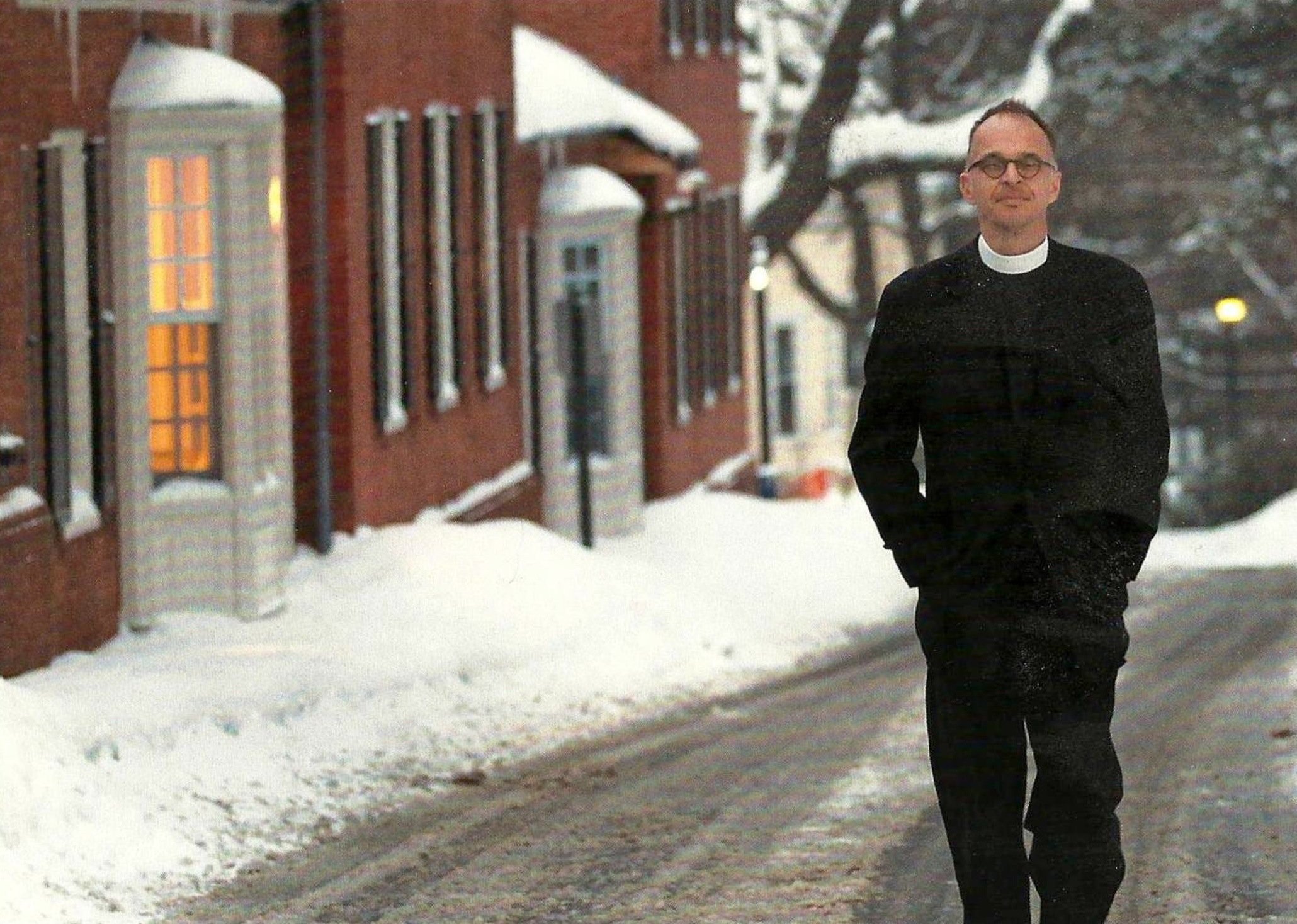
In the June 14th, 2003 issue of The New Yorker, a moving and beautiful poem entitled “The Clerk’s Tale” by Spencer Reece appeared on the back page, drawn from his debut volume of the same title chosen for The Bakeless Prize that year by Louise Gluck.

The poem began, “I am thirty-three and working in an expensive clothier,/ selling suits to men I call ‘Sir.’” The poem describes two gay men closing the store in a mall in Minneapolis on a snowy, winter evening. The speaker, younger of the two, says of his companion:

“Often, he refers to himself as ‘an old faggot.’
He does this bemusedly, yet timidly.
I know why he does this.
He does this because his acceptance is finally complete—
and complete acceptance is always
bittersweet.”

The poem later formed the basis for a short film directed and produced by James Franco. The poet, Spencer Reece, was subsequently ordained as an Episcopal priest. While working as a chaplain at Hartford Hospital, he felt inadequate without the Spanish language. Appealing to his bishop, he was transferred to an orphanage in Honduras, where he coached the schoolchildren to write poems. Now he has compiled an anthology of their poetry called Hope & Fury: Abandoned Childrens’ Voices, with gems like this one by Riccy, age 14:

Rose

This young
rose, it represents all of us here.
Careful! It is the prettiest young rose
we have: life needs love,
love needs life.

James Franco is now the executive producer of the documentary-in-the-making about the orphanage, Our Little Roses. Today and in the days ahead we’ll post poems from Spencer Reece’s new book of poems, The Road to Emmaus, just published by Farrar, Straus & Giroux.

“ICU” by Spencer Reece:

Those mornings I traveled north on I-91,
passing below the basalt cliff of East Rock
where elms discussed their genealogies.
I was a chaplain at Hartford Hospital,
took the Myers-Briggs with Sister Margaret,
learned I was an I drawn to Es.
In small group I said, “I do not like it,
the way young black men die in the ER,
shot, unrecognized, their gurneys stripped,
their belongings catalogued and unclaimed.”
In the neonatal ICU, newborns breathed,
blue, spider-delicate in nests of tubes.
A Sunday of themselves, their tissue purpled,
their eyelids the film on old water in a well,
their faces resigned in plastic attics,
their skin mottled mildewed wallpaper.
It is correct to love even at the wrong time.
On rounds, the newborns eyed me, each one
like Orpheus in his dark hallway, saying:
I knew I would find you, I knew I would lose you.

(From The Road to Emmaus © 2014 by Spencer Reece. Reprinted by permission of Farrar, Straus & Giroux. Photo of Spencer Reece © Lawrence Schwartzwald, used with his permission.)

A Grim Climate Milestone

FT-co2_800k.png.CROP.promovar-mediumlarge

Eric Holthaus notes that, as of last month, carbon dioxide concentrations in the Earth’s atmosphere exceeded 400 parts per million for the first time in human history:

Over the very long term, taking data from ice cores in Antarctica, paleoclimatologists have determined that there’s never been as quick a spike in carbon dioxide levels in at least the last 800,000 years … These data are painstakingly compiled by finding tiny air bubbles trapped in the ancient ice, and then analyzing their chemical composition. By this method, scientists have literally measured nearly a million years’ worth of the Earth’s atmosphere. Of course, looking at historical data, scientists could have made the same statement—we’re at levels not seen in human history!—in any year since about 1914 and would have been accurate. Problem is, the data didn’t exist then.

In fact, Brad Plumer notes, scientists believe CO2 levels haven’t been this high since long before humans even existed:

Indeed, some studies go further and estimate that carbon-dioxide levels may be at their highest point in 4.5 million years. During the Pliocene era, scientists have found, carbon-dioxide levels appeared to be around 415 ppm. (This rise was likely caused by wobbles in the Earth’s orbit — humans weren’t around then.)

The climate of the Pliocene was much warmer and wetter than it is today. Global average temperatures were 3°C or 4°C hotter (that’s 5.4°F to 7.2°C) and sea levels were between 5 and 40 meters higher.

That doesn’t mean we’ll get exactly those things today — the Pliocene isn’t perfectly comparable, since a variety of different factors were at play. But it’s the best guide we have to a fairly unprecedented situation.Other features of the Pliocene era: more frequent and intense El Niño events in the Pacific Ocean, intense flooding in the western United States, and severe coral reef extinctions as the oceans warmed.

Happiness May Be Hazardous To Your Health

Many people view good cheer as “a state to be avoided or even feared,” according to new research in The Journal of Happiness Studies:

Psychologist Mohsen Joshanloo and philosopher Dan Weijers of Victoria University of Wellington, New Zealand, note that in Western culture, “happiness is universally considered to be one of the highest human goods, if not the highest.” Furthermore, Weijers told me in an e-mail, “if many Americans think they live in the land of opportunity and freedom, and that their happiness is largely a result of their own efforts,” then squandering the chance of happiness may be seen as a moral failing, because the unhappy person may be “too lazy or selfish to pursue happiness diligently and honestly.”

In their surveys, however, Joshanloo and Weijers discovered that some people – in Western and Eastern cultures – are wary of happiness because they believe that “Bad things, such as unhappiness, suffering, and death, tend to happen to happy people.” In Russia, notes Stanford psychologist and happiness expert Sonja Lyubomirsky, the expression of happiness “is often perceived as inviting the ire of the devil.” And in many East Asian cultures influenced by Buddhism, the quest for personal happiness may be seen as misguided, because pleasure is focused on the self, leading to such vices as “cruelty, violence, pride, and greed.”