
Columbia Heights, Washington, DC, 7.50 am
Columbia Heights, Washington, DC, 7.50 am
After moving back to Baltimore, Alec MacGillis was impressed by its dirt-cheap, high-quality cultural offerings:
What gives? Call it the Rust Belt theory of low-cost high culture. Baltimore is one of a handful of cities where the economic might and urban scale of a bygone era (Baltimore was the sixth-largest city in the country as recently as 1960) created both premier cultural institutions and a foundation of local wealth—aka old money—that, however dissipated by time, lingers to this day and continues to provide support for the institutions. At the same time, however, these cities’ decline in population and prominence has left these institutions perpetually on the hunt for new patrons.
The result is a disequilibrium that represents a kind of golden middle: On the one hand, these cities have a richer cultural legacy than younger but more economically ascendant cities such as Phoenix and Charlotte; meanwhile, their offerings are far more affordable than those in creative-class capitals such as New York and Boston, where theaters and concert halls can fill seats with deep-pocketed local elites and high-spending tourists.
In a review of Edmund Fawcett’s Liberalism: The Life of an Idea, Katrina Forrester takes stock of his revisionist account of how the approach to politics began:
For Fawcett, liberalism is, at its simplest, about “improving people’s lives while treating them alike and shielding them from undue power.” To understand its history, “liberty is the wrong place to begin.”
Liberalism wasn’t created in the seventeenth century but in the nineteenth, after a trio of revolutions—American, French and industrial—shattered the old order. Liberalism’s first job wasn’t simply to defend private individuals and limit the size of government, but to cope with the rise of capitalism and mass democracy amid the aftershocks of a postrevolutionary world. In Fawcett’s history, there’s nothing on Locke, little on toleration, and America isn’t seen as special. The focus instead is on social conflict, political economy and capitalism, and the story Fawcett tells clears away the distortions produced by Cold War histories of liberalism. It also reflects how our own preoccupations have changed since the crisis of 2008.
For Fawcett, liberalism “as a political practice” was born in the years after 1815. Early liberals believed a new society was emerging that would change politics for good. Political and economic revolution had created a new kind of person, “the individual,” with changed beliefs and interests, who would demand more from government and put up with less. Society was in conflict, rife with clashes between rival interest groups and between capital and labor. Fundamental to liberalism was the idea that such conflict could only be contained, never eliminated. That was the primary task of politics. Institutions were designed to prevent domination by any one group and to embed the liberal “habits of bargaining, persuasion and compromise.”
Noah Berlatsky laments the way arguments and debate are often shut down by appeals to narrowly-defined expertise:
The problem with demanding a certain kind of knowledge or a certain kind of expertise in criticism … is that it can end up presupposing, or insisting upon, a certain kind of conversation. And often that seems like the point: expertise is used as an excuse to silence critics — and especially negative critics. Gamergate’s response to Anita Sarkeesian is the most obvious example, but you can see it in virtually any fandom. Folks who adore, say, Game of Thrones, are way more likely to have read all the books and seen all the episodes of Game of Thrones. People who dislike Game of Thrones are less likely to put in the time. How can you watch one episode of Game of Thrones and dismiss it? How can you read half of Maus and think that it’s boring and pompous? What gives you the right? Expertise becomes a quick, efficient way to shut down naysayers. Those who love video games, or Game of Thrones, or Wonder Woman are the only ones who can truly understand; the haters are, almost by definition, stupid.
And sometimes haters are in fact stupid, just as fans are sometimes stupid. But other times skeptical folks who don’t identify as fans can have interesting things to say despite, or maybe even because of, the fact that they’re outsiders.
Last week, two separate ships packed full of Middle Eastern migrants were found floating off the Italian coast, having been abandoned by their crews:
The cargo ship Ezadeen, which set sail under a Sierra Leone flag from a Turkish port this week, was discovered drifting without a captain 40 nautical miles from the Italian coast. Italian coastguards were forced to intervene to prevent a disaster and possibly save the lives of the estimated 450 people on board, many of them thought to be Syrian refugees. … The Ezadeen was the second vessel in four days to be found sailing without a crew. Earlier in the week, 800 migrants on the Blue Sky M, a Moldovan-registered ship, were rescued by Italian coastguards when it was discovered sailing without an active crew five miles off the coast. The two incidents have left observers of migrant routes in the Mediterranean fearing that people-smugglers have found a new and ruthless way of working in the area despite a recent decision to scale back Italian rescue operations.
The plight of the Blue Sky M and Ezadeen point to a new tactic by migrant smugglers in the Mediterranean. It’s less awful than deliberately shipwrecking them, as smugglers did on one voyage in September, drowning hundreds of refugees. Still, these “ghost ships” underscore the danger of the Mediterranean crossing and the desperation of those who make it. Barbie Latza Nadeau revisits an interview from December with Moutassem Yazbek, a Syrian refugee who had made the crossing last year and explained how the smuggling system works:
In many cases, he says, the smuggler kingpins hire refugees with seafaring experience to work as crewmembers on the ships in exchange for discounted passage. They are not the actual traffickers, Yazbek says, so generally the other refugees protect their identity. On his boat that came into Sicily three weeks ago, Yazbek says the refugee “crew members” hired by the smugglers were never exposed. Instead the refugees told the authorities that they abandoned the ship at sea, when in reality the men who piloted the ship blended in and were treated no differently than the other refugees.
“We weren’t protecting the smugglers—we were protecting the poor people that helped the ship to reach that stage,” he says. “Those people are refugees who worked as a crew to save some money. In my opinion I think that the smugglers are real criminals. If not, they wouldn’t make the prices so high; they would accept a smaller margin. I think they are anything but heroes.” Frontex estimates that the smugglers on the two large cargo ships that arrived in Italy last week cleared more than $3 million after the price of the aging vessel was subtracted.
But Melanie McDonagh isn’t sure how much sympathy she has for these particular refugees:
The Syrians now arrived in Italy paid between $4,000 and $6,000 for their passage. Many of those on deck were young and seem relatively fit. We are not talking here about the huddled masses, the human debris of the Lebanese or Jordanian refugee camps, but the more prosperous of those displaced by the conflicts in Syria and Eritrea.
If we, Europe, were to take the neediest refugees it might not be these. And if their efforts are rewarded with permanent residency in Europe, ultimately with citizenship, and in the case of those who get to Sweden, with the right to bring their families with them, then the gamble will have paid off. They have jumped the queue ahead of those perhaps more deserving of refuge abroad. They made a rational calculation about the terrible risks of going to sea with criminal traffickers and, more fortunate than those who died during the year crossing the Mediterranean (an estimated 3,500), they got lucky.
Meanwhile, Patrick Kingsley notes that the “Arab Spring” has generated the world’s largest wave of migrations since World War II:
Wars in Syria, Libya and Iraq, severe repression in Eritrea, and spiralling instability across much of the Arab world have all contributed to the displacement of around 16.7 million refugees worldwide. A further 33.3 million people are “internally displaced” within their own war-torn countries, forcing many of those originally from the Middle East to cross the lesser evil of the Mediterranean in increasingly dangerous ways, all in the distant hope of a better life in Europe.
“These numbers are unprecedented,” said Leonard Doyle, spokesman for the International Organisation for Migration. “In terms of refugees and migrants, nothing has been seen like this since world war two, and even then [the flow of migration] was in the opposite direction.”
Kassia St. Clair reviews the dollhouses on display at the V&A Museum of Childhood in East London:
For most of the period covered here—the 18th to 20th centuries—the dolls’ houses would be the closest to property ownership women would get.
They were passed from mother to daughter, moving with them from the full-sized homes of their fathers into those of their husbands. The Tate Baby House [virtual tour here], modelled after a late-18th-century country home, spent 170 years descending the female line of a single family, traipsing from Covent Garden to a Cambridge mansion to a country manor house and finally back to London.
Female empowerment comes late in the exhibition. The jewel-coloured Jenny’s Home modular system, created in the 1960s in conjunction with Homes & Gardens magazine, is set up here as a high-rise apartment block. But it could just as easily be slotted together as a sprawling villa or a two-up, two-down town house. As women’s rights progressed it was accepted that they could be architects, designing buildings and their interiors. And as the decades march on, more women can expect to be homeowners, too.
Malcolm Gladwell reviews a book that addresses that question, America’s Bitter Pill:
At the end of [the book, Steven] Brill offers his own solution to the health-care crisis. He wants the big regional health-care systems that dominate many metropolitan areas to expand their reach and to assume the function of insuring patients as well. He talks to Jeffrey Romoff, the C.E.O. of the University of Pittsburgh Medical Center, who is about to try this idea in the Pittsburgh area, and becomes convinced that the same model would work throughout the country. “The [hospital’s] insurance company would not only have every incentive to control the doctors’ and hospitals’ costs, but also the means to do so,” he writes. … A system like this, Brill estimates, based on a few back-of-the-envelope calculations, could slice twenty per cent off the private-sector health-care bill.
It’s at moments like this that Brill’s book becomes problematic. The idea he is describing is called integrated managed care. It has been around for more than half a century—most notably in the form of the Kaiser Permanente Group. Almost ten million Americans are insured through Kaiser, treated by Kaiser doctors, and admitted to Kaiser hospitals. Yet Brill has almost nothing to say about Kaiser, aside from a brief, dismissive mention. It’s as if someone were to write a book about how America really needs a high-end electric-car company that sells its products online without being the least curious about Tesla Motors.
In an interview, Brill spells out his primary complaint about Obamacare:
The basic deal that the Obama administration and the Democrats in the Senate had to make was we’ll get more coverage for people. But we’ll get more coverage for people at the same high prices that allow the drug companies to be so profitable, that allow the non-profit hospitals to be so profitable, that allow the device-makers to be so profitable — and that is the result that is Obamacare.
So the good news is this couple I interviewed in Kentucky who hadn’t had access to doctors in years suddenly had access to health care. The bad news is that you and I and all the other taxpayers are paying the same high prices for that health care that dominated and completely screwed up the system in the first place.
He continues that thought in another interview:
It is great that more people are getting health care, but we cannot continue to be a country where health care prices are 40, 50, 60 percent higher than they are in every other country where the health care results are as good, or better, than ours. It’s unsustainable.
So the only ray of hope I have is that if Obamacare will force changes in the cost structure just because there are going to be so many more people buying health care that it will just have to change the cost structure. That was sort of the implicit expectation that Gov. [Mitt] Romney had in Massachusetts, which is if we enact this plan and give more people health care, then when they have it, we’ll see that we have to do something about the cost and we’ll get the political will together to do that. The question is: Does Washington today, tomorrow, next year, in five years, even in the face of daunting health care costs — will they ever be able to summon the political will to do something about it?
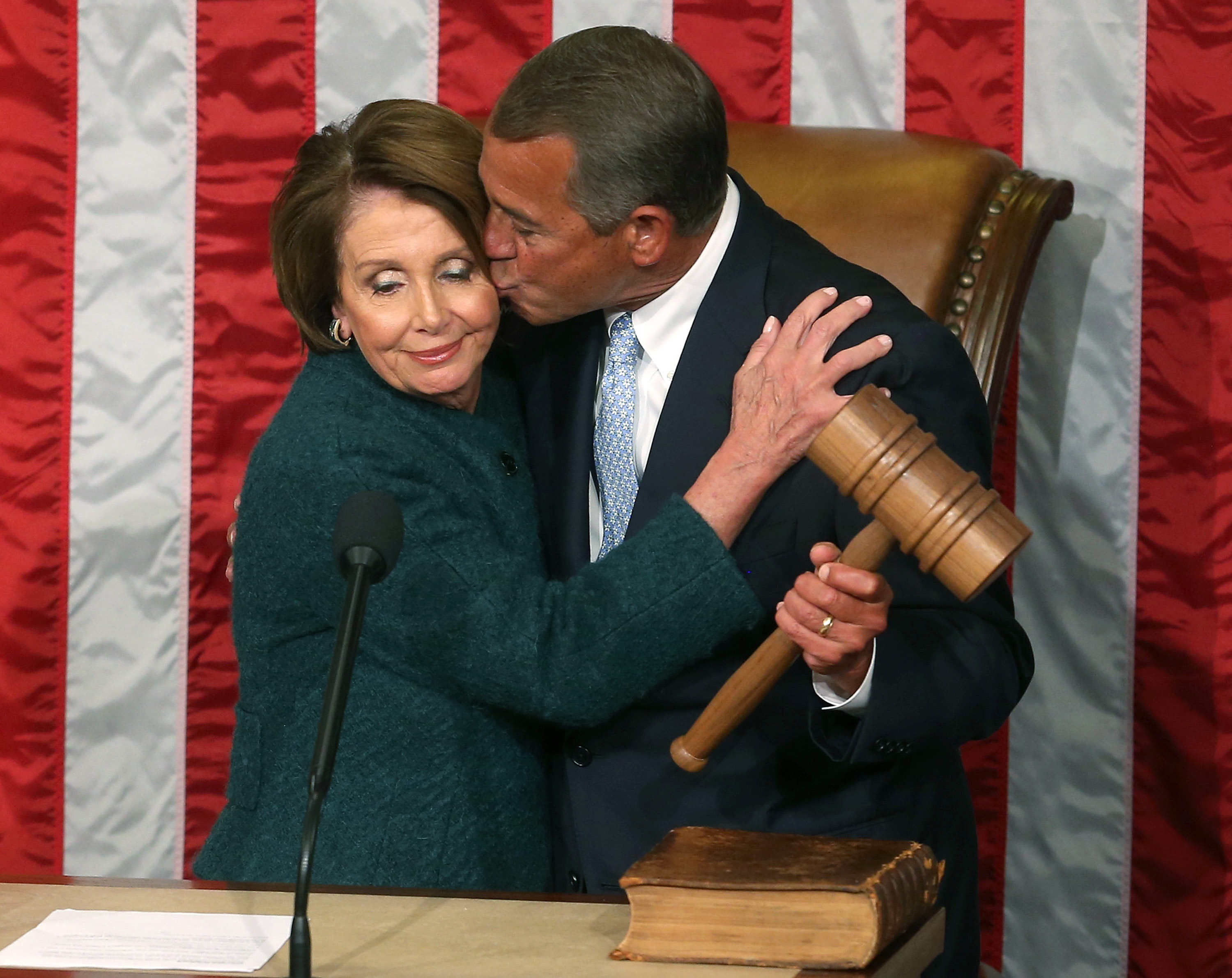
House Minority Leader Nancy Pelosi (D-CA) hands Speaker of the House John Boehner (R-OH) the speaker’s gavel during the first session of the 114th Congress in the House Chambers January 6, 2015. Boehner maintained his speakership but with two dozen House Republicans voting against him. Today Congress convened its first session of the 114th Congress with Republicans controlling both the House and Senate. By Mark Wilson/Getty Images. Update from a reader:
Good Lord, at first glance I thought this was Obama and Pelosi. Why is Boehner so dark in this photo?
Few would shed few tears if Gambian dictator Yahya Jammeh, who recently signed a law criminalizing “aggravated homosexuality” and who once claimed to have discovered an herbal cure for AIDS, were to come to some bad end. However, the two Gambian-Americans who recently tried to pull off a coup in Banjul clearly didn’t think it through:
The men, Cherno Njie, 57, of Austin, and Papa Faal, 46, of Brooklyn Center, Minn., were part of a ring of approximately a dozen co-conspirators who agreed to participate in the coup, according to a criminal complaint. In an interview with the FBI, Faal admitted playing a role in the coup and identified Njie, a businessman, as one of the leaders and main financiers of the plot, the complaint alleges. Faal told the FBI that Njie intended to serve as the interim leader of the country after they deposed 49-year-old Yahya Jammeh, the president of Gambia. …
The group had originally planned to ambush the president’s convoy but instead decided to target the government State House in Banjul, the country’s capital. Split in two teams, the group descended on the State House, the complaint says, before encountering heavy fire and taking serious causalities. Some of the attackers were killed.
Pointing to fraying ties between Jammeh and his military, which have underlain many previous coup attempts, Maggie Dwyer isn’t surprised to see diaspora dissidents trying to bump off the strongman:
Despite the fate of past coup plotters in the Gambia, military personnel have continued to try to oust Jammeh. He has endured at least eight alleged coup attempts during his 20 years in office. Many of the accused plotters had served at the highest military positions, including Army Chief of Staff and Director of the National Intelligence Agency, suggesting divisions at the most senior levels. It should be noted that there is speculation as to whether some of the attempts were real or simply ways to purge members of the military. The ambiguity of these events is another cause of uncertainty and fear within the military. These tensions, divisions, and dissatisfaction within the Gambian military probably contributed to the most recent and past coup attempts against Jammeh.
Keating comments:
Coup plots against brutal West African dictators tend to attract a certain kind of overambitious adventurer. Most memorable was the misbegotten 2004 “wonga coup” attempt against Equatorial Guinea President Teodoro Obiang Nguema, a tangled mess involving British and South African mercenaries and—allegedly—Margaret Thatcher’s son. Faal, at least according to his statements, appears to have been a bit more idealistic than the wonga plotters, motivated by concern over the dire state of affairs in his country, even if he didn’t really think through the consequences of what he was getting involved in.
In case you’re wondering, it’s legal in many cases for U.S. citizens to fight in another country’s war, but plotting aggression against a nation “with whom the United States is at peace” from U.S. soil is prohibited under the Neutrality Act, which dates back to George Washington’s presidency.
While Jammeh downplayed the coup attempt as a terrorist operation backed by foreign governments, he also reshuffled his cabinet and launched a crackdown on local dissidents in response:
“There have been massive arrests in Banjul and there’s a heavy security presence in the capital Banjul and around the presidential palace,” a Gambian journalist told DW. He spoke to DW on condition of anonymity and confirmed that both serving and former military personnel had been arrested and that security had been vamped up in the capital Banjul. He however said that life in the city was back to normal on Friday (02.01.2015). … Gilles Yabi, a researcher based in Dakar, warned that the attempted coup could result in the wider repression citizens in Guinea-Bissau. “There are fears the regime could take advantage of the situation by blaming people who had nothing to do with it.”
Slaying the playroom:
[youtube https://www.youtube.com/watch?v=YD-1fBWHioA] The Dish