And Sometimes I Just Get Things Wrong

I guess it’s a function of not following the Benghazi story as diligently as some others. But that’s no excuse. Weigel and Dickerson are must-read correctives to my take on the Ben Rhodes email, and show how this new email – though indeed foolishly withheld (the real story) – isn’t anywhere near as damning as it may sound at first blush. For two reasons: the information Rhodes was working off – via the CIA and State – was indeed that the attack was related to the inflammatory video. Dickerson:

Rhodes sent his email at 8 p.m. on Friday, Sept. 14. Nine hours earlier, the CIA had sent its first set of talking points. The very first line of the first CIA talking point read: “The currently available information suggests that the demonstrations in Benghazi were spontaneously inspired by the protests at the US Embassy in Cairo and evolved into a direct assault against the US Consulate and subsequently its annex.” (The original copies are here, released by the White House last May.) What was causing the protests in Cairo that the CIA mentions? The video.

Weigel offers this timeline, via Zeke Miller:

2:23 p.m.: The CIA’s office of general counsel adds a line about the “inspired by the protests” theory being inconclusive.

3:04 p.m.: The talking points are sent to relevant White House aides, including Ben Rhodes.

4:42 p.m.: The CIA circulates new talking points but removes a mention of al Qaida.

6:21 p.m.: The White House (Tommy Vietor, not Ben Rhodes) adds a line about the administration warning, on September 10, of social media reports calling for demonstrations.

7:39 p.m.: State Department spokeswoman Victoria Nuland objects to some of the language because “the penultimate point could be abused by members to beat the State Department for not paying attention to Agency warnings.”

8:09 p.m.: Ben Rhodes sends the “smoking gun” email, nine hours after the first draft of talking points from the CIA said that the attacks grew out of a demonstration.

Weigel’s conclusion:

The White House’s shifty-sounding excuse, that the “demonstration” story line came not from its spin factory but from the CIA, remains surprisingly accurate.

It was spin, not deception. There’s a big difference. And for full disclosure: I’m friends with Ben and should have known he is not the type to lie about anything. But sometimes, a relationship like that makes me be extra skeptical about stories involving friends or acquaintances. I learned that in the Bush administration. But in this case, I was over-correcting and under-informed. Apologies.

Iraq Votes. But Will It Matter?

Joel Wing outlines the likely results of yesterday’s general election in Iraq:

Most Iraq watchers now seem to believe that the prime minister [Nouri al-Maliki] will get the most seats in parliament, and then go through a very long process of negotiations that could drag out for up to a year, and ensure himself another four years in office. The premier is hoping that his Shiite base will come out for him out of fear of the growing insurgency, and give him a plurality of votes. He will then be able to play upon the splits within the Sunni parties to ally with Deputy Premier Salah al-Mutlaq. If that gives him momentum the history of Iraqi politics is for the other parties to jump on board to assure themselves positions within the new government.

An alternative scenario could play out however. Last year ISCI was able to cut into Maliki’s base, and are hoping to repeat that again. It has portrayed itself as a nationalist party that has the support of the religious establishment in Najaf. The Sadrists’ Ahrar bloc believes that it can maintain its alliance with the Supreme Council that it forged in the 2013 elections. If they get anything near the number of seats of Maliki it will be a free for all for to create the majority necessary for a new government.

Bob Dreyfuss recounts how Maliki has cemented himself in power since the last election:

Back in 2010, when an opposition party led by Ayad Allawi—a wily, nonsectarian, secular Shiite politician with a largely Sunni base—won the biggest share of the vote, both the United States and Iran weighed in to prop up Maliki and ensure that he was able to form a government that eventually excluded Allawi. A year later, in 2011, the remaining American troops departed, and within days Maliki went to war against Sunni politicians, the Sunni establishment and others who opposed his authoritarian style.

Maliki used spurious charges of terrorism against top politicos, including the Sunni vice president of Iraq, who was forced to flee for his life. Following that, Maliki cracked down viciously on peaceful, Arab Spring–style protests in Anbar, killing hundreds and detaining thousands. …

So, it’s no wonder that the Iraqi insurgency that erupted after 2003 is back. This time, it’s enhanced by the chaos in Syria, where a largely Sunni army of Islamist fanatics and rag-tag rebels tied to Al Qaeda and ISIS are battling the government of President Bashar al-Assad. Cities such as Ramadi and Fallujah have turned into strongholds of the insurgency, and the anti-Maliki radicals have deployed waves of suicide bombers and car bomb experts to slaughter thousands of Shiite civilians in markets, public squares and other soft targets. They’ve also carried out a lethal pattern of assassinations of moderate and establishment Sunnis outside Baghdad.

Jay Ulfelder doubts the polls will stem the rising tide of violence:

Iraq is already suffering mass atrocities of its own at the hands of insurgent groups who routinely kill large numbers of civilians in indiscriminate attacks, every one of which would stun American or European publics if it happened there. According to the widely respected Iraq Body Count project, the pace of civilian killings in Iraq accelerated sharply in July 2013 after a several-year lull of sorts in which “only” a few hundred civilians were dying from violence each month. Since the middle of last year, the civilian toll has averaged more than 1,000 fatalities per month. That’s well off the pace of 2006-2007, the peak period of civilian casualties under Coalition occupation, but it’s still an astonishing level of violence. …

In theory, elections are supposed to be a brake on this process, giving rival factions opportunities to compete for power and influence state policy in nonviolent ways. In practice, this often isn’t the case. Instead, Iraq appears to be following the more conventional path in which election winners focus on consolidating their own power instead of governing well, and excluded factions seek other means to advance their interests.

Zalmay Khalilzad, who also expects Maliki to remain in power, addresses how the US should respond:

A new leader, untainted by a record of distrust and broken deals, could offer Iraq a promising way forward. A U.S. push to oust Maliki, however, would be risky. Relations between Washington and Kabul deteriorated sharply after Afghan president Hamid Karzai won re-election over the Obama Administration’s opposition. The experience with Maliki, moreover, shows that U.S. support for the winning candidate does not necessarily translate into reliable governance. …

Instead of relying on preferred Iraqi leaders, the Obama Administration should clearly articulate the program of reform it wants implemented during the process of government formation. Iraq’s constitution, which emphasizes federalism and decentralization of power, provides a roadmap for reform. Continued effort at monopolization of power by a majoritarian central government could incite a Kurdish push for sovereignty, as well as increased violence among Iraq’s Sunni population. Some Sunni leaders, after opposing federalism in the years after Saddam’s overthrow, now seek recognition of its provinces as federal regions.

Book Club: Was There An Empty Tomb?

Resurrection

A reader challenges a part of Ehrman’s book we haven’t discussed yet:

Reading your thoughts and the reader responses so far, I’m surprised no one has mentioned Ehrman’s claim, in Chapter Four, that Jesus most likely wasn’t given a proper burial, meaning there was no tomb for his resurrection to leave empty – nor an actual body left to be resurrected, as theological orthodoxy would seem to demand. An excerpt from this chapter was recently featured on The Daily Beast, in which Ehrman makes this explicit: “Without an empty tomb, there would be no ground for saying that Jesus was physically raised.” And clearly, as Ehrman shows in his book, the “empty tomb” features prominently in Christian apologetics on this issue. The idea that Jesus really was buried allows Christians to ask, “Well, then what did happen to Jesus’ body?” If he wasn’t eaten by dogs, then we need to somehow account for his body, which people certainly would have been looking for after his followers started saying he was raised from the dead. Or so the argument goes.

bookclub-beagle-trAs it happens, the chapter on this issue by Craig Evans in the evangelical response to Ehrman’s book was the one I actually found perhaps most persuasive, and your readers should be aware of it. Evans cites a variety of ancient texts – including passages from Philo, Josephus, and Roman legal documents – that give us good reasons to think Roman authorities were tolerant of Jewish religious customs. It would take too long to go through all of Evans’ evidence, but their cumulative force is striking, and he makes clear that his argument especially concerns what the Romans allowed in Jerusalem, the center of Jewish religious life, where religious demands for performing certain rites, like the burial of the dead, would have been especially forceful (Jews in other places, such as Alexandria, seemed to fare worse).

Even Ehrman’s own book unwittingly offers evidence for this. Recall the account he gives of Pontius Pilate erecting images of the Roman emperor in Jerusalem, which violated Jewish beliefs about “graven images.” What happened after the Jewish uproar over this? They were removed.

Evans also makes clear that tolerance for Jewish burial customs extended, in various circumstances, to those who were crucified. Most interestingly, in my view, is the archaeological evidence he marshals on this point.

He walks the reader through examples we have of tombs and (more frequently) ossuaries containing the remnants of those crucified or nails of the kind used in crucifixions covered in calcium, meaning they were once in human bones. In short, not everyone who was crucified, and certainly not all Jews, were simply left for the wild dogs or carrion birds to eat. Evans cites Jodi Magness, a Jewish archaeologist at Ehrman’s own UNC-Chapel Hill, who summarizes the matter this way:

Gospel account of Jesus’ burial are largely consistent with the archaeological evidence. Although archaeology does not prove there was a follower of Jesus named Joseph of Arimathea or that Pontius Pilate granted his request for Jesus’ body, the Gospel accounts describing Jesus’ removal from the cross and burial are consistent with archaeological evidence and with Jewish law.

And speaking of Joseph of Arimathea, Evans argues that even that story has some real credence. Because the Sanhedrin, or Jewish Council, delivered Jesus to the Roman authorities, they would have been responsible for arranging a proper burial. So whether or not Joseph actually existed, the broad outline of the story he figures in is, according to Evans, reasonably consonant with the customs of the day.

Lastly, Ehrman makes a big deal of the fact that in the early creed Paul cites in his first letter to the how-jesus-became-godCorinthians, it merely says “And he was buried” rather than “And he was buried in a tomb.” When I read Ehrman’s book, I couldn’t understand quite why that mattered. Being buried implies a tomb, or a grave of some kind, but regardless being buried is not the same as being left to the dogs. Evans makes exactly the same point. And as for the supposed lack of symmetry in the creed – the line corresponding to the one just mentioned says “And he appeared to Cephas,” which leads Ehrman to think Joseph should be noted as the one who buried Jesus – Evans makes the reasonable point that naming who Jesus appeared to after his resurrection would be a far more important detail to include than the name of who buried Jesus, so the comparison doesn’t quite hold. Of course, maybe Joseph wasn’t named because that particular tradition arose later, but even if it did, the lack of knowing exactly who buried Jesus does nothing to alter the other contextual evidence that leads Evans to argue that it wouldn’t have been unusual for Jesus, a Jew in Jerusalem, to be given a proper burial.

Overall, then, this is one point where my layman reading of both sides of the argument makes me lean toward Ehrman’s evangelical critics.

Agreed. Another critical point worth reiterating in this context: perhaps the most striking thing in the book is that Ehrman explicitly states he has changed his mind as to when the belief in Jesus’ divinity arose. He used to think it came about decades later, but is now convinced by the evidence that the resurrection was a very early Christian belief. So the empty tomb is a real possibility and the resurrection was claimed by the earliest Christians. Sometimes religious beliefs are weakened by historical evidence; but sometimes they are actually strengthened.

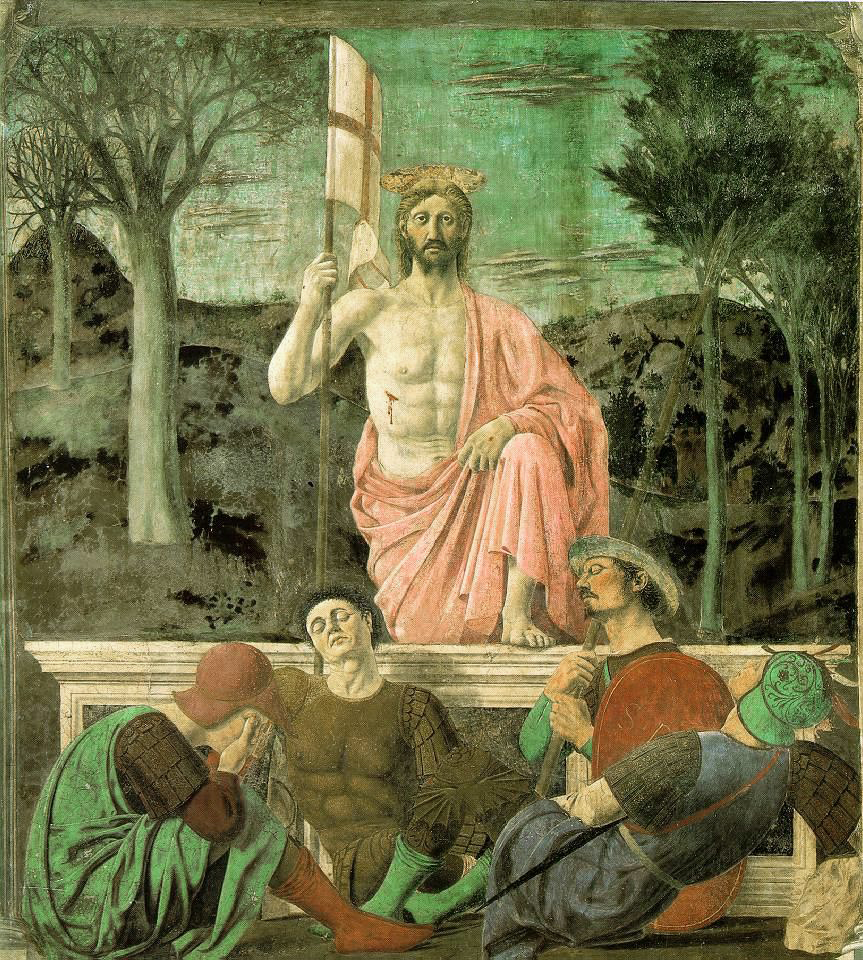
(Read the whole Book Club thread on How Jesus Became God here. Email any responses to bookclub@andrewsullivan.com rather than the main account, and please try to keep them under 500 words. Painting: The Resurrection Of Jesus by Piero Della Francesca.)

Yes, Mormons Can Be Funny

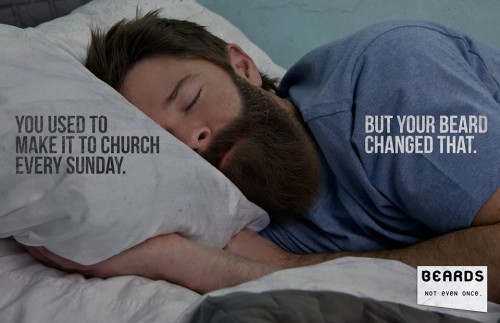
A parody of an LDS childrens’ book meets the Mormon prohibition on facial hair. It’s from the BunYion, at BYU:

beard2-e1398723503374

The comments are a trip:

It saddens me that the men of the church are addicted to beards. I recently heard that Utah leads the nation in subscriptions to “Beard Aficionado” magazine. Some may justify their addiction by saying beards are “natural” that “no one is getting hurt” or that I only grow “soft” beards and not “hard” beards. However, once you grow a beard you don’t know what future happiness will be forfeited. Remember the story that was told in General Conference about the young woman who refused to marry a young man because, in the past, the young man had a beard? Sin has consequences!

Another:

For all of those facial hair lovers, please know that there is still hope. For sometime I struggled with “beard or no beard” I would play on the edge with mustaches, goatees, and I even attempted a handlebar at one point. Just to see what it was like….

After sometime I noticed something missing in my life. I was with some friends and I noticed they all seemed to be happy and I couldn’t tell why. Then I realized it, they all were clean shaven! I went home that very night and threw away all my beard trimming equipment, found an old razor, and shaved off those vile hairs. Oh the silky smooth feeling of redemption. If you feel manly, awesome, and/ or like you could survive a zombie apocalypse with only a crowbar you don’t have to stay that way. Shave off your beard and go from looking like a man to a boy in a matter of minutes. Shave brethren, shaving is the answer.

How Many Obamacare Enrollees Have Paid Up?

A committee report by House Republicans claims it’s relatively few:

Only two-thirds of people signing up on Obamacare’s exchanges paid their premiums as of April 15, the US House Energy and Commerce Committee reported Wednesday. If true, that means one-third of people on the exchanges had not completed the final step to actually obtaining health insurance in time for the committee’s report.

Cohn calls bullshit:

With House Republican committee reports, you always have to read the details. And in this case the details say quite a lot.

The committee staff got their information directly from insurers, but it’s only valid up through April 15. As experts and industry officials quickly pointed out, that’s too early to get an accurate sense of the payup rate.

Remember, open enrollment officially ended on March 31. And, thanks to the Administration’s extensions, people were still signing up well into April. At the time the Committee requested the information, many of these people would have just received their first invoices for payment. Payment wouldn’t have been due until the end of the month—in other words, Wednesday. It’s safe to assume that lots of people waited until the last minute to send their checks, which means it’s safe to assume the real payup rate is higher than 67 percent.

Benen scoffs at “the latest evolution in the GOP’s anti-healthcare line”:

What started with “no one will want to sign up” eventually became “no one should sign up,” which morphed into “not enough people are signing up,” and finally “those who did sign up don’t count.”

But Suderman points the finger at the administration:

Republicans on the Committee are aware that the information they have so far is incomplete, and they are going to follow up with insurers toward the end of May. So we’ll get more information—eventually. But it’s going to take time. The administration could have headed off a lot of this sort of discussion by being more transparent from the start, releasing updates about payment rates, along with sign ups and demographics, and context about deadlines as well. Instead, they stonewalled and deflected. Which is how we ended with a Republican Committee trying to get this information themselves, and a report that at most suggests an eventual possibility of significant non-payment problems, but doesn’t demonstrate much of anything right now. For the time being, then, we’re left right back where we started, with no solid, comprehensive information to rely on about how many sign ups have paid.

And Philip Klein thinks the report “puts HHS officials in a pickle”:

If they attack the Republican report as inaccurate, it will be an implicit acknowledgement that they have numbers that they aren’t releasing. So their choice is either to stay silent and let the GOP-obtained data fill the news vacuum, or release detailed enrollment data. It’s way past time for them to come clean.

Chart Of The Day

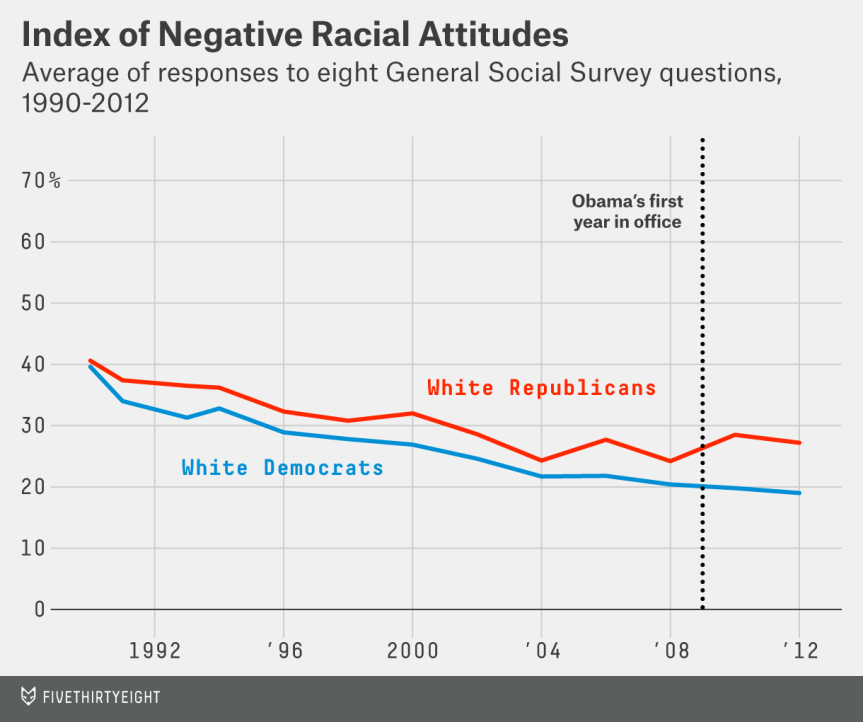
silver-index-racial-92

So yes, there does seem to be a slight partisan aspect to racist attitudes in the Obama era. But it is not that big, and the general trend lines over the longer term are positive. What I’m grappling with is whether my own confirmation bias is blinding me to the persistence of truly base racism in American society. I can remember only two instances in my adult life when someone said something to me foully racist. One was when someone observed that in Provincetown, there was no crime because “there aren’t any blacks.” I ended that conversation at that point. Another was a long-ago one-night-stand which in the end lasted only a few minutes. We were back in this dude’s apartment and he was cussing the cable service he had. Then he started going off on the African-American men who had installed it. “Worthless niggers,” he said in a tone that stopped me dead. I left.

I remember those moments because they were so rare. But then I went to Harvard, a bastion of anti-racist liberalism, and live in a still-largely African-American city in what remains a very racially mixed neighborhood and over the years have obviously selected racists out of my life. No, I’m not saying racism is exhausted by the kinds of vile things I heard, and obviously milder forms can be much more pervasive (even in my own consciousness). What I’m saying is that I have been actually shocked by the baldness of Donald Sterling’s bigotry – and perhaps I shouldn’t be. Charles Blow has an excellent column today, unpacking its evil. One aspect:

Stiviano asks, “Do you know that I’m mixed?” Sterling responds, “No, I don’t know that.” She insists, “You know that I’m mixed.” Later he tells her, “You’re supposed to be a delicate white or a delicate Latina girl.”

The word “delicate” there hangs in the air like the smell of rotting flesh, because by omission and comparatively, it suggests that black women, or women who associate with black men, are somehow divested of their delicateness, which in this case, and the recess of this distorted mind, sounds a lot like a term of art for femininity, and by extension womanhood. This is a disturbing peek at the intersection of racism, misogyny and privilege. “I wish I could change the color of my skin,” Stiviano says. Sterling responds, “That’s not the issue.” He continues, “The issue is we don’t have to broadcast everything.”

Another disadvantage I have in grasping all this is that I wasn’t born in America and didn’t grow up here – and so the contours of America’s long and hideous conversation about race are not in my bones. All I can say is: I’m trying to fit all the new data points in my worldview, and haven’t reached a conclusion. Oh, and Ta-Nehisi could not have invented a series of revelations more likely to prove him right about the lingering power of white supremacy, in the shadows of our lives.

The Benghazi Email

[Update: please see my correction to this post here]

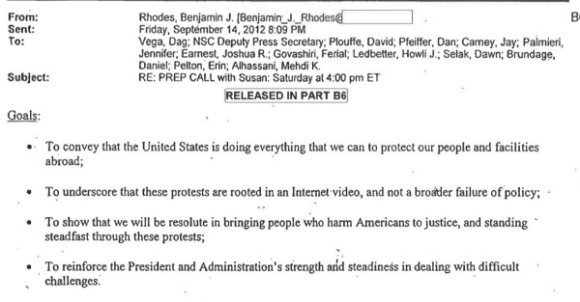
A couple of obvious things. The notion that the Ben Rhodes email was really about the broader situation in the Middle East and not about Benghazi – something actually peddled with a straight face by Jay Carney yesterday – is absurd. The email was specifically sent to prep Susan Rice for her Sunday morning talk show appearances after the attack on the US Consulate. It’s an obvious attempt to push back on the idea that the attack in Benghazi was a coordinated Jihadist effort which took the US by surprise and to present the infamous video as the real cause. I really can’t see any other viable interpretation:

580x302xRhodesEmail022-600x313.jpg.pagespeed.ic.4XiKfpQ9fx

The question is whether Rhodes was conveying the best spin on a confusing situation, or whether he knew full well that the video was unrelated to the attack and was providing political cover for the president. I simply don’t know the answer to that. Spinning and lying are related but different things. But even if the reports were confusing, as they probably were, Rhodes is clearly trying to pin the attack on one cause alone, for which there was no categorical evidence. At the very least, this was self-serving spin. But that alone, it seems to me, is hardly a high crime or misdemeanor. Governments spin events all the time. And if there’s chaos and confusion, best to cherry pick the facts that put you in the best light – especially in an election season. Until we have evidence that Rhodes was knowingly propagating something untrue, I don’t think there’s much here.

But the administration’s withholding that email from previous inquiries truly does stink. In fact, that is the real reason to regard this email as meaningful. Yes, I know this is really about finding ways to derail Hillary Clinton’s path to the White House – this WSJ editorial almost says that out loud at the end. Yes, it’s really not that big a deal – the real scandal is that the consulate was unprotected and vulnerable and the blame for that has always belonged to the State Department and to tighter budgets imposed by the GOP. But you don’t withhold transparently relevant evidence if you truly believe you have nothing to hide.

Letting Go Of Global Hegemony

US-POLITICS-OBAMA

Yesterday’s Wall Street Journal poll on foreign policy made for a stark contrast with the growing consensus among the chattering classes about president Obama’s foreign policy. Here’s MoDo channeling the frustration of many and addressing herself directly to Obama:

You are the American president. And the American president should not perpetually use the word “eventually.” And he should not set a tone of resignation with references to this being a relay race and say he’s willing to take “a quarter of a loaf or half a loaf,” and muse that things may not come “to full fruition on your timetable.”

An American president should never say, as you did to the New Yorker editor, David Remnick, about presidents through history: “We’re part of a long-running story. We just try to get our paragraph right.” Mr. President, I am just trying to get my paragraph right. You need to think bigger.

A great line. Until you ask yourself what exactly does she mean by thinking bigger. The closest MoDo comes is the following:

Especially now that we have this scary World War III vibe with the Russians, we expect the president, especially one who ran as Babe Ruth, to hit home runs.

Home-runs, please is not exactly a productive contribution to the discussion. What on earth would a “home-run” mean in Ukraine, for example? But this analysis misses one core fact: Americans, in polling, really do not want to be policing the world any more. Here’s one take-away from the WSJ poll:
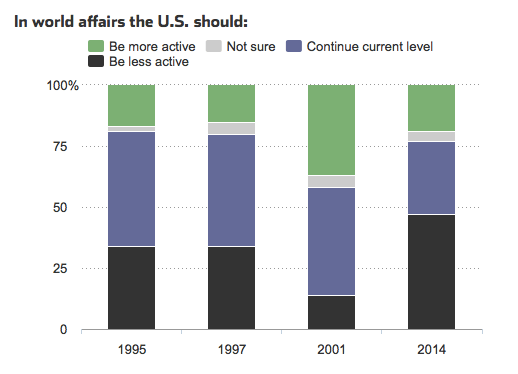
Screen Shot 2014-04-30 at 5.17.17 PMThat’s a record 47 percent favoring a less active foreign policy than Obama has conducted. As for the “scary World War III vibe” MoDo wants reassurance on, only 5 percent of Americans want the US out front alone on Ukraine. A quarter want to delegate the issue to the EU. And almost half want action only in cooperation with other countries. The decidedly non-interventionist public also strongly opposed a strike in Syria; wanted withdrawal from Iraq and Afghanistan; and still prefer, in record numbers, for the US president to focus on domestic affairs. More to the point, this non-interventionist consensus crosses party lines. Obama has, on most issues, stayed in line with popular opinion. That’s one key reason why Rand Paul has traction. And it’s one reason Hillary Clinton will be vulnerable if she appears to want to return to neocon reflexes.

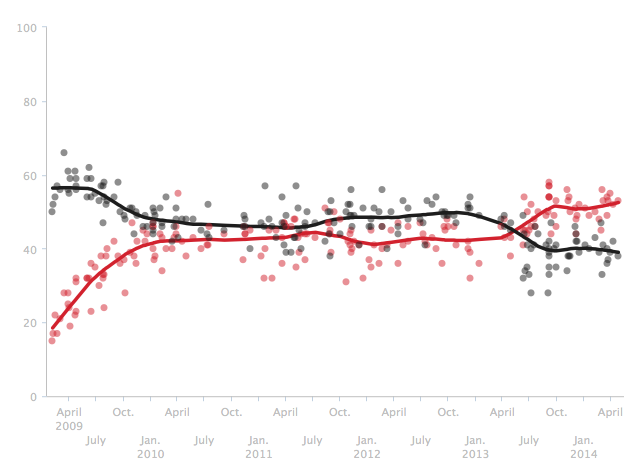
The paradox, it seems to me, is that Americans also miss the glory days. They both want withdrawal from the world but feel nostalgic for the heady post-Cold War days of easy hegemony, a budget surplus and a global reputation not stained by military occupations and torture. Robert Kagan had a shrewd column a month ago on this strange confluence of a president pursuing popular policies and becoming unpopular as a result. Here’s the poll of polls on foreign policy for Obama:

Screen Shot 2014-04-30 at 5.32.58 PM

The switch to disapproval happened about a year ago. Some of the subsequent shift may be due to the harsh criticism Obama received for not striking Syria after seeming to move toward it (even though the public wants to go to war in Syria like they want to abolish social security). Some of it may be due to Putin’s ugly machinations – prompting unreconstructed neocons like McCain to blame Obama for somehow encouraging it. The open wound of the Israel-Palestine question – where Obama has been very very active but without any progress at all – may also be a factor. But I suspect the bigger picture is that we’ve seen both an acceptance of a much more restrained America after the catastrophe of neocon governance and subsequent lingering unease about no longer being the sole superpower whose authoritah is always respected.

My view is that Obama has done about as good a job as possible in managing the core task of his presidency: letting self-defeating global hegemony go. That required a balancing act – of intervention where absolutely necessary and caution elsewhere. He prevented the world economy tipping into a second Great Depression, has maintained overwhelming military superiority and shored up Asian alliances even as he concedes, as we should, that China will be the dominant power in the region in the 21st Century. He rescued us from the Iraq and Afghanistan disasters, without chaos or immediate blowback. He’s successfully coordinating European responses to Russian aggression in Ukraine. It all adds up to the effective tending to a new era in which other countries and regions no longer accept American supremacy, and when US ideals – such as opposing torture – have been revealed as frauds.

This kind of pragmatic balancing act has none of the glory of the Cold War and a dispiriting (to some) element of retreat. But in many ways, this is inevitable. The staggering success of the West’s model in the last two decades is not one that can be sustained at the same pace. You don’t get to liberate Europe twice. And of course the biggest factors behind this new climate are the disastrous wars in Afghanistan and Iraq. They essentially revealed the US military as all-powerful on paper but inevitably insufficient to deal with sectarian hatred in the Muslim world, or running a “country” that cannot be run outside of a dictatorship or authoritarian figure. Even drones reached a point quite quickly at which their costs outweighed their benefits.

This is the essential context which makes sense of Obama’s pragmatic re-calibration of US foreign policy. What this picture reminds me of is the conventional wisdom about George H. W. Bush’s foreign policy at the time. In retrospect, his management of Soviet collapse was deeply under-rated, as was his decision not to invade Iraq. Like Obama, he saw China as a naturally emergent power to be coaxed rather than alienated. Like Obama, he tried and failed to move the Israelis out of their new project of Greater Israel. He was never going to be a Reagan, but in politics and world affairs, timing is everything. The difference, of course, is that Bush followed Reagan, whereas Obama followed the foreign policy equivalent of two terms of Jimmy Carter. So the bathos of pragmatism is all the more vivid this time around.

The one exception to this picture with respect to Obama is the overture to Iran. If he manages to resolve the nuclear issue in the next year, it will be a clear and revolutionary break from the past, as well as being the sanest approach to handling that poisonous but rational regime. But again, his success, if it occurs, will prompt more cat-calls from the neocons and loathing from the hard right. And it will not be greeted with the same relief as the end of the last Cold War, not least because the ayatollahs will remain in power, even if the landscape then shifts against them. Avoiding war is often not as popular as starting one. But it is what this country wants at this juncture in history, and it’s what the world needs. In the end, even queasy Americans may see the pragmatic sense in much of it. But they’ll keep it quiet if they do.

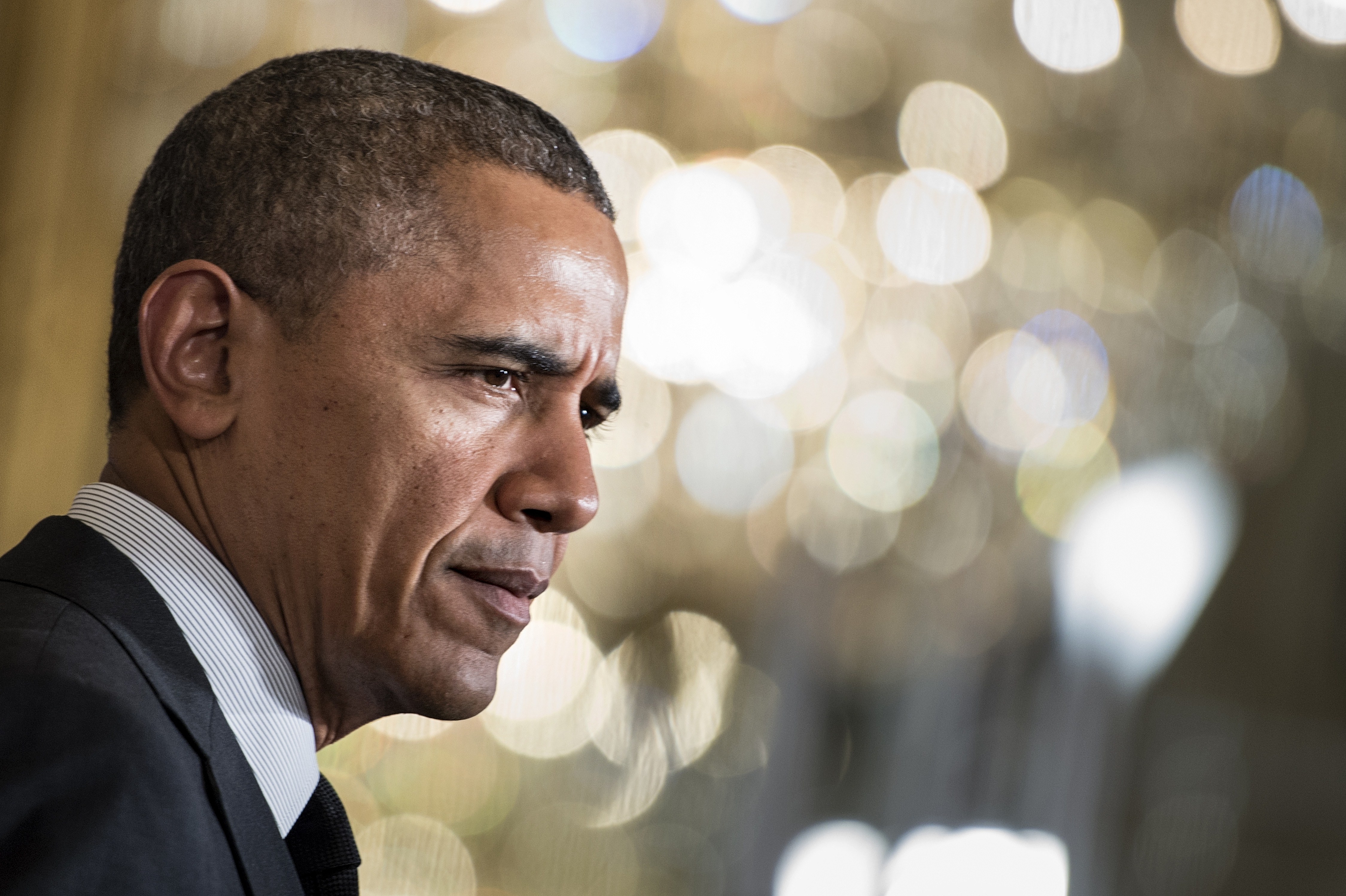
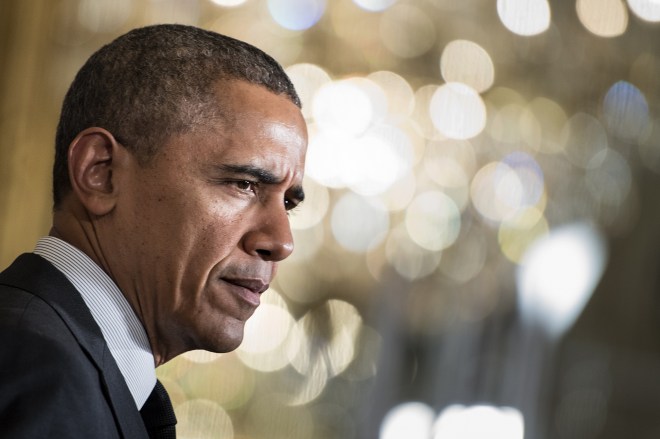
(Photo of Obama yesterday by Brendan Smialowski/Getty)
Do I Sound Gay? Ctd

David Cross’s genius and NSFW take on the subject:

I have to say I haven’t thought about this in a while, and since posting that promo for the documentary, I find myself a little paranoid. Maybe it applies to me. I have never been able to bear hearing myself or watching myself on TV. It creeps me out in visceral ways. I can’t even listen to a podcast for very long without wanting to coil up in a ball of self-loathing. (By self-loathing, I don’t mean merely because of my sexual orientation. My self-hatred is so much more extensive and varied than that.) Still, I doubt it has nothing to do with anxiety over the “gay voice.”

I actually had a dream not too long ago where I was listening to an interview I gave on the radio and I sounded like Princess Diana. Seriously, my voice was quite clearly a woman’s. And it wasn’t a pleasant dream. Occasionally, I’ll catch a whiff of an old clip from, say, Charlie Rose or Brian Lamb, and my gay voice sounds gayer then than it does now – or at least so it seems to me. And in fact, before I came out in my late teens, I was much more stereotypically gay than I am now. I wore dandy-esque clothes; I was in the theater; as president of the Oxford Union, my first debate included a drag queen (by my invitation); at Oxford, I gamely initiated the Poohsticks Club, and my nickname was Piglet! I wasn’t just into college drama, I played the lead role in Another Country, a play where my first line was “I want to pour honey all over him and lick it off again.” No wonder that I was outed by the college newspaper, even though I’d never touched another man.

Sometimes I wonder if the outwardly gay presentation, for me at least, was related to the closet. Because I could not be public and open about my sexual orientation, my psyche sought to express it in other ways. What is repressed up-front finds a way to express itself indirectly. That’s why when I see a priest all decked out in frills and lace and gold, I immediately think: another repressed gay. In fact, I doubt whether much of the more elaborate liturgy, ritual and drama of high Catholicism isn’t entirely a function of frustrated queens finding some outlet for their otherwise repressed nature.

But after I came out, and grew up as a gay man in the midst of a sobering, mind-concentrating plague, I found those external signals less necessary.

I’m not saying that this was a conscious or deliberate process. It just happened. In fact, it was only after coming out that I got in touch with more stereotypically masculine aspects of my personality. I grew much more comfortable in my body and became a gym-rat. I grew a beard and found myself more comfortable with straight guys than before (even though my bro-ness quotient was pretty high in my all-boys, rugby-playing high school). My clothes went from dandy to crappy. I still couldn’t give a shit about sports, but equally, I can’t bear being in a room where The Real Housewives of Beverly Hills is on the TV. All in all, after coming out, I found myself much less stricken between two polarities of what it means to be a man. I became much more comfortable in myself.

I wondered in the past what more social integration might do to the gay voice. Would it wane somewhat and eventually disappear? That’s the question I’d like to see addressed. If the gay voice is a function of the closet and of marginalization, would it have a harder time propagating in an era of much greater toleration and inclusion? My anecdotal evidence suggests something mixed. Yes, it is still there, but the extremes of either hyper-masculine presentation of hyper-feminine identity seem less extreme in the next generation. Here’s my ballsy guess: it’s a function in some ways of genetics but also the environment. Like every other fucking thing we humans do and are. But it’s fascinating to think of how specifically those two factors might interact, and what they may tell us about the paths for various homosexualities.

And by the way, do I sound gay?