Suicide Leaves Behind Nothing, Ctd

A reader merges the Leelah Alcorn thread with another popular one:

You’re no doubt unsurprised that I disagree with your reader who characterized Leelah’s suicide as “the worst and most selfish way to get satisfaction.” I can imagine far worse and more selfish ways of receiving satisfaction over grievances. In fact, I don’t have to imagine them, because we’ve seen them at Sandy Hook and earlier this month in Arlington, Texas, when Veronica Dunnachie killed her estranged husband and his daughter. Leelah didn’t shoot up her church or kill her parents – two choices that would have been far worse and more selfish than stepping in front of a truck.

I’m doing more than just objecting to the hyperbole. This loops us back to your “Suicide Leaves Nothing Behind” thread. People who have calmly, rationally decided that death is their best option should have better, more dignified, less violent options. They shouldn’t be forced to put loved ones at legal risk or involve anonymous third parties like that truck driver.

And, yes, it should include counseling, and in the case of minors, consent from either parents or a judge. But if at the end of the counseling the person is still resolved to die, they should have a painless dignified option of doing so on their own timetable. Martin Manley should have a more dignified exit available to him than a bullet to the head in a parking lot, and teens like Leelah should have a place to go to get the support she needs to make a better choice that won’t start by calling her decision to die awful and selfish.

An expert weighs in:

As a psychotherapist, I’d like to push back a bit on the notion expressed by some readers that Leelah Alcorn’s suicide, or that suicide in general, is selfish.

Or that it’s in any way an extension of the “typical” “selfish” behavior of teenagers. I think selfishness is not a helpful adjective to use in this conversation. Suicide is the last, most desperate act of person who is suffering beyond what most of us can imagine. Suicide is no more selfish than having major depression or a terminal illness plus chronic pain is selfish.

And it is developmentally normal for teens and young adults to be somewhat more self-focused than middle-aged or older adults. There is nothing useful to be gained by labeling teens as selfish with the moral sanctimony that conveys.

My reading of the data is that suicide is less common among adolescents than older age groups, which would suggest that it’s misguided to associate the normal increased self-focus of teens with the act of suicide, speaking at the level of trends. At the level of the individual, increased sensitivity to self-image in a teen may be one additional risk factor for those who are already struggling with depression and lack of social support. But the idea that teen behavior is “selfish” and teen suicide an example of this “selfishness” is a terrible and inaccurate notion to perpetuate.

Suicide represents a systemic failure, not an individual failure. It often reveals a lack of adequate family and social support of the individual who is suffering, and often also a lack of access to adequate healthcare and counseling. Suicide is a collective failure that manifests in an individual’s actions. Which isn’t to say that individuals have no responsibility to get help; we all have choices. Of course some of us have more choices than others because of economic of social privilege.

Talk of suicide always makes me think of both David Foster Wallace and a close friend of mine, also a writer, who committed suicide around the same time. Both of these individuals were well into adulthood when they killed themselves and had struggled with depression for many years. They pursued multiple, invasive, and costly treatments, were hospitalized, did talk therapy, and as far as I can tell worked hard to love and be loved in their daily lives. They were people with significant economic resources to avail themselves of all these treatments and with substantial social supports. And yet, after many years of steady, hard work to recover from their depressions, they both took their lives.

If DFW and my friend had been diabetes patients, we would say they did all the right things to safeguard their health, and the illness still took them. If they had been cancer patients, we would have praised them for fighting courageously against their disease before succumbing to it. We would never think to call them selfish. It continues to astonish me how much stigma we still tolerate being assigned to serious and devastating mental health issues.

The Rise And Fall Of Music Genres

It’s connected to the complexity of the songs:

We show that changes in the instrumentational complexity of a style are related to its number of sales and to the number of artists contributing to that style. As a style attracts a growing number of artists, its instrumentational variety usually increases. At the same time the instrumentational uniformity of a style decreases, i.e. a unique stylistic and increasingly complex expression pattern emerges. In contrast, album sales of a given style typically increase with decreasing instrumentational complexity. This can be interpreted as music becoming increasingly formulaic in terms of instrumentation once commercial or mainstream success sets in.

Lenika Cruz reads through the research:

Perhaps most interesting is the study’s tracking of “complexity life cycles.” For one, “experimental,” “folk,” and “folk rock” consistently maintained high levels of complexity through each time period studied. Others weren’t so lucky: “Soul,” “classic rock,” and “funk” started out high on the complexity scale but have since plummeted.

At different points in time, styles such as “euro house,” “disco,” and “pop rock” decreased in complexity, but enjoyed higher average album sales, while “experimental,” “alternative rock,” and “hip hop” became more complex, but saw overall sales decline. “This can be interpreted,” the researchers said, “as music becoming increasingly formulaic in terms of instrumentation under increasing sales numbers due to a tendency to popularize music styles with low variety and musicians with similar skills.” (In terms of instrumentation being the key here—and the study only looked at complexity factors that lent themselves to quantitative analysis such as acoustics and timbre).

Consent Of The Nudged

Steve Teles worries about it in his review of Cass Sunstein’s Why Nudge? The Politics of Libertarian Paternalism, asserting that “for a book supposedly on the politics of libertarian paternalism, there is very little here on the core of politics, which is principally about the mobilization of consent”:

Sunstein says nothing about how his favored range of interventions can be expected to generate the power necessary to overcome the opposition one would expect from changes sufficient to alter significant social outcomes. Why? Because it is fairly obvious that you will not get masses of ordinary Americans flooding the streets with signs saying, “Nudge Me!” or “Stop Me Before I Snack Again!” The liberalism of nudgers is a recipe for an unmobilized citizenry, not only because these sorts of interventions are unlikely to attract citizens to ensure their enactment, but also because their relatively low-profile, under-the-radar quality will attract, at best, modest interest group support from professional nudgers and those who stand to be economically advantaged by the nudge in question. The more liberalism seeks its ends through nudging, the more it both depends upon and generates a prostrate citizenry—one insufficiently mobilized to actually challenge deep structural inequalities, let alone to explicitly recognize who has leased its consent.

Due Process For The Devil

Jury selection began yesterday in the trial of the accused Boston Marathon bomber Dzhokhar Tsarnaev. Reporting from the courtroom, Seth Stevenson touches on why it is significant that he is being tried in the same city where the bombings took place:

Judge [George A.] O’Toole has refused to move the trial to another location. It’s worth remembering that the most comparable act of domestic terrorism, Timothy McVeigh’s bombing of a federal building in Oklahoma City, was not tried within walking distance of the site of the crime. It was shifted to Colorado in search of a less biased jury pool. Some of the circumstances in that case were different, but there’s no doubt there are parallels in how these two attacks cut at the heart of the regions they damaged.

Whatever the final makeup of this jury, the hardest question they face will have little to do with simple guilt or innocence. It’s safe to assume Tsarnaev will have no hope of disproving his involvement in the bombing. There are videotapes. A rumored confession. A revealing, anti-American screed written in the boat cockpit where he lay bleeding.

The gut-wrenching decision for this jury will come later, during the penalty phase, when Tsarnaev faces execution. This is a state where a firm majority opposes the death penalty on principle. But Tsarnaev’s jurors, to be chosen, will need to state that they are willing to impose a death sentence if they determine one is justified.

Noah Feldman can’t see him getting a fair trial in Beantown:

The Boston Marathon bombing poses a new challenge. It’s not just that many and maybe most Bostonians know one or more of the thousands of people who ran in the marathon and were targets of the attack. (I certainly do.) The search for the bombers actually shut down the city and several suburbs after they killed a police officer for the Massachusetts Institute of Technology and exchanged fire with Watertown police. Having been in lockdown, with the sound of Black Hawk helicopters overhead and the children barred even from the backyard, was an experience not easily forgotten. And it affected hundreds of thousands of people who might be in the jury pool.

Deepening the problem of a fair trial is the collective response to the bombings. The “Boston Strong” campaign, which featured everyone from then-Mayor Thomas Menino to the redoubtable Red Sox slugger David Ortiz (the latter mere popular even than the former) united greater Boston like no other public outpouring in my lifetime.

Masha Gessen agrees:

[T]he eighteen jurors who are eventually seated will face the difficult, if not impossible, task of separating their duty of representing the community as jurors from the outrage they may feel as members of a community that was attacked, by proxy, when the bombs went off at the Boston Marathon. The prosecution and, likely, its witnesses will repeatedly stress this sense of collective injury. Tsarnaev is accused of attacking America, and he may believe he did. The government will, in effect, ask the jury over and over again, “Are you with us or against us?”

Oil Prices Keep Falling

Mooney watched as oil dipped below $50 per barrel yesterday:

So when does the oil price decline actually stop? Brian Youngberg, a senior analyst at Edward Jones who focuses on the energy sector, says he’s expecting an oil price bottom in the first half of 2015 — but more downside pressures are definitely possible in the interim. The reason is simple: supply, supply, supply.

“Russia is producing at the highest levels since the Soviet Era, and Iraq is producing at its highest levels since the 80s,” says Youngberg. “There’s just plenty of oil to go around right now, and not enough places to put it.”

Plumer says much the same:

Whenever new data shows an unexpected boost in oil production or an unexpected drop in oil demand, prices go down. For oil prices to go up, we’d need to see either an unexpected drop in supply — say, new fighting flares up in Iraq, or US shale projects start going offline faster than expected, or Saudi Arabia switches its stance and decides to cut back on output to prop up prices. Or we’d need to see a surprising rise in demand — say, China starts growing faster than expected or the euro zone somehow fixes its economic woes.

Drum imagines how this will impact the fight over Keystone XL:

Prices have plunged, OPEC is engaged in a production war, and gasoline is selling for two bucks a gallon. Does the American public really care very much right now about a pipeline that makes it easier for Canadians to ship their oil to Japan via the Gulf of Mexico?

I’m not sure, but I suspect Republicans may be choosing the wrong moment to take a stand on Keystone XL. Democrats can probably hold it up in the Senate without paying any real price, and even if they can’t, Obama can veto it without paying any real price. It’s lost its salience for the time being.

What We Lose When Magazines Fade Away

The historian David A. Bell, who resigned as a contributing editor of The New Republic last month, considers the intellectual ramifications of the decline of dead-tree magazines:

In this new digital universe where words have broken free of their traditional covers — and reading so easily turns into skimming — arguments flow faster and fiercer than ever, but they dean20and20obamaare atomized, and hyper-accelerated. A group of authors may momentarily coalesce to argue a particular point — the way commentators from Ta-Nehisi Coates to Corey Robin came together to say “good riddance” to TNR. But then the molecules of argument break apart again in the constant flow. In this universe where unified magazines are dissolving, it is becoming far harder for a group of editors and writers to have the sort of durable influence that TNR acquired at moments in its past, notably in the 1980s. For all the excellent articles that the surviving weekly magazines still publish, their existence as distinct editorial projects jibes poorly with the way more and more of its readers actually read.

Worse, the structure of this new universe further reinforces the tendencies toward ideological polarization that began in America well before the age of social media, and that has led to what the sociologist Paul Starr calls the “ideological sorting out” of the major political parties, with conservatives flocking to the GOP and liberals to the Democrats. In the personalized info-feed that makes up more and more of my own daily reading, it has become rarer and rarer to encounter arguments that challenge me to think in a fundamentally different way about an important issue.

Did Fox News Put Bush Over The Top?

A new working paper argues that former President George W. Bush’s popular vote total would have been 1.6 percentage points lower in his race against former Vice President Al Gore if Fox had not launched four years earlier. The paper provides new evidence that Fox and MSNBC have a real influence on how their audiences are likely to vote.

Cass Sunstein declares that the study authors’ “evidence is the most compelling to date that cable news has a major influence on viewers”:

The researchers estimate that in 2004 and 2008, if there had been no Fox News on cable television, the Republican vote share (as measured by voters’ expressed intentions) would have been 4 percentage points lower. And if MSNBC had had CNN’s more moderate ideology, the Republican share of the 2008 presidential vote intention would have been about 3 percentage points higher. (In general, Fox has more success in converting viewers than MSNBC does; it also has a much larger audience.)

Drum wonders why Fox is better than MSNBC at persuading viewers:

I’ve always believed that conservatives in general, and Fox in particular, are better persuaders than liberals, and this study seems to confirm that. But why? Is Fox’s conservatism simply more consistent throughout the day, thus making it more effective? Is there something about the particular way Fox pushes hot buttons that makes it more effective at persuading folks near the center? Or is Fox just average, and MSNBC is unusually poor at persuading people? I can easily believe, for example, that Rachel Maddow’s snark-based approach persuades very few conservative leaners to switch sides.

Rouhani The Democrat

On Sunday, Iranian President Hassan Rouhani suggested invoking a provision of the Islamic Republic’s constitution that would allow him to put issues of major national import to a popular referendum:

Rouhani, speaking during a conference on the country’s economic problems, said that Iranians were entitled to have major issues put to a nationwide vote, as described in the 1979 Constitution. “It will be good to, after 36 years, even for once, or even every 10 years if we implement this principle of the Constitution, and put important economic, social and cultural issues to a direct referendum instead of to the Parliament,” Mr. Rouhani said.

In the opaque world of Iranian politics his remarks are a clear warning to hard-liners, who control the Parliament, key decision-making councils, the state-run media, the security forces and the intelligence services, but who have a shrinking base of support in the country.

While Rouhani didn’t refer to the nuclear negotiations specifically, many Iran watchers interpreted the speech as a signal that he might try to use the referendum process to bypass hard-line opposition to a deal with the US. “Rouhani’s gambit is very clever,” Juan Cole writes:

Likely there are people in his circle who have been influenced by the California referendum system. Rouhani is popular, and his policies are for the most part welcomed by the general public, however much the hard liners despise him for his shift to the left. If he does conclude a deal with Barack Obama this summer, allowing Iranian nuclear enrichment but forestalling any weaponization of the program, Rouhani could confront a risk of the deal being undone by hard line opposition. A popular referendum would give him the proof of popular backing he would need to over-rule the hawks.

But his opponents were quick to push back:

In an interview with Fars News Agency, conservative Kayhan newspaper’s editor Hossein Shariatmadari said that Rouhani misunderstood the two articles in the constitution pertaining to referendums. He said that Article 59 refers to a “legislative referendum” that needs two-thirds approval by the parliament to be put to the people. The second reference, Article 177, concerns appealing or revising laws. Rouhani appears to have invoked Article 59, which outlines a “legislative referendum” and not an “executive referendum.”

Conservative Mashregh News reported that instead of distracting the public, Rouhani should “give the reasons for the ineffectiveness” of his foreign policies. Its article read that many people are wondering why despite Iran’s “suspending a great deal of the nuclear program, the price of the dollar has increased and the price of oil has dropped? Why have the sanctions increased? What is the limit of [Rouhani’s] confidence-building with the enemy? And finally, when are the people going to see the results of a different diplomacy in their lives?”

In the same speech, Rouhani also called for opening up the largely state-controlled economy and ending Iran’s international isolation—another implicit criticism of his conservative rivals:

His appeal in a speech to 1,500 economists appeared to be critical of hardliners who oppose his efforts to deliver Iran from years of erratic economic management by the previous administration of Mahmoud Ahmadinejad. “Our economy will not prosper as long as it is monopolized (by the government). The economy must be rid of monopoly and see competition,” he said. “It must be freed of insider speculation, be transparent, all people must be aware of the statistics. If we can bring transparency to our economy, we can fight corruption.” He added: “Our political life has shown we can’t have sustainable growth while we are isolated.”

Here’s hoping the Iran hardliners in Washington can see past the turban and understand that this is a man we can work with. On that front, though, Derek Davison is bearish:

Senator Lindsey Graham (R-SC) visited Israel late last month and told Israeli Prime Minister Benjamin Netanyahu that there would be a vote on the previously stymied Kirk-Menendez bill (to impose additional sanctions on Iran) sometime in January, and that the new Congress would “follow [Netanyahu’s] lead” on dealing with Iran and the nuclear talks. Putting aside the astonishing sight of a US senator pledging allegiance to a foreign leader, sanctions are a clearly decisive issue for Tehran. The imposition of another round of broad US sanctions, even if they are made conditional on Iran abandoning the talks or breaking its obligations under the existing negotiating framework, would strengthen hardliners in Tehran who have long argued that Washington cannot be trusted. The Obama administration has pledged to veto any additional sanctions on Iran so long as talks are ongoing, but that may not matter; Senator Marco Rubio (R-FL) told reporters last week that he expects the new Congress to pass a new sanctions bill with veto-proof majorities in both the House and the Senate.

Sledding Runs Into Legal Trouble

Dubuque, Iowa is banning sledding in 48 of its 50 parks. And they aren’t the only ones:

Local governments can be held liable for injuries that occur in parks and other public areas—and with at least 20,000 sledding injuries occurring in the US each year, public officials have plenty of potential lawsuits to be wary of. For this reason, as the Associated Press recently reported, a growing number of US cities are banning sledding on public property. Following sledding accidents, one Nebraska family won a $2-million payout from the city of Omaha and another family secured a $2.75-million settlement from Sioux City, Iowa. Both cases involved individuals who survived their accidents but were paralyzed for life.

Wilkinson disapproves of being so cautious:

Americans are not so much unusually litigious as unusually fearful, and this fearfulness extends to the prospect of lawsuits.

The occasional jaw-dropping award in a personal injury or class-action lawsuit creates, like the occasional terrorist attack, a salient sense of pervasive danger. It’s not that Dubuque or Des Moines suddenly faces a new and extraordinary risk of getting sued into oblivion. It’s just that the risk, as small as it is, now looms larger in the imagination, becoming too great for the no-longer-bold American spirit to bear. Shutting down sledding hills is inspired by the same sort of simpering caution that keeps Americans shoeless in airport security lines and, closer to home, keeps parents from letting their kids walk a few blocks to school alone, despite the fact that America today is as safe as the longed-for “Leave It to Beaver” golden age.

As an American (and Iowan!) I find this sort of flinching risk-aversion profoundly embarrassing. We might like to locate the blame for things like sledding bans somewhere out there in the unruly tort system (and indeed Messrs Ramseyer and Rasmusen do), but we must face the possibility that the blame also lies within. Perhaps it’s better to be safe than sorry, but one wonders whether we won’t become sorry to have made such a fetish of staying safe.

Update from a reader:

Dubuque is actually my hometown. Most of the parks aren’t sleddable (is that a word?) anyway. Some are tucked away in residential neighborhoods and fairly flat. Those that aren’t don’t boast hills as much as rolling terrain or they are boxed by homeowner’s landscaping and fences. The only two with decent sledding are the two that the ban doesn’t include – Bunker Hill, which is part of the public golf course and Allison Henderson, where the sledding hills lead to what used to be the outdoor ice rink.

But the heyday of public sledding hills – in Dubuque anyway – ended long ago. I have an old home movie of my parents, uncles and cousins sledding at Bunker Hill one Christmas back in the early 1960s. It includes a shot of my Uncle Jimmy and my mother narrowly avoiding a collision with another sled piloted by a child. The hills resembled a ski resort crowded with adults, teens and kids. Conditions that really haven’t existed for years. Probably not since I was a young adult myself.

I wonder if the “uproar” is really just nostalgia rather than actual despair. Who takes their kids sledding anymore? What kids venture out of their homes to sled on their own?

When I was a kid, we were out on the hills all day and back out in the evening with back porch lights on at nearly every house to light our way. The proliferation of fenced yards in the late ’90s eventually closed down my old winter sledding heaven but there were few sledding in any case. The winter activities that survive are “sports” now like skiing and snowboarding. Activities that require expensive equipment, memberships or day passes.

Sledding was just fun. Maybe that’s why it faded away and became a liability?

The View From Your Window Contest: Winner #237

VFYW-C-237

Difficult contests often bring out the sci-fi guesses:

This wretched hive of scum and villainy is obviously Mos Eisley on Tatooine.

And the snark:

Judging from the lone stars on those minarets and generally dry looking environments, this is obviously Texas.  I’ll pinpoint it to Laredo, Texas, though I’m comfortable to leave it at that.

A serious guess:

Burgas, Bulgaria. Thinking this due to red roofing tiles, and would have to be in the southern coastal region of the county for palm trees.

Or further east?

My wife, who is Han Chinese, is from Kashgar, Xinjiang.  I’ve never visited there but it looks like a Uighur guy walking in the foreground.  There appear to be Chinese license plates on the car.  The mosque has what appear to be Chinese stars on it.  And the buildings look like those in Kashgar.  Anyway, a WAG for what it’s worth.

This reader goes wide:

Hmmm. Sub-Saharan Africa? That’s as good as I’m doing this week. Watch the answer be “not Africa.”

It’s Africa. A rookie contestant tries her luck there too:

I always follow but seldom play.  I thought it had to be a mosque in Africa (like there are few of those).  License plate white on black: the Gambia?  No standing sign, so former English colony: the Gambia?

I have spent maybe two hours trying to track down mosques in the Gambia, with a detour to Sierra Leone on Open Street Map and Google Maps aerial view, but no dice finding this nice domed mosque with two brick minarets.  Oh well. This is why I don’t play!!

Our contest poet is finally wrong:

If this can be guessed,
then I gave up too soon.
Alas! Minarets,
Of the star and the moon!

Well … maybe the web,
is suff’rin’ amnesia.
I only can venture:
….. some place in Tunisia?

Tunisia was the most popular incorrect country:

As Chini would say (while backpacking 200 miles to escape Hurricane Sandy), it’s all in the Clues:

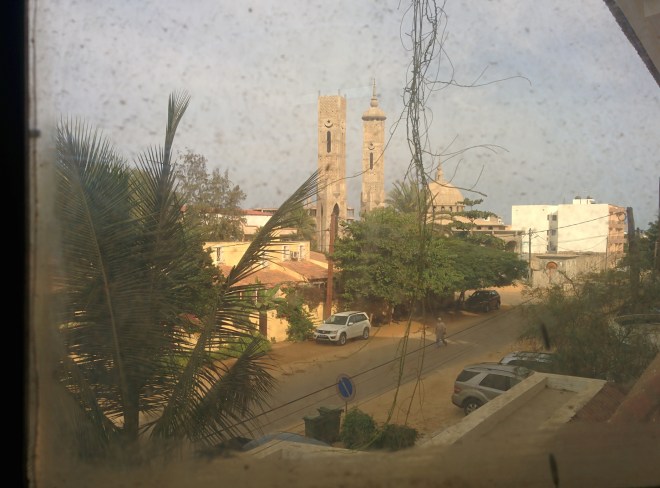
A window. In dire need of washing.
Four late model cars produced by Suzuki and Toyota.
A license Plate, white on black.
A man dressed as if in an Arab country or as an Afghani Pashtun.
A domed mosque under construction with the star and crescent motif on its minarets that mimics the flag of Mauritania.
A wall split air conditioner that, based on the red logo was probably made by Chinese company Ningbo AKL Electric.
A round top orange door.
A European style “No Parking” sign.
Trash bins for regular pick up.

Ok, so the license plate says we are in Tunisia, but where in Tunisia? After seven hours of searching, I have no freaking idea. Only Chini and the person who took the picture know.

BUT… I’m counting in the facts that:
1. The mosque is still under construction so doesn’t show up on any Google search and …
2. A certain group of VFYW contestants who insist that everything they can’t figure out comes from “Tatooine” and you being JUST snarky enough to hoist them on their own petard because there IS a Tataouine, Tunisia.

So I’m stating that the picture was taken from the Hotel el Ghazel, Tataouine. I hate you all.

The most popular incorrect city was Nouakchott:

Way to wrap up the year, you clever bastards. The crescent/star on the minarets are Flag_of_Mauritania.svgdistinctive in the way the moon faces up. This is pretty distinct and is used the flag of Mauritania. After plugging away online looking for mosques in that country I looked at the original again and saw that the second tower isn’t “different,” it’s unfinished. It won’t show up because, until recently, it hasn’t been there.  The building behind the minarets is a mere skeleton. Clever bastards! I hope someone has more luck than I did looking up hotels and guest houses to find that street.
The license plate got this reader into the right country:

Mosque in the background. Man in Islamic garb, appears clearly African. Dry but tropical. Coastal vibe. Signage suggests British colonial history. Cars and garbage cans suggest relative wealth. Appearance of license plates resembles Senegal. Can’t find the specific towers shown, but I’m going with Saint Louis, Senegal.

And this globe-trotting reader was one of only ten to get the right city:

Since the building in the picture is clearly a mosque, and there is an African-looking man in a prayer cap walking in the street, I’m going to go with Dakar, Senegal. The buildings look like Dakar to me (I was there back in 1990) and Senegal has blue license plates. Looking closely, it seems like the front two letters of the plate are DK for Dakar. So that’s my guess. I can’t identify the neighborhood, I just know it doesn’t look like the Grand Mosque so presumably it’s a smaller local one.

Another:

A shot in the dark here. Looks very much like my home country of Senegal.  There’s a few clues pointing towards Dakar the capital:

1. Blue license plate plate on the white SUV. Couldn’t focus in too much but I think I can make out the ‘DK’ for Dakar.
2. Reddish color of the sand.
3. Mosque in the background.  Senegal is approximately 92% Muslim.
4. Dakar is often in a state of construction. Lots of unfinished home improvements and construction projects.

This could possibly in the Almadies neighborhood near my parents’ home.

That’s indeed the right neighborhood. One more:

Well, normally I don’t even try these contests, as I know I won’t be able to get very close. The only one I was able to recognize before this was the Alhambra, Granada, and I wasn’t able to discern the precise window. However, your announcement that this week’s contest was very difficult piqued my interest.

I teach Islamic Art, so was able to quickly identify the mosque as North African. After looking up license plates online, I was able to identify the country as Senegal. The soil color and vegetation support this conclusion. I spent much too much time today looking at fuzzy mosques in Senegal on Google Maps, but wasn’t able to firmly identify any as this mosque. There are an awful lot of mosques to look at! Dakar is a reasonable guess just due to its sheer size, and I wasn’t able to find anything at all similar in other towns. The closest mosque to the one in the picture (grey dome, two square minarets) is Grande Mosque Hann Maristes I, but I don’t think it is the same – that mosque is a bit larger and in a more built-up area. The street it is on does not have a name in Google Maps. Nevertheless, I can tell the view is from the south because of the mosque’s orientation.

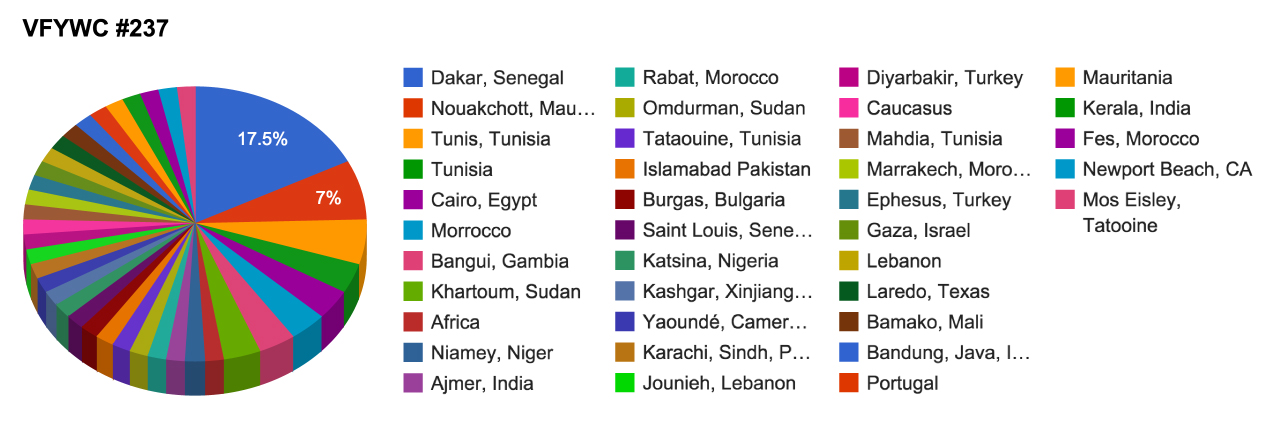
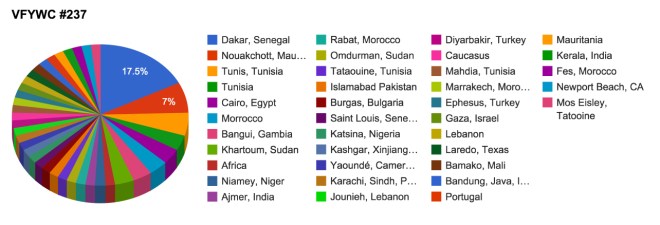
In all, players guessed a whopping 38 different locations this week:

This embed is invalid
vfywc-237-pie-chart

And a handful of our veterans really earned their stripes:

This week’s view comes from the La Demeure B&B in Dakar, Senegal.  Rather than an address, the hotel website provides GPS coordinates:  Latitude 14°44’07.74″ (North), Longitude -17°30’26.66″ (West).   We are looking northeast out from the hotel’s Zanzibar room towards a mosque that is under construction.  La Demeuere is located in the Ngor neighborhood of the Almadies Arrondissement on Cap-Vert (NASA Earth Observatory image of the day here), the western most point in Africa.

The picture looked like it was taken in Africa, particularly a coastal area in or near the Sahel.  And the license plate seemed like it came from Senegal.  Once in Senegal, it took a bit of time to find the mosque and hotel; mostly because the mosque is too new to appear on maps yet.
Untitled

Another:

“Oh no!” I cried, when I realized what was in this week’s picture. Another still-in-construction mosque, as in contest #235. In other words, a mosque whose pictures are very hard to find, like that mosque in Antalya. This time, however, there weren’t other clues; yes, I could tell that the photo was shot somewhere in the Sahel region, in Africa (Islam, palms, sand, the gentleman’s outfit), but the decisive clue to guess the view was doubtless the mosque. And the prospect of spending the next few hours sifting through hundreds of photos of mosques, probably in vain, was very unpleasant, to say the least. What could I do? “What would Chini do?” I asked myself.

Here’s the answer I gave me. First of all, let’s cast a wide net and google “Africa ‘new mosque’”. The aim is not to directly find our mosque (unless we were very lucky), but to find a similar looking one, in order to nail the right country. As expected, the mosque in the picture is not among the results; but there is something almost as valuable…
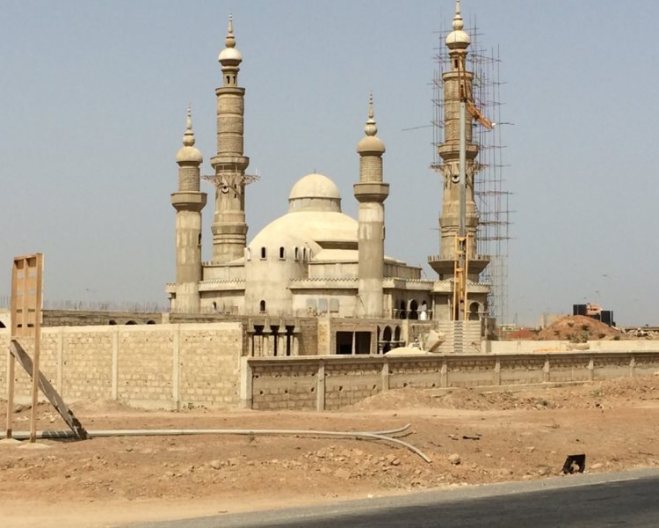
a-new-mosque-going-up-on-the-entrance-of-Dakar

This is a mosque which is being built in Dakar, Senegal. See the upper part? It’s exactly the same as our mosque’s. So let’s turn to Google Maps, looking for mosques in Dakar. Sixty mosques later, we come to the conclusion that our mosque is not labelled as such in the map – which was to be expected, if it really is still in construction – or that it is somewhere else. A quick search in the other major cities of Senegal gives no results, so we are soon back to Dakar. What comes next? Almost all of the contest pictures are taken from a hotel’s window. This time we are lucky: not only are there fewer hotels than mosques in Dakar, but the third hotel in the list is the one we were looking for.

This week’s picture was taken from the Zanzibar suite, on the second floor of La Demeure hotel, in the Almadies neighbourhood, Dakar, Senegal.

Don’t worry, Chini had a work for it too:
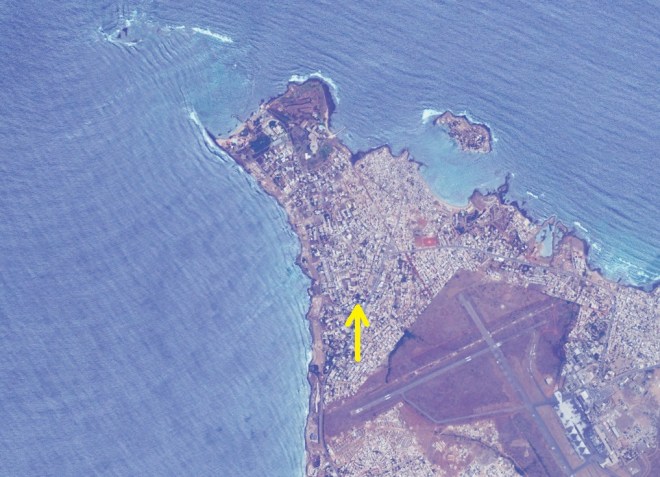
VFYW Dakar Overhead Far Marked - Copy

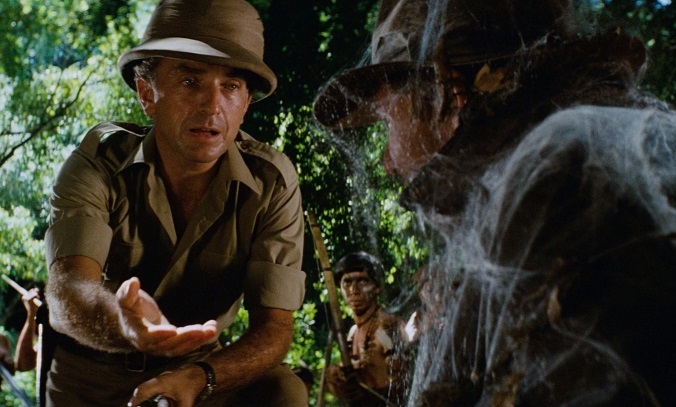
I hate ones like this. You track the location down, bit by bit. Then, at the end of a long hunt, just when you think you’ve got a real toughie on your hands, you discover that there was a dead simple, five minute way to find the location. It’s like running out of the tomb, idol in hand, only to find Belloq waiting for you outside. There goes my fortune and glory …
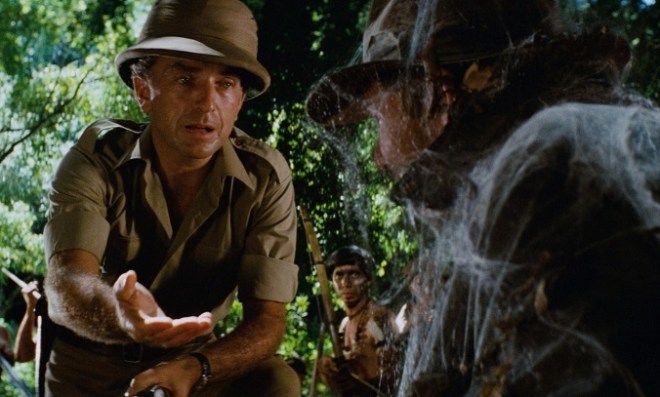
VFYW Dakar Chini Wuz Robbed - Copy

Another former winner who got the guesthouse and window:

At first glance, this one felt like North or West Africa. Looking more closely at the mosque architecture, it reminded me of some West African mosques I’d come across working on previous contests. (I think I may have learned more about regional Islamic architecture than anything else in the time I’ve been doing the contest.) Looking at the clothing on the man in the frame also made me think West Africa. The positioning of the crescent and star on the minarets is like that on Mauritania’s national flag, but the other aspects looked closest to images I’d found from neighboring Senegal. (Also the front license plate that is visible looks like it could be Senegalese but it’s too blurry to tell for sure.) I came across an in-progress mosque in Dakar that really similar. I Googled “new mosques under construction in Dakar Senegal” and found views like ours on TripAdvisor.

I am thinking this was taken from the La Demeure Hotel/Guest House in Dakar, Senegal. My guess is from this window, which I think might be the Zanzibar room:
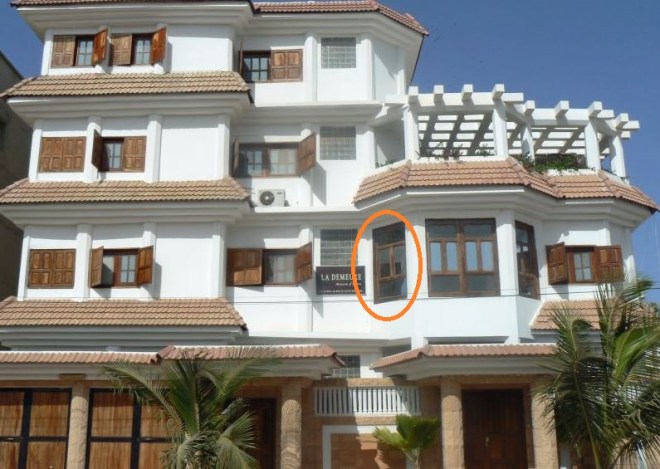
La Demeur Dakar

Only one reader without a previous win was able to ID the right city, hotel and room this week. Bravo:

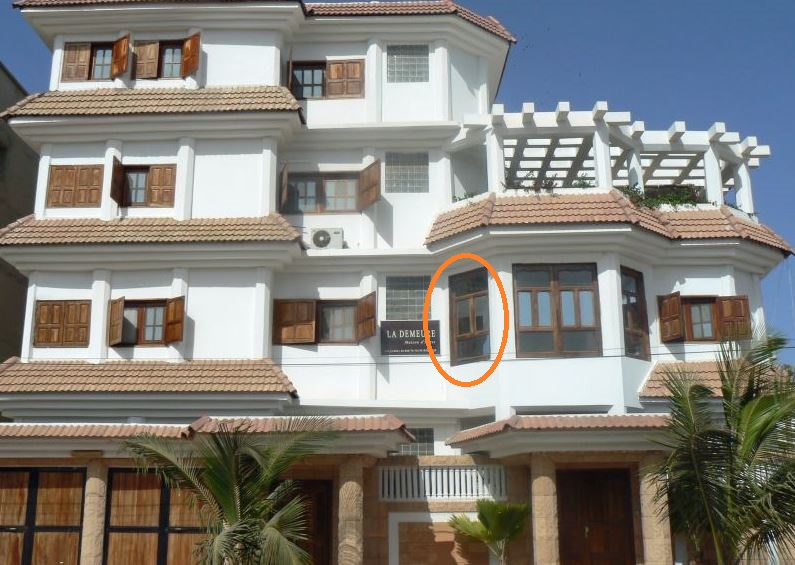
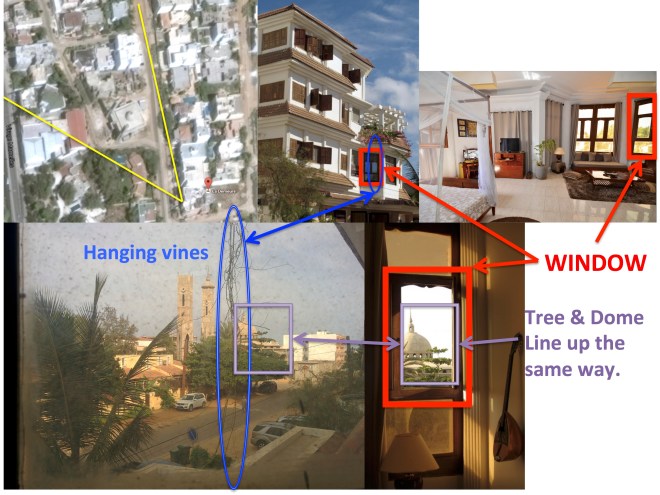
This week’s picture was taken from the Zanzibar Suite at the La Demeure Bed & Breakfast on Route de Ngor in Dakar, Senegal, looking north-northwest towards the mosque on the same street:
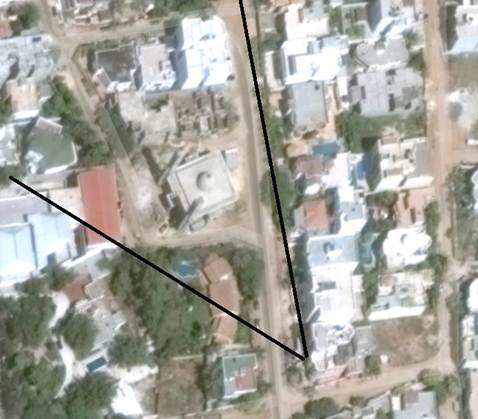
w01

Here is an external photo of the window, in which you can see the vine hanging down from the terrace on the level above which appears in the foreground of this week’s photo:
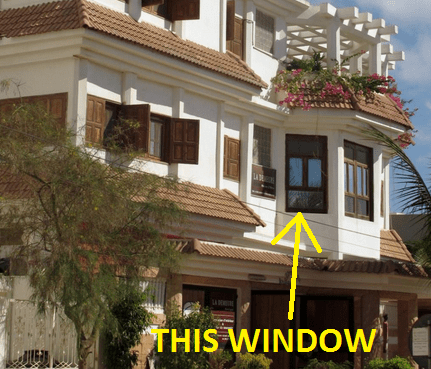
w02

Here is a shot of the window from another angle, which shows the palm tree which appears in the left of this week’s photo:
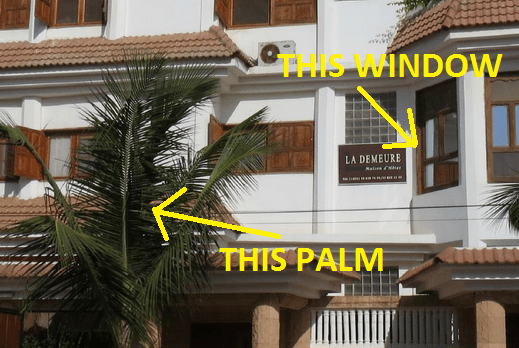
w03

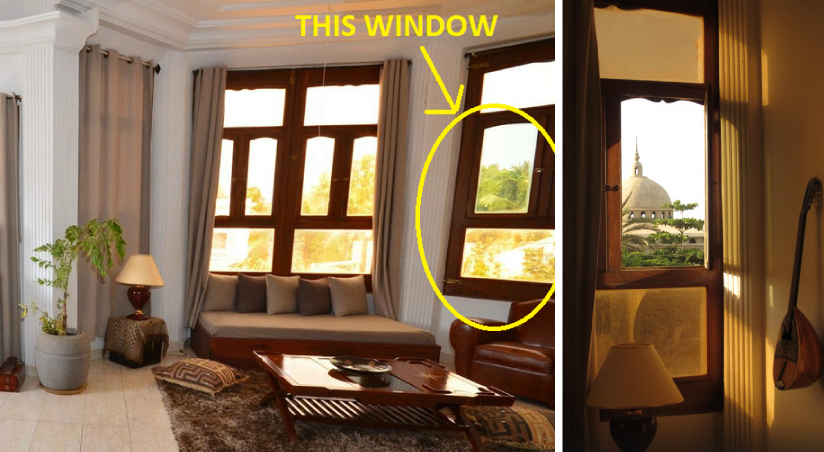
Here is are a couple of shots from inside the room showing which window the photo was taken from and the view of the mosque in the centre of the photo:
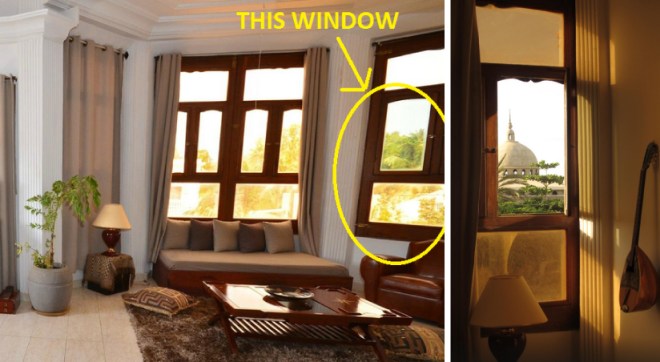
w04

I found the location of this week’s photo in the traditional VFYWC manner – hours of fruitless searching combined with a few moments of luck.  The photo appeared to be taken in a part of Africa with an Islamic population.  The European-style street sign in this week’s photo resulted in a brief spell researching the African signatories to the Vienna Convention on Road Signs and Signals (surely the UN has more pressing matters to address?!) and cross-referencing pictures of licence plates from those countries.  Once I convinced myself that the first two letters on the licence plate of the car in the photo were “DK”, I then focused on Dakar in Senegal as the most likely candidate.  After a searching through photos of mosques in Dakar for way too long, I changed course and stumbled across the above photo which shows the dome of the mosque.  This lead me to Le Demeure, where it was easy to identify the correct room as the Zanzibar.

Thanks for an enjoyable way to pass some time at work during the first couple of days back at work after the Christmas/NYE break.

A very well-earned win. From the reader who submitted the view:

I’ve been visiting Dakar periodically for work and to visit friends since 1989. In earlier years I used to stay in or near downtown Dakar, including a couple of times at the funky Lagon II, which gives the impression of being on a cruise ship. However, as work and friends have moved out towards Fann, Mamelles, and Almadies, I now usually stay at La Demeure Guesthouse.

Don’t let the dirty window fool you. It is very charming and well maintained where you can easily feel at home during long stays. They seem to be replacing windows one by one, although I haven’t figured out their criteria for choosing windows to replace. The view is facing northwest and is taken from the Zanzibar room. Just before leaving Dakar I went to a Christmas party with friends at the house on the corner where the red vehicle is. As for the unfinished mosque, I don’t know the full, or possibly even accurate story, but apparently it was begun as a private project from the previous mayor of Dakar, but came to a halt at some point after he lost the last mayoral election.

Knowing that there are other Dish readers in or passing through Dakar and that this place isn’t really off the beaten track, I expect you will have several correct guesses. Hopefully someone else can fill in the details about the mosque.