Oy:
Hathos Alert
Oy:
Oy:
The science is clear: The earth is round, the sky is blue, and #vaccineswork. Let’s protect all our kids. #GrandmothersKnowBest
— Hillary Clinton (@HillaryClinton) February 3, 2015
The world will be better off without my blogging the next chapter in the Clintons’ long march through our national life. But let me say that this tweet is the kind of Clinton who might stand a chance in 2016. There’s no equivocation here; no shading; no positioning; there’s even the whiff of sincerity. More, please. And good luck.

The question is a truly difficult one. I used to find Christie’s bluntness and boldness refreshing. I don’t mind his aggressive manner – it’s entertaining at least, and we can all use some personality in our politics at times. I’m in favor of standing up to public sector union mediocrity. I like his relative social liberalism, especially in the madrassa-like swamps of the GOP base. He may even be exonerated in the Bridgegate scandale.
But then you just read about him. It’s clear to anyone with eyes and ears by now that he is an almost pathologically ambitious figure, who has no qualms about persecuting his enemies, pettily seeking payback when necessary, and using public office to pursue political vendettas. What you really see in the Bridgegate mess is his desire to get Democratic party officials to endorse him to burnish his bipartisan credentials for a national race. If they didn’t, they had something to fear in New Jersey. He’s a big guy, in other words, with a tendency to punch down and suck up.
And now we have the other dimension of his egomania and taste for power and celebrity:
As he has traveled more widely, particularly during the last year … Mr. Christie’s first-class tastes have become well known. He made it clear when he campaigned for Mr. Romney in 2012 that he would do out-of-state events only if he was given a private plane, even during the primary, when the candidate’s wife was still flying commercial to save money. The Romney campaign came to understand that he preferred a Cessna Citation X, which, its manufacturer boasts, has exotic wood interiors and a Rolls-Royce engine.
While many high-profile Republican politicians resist insinuating themselves into celebrity circles, Mr. Christie seeks them out — Howard Stern in the Hamptons; Donald J. Trump at Jean-Georges in Manhattan, where the menu begins at $128 per person. He danced onstage with Jamie Foxx at a celebrity benefit at the Hamptons in August before a crowd that included Barbra Streisand, Paul McCartney, Jack Nicholson and Robert De Niro.
These habits and tastes are not unique to Christie, nor are they mortal sins. He has much in his record to be proud of, even though New Jersey’s current economic health is not exactly an advertisement for good government. But the more we learn about him, the more troubling a figure he seems to be. He can lash out; he can do rash things; he can be vindictive; he bullies; he does his best to cover things up; he has close ties and receives gifts from those who inevitably have business before the state; he acts like a minor princeling rather than a simply governor.
Of the entire GOP field, I find him the most troubling. I don’t trust him to wield power without corruption, small and potentially large. I do not believe he has the steady or calm character to be a solid president of the United States. I might as well say that now. For the record.
(Photo: New Jersey Governor Chris Christie speaks to a full house at a Reform Agenda Town Hall meeting at the New Jersey Manufacturers Company facility in Hammonton, New Jersey on March 29, 2011. By Jessica Kourkounis/Getty Images.)
The NYT came up with one today:
Mark Thompson, the company’s chief executive, highlighted digital advertising numbers, specifically noting growth in mobile and video ad sales, as well as native advertising, which are ads that resemble news articles.
I can live with that definition. I just don’t know how the NYT lives with the reality that it is bragging of blurring the lines between advertising and journalism.
Last week, Louis C.K. emailed his fans a manifesto on the importance of comedy clubs:
Nightclubs, comedy clubs, is where comedy is born and where comedy, standup comedy, truly lives. Going back to Abraham Lincoln, who was probably America’s first comedian, Americans have enjoyed gathering at night in small packed (and once smokey) rooms, drinking themselves a bit numb and listening to each other say wicked, crazy, silly, wrongful, delightful, upside-down, careless, offensive, disgusting, whimsical things. Sometimes in long-winded, red faced hyperbole, sometimes in carefully crafted circular, intentionally false and misleading argument. Sometimes in well-chiseled perfectly timed trickery of verbiage. Pun-poetry. One line, one off, half thoughts. Half truths. Non-truths. Broad and hilariously wrongful generalizations, exaggerated prejudices and criticism of nothing and everything while a couple over here shares a pitcher of sangria, this table of guys order round after round of beers. … These are the things we do when we are DONE working and being citizens. We go to a comedy club and pay a bit of money to laugh harder than we ever do anywhere else.
What fascinated David Haglund about the email was the focus on how integral clubs are to the creative process:
[C]onsider the joke-writing process that C.K. describes later in the e-mail.
In Los Angeles, where the New York-based C.K. filmed the special, he would do “twenty minutes of new material” at alternative venues and get “cheered on by the young, open and adaptive crowds” there. Then he would take those jokes to the Improv, “where the more basic and average character of the audience would cut the new material down to about three jokes.” And then he’d take those three to the famous Comedy Store, where, he writes, “maybe ONE of those jokes would get a chuckle.” That’s the keeper.
Having watched C.K.’s latest direct-to-fans special, Matt Zoller Seitz stands in awe:
[W]hen C.K.’s brain starts buzzing and his mouth follows the firing synapses, the result is marvelous. He’s one of those comics who can be very good when the material is intellectual, theoretical, or rhetorical, and there are a few stretches here that fit that description; my favorites are his very Louie-like discussion of how pets can be used to prepare children for the reality of death. (When a dog dies, you can tell them, “Yeah, well, Grandma now.”)
But he soars when he goes off-book (or seems to) and starts riffing, or seems to riff. You can tell when this is happening. C.K.’s eyes seem to almost literally light up, and a thrilled and demented grin appears on his face. This is the signal that he’s seized on a marginal aspect of whatever he just said and is about to grab hold of it, take it apart, and see if there’s a more ludicrous or surprising notion hiding inside of it.
Bouree Lam revisits a topic the Dish discussed at some length after we set the minimum price for a Dish subscription:
The “undercover” economist Tim Harford (he has a book and writes column at the Financial Times by that title) has explained the theories for why
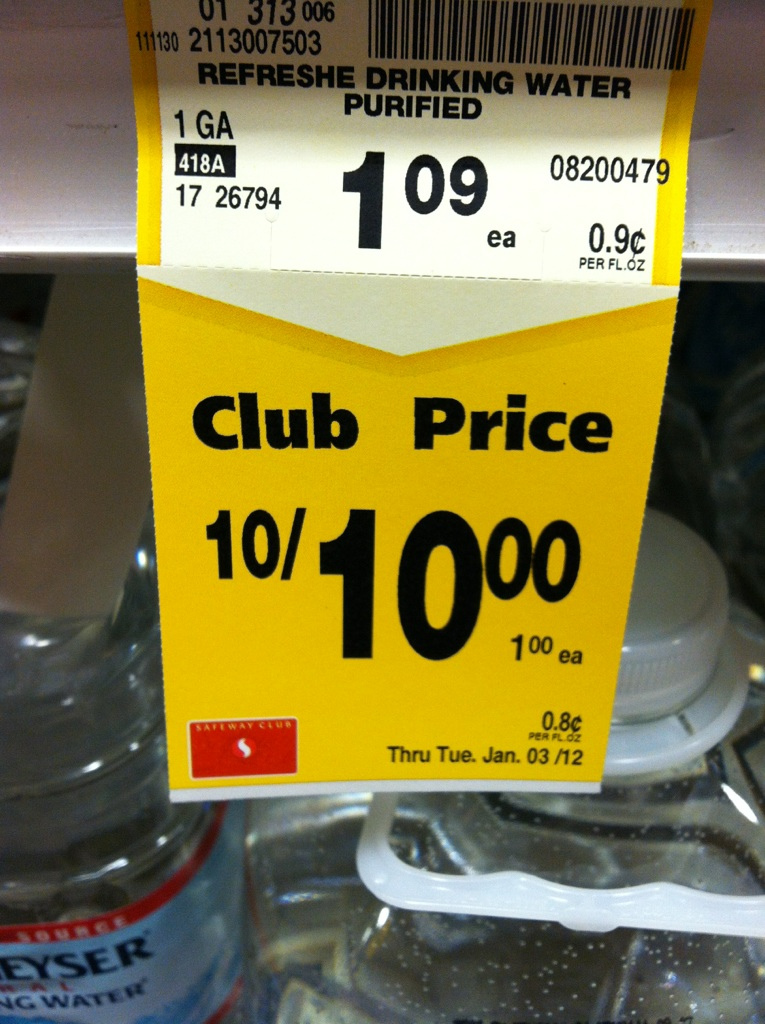
prices in our world end in “9.” First is something called the left-digit effect, which suggests that consumers just can’t be bothered to read to the end of prices. The mind puts the most emphasis on the number on the far-left, so even though $59.99 is closer to $60, it’s the “5” that registers. The other theory is that prices ending in “.99” signal a deal to consumers. In short, consumers seem to like prices that end in “9,” and experiments say that pricing things this way increases purchases.
Despite the ubiquitous “9” pricing practice, most numbers used in everyday life are whole numbers. It’s not common to say, “just give me 5.27 minutes.” But why do [restaurant] Le Pain Quotidien’s prices still make my mind reel? A new study in the Journal of Consumer Research might have the answer. Researchers found that shoppers deal with pricing information differently when prices feature round numbers (“5”), as opposed to non-round ones (“4.99”). When something costs $100, consumers tend to rely on their feelings, whereas when something has an irregular price—such as $98.67—consumers have to use reason to compute whether it’s a good price.
(Photo by Matt Fox)
John Judis fears “a resurgent Republican coalition”:
Republicans are gaining dramatically among a group that had tilted toward Democrats in 2006 and 2008: Call them middle-class Americans. These are voters who generally work in what economist Stephen Rose has called “the office economy.” In exit polling, they can roughly be identified as those who have college—but not postgraduate—degrees and those whose household incomes are between $50,000 and $100,000. (Obviously, the overlap here is imperfect, but there is a broad congruence between these polling categories.)
The defection of these voters—who, unlike the white working class, are a growing part of the electorate—is genuinely bad news for Democrats, and very good news indeed for Republicans. The question, of course, is whether it is going to continue. It’s tough to say for sure, but I think there is a case to be made that it will.
He admits that, after 2008, he “thought Obama could create an enduring Democratic majority by responding aggressively to the Great Recession in the same way that Franklin Roosevelt had responded in 1933 to the Great Depression”:
In retrospect, that analogy was clearly flawed. Roosevelt took power after four years of the Great Depression, with Republicans and business thoroughly discredited, and with the public (who lacked any safety net) ready to try virtually anything to revive the economy. Obama’s situation was very different. Business was still powerful enough to threaten him if he went too far in trying to tame it. Much of the middle class and working class were still employed, and they saw Obama’s stimulus program—which was utterly necessary to stem the Great Recession—as an expansion of government at their expense.
In the wake of the dramatic gains Republicans have made during Obama’s presidency, I now read the history of the last 80 years much differently. The period of New Deal Democratic ascendancy from 1933 to about 1968 may well prove to have been what historians Jefferson Cowie and Nick Salvatore have called the “long exception” in American politics. It was a period when Americans, panicked about the Depression, put on hold their historic aversion to aggressive government economic intervention, when the middle and bottom of the American economic pyramid united against the top, and when labor unions could claim the loyalty of a third of American workers. That era suffered fatal fissures in 1968 and finally came to a close with Reagan’s landslide in 1980.
It’s great to see someone absorb new data and shift their opinion – and John is about as intellectually honest as it’s possible to get. I have to say I don’t know. But I’m looking forward to finding out.
Jon Lee Anderson describes how the group made its way to Libya:
The Libyan ISIS affiliate had been developing for some time. Since 2011, hundreds of Libyans have travelled to Syria to fight Bashar al-Assad’s regime, and have joined either Jabhat al-Nursra, the Al Qaeda affiliate there, or ISIS. Many of those fighters reportedly have returned to Libya since last summer, in order to establish an ISIS affiliate. … Recent attacks for which the group has claimed responsibility have included the abduction of a group of twenty Coptic Christian Egyptians, in the city of Sirte; the decapitation of several media activists in Derna; and, several weeks ago, the murder of ten soldiers at a remote desert outpost in Libya’s deep south.
He doubts the country’s militia-coalition government is up to the task. Meanwhile, ISIS has an affiliate in Egypt now as well:
An Islamic State affiliate also appears to be gaining momentum in Egypt’s restive Sinai Peninsula by tapping into a vein of anger left over from the ouster of the Muslim Brotherhood’s Mohammed Morsi, the country’s first freely elected president who was pushed aside in a popularly backed military coup in 2013. The group, which calls itself Province of Sinai, claimed responsibility for a coordinated assault against multiple Egyptian police and military targets Thursday night that killed at least 30 people.
According to Khalil al-Anani, the group’s growing influence on other Islamists is palpable:
The Islamic State is seizing the current moment to present itself as a role model for young Islamists around the globe, pushing them to adopt its ideology and emulate its tactics and strategy. The Islamic State hopes to become a hegemonic socio-religious force by capitalizing on the failure of the so-called Arab Spring, the weakness of the Arab states and the decline of moderate Islamists. Its appeal reflects not only the young Islamists’ mistrust in other Islamist movements but also their admiration of the Islamic State’s boldness and capabilities. Despite its brutal and barbaric behavior, The Islamic State’s support is growing across the region from Yemen to Algeria.
Aaron Y. Yelin compares the ways ISIS and al-Qaeda are expanding:
Al-Qaeda wanted to use its new franchises in service of its main priority: attacking Western countries to force them to stop supporting “apostate” Arab regimes, which without the support of Western countries would then be ripe for the taking. This has only truly worked out with its Yemeni branch, al-Qaeda in the Arabian Peninsula (AQAP).
On the other hand, while the Islamic State does not have an issue with its supporters or grassroots activists attacking Western countries, its main priority is building out its caliphate, which is evident in its famous slogan baqiya wa tatamaddad (remaining and expanding). As a result, it has had a relatively clear agenda and model: fighting locally, instituting limited governance and conducting outreach.
This differs from al-Qaeda’s more muddled approach – it hoped a local franchise would conduct external operations, but many times franchises would instead focus on local battles or attempts at governance without a clear plan, as bin Laden had warned.
Moreover, the Islamic State has had a simple media strategy for telegraphing what it is doing on the ground to show its supporters, potential recruits and enemies that it is in fact doing something. This accomplishes more, even if it appears that the Islamic State is doing more than it actually is, in comparison with al-Qaeda’s practice of waiting for a successful external operation to succeed and then claiming responsibility after the fact.
Ezra Klein acknowledges it:
Blogging encourages interjections into conversations, and it thrives off of familiarity. Social media encourages content that can travel all on its own. … The incentives of the social web make it a threat to the conversational web. The need to create content that “travels” is at war with the fact that great work often needs to be rooted in a particular place and context — a place and context that the reader and the author already share. I think we’re getting better at serving a huge audience even as we’re getting worse at serving a loyal one.
I found Ezra’s piece dead on the money. I’ll have more to say in due course, but this paradox of more and more eyeballs but less and less loyalty or commitment is a real one. The basic model for online journalism today – social media as the delivery mechanism, maximum quantity for ad money, and sponsored content to create some revenue – is one I’m deeply skeptical of. I had a chat with a young journalist at a major online site recently and he was discussing how many millions of uniques the site had had the previous month. He told me that everyone was very proud of themselves for such a total, and then confessed: “But I’m not sure what millions of uniques actually means.”
Since I’ll be out of blogging soon and won’t have to immediately recant and correct myself, let me conjecture a different future. We may be at peak scale in terms of opinion/aggregation/curation websites right now. At some point, the sponsored content machine in which magazines moonlight as advertising and p.r. companies will sputter as readers cannot tell the difference between propaganda and honest argument, and have long since forgotten which site they read anything on. A site that lacks a cohering and distinct identity can become simply a competitor for an endless and often fruitless search for links, tweets and likes. At some point, readers will want a place they know and love and trust and that they will support with their own money. And they will want a return to more of the intimacy and personality of the original blogosphere.
In other words: I think blogging will have a big revival in the near future. I think the more successful sites will be those with smaller scale and more identity and a stronger connection with readers. I think the individual voice is still the most powerful on the web. And I agree with Nick Denton that blogging is “the only truly new media in the age of the web … Blogging is the essential act of journalism in an interactive and conversational age.” I totally understand what many sites are doing on the social media-sponsored content-Twitter-fueled front. It makes sense on many levels. But my money remains on blogging, even as I’m quitting it.
Kevin Drum diagnoses how “most conversation now seems to have moved to Twitter”:
There are advantages to this: it’s faster and it’s open to more people. Blogs were democratizing, and Twitter is even more democratizing. You don’t have to start up your own blog and build up a readership to be heard. All you have to do is have a few followers and get rewteeted a bit.
Needless to say, however, there are disadvantages too.
Twitter is often too fast, and when you combine that with its 140-character limit, you end up with a lot of shrill and indignant replies. Sometimes this is deliberate: it’s what the tweeter really wants to say. But often it’s not. There’s a premium on responding quickly, since Twitter conversations usually last only hours if not minutes, and this means you’re often responding to a blog post in the heat of your very first reaction to something it says—often without even reading the full blog post first. In addition, it’s simply very difficult to convey nuance and tone in 140 characters. Even if you don’t mean to sound shrill and outraged, you often do. Now multiply that by the sheer size of Twitter, where a few initial irate comments can feed hundreds of others within minutes, and you have less a conversation than you do a mindless pile-on.
Tyler Cowen makes clear that he has “no plans to chase traffic from social media”:
The human desire to be social used to be a huge cross-subsidy for music, as young people used musical taste to discover and cement social alliances. Now we don’t need music so much to do that and indeed music plays a smaller role in the lives of many young people today. This has been bad for music, although arguably good for sociability and of course good for Mark Zuckerberg.
The “problem” is that the web gives people what they want. Those who survive as bloggers will be those who do not care too much about what other people want, and who are skilled at reaping cross-subsidies.
I’m with Tyler. Be yourself. Do your work. And they will find you. And serving those readers is all the reward you need.
(Thumbnail image by William Hook)
Measles Day at Disney! #WorstDayIn4Words @HashtagShenani pic.twitter.com/Liwixs89Ol
— Joe Messina (@joemessin) February 1, 2015
Thanks in part to anti-vaxxer hysteria – now getting a boost from Christie – the measles are making a comeback:
Between Jan. 1 to 30, 102 cases of the measles were reported to the CDC from 14 different states. The majority of the cases are from an ongoing outbreak linked to Disney California Adventure Park in Anaheim, Calif. The CDC says the majority of people who got measles were unvaccinated. … The people infected in the current outbreak have exposed others at the amusement park as well as schools, daycares, emergency departments, airplanes and outpatient clinics the CDC says. In 2014, the Unites States had the highest number of measles cases reported in over 20 years, at over 600 cases.
In response to the outbreak, the White House is urging “vaccine-hesitant” parents to make the right choice and get their kids their shots. Steven Salzberg lays the blame for the outbreak squarely at the feet of the Jenny McCarthyites:
The problem arises from California’s vaccine exemption policy: although public schools require kids to be vaccinated, parents can exempt their kids simply by saying they have a personal objection to vaccination. It’s not just California: only two states, Mississippi and West Virginia, don’t allow parents to claim a philosophical or religious exemption to vaccines And Colorado has the worst rate of vaccination, at just 82%, primarily due to parents claiming a “philosophical” exemption.
These parents are the anti-vaxxers.
Thanks to them, we now have large pockets of unvaccinated children through whom epidemics can spread further an faster than we’ve seen in decades. The CDC reports that in 2014, 79% of measles cases in the U.S. involving unvaccinated people were the result of personal belief exemptions.
But as Julia Belluz voxplains, outbreaks like these aren’t simply the fault of such parents individually; the disease spreads in communities where vaccination rates are especially low:
It’s not actually a rising anti-vaxx tide or naturopathic, private school mothers driving a return of vaccine-preventable disease here. It’s not even low-income folks who wind up getting sick, and it’s especially not undocumented migrants bringing in viruses, the CDC’s [Jane] Seward says: “The people getting measles are those that travel abroad, come back, and live in a community among people who weren’t vaccinated.” Some years, we get 40 “importations.” Last year, there were about 65. “This is more than normal,” she added, “and it reflects travel patterns and where measles is active globally.”
The travelers spark outbreaks when they hit geographic clusters of unvaccinated people, like the one in Ohio [among the Amish community, where last year’s measles outbreak was centered]. These infectious disease powder kegs exist all across the US, waiting to be sparked.
Marcel Salathé considers what these anti-vaxxer pockets mean for our society’s herd immunity as a whole:
When we analyzed data from Twitter about sentiments on the influenza H1N1 vaccine during the swine flu pandemic in 2009, we found that negative sentiments were more contagious than positive sentiments, and that positive messages may even have back-fired, triggering more negative responses. And in measles outbreak after measles outbreak, we find that the vast majority of cases occurred in communities that had vaccination coverages that were way below average.
The sad truth is this: as long as there are communities that harbor strong negative views about vaccination, there will be outbreaks of vaccine-preventable diseases in those communities. These outbreaks will happen even if the population as a whole has achieved the vaccination coverage considered sufficient for herd immunity.
An exasperated Aaron Carroll outlines why failing to vaccinate against measles – which, as Michael Byrne reminds us, is a very nasty disease – is so dangerous:
The system breaks down, and outbreaks occur, when more people are susceptible. Everyone, for instance, is susceptible to Ebola at a certain point in the illness. So we have to be careful to quarantine people who are infected when they are sick. But Ebola is relatively hard to catch. It has an R nought of 2, meaning that an infected individual might infect, on average, 2 others. But measles has an R nought of 18. It’s one of the most infectious pathogens around.
Quarantining is difficult, if not impossible. The virus is unbelievable hardy and easy to catch. So the absolutely, positively best thing you can do it to be vaccinated. Period. I should point out that it also doesn’t matter to the outbreak why people remain unvaccinated and susceptible. It can be because of religious reasons. It can be because of irrational fear. It can be because they’re “hippies”. I don’t care – the outbreak is the same.
Sarah Kliff revisits the anti-vaxxers’ spurious objections to inoculation and why they’re wrong:
Objections to vaccination among those healthy enough to get immunized (those of us over the age of one, essentially) typically just aren’t good enough to justify the risk. Much of it revolves around the safety of the vaccine. Even in the Amish community in Ohio, it wasn’t a religious belief that caused low vaccination rates — and laid the groundwork for a huge outbreak. Instead, it was news of two nearby children suffering complications from the shots that turned the community against vaccination.
So let’s clear that fact up here right now: the measles vaccine is, without a doubt, safe. Study after study after study confirms this. The study that suggested the measles vaccine was not safe — and had possible links to autism — was retracted by the academic journal Lancet in 2010. The researcher who published the study, Andrew Wakefield, was stripped of his medical license in Britain. Not only is the measles vaccine safe, it’s also incredibly effective.
And Elizabeth Stoker Bruenig mulls over why the anti-vaxx movement has gained ground in recent years, and why that’s cause for concern:
For Americans, the reality is that parents who refuse to vaccinate their children make their choice in relative comfort. Parents with toddlers today do not remember the scourges of prior centuries: the bubbling blisters of smallpox, the iron lungs of polio, the florid rash of measles that has, since 2010, taken the lives of over 4,500 people in the Democratic Republic of Congo, most of them children under five. All of those things, thanks to time or distance, go out of thought and out of mind. Moreover, since most American children—thanks to the good sense of most American parents—are still vaccinated, the likelihood that these plagues will come roaring back has always seemed distant. Now, perhaps not so much.
Lastly, Chris Ingraham breaks down vaccination rates by state and looks for patterns, though they’re actually hard to find:
Alabama usually accompanies Mississippi at the bottom of health rankings, but it does even better when it comes to vaccines — 77 percent of toddlers there are completely covered. Overall, state-level vaccine rates buck the familiar trend of “south= bad, northeast and west = good” that we see on countless other health measures. New Hampshire kids are well-vaccinated, but Vermont and Maine kids less so. Mississippi comes in at #12 in the rankings, while just across the river Arkansas is dead-last. California, currently in the news for a large measles outbreak at Disneyland, is squarely middle-of-the-pack at number 30.
It’s tough to tease out demographic patterns behind vaccination rates. In California, some affluent areas have lower vaccination rates than the average. But looking at all 50 states, there’s a small correlation between increased income and increased vaccination. Some people maintain that vaccine skepticism is strongest on the left, but the data don’t support that notion.
 The Dish