A Portrait Of The Artist As A Young Networker

William Deresiewicz, tracing a history of the creative process, notes that for today’s artist, “10,000 hours is less important now than 10,000 contacts.” So what kind of art should we expect from new generations of highly networked, creatively diversified makers?

What we see in the new paradigm—in both the artist’s external relationships and her internal creative capacity—is what we see throughout the culture: the displacement of depth by breadth. Is that a good thing or a bad thing? No doubt some of both, in a ratio that’s yet to be revealed. What seems more clear is that the new paradigm is going to reshape the way that artists are trained. One recently established M.F.A. program in Portland, Oregon, is conducted under the rubric of “applied craft and design.” Students, drawn from a range of disciplines, study entrepreneurship as well as creative practice. Making, the program recognizes, is now intertwined with selling, and artists need to train in both—a fact reflected in the proliferation of dual M.B.A./M.F.A. programs.

The new paradigm is also likely to alter the shape of the ensuing career. Just as everyone, we’re told, will have five or six jobs, in five or six fields, during the course of their working life, so will the career of the multiplatform, entrepreneurial artist be more vagrant and less cumulative than under the previous models. No climactic masterwork of deep maturity, no King Lear or Faust, but rather many shifting interests and directions as the winds of market forces blow you here or there.

But Robinson Meyer doubts that Deresiewicz is sizing up a real sea change in how art gets made:

The value of any discipline, whether craft or art, is not extracted solely by experts. In his essay, Deresiewicz approves of how Gertrude Stein once scolded Picasso for writing poetry. I have also heard Picasso was a terrible poet, but I really don’t know, and I can’t hazard whether some iambic innovation would have spurred him to paint differently.

I am not Picasso, though, and neither are you. And in the world I’d like to live in, everyone—whether they’re a famous painter or a CPA—would feel as though they can explore the breadth of human expression, whether through writing poetry or learning about Chinese pottery or even researching historical pickling methods. If cultural democracy comes, my guess is it will not look like 100 million specialists. It will appear as a society of curious minds, captivated by human traditions and inspired to improve upon them, interested in the many places in the world where humans have spent their attention—and hungry to invest more.


The View From Your Window Contest

VFYW-C-237

We’re giving everyone one more week to figure out this difficult view.

City and/or state first, then country. Please put the location in the subject heading, along with any description within the email. If no one guesses the exact location, proximity counts.  Be sure to email entries to contest@andrewsullivan.com. You have until Tuesday at noon, and the winner gets a free The View From Your Window book, a new Dish mug, or two free gift subscriptions to the Dish.

Browse a gallery of all our previous contests here.

A Short Story For Saturday

This week’s short story, Isaac Bashevis Singer’s “Job,” was written in 1970 but not translated from Yiddish until 2012, over twenty years after the writer’s death. Here’s how it begins:

Being a writer for a Yiddish newspaper means wasting half the workday on people who come to request advice or simply to argue. The manager, Mr. Raskin, tried several times to bring this custom to an end but failed repeatedly. Readers had each time broken in by force. Others warned that they would picket the editorial office. Hundreds of protest letters arrived in the mail.

In one case, the person in question didn’t even knock. He threw open the door and before me I saw a tiny man wearing a black coat that was too long and too wide, a pair of loose-hanging gray pants that seemed ready to fall off at any moment, a shirt with an open collar and no tie, and a small black spot-stained hat poised high over his brow. Patches of black and white hair sprouted over his sunken cheeks, crawling all the way down to the bottom of his neck. His protruding eyes—a mixture of brown and yellow—looked at me with open mockery. He spoke with the singsong of Torah study:

“Just like this? Without a beard? With bared head? Considering your scribbling, I thought that you sit here covered in prayer shawl and phylacteries like the Vilna Gaon—forgive the comparison—and that between each sentence you immerse yourself in a ritual bath. Oh, I know, I know, for you little writers religion is just a fashion. One has to give the ignorant readers what they truly desire.”

Read the rest here. Interested readers might also check out his Collected Stories. Peruse previous SSFSs here.

Publishing The Torture Report

The small independent publisher Melville House has done it, turning “a five-hundred-and-twenty-eight-page PDF with the slanted margins and blurred resolution of a Xerox made by a myopic high-school Latin teacher” into a more readable text. Alexandra Schwartz, who stopped by the publisher’s offices, offers a glimpse into the process:

“There’s a lot of reasons why this is insane,” [Melville House co-founder Dennis] Johnson said. “We’ve basically shut down the company to do this reportontorture-320x487 at the busiest time of the year.” The cost of printing alone, he estimated, would run to six figures, a lot of money for such a small, if scrappy, operation to risk. There’s also the possibility that Americans may feel that a book detailing the chronic and grotesque abuses of its government is not in keeping with the Joy to the World spirit. As Johnson put it, “Torture isn’t something you want to carry over the holiday season.”

Still, Johnson has faith in the power of the book as a physical object—“You can still read the first book ever printed, the Gutenberg Bible. I’ve seen it. It still works! The binding has held up!”—and in the power of the written word to move the masses to action. “They really were reading that at Valley Forge,” he said, of Thomas Paine’s “Common Sense.” “They really did sell a hundred thousand copies of that in what was then a tiny little country. That’s probably the equivalent of—” he paused to do a mental calculation. “Tens of millions of copies today. It really did inspire people to go into revolution!”

The manuscript of the torture report was due to the printer at nine the next morning, a start-to-finish turnaround of less than seventy-two hours. A dozen full-time employees, plus a smattering of freelance proofreaders, copy-editors, interns, and volunteers sat at computers, retyping the government PDF’s tangle of text into Microsoft Word files. Melville House’s office was once a warehouse, and a nose-to-the-grindstone atmosphere—part college library, part North Pole workshop—pervaded the space.

Adam Chandler paid them a visit as well, noting the employees there couldn’t resist giving the report a literary spin:

Place the material before a group of literary minds, and a discourse begins. The report’s reference to Grayson Swigert and Hammond Dunbar, the pseudonyms of the CIA’s contract psychologists who were paid $81 million to help create the interrogation program, recalled “Thomas Pynchon names,” according to some of those gathered.

Other passages in the text were reminiscent of “a John le Carré novel,” “an Oscar Wilde story,” and “a really boring porno.” (The delirious team of about 15 employees and volunteers, which had been working on the project more or less without rest since Tuesday, found this last remark hilarious.)

The report’s linguistic flourishes were noted. “He sang like a tweetie bird. He opened up right away and was cooperative from the outset,” one quote read. One official repeatedly referred to the detainees as “yahoos.”

The first printing of 50,000 sold out in one day, and the publisher is preparing a reprint.

Chess Match Of The Day

Dan Colman explains:

In a pretty neat project, Scott Kildall has looked back at records of Duchamp’s chess matches and created a computer program that lets you play against a “Duchampian ghost.” Just click here, and then click on the chess piece you want to move. It will turn green, and then you can move it with your trackpad/mouse. Enjoy.

Step By Snowy Step

dish_snowdrawing

Last February, Sonja Hinrichsen and 60 snowshoe-equipped volunteers patterned the above piece of land art, Snow Drawings at Catamount Lake, in Colorado. She passed along a slightly edited version of a recent interview she gave to My Modern Met:

Your pieces can be destroyed within days, weeks, or even hours, so there’s a really interesting sense of temporality or ephemerality about them, isn’t there?

It could snow the next night, and it’s all gone. Snowdrifts are a big issue in some areas, too. I’ve done some pieces in Wyoming which was tricky because there’s so much wind and the snow is so light, and dry. So the snow drifts and simply fills in the footsteps. There was a situation where I was working alone and, looking back, realized that it was all going away as fast as I was creating it. There are a lot of challenging elements with this work: there has to be enough snow to cover the landscape completely, and also the snow has to be right. If it’s too fluffy it’s difficult.

When we created the piece in Colorado in 2013 it had been snowing for three days in a row right before we started. So there was a lot of fresh snow on top of the lake. It didn’t have time to settle before we went out there. So it was hard work, because even with snowshoes – which are supposed to keep you on top of the snow – we were sinking in knee-deep. It was quite a workout, and I was worried my volunteers would not stay for very long. But they were so enthusiastic and the piece came together really well. It was amazing. Had the conditions been easier, maybe we would have covered the entire lake, but with the conditions as they were, we were still able to create a pretty impressive piece.

See more of Hinrichsen’s work here.


Reading Into Reading Campaigns

Emmett Rensin and David Shor criticize public efforts – like Hillary Clinton’s Too Small to Fail campaign – that suggest reading to your kids will make them smarter. They explain why their preferred method of educational reform is simply “called ‘giving money to people'”:

Here’s a story about Norway. On August 21, 1969, massive oil reserves were discovered under Norway’s sovereign waters in the North Sea. Previously poor regions became suddenly wealthy as the petroleum boom–later bolstered by a natural gas discovery–poured new income into the region. But the wealth wasn’t spread evenly—not every Norwegian in the north could get in on the action. Suddenly there were the makings of a great natural experiment (PDF). Researchers wanted to see what the impact of sudden cash infusions–a significant environmental change–had on previously poor students, as compared with their still-impoverished peers. The influx of money bested almost every other popular solution to the education gap: students in suddenly-well-off families saw an average of 3 percent increase in absolute IQ and a 6 percent increase in college attendance. The results were as good as the best American charter schools at a fraction of the cost and logistical hassle.

Another set of circumstances conspired to demonstrate the same principle in the United States. During the course of a long longitudinal study, the calculation of the Earned Income Tax Credit–an essentially unconditional cash transfer to poor parents–changed several times, allowing researchers to plot the causal achievement impact of cash transfers on a curve of multiple benefit levels (PDF). These results were even more significant: for a mere $3,000 given annually to the parents of poor children, the data suggests a 7 percent increase in expected student test scores. That’s a relatively low number, too: $8,000 annually wouldn’t double the impact, but it would get us well clear of 10 percent, and still cost less than comparable alternatives. Other studies back up the same thesis, though they don’t quite have the same fun stories.

The Best Poems From The Year

[Re-posted from December 22. Today is the last day to take advantage of The Poetry Society of America’s holiday membership drive. Please consider supporting their work here. Review all of our poetry picks from 2014 here.]

There isn’t another political or current affairs blog I know of that has poems suddenly poking up all over the place. It’s one of the things I’m proudest of here at the Dish – because it makes the implicit alicepoint that wisdom comes in many guises and that there are more ways to understand life than explainer-journalism. All of this is very fine and dandy in theory, but none of it would be possible in practice without our Poetry Editor, Alice Quinn. In the world of poetry, Alice is a legend. Her impeccable taste and depth of knowledge, her passion for the form, and her dedication to its survival and its necessity are the stuff of literary lore. And sometimes it seems not only that she knows a poet’s work, but that she actually knows him or her, and is or was a friend. So when I think of how we can sustain the kind of culture that the now-dying liberal arts magazines once did, I hope the integration of poetry into blogging is one small sally into the prevailing winds.

Alice was Knopf’s poetry editor from 1976 – 1986 and the New Yorker’s poetry editor for the next twenty years, and is now the executive director of the Poetry Society of America. And, every Christmas, we invite our poetry-loving readers to express their appreciation by joining the Society. This year, they are running a special year-end membership campaign from now until January 2nd. While supplies last, anyone who joins at the basic membership level gets a signed, limited-edition broadside of “Frogs” by Gerald Stern with an extra $10 donation. Any donation is tax-deductible – and for a short time, you also get a beautiful broadside in the bargain.

Sign up for your membership here.

Taking A Stand On The Can, Ctd

IMG_0662

A reader responds to our recent post on bathroom graffiti:

Oh, I think you’ve started a whole new thread here. My personal favorite, from an old-style English public convenience: “Here I sit broken-hearted; paid a penny and only farted.”

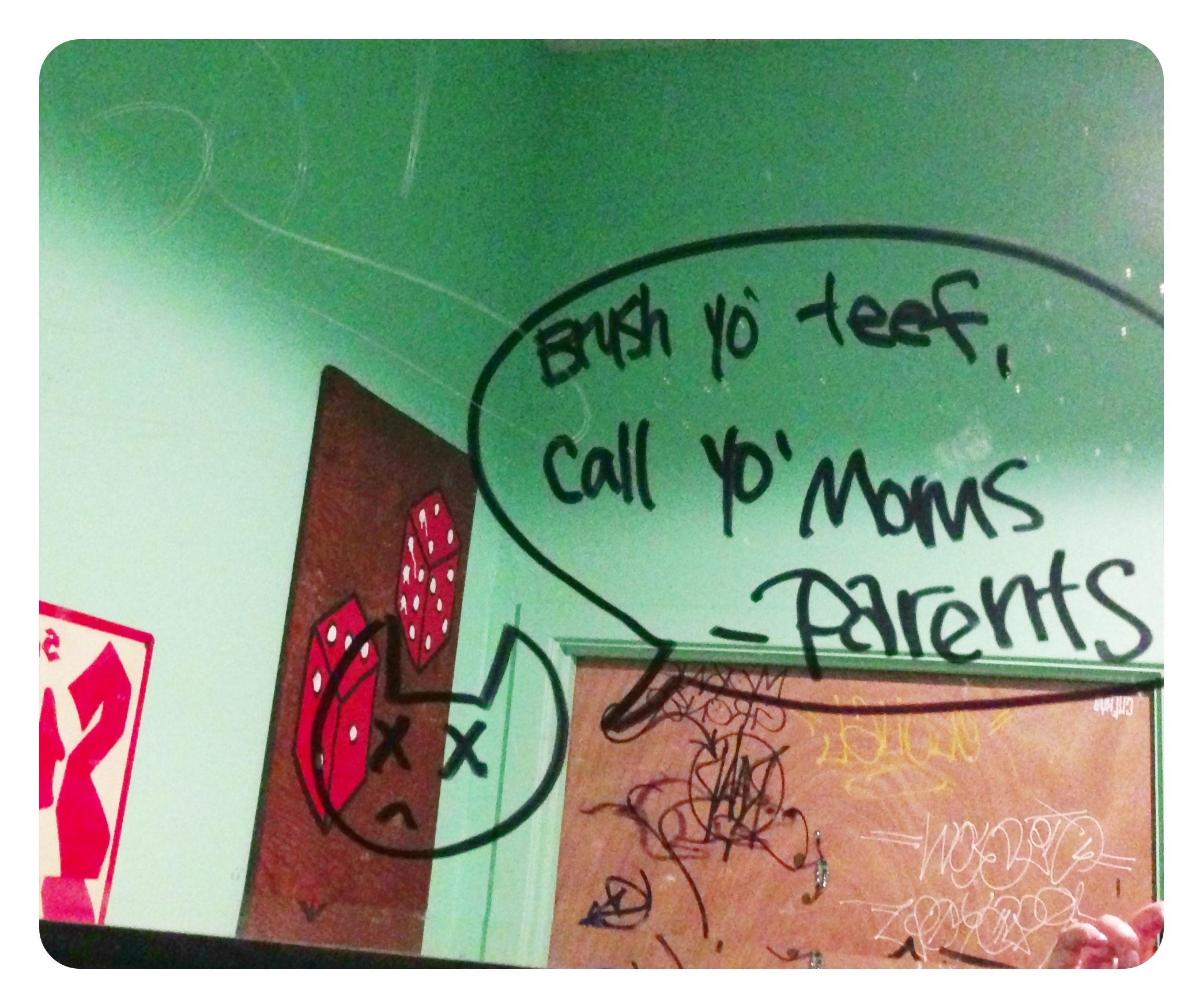
Another sends the above photo: “Here is my favorite from a mirror at Telegraph Beer Garden in Oakland, from ‘parents'”. Another reader:

Do I have what it takes to turn this one into a thread? Let’s find out.  I want to add another dimension to why people scrawl bathroom graffiti, which is group identity.

When I’m in the bathroom at a trendy or well-known bar or club, I often notice a big difference in tone and quality of the wall scrawling, compared to the average truck stop or gas station. Jokes that are actually funny, bits of poetry, or even running conversations are much easier to find. It seems like patrons want to demonstrate the value of their establishment in the kinds of things they write. Sometimes the jokes are so good that I wonder if some of the paid staff were instructed to write them to contribute to ambience.

Spontaneous case in point: at my small, very bookish liberal arts college, someone penned, in the grout between the tiles above a urinal, a pun playing off of the word “grout.” Other students found this so delightful that they started contributing additional grout puns along other parts of the grout. “Grout Expectations,” “The Grout Books,” etc. After a few years of many people adding more puns, it got to the point where you had to be very lucky, or have a very full bladder, to successfully think of a new one before your purpose at the urinal was spent.

Eventually, the grout puns spread to other men’s rooms on campus. I never discussed these puns aloud with anyone at school, but it was clear that all of the male students knew about them and that many of us contributed at one point or another. (I never found out if they spread to the women’s rooms.) How can one explain this popular, leaderless explosion of puns on the unlikely word “grout”? How else but that it nicely conformed with our self-conception as a student body of being clever, non-conforming nerds who read too many books?