Sticks And Stones And “Homosexual” Ctd

A reader writes:

As the Democratic Party speechwriter (for another week, anyway), this post hit home. A-fucking-men! I’ve had to write so many speeches for GLAAD-type events, to the point where I’m being discouraged from writing “gay” because LGBT is more “inclusive.” One problem is that the acronym doesn’t lend itself to a plural, meaning we have to say “LGBT Americans” again and again. Eight clumsy syllables! Thank God I haven’t had to write any remarks that deal with the persecution of gays in other countries, because I don’t even know how I’d refer to that group of people in the plural.

Human beings are fairly sophisticated social creatures. There are many, many words that are capable of causing offense, but we don’t feel the need to silence all of them, because where do you start and end? I wish we could just agree that every word within a language can be used, and if we insist on taking offense at an utterance, let’s be offended not by the word itself but by the context.

Another adds sarcastically, “Isn’t the politically correct acronym now LGBTQIA? Just check out UC Davis.” Another alternative:

If you don’t like “LGBT”, you may prefer the version a friend coined: translesbigay. It just rolls off the tongue.

“BLT” is much easier to pronounce:

Another reader:

One problem with “gay” as a replacement for “homosexual” is that “gay” has become a sexist term. Half the time, “gay” refers only to gay men. “Gay porn,” for example, is gay male porn. If one wants to refer to both sexes, one must therefore say “gay and lesbian.” But half the time, “gay” refers to both men and women. A “Gay Pride” march includes both gay men and lesbians. Feminists have long objected to using the word “man” to refer to all human beings, male or female. What does it mean that we use the specifically masculine term “gay” as a universal term for all “homosexual” people? Why is there no currently acceptable term for both gay men and lesbians?

Interestingly, in the lesbian community, the universal term “woman” also means “lesbian.” I don’t know what that means.

Another dissents:

You make a fair point on the term “homosexual,” though I understand GLAAD’s resistance to the term, given that it has mainly been used by anti-gay groups. Whatever; I don’t know many gay people that feel very strongly about it. On the other hand, you are far too cavalier about “queer” and “fag,” which have historically been insults that the gay left has attempted to – ugh – “reclaim.”

It’s a beautiful notion, but practically speaking it doesn’t work. Dave Chapelle tried a similar intellectual tack by repurposing several words and images (including the dreaded N-word) to take them away from racists. All he accomplished was creating a new white audience that used offensive words while being ignorant of their social context, or worse, who thought they were exempt from normal rules of polite society because they were trying to be funny.

We’re seeing a similar thing happen now with “queer.” Now it’s a word that college students use to mean everything from gay to gay-friendly, understanding that it’s still an epithet in the dictionary but thinking they are exempt from blame because they simply do not mean any harm. (God, if only it were true that people who don’t mean harm couldn’t cause it.) Many of us have had that word directed at us in a derogatory way, so hearing rich college kids bandy it about out of a need to feel special or tolerant doesn’t comfort us. It’s intensely irritating at best and offensively ignorant at worst.

Of course, the irony is that we, gay people, are responsible. Until we can talk about ourselves using language that is universally understood to be respectful, how can we expect anyone else to do so?

Another makes an interesting point:

Regarding you being fine with “fag,” I think it’s a generational thing, but also an English thing on your part. Perhaps look at whether you’d like to be described as a “poofter.” Somehow I doubt it. I think the key is what age you were when you first heard the derogatory description of who you are. At this point I’m fine with being an outsider, but the 12-year-old in me is still outraged that anyone would dismiss me so easily with that one f’ing word.

“Woofter” and “shirt-lifter” were more common in my youth. But I do think the fact that I wasn’t ever bullied for being gay affects me perspective on this. I recently reunited with several old classmates from my high school and they all said they didn’t know I was gay so didn’t call me those things. My nerdiness helped me slip below the radar. A female reader illustrates the impact of being way too sensitive to words:

For a year or two my brother and I (he lives next door) have not spoken much. We wave if we pass each other on the dirt road that leads to our houses. We live in a rural community outside of Tucson, AZ.

The reason for our estrangement is a word: “puto”, which in Spanish means faggot, sissy, male whore. Growing up he always used that word and I have always hated the word. I finally had the balls (that’s probably a hated word to some as well) to call him on it and our argument escalated to the point that we do not speak to one another now. We are in our early sixties, but he is for gay marriage and not a homophobe, he says. He occasionally yuck-yucks with his straight friends about gays, as in, “And I don’t care if they fuck ducks”. He is pro gay marriage and equality for his sister and her wife and everyone else. (Nancy and I were married in Seattle this past year.) However, when I asked him to use another word to describe someone he was trying to put down, he went ballistic. We are of Mexican-American heritage and I think the machismo man is emphasized and no one wants to be described as a sissy. Thus, I think it is a pejorative.

Team Dishness

composite-staff

A reader wrote while I was on vacation last week:

Dammit. You finally convinced me to fork over my money. Good work. I’d been hesitating for so long because I didn’t really have a reason to subscribe. I rarely hit the meter, and when I did, it didn’t really bother me. I could still get enough “Sully” above the “Read on” button to satiate myself.

Recently, though, you’ve been killing me. You’re simply posting way too much on far too many interesting topics. I was catching up on the Dish last week and my wife was reading over my shoulder. “Holy shit. He posts a ton!” to which I reminded her that you don’t work alone, of course …

Today I hit the meter on this post. I wanted to finish reading, so I begrudgingly pulled out my wallet and subscribed. (Sidebar: today is my 30th birthday, so I guess this was my treat to myself.) It wasn’t until after I signed up that I realized you are out of town, and the rest of your team is taking the lead right now. Watch out if those guys ever decide to leave you and start their own venture. My money will follow them!

They’re this site’s core assets. I couldn’t begin to do this without them.

(Images, clockwise from top-left: Matthew Sitman, Patrick Appel, Chris Bodenner, Katie Zavadski, Brian Senecal, Chas Danner, Alice Quinn, Jessie Roberts (inset), Tracy Walsh, and Jonah Shepp in the center square. Read a bit about each of them here.)

A Rough Election For Democrats?

Generic Ballot Lead

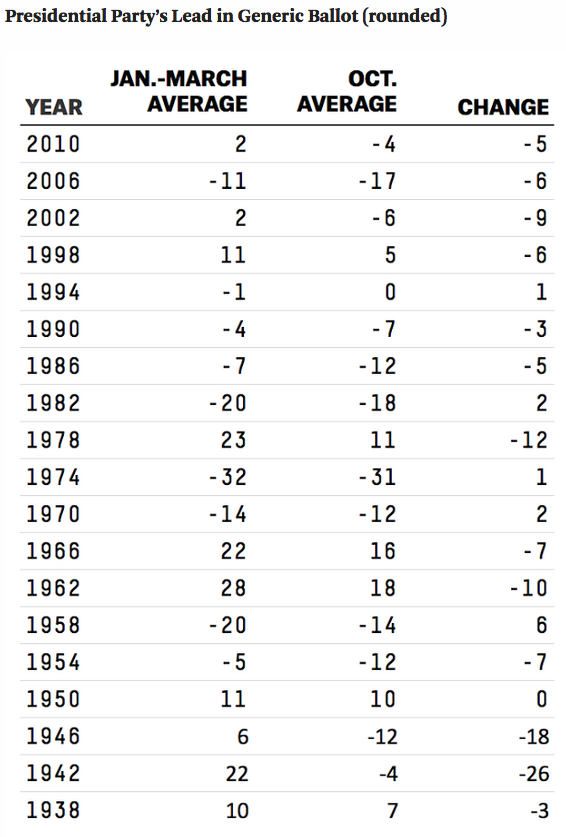
Looking at historical precedents, Harry Enten finds that Democrats have little reason for optimism in 2014:

The only year in which the president’s party improved its position by more than two percentage points was 1958, when Republicans under President Dwight D. Eisenhower picked up nearly six points on the generic ballot. The party holding the White House gained two points or less in four other years (1970, 1974, 1982 and 1994). Every other year saw at least a small decay in the presidential party’s position on the generic ballot. The median year was 2010, when the Democrats’ position declined 5.3 percentage points compared to the Republicans’. In the past five elections, the median drop was similar — -5.7 points.

Bernstein adds his analysis:

Is there any good news for Democrats here?

Not much. First, most of the large poll movements in Enten’s chart appear to be regression to the mean. Three of the four instances in which polls changed more than 10 points — all negatively for the president’s party — came after the president’s party held a 20-point lead or more in the generic ballot early in the presidential year. So perhaps a major decline for Democrats is unlikely. Unfortunately for Democrats, however, the one significant movement in favor of the president’s party was probably a result of exactly the same phenomenon. In 1958, Republicans improved from an awful 20-point deficit to a less awful 14-point gap. They received a shellacking in November, anyway. With the generic ballot measure essentially even now, there is no precedent for a sizable rally by the president’s party under similar circumstances.

How Healthy Is Obamacare?

Beutler flags evidence that the ACA “is experiencing an enrollment surge”:

Charles Gaba — an ACA supporter and data Hoover — has been documenting the March surge, state by state on his Twitter account and his site, ACAsignups.net. Gaba has the best numbers out there, and has been accurately forecasting official enrollment statistics for weeks. He currently projects total exchange enrollment will hit 6.2 million by the end of the month, not counting enrollment in off-exchange plans, and puts the grand beneficiary total (including Medicaid beneficiaries and “young invincibles” on their parents’ plans) at 11.9-15.6 million as of Saturday. Conservatives are thus, to no one’s surprise, furiously attempting to “un-skew” his figures.

But Kate Pickert notes that many Americans are still uninformed about the March 31st enrollment deadline:

The latest tracking poll from the Kaiser Family Foundation finds that, among uninsured adults, 43% don’t know when the deadline is or refused to answer. Five percent believe the deadline has already passed and 13% think it’s later this year.

Which may be why the administration is relaxing the deadline slightly. Avik Roy pans the extension:

It’s yet another improvisation by the administration, designed to get as many people under the Obamacare tent as possible, to ensure that the law is impervious to repeal. But the upshot is that people who haven’t bought insurance, and recently fallen ill, can now buy coverage at the old rate. So while the extension may increase enrollment figures by a few hundred thousand people, it will also ensure that the pool of people signing up is even sicker and older than it would have been otherwise.

Arit John is much calmer:

The Washington Post reported on Tuesday night that people who attempt to enroll in a health care plan through the federal exchange by mid-April will be given a special enrollment period of an unknown length. The Wall Street Journal reported last week that the Obama administration was planning on creating some kind of work around for people who experienced technical problems. While detractors of the law will argue that this is another sign of “the unintended consequences of the Democrats’ failed healthcare law,” as Republican National Committee Chairman Reince Priebus put it, it’s not. Insurance companies expected this and are waiting to see what the full plan is, and the precedent for special enrollment periods is well established.

Drum is on the same page:

Unlike the renewal delay and the employer mandate delay, which are both calculatedly political and of long duration, this one is merely an attempt to allow as many people as possible to enroll. It’s pretty justifiable, and it only extends the deadline by a few weeks. Nothing to get hot and bothered about.

Finally, taking a step back from today’s news, Dylan Scott sets the bar for Obamacare’s long-term success:

The real data for measuring Obamacare’s success aren’t in yet, but they eventually will be. At the top of the list: What happens with premiums in 2015? Plus: Do insurance companies leave the market or enter it? And the ultimate barometer: Has the number of uninsured Americans dropped significantly?

In simpler terms: Did Obamacare, in year one, create a sustainable insurance market for the long term?

The Left’s Favorite Bogeymen, Ctd

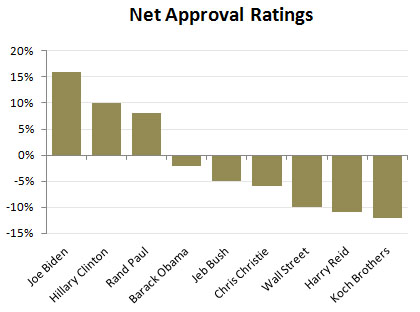
Weigel parses a recent poll (pdf) on the Koch brothers:

So 13 percent of Americans view the Kochs favorably and 25 percent view them unfavorably. By contrast, “Wall Street” has a 29/39 Koch Brothersfavorable/unfavorable rating, and the most prominent libertarian in America, Rand Paul, is at a robust 38/30. There you go—the Kochs are by miles the least popular icons of the pro-business, libertarian right. It only makes sense to pummel them. And when you pummel, you realize that “all Americans” will not be the electorate in 2014. The electorate will consist of maybe 40 percent of registered voters. Democrats need that electorate to grow a bit and include more Democrats. Anything that scares or angers them and makes them vote, they’ll use.

Drum passes along the chart above:

Given their low profile, you’d hardly expect the Kochs to be a household name. And yet, nearly half of all American have heard of them, and among those who are in the know they’re very unpopular. So maybe the Democratic strategy of personalizing the robber-baron right by demonizing the Kochs is paying off. Give it another few months and maybe the Kochs will be a household name.

Cillizza doubts the strategy will earn Democrats votes:

We’ve long believed that attacks on two relatively low-profile billionaires isn’t likely to work for Democrats simply because, as this poll shows, people don’t know who the Koch brothers are.  And, beyond their low name identification, the reality is that voters almost never use campaign finance or money in politics as a voting issue.  Yes, in polls people will say there is too much money in politics and that it’s a bad thing. But, time and time again in actual elections they don’t vote on it.  Take 2010 when, in a last-ditch attempt to change the narrative from one focused on President Obama and Obamacare, the White House and its allies insisted that the “dark” money that groups like American Crossroads were putting into the system was going to be a major issue for voters. Um, not so much.

David Graham largely agrees. But he sees few other juicy targets:

In 2014 the White House (and congressional Democrats) once again have few choices. The Republican presidential field two years ago was weak and diffuse; Mitt Romney’s ultimate victory came after boomlets for Rick Santorum, Michele Bachmann, Rick Perry, Newt Gingrich, and, yes, even Herman Cain. At this early stage, the 2016 GOP field promises to be much stronger, but it’s still a wide-open race and Romney has shown no interest in giving it another shot, so there’s no obvious bogeyman. So who else do Democrats have to attack? Reince Priebus isn’t exactly a household name either.

Ed Morrissey’s take:

[T]his is red meat for the base. Most everyone else could care less, mainly because the “look — billionaires!” scare tactic is so blatantly hypocritical.

Earlier Dish on the Kochs here.

The New York Times Embraces Sponsored Content

And then some. On its new app, NYT NOW, there will be nothing but sponsored content supporting it. No actual ads, just corporate propaganda designed to look like the rest of the app:

Paid posts in the news stream will be the only form of ads on The New York Times’ NYT Now app, due to roll out on the App Store on Apr. 2, the company said today… Cartier has signed on as the initial sponsor of NYT Now. Paid Post units and branded content will also begin appearing on the Times’ other mobile apps in the coming months, the Times said… The Times introduced native ad units in January, with Dell, Intel and Goldman Sachs as the initial sponsors. The company hopes native ads will help turn around its declining digital ad revenue, which Times CEO Mark Thompson has pledged to begin growing again in 2014.

In-stream ads in mobile apps are the latest step in this process.

That’s the end, isn’t it? I’m sure the NYT will be better than most in labeling its paid posts, but when the NYT has put its full weight behind blurring the line between editorial and advertizing, what chance that the rest of the industry can resist jumping into the fray? I can’t help but notice that the 100 percent native advertizing on NYT NOW somehow didn’t make it into the NYT’s own story on the changes. I guess I’m not surprised why. The goal of these journalistic enterprises is to keep that kind of thing on the downlow.

Dissent Of The Day

A reader writes:

In response to this quote from Donald Rumsfeld …

This administration, the White House and the State Department, have failed to get a status of forces agreement. A trained ape could get a status of forces agreement. It does not take a genius.

… you make the absurd leap to claim that Rumsfeld “described the first black president as inferior to a trained monkey.” That’s a low blow, and a baseless one. “So easy a trained monkey could do it” is an extremely common phrase. And immediately prior to using it, Rumsfeld refers to “the administration, the White House and the State Department” – which collectively encompass thousands of people, not just Obama, whom Rumsfeld doesn’t even call by name.

Even Jamelle Bouie, who’s very left-liberal when it comes to race, insists that it’s “unfair is to attack him for race-baiting”:

In fact, when you consider the full interview, it’s easy to see the rhetorical logic. Rumsfeld spends most of the segment complaining about the poor diplomacy of the administration, condemning John Kerry, Joe Biden, and others for their treatment of Afghanistan President Hamid Karzai. … [T]his isn’t an attack on a person, it’s an attack on an approach.

I know you despise Rumsfeld, and rightly so. He’s an arrogant asshole, and for him to criticize anyone when it comes to Afghanistan is the height of chutzpah. But to accuse him of crude racism like that – something you just recently slammed liberal critics of Paul Ryan for – is really out of line.

I withdraw that slippery aside.

An Act Of Musical Politics

A reader writes:

As World War I got underway, Romain Rolland and Hermann Hesse, two Swiss writers, appealed to their war-frenzied friends in France and Germany citing the lede to the choral movement of Ludwig van Beethoven’s Ninth Symphony: O Freunde, nicht diese Töne! sondern laßt uns angenehmere anstimmen! (Friends, not these sounds! Let us rather make more pleasant, more joyous notes). And last Saturday, in Odessa, a Russian-speaking city of Ukraine, one of the cultural treasure-houses of Europe, the city that gave us Anna Akhmatova and Issak Babel, Sviatoslav Richter, David Oistrakh, Nathan Milshtein and Emil Gilels, performers from the Philharmonic flash mobbed a performance of the last bars of the symphony at the Odessa fish market. A decidedly political musical statement. Amazing.

It takes off around 4:00. We must not abandon Ukraine.

Where Will Putin Stop?

Pavel Felgenhauer claims that Putin must move fast if he’s going to grab Eastern and Southern Ukraine:

If Putin decides to send in his troops, he has a narrow window in which to act. The winter of 2014 in Russia and Ukraine was relatively mild with little snow, while the spring is early and warm. The soil is drying rapidly, meaning that it will soon be possible to move heavy vehicles off of highways and into fields in southern areas of Ukraine close to the Black and Azov Seas. A key date is April 1, which marks the beginning of the Russia’s spring conscript call-up, when some 130,000 troops drafted a year earlier will have to be mustered out as replacements arrive. This would leave the Russian airborne troops, marines, and army brigades with many conscripts that have served half a year or not at all, drastically reducing battle readiness. The better-trained one-year conscripts can be kept in the ranks for a couple of months but no longer. Otherwise they’ll start demanding to be sent home, and morale will slip. As a result, Russia’s conventional military will regain reasonable battle-readiness only around August or September 2014, giving the Ukrainians ample time to get their act together.

But Masha Gessen, who sees the annexation of Crimea as payback for the West’s intervention in Kosovo, believes that Putin is playing a very long game:

Once Putin held power in Russia, he never planned to cede it, so he had all the time in the world. Two of Putin’s key character traits are vengefulness and opportunism. He relishes his grudges and finds motivation in them: He has enjoyed holding the bombing of Yugoslavia against the United States all these years—and knowing he would strike back some day. He is anything but a strategic planner, so this knowledge was abstract until it wasn’t, when the opportunity to grab Crimea presented itself. Revenge has been sweet, but when other opportunities present themselves—and this will happen more often now, at least from Putin’s point of view—he will deploy Russian military force or the threat of Russian military force in other neighboring countries. He will take his revenge not only cold but plentifully.

Kim R. Holmes argues that one of “the most important lessons of the Cold War is that drawing lines in the sand actually works”:

We often think of how the containment strategy held the Soviet Union in check, but the real tests of strength actually occurred before that strategy was fully in place. Truman “lost” Poland (mainly because he never had it in the first place), but he drew the line with Turkey and Greece. Both countries ended up as NATO allies, not members of the Warsaw Pact. We should be drawing similarly clear lines in the sand today, particularly with respect to the Baltic members of NATO, making it absolutely clear that the United States will honor its NATO Article Five commitment to defend those countries.

The challenge for U.S. policy is not to let Russia’s fait accompli in Crimea signal a complete abandonment of Ukraine. It’s one thing to say we will not go to war to defend Ukraine’s independence, and another one altogether to consign Ukraine forever to Russia’s sphere of influence. Not everything in foreign policy comes down to threatening war. Most Ukrainians want to be part of the West, as the Poles did some 70 years ago, and this matters more in the long run than the strength of Russia’s armored brigades.