Congressional Testimony Of The Day

Well yesterday:

“I don’t know if you know who I am at all,” [Seth] Rogen said to Sen. Tom Harkin (D-Iowa), the subcommittee chairman. “You told me you never saw ‘Knocked Up,’ Chairman, so it’s a little insulting.” Harkin responded that to his recollection, that was the first time the term “knocked up” had ever been used in a congressional hearing.

“You’re not going to like the rest of this, then,” Rogen responded, to laughs from the audience. “First, I should answer the question I assume many of you are asking: Yes, I’m aware this has nothing to do with the legalization of marijuana. In fact, if you can believe it, this concerns something that I find even more important.”

You should probably just watch the whole thing.

The Invisible Workforce

George Packer sees the “invisibility of work and workers in the digital age is as consequential as the rise of the assembly line and, later, the service economy”:

[T]he sheer size of the tech giants, and the economic and political power that comes with this, generates much less skepticism than Rockefeller and Morgan ever inspired.

One reason, I think, has to do with the sense in which these companies are everywhere and nowhere, ubiquitous in our lives but with no physical presence or human face. They are regarded by many users as public resources, not private corporations—there for us—and their own rhetoric furthers this misperception: Facebook’s quest for a “more open and connected world”; Google’s motto, “Don’t be evil,” and its stated mission to “organize the world’s information and make it universally accessible and useful”; Amazon’s ambition to become “Earth’s most customer-centric company.” Because these endeavors seem to involve no human beings, no workers, other than ourselves—the supposed recipients of all the benefits—it takes an effort to realize that the tech economy is man-made, and that, as with the economies that preceded it, human beings have the capacity to shape and reform it for the public good.

Face Of The Day

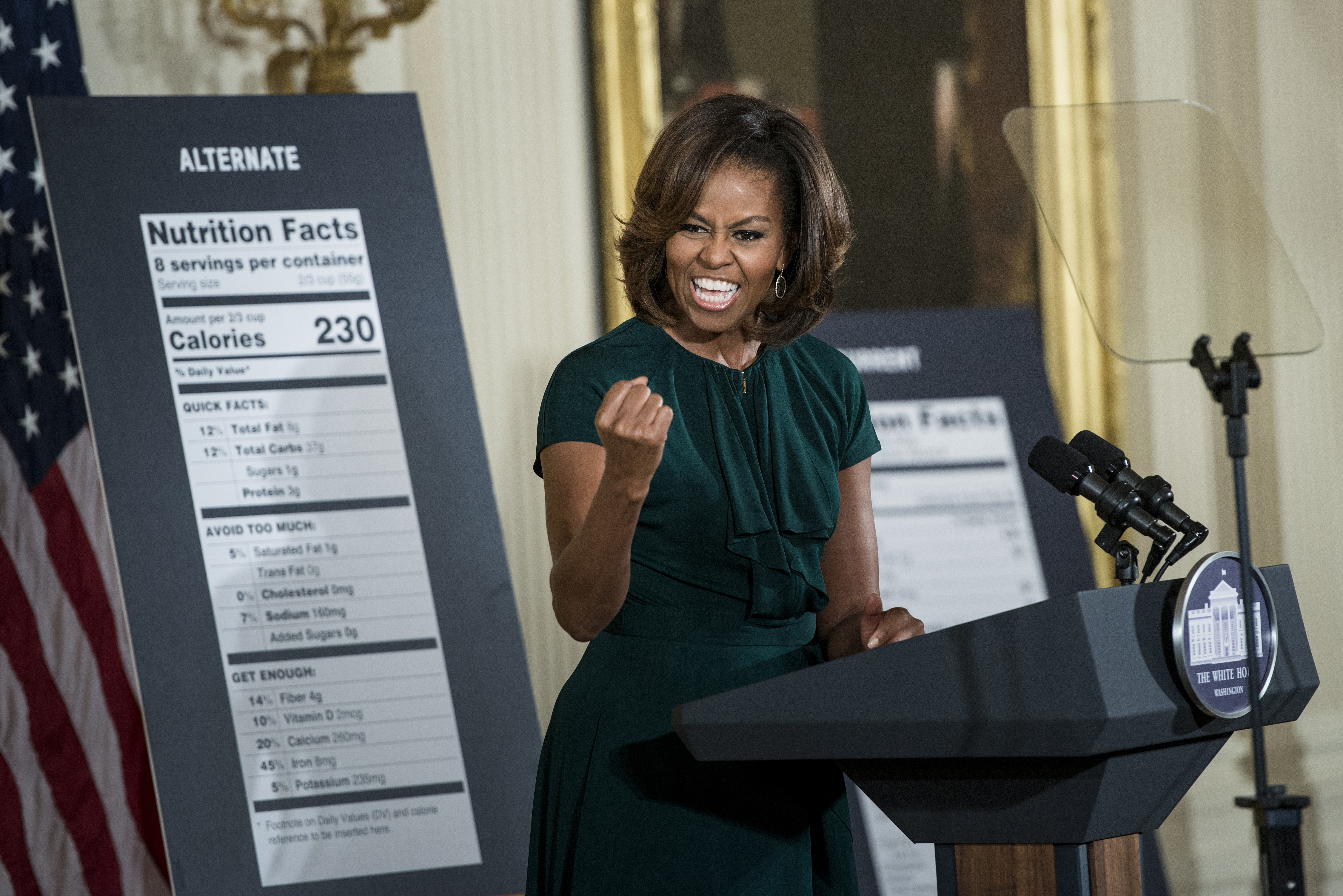
US-POLITICS-MICHELE OBAMA

US First Lady Michelle Obama speaks during an event in the East Room of the White House on February 27, 2014. Obama was joined by US Secretary of Health and Human Services Kathleen Sebelius and others to introduce a new proposed nutrition facts labeling for food in DC. By Brendan Smialowski/Getty.

When You’re Young, You Get Shot

A new report from the Center for American Progress finds that gun violence could soon become the leading cause of death among young people:

In 2010, 6,201 young people between the ages of 15 and 24 died by gunfire. Guns were a close second to the leading cause of death among this age group, car accidents, which took the lives of 7,024 young people that year. But, while car accident deaths among young people have been steadily declining over the past decade, gun deaths have remained relatively unchanged. And, as described in a new Center for American Progress report [pdf] released Friday, if current trends continue, gun deaths will surpass car accident deaths among young people sometime in 2015[.]

Zara Kessler reads the report and adds some context:

More than half — 54 percent — of Americans murdered with guns in 2010 were younger than 30. Among 15- to 24-year-olds murdered with guns, 65 percent were black. Adulthood not delayed, but stolen. In addition, in 2010, 33,519 individuals ages 17 to 29 survived being intentionally shot. Disabilities, physical and emotional scars – those last for life.

Low levels of household formation among young Americans may be a troubling portent for the nation’s financial health. But not nearly as disturbing as the annual loss of more than 1 million years of potential life due to gun deaths. (Quite a few unformed households, to say the least.)

Because young people also perpetrate a substantial portion of gun violence, millennial lives are destroyed on both sides of the muzzle. In 2012, people under 29 accounted for about two-thirds of arrests on weapons offenses. Almost 5,000 12- to 24-year-olds were arrested in 2011 for homicides, and guns were implicated in about 70 percent of the murders. It costs taxpayers (who have already paid to educate the perpetrators) about $2 million to imprison someone for life beginning in his or her late teens. Not much economic stimulus there.

The Party Of No Ideas

In one of his trademark takedowns, Chait explains why the Republican party can’t seem to coalesce around their own version of Obamacare:

Lots of people treat the Republican Party’s inability to unify around an alternative health-care plan, four years after the passage ofthe Affordable Care Act, as some kind of homework assignment they keep elephant_2.jpgprocrastinating on. But the problem isn’t that Cantor and Boehner and Ryan would rather lay around on the sofa drinking beer and playing video games than write their health-care plan already. It’s that there’s no plan out there that is both ideologically acceptable to conservatives and politically defensible.

Carping from the sidelines is a great strategy for Republicans because status quo bias is extremely powerful. It lets them highlight the downside of every trade-off without owning any downside of their own. They can vaguely promise to solve any problem with the status quo ante without exposing themselves to the risk any real reform entails. Republicans can exploit the disruption of the transition to Obamacare unencumbered by the reality that their own plans are even more disruptive.

I know we’re all supposed to be used to this by now, and regard it as the way politics works, but seriously: is there a more glaring example of the subordination of the public good to opportunistic factionalism? The GOP acts as if its only goal is to get power, even if it has nothing much to offer about how it would tackle such tough problems as climate change or immigration reform or healthcare when it gets it. They are in this for the electoral game, as Mitch McConnell once famously explained. The rest seems subordinate to that objective. Jonathan Bernstein adds:

Chait mentions that this has been going on for years, but he doesn’t refer to the granddaddy of all “repeal and replace” claims: the op-ed written in early 2010 by House Republican committee chairmen promising not just a bill, but a whole process. They were going to hold hearings, draft a bill and bring it to the House floor. I haven’t checked recently, but last I looked the story was that they hadn’t even bothered with the hearings part. As Chait says, there’s just nothing there.

Looking at the proposals that have come from the GOP so far, Peter Weber says they all have drawbacks:

The CBO analysis for Rep. Young’s bill to raise full-time employment to 40 hours, for example, found that the bill would raise the federal deficit by $74 billion while reducing the number of people getting employer-sponsored health insurance by about a million; about half of those people would go on Medicaid or other public programs, the other half would be uninsured.

It’s not clear the other Republican proposals would be popular in practice, either. Some of them, as the Washington Post editors note, would be better than ObamaCare at holding down health care costs and incentivizing people to buy private health insurance. But they are more disruptive to the status quo — especially post-ObamaCare — and almost all of them would be ripe for articles about sick people losing coverage or watching their health insurance costs skyrocket.

A major cause of the GOP’s ideas deficit is, of course, the Tea Party:

In Jindal’s diatribe, he claimed that Obama is “waving the white flag” on the economy by focusing on executive actions in the face of Congressional gridlock, and took a shot at Obama’s push to raise the minimum wage by decrying his “minimum wage economy.” The evocation of the minimum wage sheds light on the real cause of “polarization.” Here is a policy that is supported by broad majorities, one Republican officials have voted for in the past. Large chunks of Republican voters support it. But as two recent polls showedTea Party Republicans overwhelmingly oppose the hike, while non-Tea Party Republicans support it. The GOP position is dictated by the Tea Party.

When Will The Christianists Embrace The Islamists?

As always, theocon-in-chief Robbie George is ahead of the curve:

Let us, Muslims and Christians alike, forget past quarrels and stand together for righteousness, justice, and the dignity of all. Let those of us who are Christians reject the untrue and unjust identification of all Muslims with those evildoers who commit acts of terror and murder in the name of Islam. Let us be mindful that it is not our Muslim fellow citizens who have undermined public morality, assaulted our religious liberty, and attempted to force us to comply with their ideology on pain of being reduced to the status of second-class citizens. Let all of us—Christians, Jews, Muslims, and people of other faiths who “esteem an upright life” and seek truly to honor God and do His will—embrace each other, seeking “mutual understanding for the benefit of all men [and working] together to preserve and promote peace, liberty, justice, and moral values.” … It is unjust to stir up fear that they seek to take away our rights or to make them afraid that we seek to take away theirs. And it is foolish to drive them into the arms of the political left when their piety and moral convictions make them natural allies of social conservatives. (A majority of American Muslims voted for George W. Bush in the 2000 election. A majority of the general voting population did not.)

In case you miss the point, the piece is entitled: “Muslims, Our Natural Allies.” George cites the woman in the video as an ally. But that’s a classic piece of misdirection. I fully support a Western Muslim woman’s decision to wear the hijab as an expression of her religious identity. But I just as equally oppose the use of the civil law to combine religious edicts with secular politics. And the latter is essentially the theo-conservative and Christianist project. It sure will be fascinating to see if these Christian fundamentalists join forces with Islamists in the fight for a more expansive definition of religious liberty at home, along with bans on pornography, gay civil equality. George is onto something. Here he is, for example, on the role of women:

I admire Muslim women and all women who practice the virtue of modesty, whether they choose to cover their hair or not. There are many ways to honor modesty and practices vary culturally in perfectly legitimate ways. Men and women are called to serve each other in various ways, and women who refuse to pornify themselves, especially in the face of strong cultural pressures and incentives to do so, honor themselves and others of their sex while also honoring those of us of the opposite sex.

Let’s see: a global movement for religious fundamentalism and social conservatism, uniting much of the developing world with American Christianists (who have already succeeded in jump-starting pogroms against gay people in Uganda and Nigeria) and led, perhaps, by Vladimir Putin and his Euro-Asian community of despotisms. Sure there will be some pushback. But one senses that this transnational fundamentalism will be as tempting for the social right in the short term as it is doomed in the long.

The Domino Hits Texas

Allahpundit reacts to the latest Windsor-inspired court ruling in a red state:

By now, if you’ve read one of these decisions, you’ve read ‘em all. Sometimes they find a violation of equal protection, sometimes Screen Shot 2014-02-27 at 12.17.16 PMthey find a violation of equal protection and of due process insofar as the right to marry is “fundamental.” Sometimes they find that gays are a “suspect class” deserving of special protection for purposes of EP analysis, sometimes they skip that part and find that bans on gay marriage have no rational basis and therefore it doesn’t matter how you classify gays. The judge in Texas, a Clinton appointee, took the latter route in both cases.

The basic point is always the same, though: Federal courts don’t see any compelling reason to restrict marriage to straights only.

Amy Davidson isolates a core rationale in the Texas ruling:

A word that appeared several times in Judge [Orlando L.] Garcia’s ruling was “dignity.” “By denying Plaintiffs Holmes and Phariss the fundamental right to marry, Texas denies their relationship the same status and dignity afforded to citizens who are permitted to marry. It also denies them the legal, social, and financial benefits of marriage that opposite-sex couples enjoy.” The laws, he continued, “demean their dignity for no legitimate reason.”

It’s great to see a word with deep origins in Catholic Christianity coming to the defense of homosexual persons. Garcia’s ruling can be read in full here. Sean Sullivan and Scott Clement put it in context:

More recent data show that Texas ≠America as a whole when it comes to gay marriage.

A December 2013 poll from The Public Religion Research Institute showed that 48 percent in Texas favored allowing gay and lesbian couples to marry legally while 49 percent opposed. That compared with a national rate of 53 percent in favor to 41 percent opposed. In short, even as attitudes nationally have shifted dramatically toward embracing gay rights during the past decade, there are plenty of states, like Texas, where opinions don’t mirror the broader attitude. What Wednesday showed is that even in these states, the laws may change.

Still, these changes will continue to encounter stiff criticism from opponents of gay marriage. Texas conservatives led by the state’s top Republican swiftly criticized Wednesday’s decision, signaling the stiff push back that is sure to surface in the GOP-dominated Lone Star State in the coming days.

But I can remember when the very idea that Texas would be evenly split on the question was incredible. Lyle Denniston looks ahead even further:

Texas Attorney General Greg Abbott immediately announced plans to appeal the case to the U.S. Court of Appeals for the Fifth Circuit. Among the five federal appeals courts where appeals on this issue are or soon will be unfolding, the chances seem greatest in the Fifth Circuit that a panel of conservative judges would be ruling on the case. If that happens, it would likely increase the chances that there will be conflicting decisions on same-sex marriage bans, and that would enhance the chances that the Supreme Court would step in to decide the issue, perhaps as early as next Term.

The Next Country To Decriminalize Weed

It’s shaping up to be Jamaica:

The island’s energy minister, Philip Paulwell, who also leads government business in parliament, has said he will find time this year to decriminalize possession of small amounts of marijuana. At a stroke, the move will cut the number of criminal offenses by as many as a million a week. It will also make a Jamaican break somewhat less nervy for ganja-puffing tourists. Reform proposals have been knocking around for some time: a National Commission on Ganja recommended decriminalization in 2001. But helped by moves towards legalization in Uruguay and decriminalization in the United States, momentum has been growing. A Cannabis Future Growers and Producers Association was launched last month, and a commercial company to support medical marijuana in December.

Alas for the ghost of Peter Tosh, legalization is still a ways off:

It will remain illegal to grow and trade marijuana in large quantities, something that suits the big players just fine. Full legalization would knock the bottom out of the market, hurting the island’s powerful criminal gangs. It would also curtail the potential for extortion; seven police officers appeared in court this month on allegations that they took a $2,750 bribe from a businessman in return for overlooking a ganja find on his premises.

“As A Jew, It Embarrasses Me” Ctd

Judis responds to those calling his new book anti-Semitic. God, I hope we can move past that idiotic and foul rhetorical device. His broader argument:

Screen Shot 2014-02-27 at 10.58.06 AMTheodor Herzl, Chaim Weizmann and the British Zionists who helped draft the Balfour Declaration did not aspire to create an empire like that of the British or French, but to be junior partners of the Western imperialist powers. Herzl, who admired CecilRhodes, described the Jewish state as “a part of a wall of defense for Europe in Asia, an outpost of civilization against barbarism.” The Zionist movement established “colonies” and aspired to create a Jewish state in a territory where, at the beginning of the Zionist movement, Arabs made up 95 percent of the population. American Zionists compared the Zionists in Palestine with American colonial settlers. At the time, colonialism and imperialism were not dirty words they way they are now. So yes, I think much of the Zionist movement—with the exception of Ahad Ha’am and his followers—saw themselves engaged in a mission that could be described as settler colonialism.

I think the problem is that some enthusiastic supporters of Israel may believe that by acknowledging that history, they thereby confirm that Israel is “illegitimate.” But

many states, including the United States, are products of settler colonialism and conquest. There is no going back in these cases. What Israel’s early history does suggest, though, is that Palestinian Arabs have a legitimate grievance against Israelis that has never been satisfactorily addressed. It won’t be addressed by abolishing Israel—that’s not going to happen—but it can be addressed by an equitable two-state solution that gives both peoples a state and that opens the way for Israel’s reconciliation with its neighbors. If there is a lesson to Genesis—and I happen to believe that history can tell us things about the present—that’s what it is.

For a great summary of the bile Leon Wieseltier has unleashed on one colleague after another, check out this Jacob Heilbrunn piece at the National Interest. Money quote:

Among those who have felt the lash are Andrew Sullivan, Peter Beinart, James Wood and Louis Menand. The latter two worked directly for Wieseltier, and he championed both Sullivan and Beinart, at least initially. Some of the quotes that a brief web search excavates include these morsels. On Menand: “Menand is the professor of littleness. He is a man in flight from the seriousness of his own vocation.” Menand’s offense? Not to bow sufficiently at the shrine of Lionel Trilling. In the case of Sullivan, he diagnosed “something much darker,” namely, anti-Semitism: “To me, he looks increasingly like the Buchanan of the left. He is the master, and the prisoner, of the technology of sickly obsession: blogging–and the divine right of bloggers to exempt themselves from the interrogations of editors–is also a method of hounding.”

In another piece, Wieseltier offered a twofer, criticizing (if that is not too andoyne a word) Beinart and Wood simultaneously. On Beinart: “Beinart’s pseudo-courageous article is an anthology of xenophobic quotations by Israeli hawks and anguished quotations by Israeli doves: familiar stuff.” Then came Wood’s spanking: “So what if Wood’s authorities are Jews? Can Jews not be wrong, or anti-Semitic? Wood’s Jews are certainly anti-Zionist.” Is it really an accident that, having left the New Republic, several of its editors have repudiated its long-time reflexive support for Israel?

Dave Camp vs The Tax Code, Ctd

Philip Klein has mixed feelings about the Michigan Republican’s proposal:

Overall, though the bill would represent progress, too much of it still accepts the premise that the federal tax code should be used by the government to promote certain national priorities rather than merely being a neutral way to raise revenue. There are other provisions that I’d take issue with, such as the one targeting investment firm managers (see this Avik Roy post for a good explanation of the issue).

Additionally, I would have liked to have seen Camp tackle payroll taxes, because for most Americans, this is the heavier burden than income taxes. They are also an incredibly economically destructive tax, because not only do they reduce spending power, but they make it more expensive for employers to hire new workers.

I’m sympathetic to that. I’d love a tax code whose sole purpose is the most efficient, simple and least market-distorting mechanism by which to raise revenues. But I’ve learned not to prefer the perfect to the good. In terms of economic impact, Chait says the proposal is the best he’s seen from Republicans:

The evidence suggests that cutting tax rates, financed by deficits, does little or nothing to spur economic growth. But Camp’s plan doesn’t do that. It instead reduces tax rates by eliminating preferences in the tax code. Subsidies for home mortgage debt and employer-sponsored insurance, among others, would be radically scaled back. And eliminating these kinds of favoritism encourages workers and businesses to instead follow market signals, and likely to make more market-friendly decisions.

It would surely be better if Camp agreed to draw up a plan that increased revenue, but let’s get real about this. Republicans were never going to agree to higher tax revenue for nothing.

Drum takes a second look and is more impressed:

I was wrong. It turns out that Camp’s plan specifies the tax breaks he wants to close in considerable detail. And according to the analysis of the Joint Committee on Taxation, which is usually fairly reliable, it would be both revenue neutral and distributionally pretty neutral too. Over ten years it would raise about $3 billion more than present law[.]

But Jared Bernstein insists that the plan is “fundamentally flawed”:

First, it claims to be revenue neutral, but achieves that goal only with timing gimmicks that ensure that its revenue neutrality will not last. Second, revenue neutrality is itself a recipe for an unsustainable budget path. Our demographics alone, not to mention growing challenges like climate change, imply future demands on government programs that clearly show neutrality to be a misguided guidepost for tax reform.

Yes, but you can still raise revenues after tax reform, can’t you? Chye-Ching Huang also warns that the plan will lead to lower revenues in the long run:

The plan’s scaling back of certain tax breaks raises more revenue up front than over time.  For example, the plan ends “accelerated depreciation,” which allows businesses to deduct the cost of new investments at an accelerated rate.  The JCT estimates show that the revenue gains from ending accelerated depreciation peak in 2019 and then dwindle.  Treasury economists have found that ending accelerated depreciation saves much less revenue in the second decade than in the first, and less in the third decade than in the second.

Mark Calabria worries that the proposed bank tax would further enmesh the government with the finance sector:

While standard Pigouvian welfare analysis would recommend a tax to internalize any negatives externalities, [Too Big To Fail] is not like pollution, it isn’t something large banks create. It is something the government creates by coming to their rescue. I don’t see TBTF as a switch, but rather a dial between 100 percent chance of a rescue and zero. By turning the banks into a revenue stream for the federal government, we would likely move that dial closer to 100 percent–and that is in the wrong direction. For the same reason, I have opposed efforts to tax Fannie Mae and Freddie Mac in the past. The solution is not to bind large financial institutions and the government closer together, as a bank tax would, but to further separate government and the financial sector.

Politically, Stan Collender explains why the plan is probably going nowhere:

The plan includes tax increases on key Republican constituencies. No matter how rational that might be from a numerical point of view, that’s not something Camp’s colleagues will be able even to tacitly approve let alone actually vote for before either the next congressional election this November or the next presidential election in 2016.

In fact, Camp’s heir-apparent at ways and means — House Budget Committee Chairman Paul Ryan (R-WI) – and Speaker John Boehner (R-OH), the two most important people on tax reform other than Camp himself, both made it clear today before the Camp plan was formally revealed that they (and, by extension, House Republicans) are not close to being ready to deal with tax increases any time soon. Given that Ryan will likely take over from Camp next year, the very clear message he sent this morning was that the prospects for a tax increase will be different when he’s chairman.