Beards Of The Week

Rob-DuBois-and-Gander

And for a good cause:

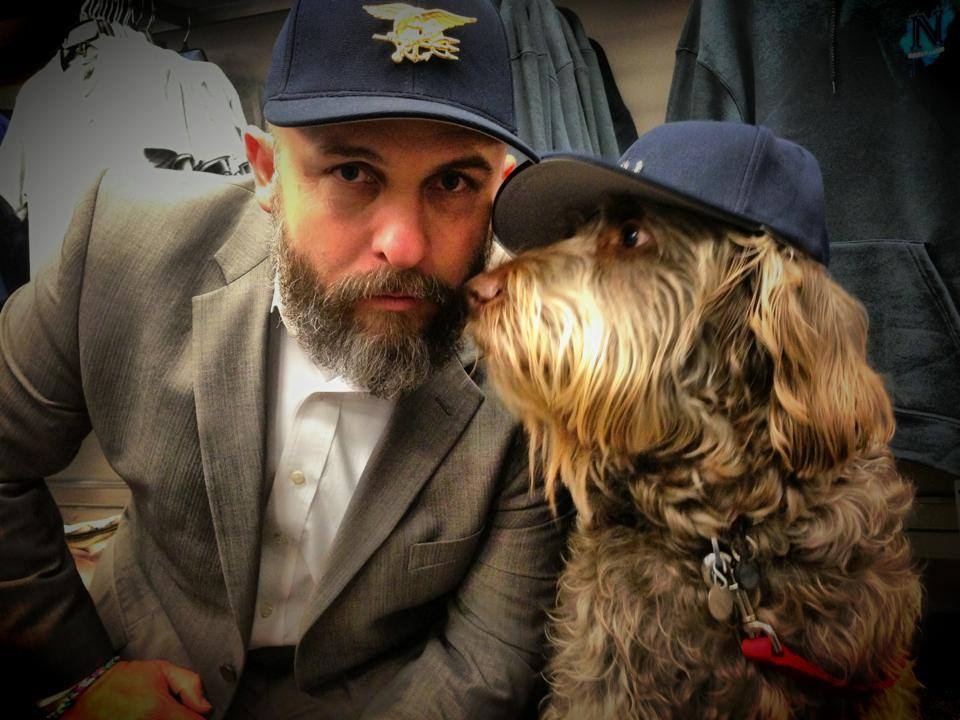
Veterans Lon Hodge and Rob DuBois host workshops on conflict resolution and how to defuse stress for other vets. These seminars are especially geared for veterans with service animals—particularly veterans with PTSD (post-traumatic stress disorder) issues. When Lon Photoshopped a picture of Rob, a Navy SEAL, right next to his dog, Gander, it caused such an Internet stir that the two friends made a pact to have a “beard-off” for each of their workshops.

The next beard-off between Rob and Gander will be held from March 1-20 to raise funds for LZ-Grace Special Forces RetreatLt Michael P. Murphy Memorial Scholarship FoundationFreedom Service Dogs, and Warrior Dog Foundation. The winner will be announced on March 21. The loser will be shaved… and not his beard. “SEALs are crazy wild about their beards,” says Lon. “So if Rob loses, he will shave his head—not his beard. If Gander loses, he will get a buzz-cut.”

Follow the beard-off on Gander’s Facebook page.

Quote For The Day

“Pope Francis has described gay people as ‘socially wounded’ because ‘they feel like the church has always condemned them.’ Catholics must examine how we contribute, perhaps even inadvertently, to a culture of fear and shame. In a field hospital after battle, a basic responsibility of the caregivers is to ‘do no harm.’ The church must oppose violence against gay persons and should strongly advocate for the decriminalization of homosexuality. No one should be subject to a criminal penalty simply for being gay. If laws like these do not constitute the ‘unjust discrimination’ against gay people that the church rightly denounces, then what possibly could?” – America, the Jesuit magazine, on the wave of legislation in Africa, re-criminalizing homosexuality and anything to do with it.

It’s The Economy, Estúpido

Venezuela

Juan Cristobal Nagel looks at the state of Venezuela’s economy:

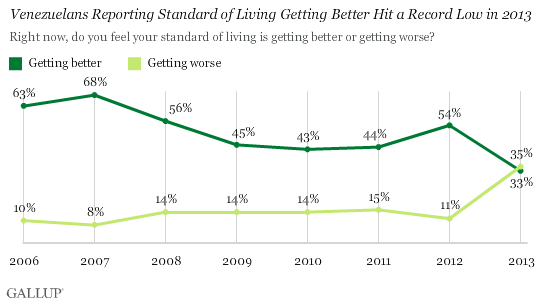
I think we are underestimating the extent to which economic expectations took a hit in the last few months. Venezuela’s economy is not yet officially in a recession, but people are, increasingly, sharply worried about their future. According to surveys conducted around early October, the Gallup organization found Venezuelans increasingly concerned about their future well-being.

Max Ehrenfreund argues that Venezuela’s socialism has been relatively ineffective:

While the gap between rich and poor is smaller than in many other Latin American countries, it is still quite large. And while Venezuela is wealthier than some of its neighbors, the economy has performed badly since Chávez took office fifteen years ago, according to data from the World Bank. The economy has expanded by less than 3 percent per year on average, despite an oil boom, and is now in crisis. Shortages of staples and basic commodities are now routine, and Maduro’s government nationalized a major manufacturer of toilet paper last year in a desperate effort to keep shelves stocked. The official inflation rate is now at 56 percent per year, and the true rate might be much higher. (A tip of the hat to David Frum.)

A useful contrast is with Uruguay, where the economy has expanded at a rate of more than 5 percent per year since 2008 and less than 10 percent of the population is living in poverty, according to the World Bank. No one could accuse Uruguayan President José Mojica, who took office in 2010, of being a fascist — he rides around in an old Volkswagen, and his government passed laws legalizing gay marriage and marijuana last year. Yet Mojica is focused on managing the country effectively, not on curtailing the freedoms of his political opponents.

But Raul Gallegos bets against Venezuela’s government collapsing the way Ukraine’s did:

Opposition leaders may gain political capital from the current discontent. But only broad unrest among the poorest members of society could shake Maduro’s control. Former presidential candidate Henrique Capriles Radonski made that clear when he declined to support the recent opposition led protests earlier this month: “Where are the poor in all of this? There’s none, and we won’t participate because we won’t fall for this, we won’t let ourselves be carried away” by events.

The Death Throes Of The Anti-Gay Movement, Ctd

Marc Tracy looks at how the politics around gay rights have changed:

Now, in 2014, reports Politico, the reaction to an Arizona bill that would allow businesses to refuse to serve gay people is this: “top national Republicans just want the issue to go away.” If Arizona Gov. Jan Brewer doesn’t veto the bill, the consensus is that the issue will weigh down Republicans throughout the country who would have to answer for why their party is associated with such an obviously distasteful law.

When even Gingrich demurs, you know the Christianists have jumped the shark. In a sign of their intellectual desperation, check out this piece, “Against Heterosexuality”, in the theocon magazine, First Things. It echoes the far left in denying that homosexuality exists apart from a social construction, which they want to deconstruct. The piece aims to take the debate back to the nineteenth century, before the very concepts of homosexuality and heterosexuality were forged. Well, at least they are trying to be consistent.

On the new “religious liberty” bills proliferating around the country, it’s also worth noticing the deep rift in the Republican coalition. Big business is adamantly against this kind of thing. Here’s Delta Airlines taking a stand:

As a global values-based company, Delta Air Lines is proud of the diversity of its customers and employees, and is deeply concerned about proposed measures in several states, including Georgia and Arizona, that would allow businesses to refuse service to lesbian, gay, bisexual and transgender individuals. If passed into law, these proposals would cause significant harm to many people and will result in job losses. They would also violate Delta’s core values of mutual respect and dignity shared by our 80,000 employees worldwide and the 165 million customers we serve every year. Delta strongly opposes these measures and we join the business community in urging state officials to reject these proposals.

It appears that the Georgia bill is now dead in the state House, but not the Senate. Conor echoes my own core worry:

I can’t help but wonder, when I hear about Christian businesses boycotting gay weddings, is how many of those businesses also refuse to take photographs or bake cakes for other marriages that don’t strictly conform to Biblical codes.

I suspect many, though not all, who object to gay marriage actually do have a specific problem with gays and lesbians. (I’ve known Catholics like that too.) And while I don’t want the state coercing anyone to bake cakes, I do think people with hateful views towards gays should be subject to shame and, more importantly, persuasion.

Millman makes related points:

The principle of non-discrimination is plainly in conflict with the principle that people should be free to deal with whomever they damn well please, and not with anybody else. Both principles are weighty and valuable. …

There is nothing wrong with adjusting the balance of equality-versus-freedom. Of course, as the Arizona law suggests, doing so may get you a lot more than you bargained for. But adjusting the balance only to permit discrimination against married gay couples transparently singles out those couples as uniquely unprotected. It’s practically a textbook example of invidious discrimination in law. If you want to adjust the balance, you have to adjust the balance generally. You don’t just make an exception for people you don’t like.

Beutler zooms out:

As America grows more liberal, conservatives are retreating into a variety of interlinking, but isolated subcultures and, when necessary, making or manipulating law to insulate themselves from contact with the masses. Like a cultural manifestation of Going Galt. Welcome to white America’s waiver society.

We’ve already belabored the right’s parallel argument that religious owners of businesses should be exempt from the Affordable Care Act’s contraception mandate. That argument’s much more widely accepted on the right than is the recent push for state-based anti-gay “rights” bills, but it’s actually identical in construct to the argument that religious individuals and businesses ought to be free to discriminate against gay couples or any number of other people.
The Pope Emeritus In White

Pope Francis Appoints 19 New Cardinals at St. Peter's Basilica

Around the anniversary of Pope Benedict’s almost unprecedented resignation as Pope, there has been a predictable uptick in speculation about what actually happened and why. If he was forced out by scandal, then his resignation would not have been valid. So in response to some pointed questions from La Stampa, Benedict has gone public. Money quote:

There is absolutely no doubt regarding the validity of my resignation from the Petrine ministry. The only condition for the validity of my resignation is the complete freedom of my decision. Speculations regarding its validity are simply absurd.

His rationale was declining health and energy in the face of huge problems – from the Vatican Bank to factionalism in the Curia to the resilient stain of the child-abuse scandal. We may never know the full story – but if we were able to read the report of three cardinals on corruption in the Church, we might get a better sense. It says something about the church’s dysfunction that such critical details about its governance are deemed too sensitive to be revealed to the people of God in the pews, who largely finance it. Maybe Francis might contemplate some sunlight there. It might presumably strengthen his hand against the Curia – or prompt sabotage and revenge.

I’m inclined to believe Benedict on this. It’s plausible, if not completely convincing. But here’s a statement in the letter I do find a little odd:

I continue to wear the white cassock and kept the name Benedict for purely practical reasons. At the moment of my resignation there were no other clothes available. In any case, I wear the white cassock in a visibly different way to how the Pope wears it. This is another case of completely unfounded speculations being made.

So your vestments are like musical chairs: you have to keep the ones you’re wearing at the time of your resignation?

Is he really saying that in the vast ornate closets in which he kept his bewildering variety of Liberace-style outfits, he couldn’t find a suitable one that in no way confused people about who might be the actual Pope? Not buying it. La Stampa elaborates on how Benedict maintains deference to Francis:

Benedict XVI proved this at last Saturday’s Consistory – which Francis had invited him to – when he took a seat along with the cardinal bishops instead of accepting the special seat that was offered to him. When Francis came up to him to greet and embrace him at the start and end of the ceremony, Benedict removed his zucchetto as a sign of respect and also to show that there is only one reigning Pope.

So he keeps his papal name and his white papal outfits, but removes his zucchetto. And his outfits remain as fabulous as ever.

(Photo: Pope Emeritus Benedict XVI, flanked by his former personal secretary and Prefect of the Pontifical House Georg Ganswein, greets cardinals as he leaves the St Peter’s Basilica at the end of the Consistory on February 22, 2014 in Vatican City, Vatican. By Franco Origlia/Getty Images.)

Yglesias Award Nominee

“Basic publishing ethics dictate that fake articles be printed in clearly different type fonts and column widths, be enclosed by borderlines and be identified prominently as advertising. By contrast, as native advertising is most often practiced – and as the Federal Trade Commission has very much noticed – publishers allow their advertisers to run content strikingly similar in look and style to the real editorial. The label “advertising” is almost never applied. Instead they use confusing wiggle words like “sponsored content” or, even more obscurely, “from around the web”. The result is not merely deceiving to readers, it bespeaks a conspiracy of deception among publishers, advertisers and their agencies,” – Bob Garfield, at the Guardian, the latest publication to embrace the unethical deception of “native advertizing.”

Garfield also has a good round-up of those outlets who have now embraced whoredom: The Economist. Forbes. The Atlantic. The Huffington Post. The Washington Post. Time Inc. The New York Times, and, most recently, Yahoo.

“As A Jew, It Embarrasses Me”

This embed is invalid


Here’s a good summary of the key point of John Judis’s new book, Genesis: Truman, American Jews, And the Origins Of The Arab-Israeli Conflict: that some early American Zionists had a blind spot when it came to the Arab inhabitants of Palestine. They just wanted them “transferred” from their homes and land. Their dignity and communities were to be erased, without much serious consideration, in favor of a great utopian scheme.

As if on cue, the literary editor of The New Republic, Leon Wieseltier, has decided yet again to go public in lacerating a colleague for daring to write about Israel without his oversight and permission. An email to Ron Radosh has appeared on the right-wing site, The Washington Free Beacon. Brimming with the usual venom and invective, it’s yet another collegial bridge burned by the Zionist fanatic. Are there any editors of TNR that Leon Wieseltier hasn’t personally trashed, if they dare disagree with him? Again, much of the diatribe is ad hominem, and deploys the usual tropes of the far right in smearing critics:

I am no authority on Truman’s decision (though you are), but I know with certainty that Judis’ understanding of Jewish history, and of the history and nature of Zionism, is shallow, derivative, tendentious, imprecise, and sometimes risibly inaccurate—he is a tourist in this subject. Like most tourists, he sees what he came to see. There is more to be said also about the utter shabbiness of discovering a Jewish identity in—and for the purpose of—criticizing the Jews: it is not only ignorant but also insulting. The magnitude of Judis’ indifference to the fate of the Jews in the very years in which they were being massively slaughtered—the 1940s: now there was a decade of Jewish power!—is quite shocking.

Note the incoherence: Wieseltier does not know the history on Truman with any authority, while Judis has spent years researching it. And yet Wieseltier is still capable of knowing “with certainty” that Judis’ book is “risibly inaccurate.” You can read the highly critical Radosh review here – and, like most of Radosh’s work, has none of the ad hominem poison that is Wieseltier’s lazy hallmark. It does take issue with some factual details but on the critical period analyzed in the book, Radosh writes: “I’m afraid that we see the same facts somewhat differently.” That’s “risible” inaccuracy?

Then there’s an almost text-book case of the Goldberg variations in Wieseltier’s personal attack on Judis: the writer knows nothing; the writer is a phony Jew; the writer is indifferent to the Holocaust; the writer is therefore a self-hating Jew/anti-Semite. These are not arguments; they are insults. And they are as disgusting as they are entirely unsurprising.

A simple question: is there an editor at The New Republic capable of preventing this kind of vicious anti-collegial invective? Not when it comes to Wieseltier, it seems. Chris Hughes and Frank Foer seem to answer to him, and not the other way round.

Marking Our Words

As part of a symposium on the “best punctuation mark,” Kassia St. Clair makes the case that the ellipsis is especially well-suited to the social media era:

Its fortunes have risen with e-mails, texts and instant messages. Immediate, informal, midway between letters and conversation, these media have changed the way we write, and the ellipsis has done much of that work. With just three jabs of a digit you can elegantly express polite disagreement, thoughtfulness or expectation, or just let the other person know there’s more to come. A well-placed ellipsis cuts through swathes of verbosity, leaving quotes with the necessary punch to entertain or enlighten.

Julian Barnes differs, favoring the exclamation mark, while Claire Messud prefers the semi-colon. Johnny Grimond, the author of The Economist’s style guide, insists that the comma reigns supreme:

[T]he comma is an adaptable, protean multi-tasker. It started life long ago as a device to separate passages of text into smaller fragments, and thus to aid understanding. It has evolved ever since, amid changing fashions and disputed rules. In this, it is like the English language of which it is a part. Well used, it resolves ambiguities and makes communication easier. It also makes English more fun.

The full stop is perfect for jabbers and peckers. They’re the staccato exponents of the short sentence. The dash has an obvious appeal for those who relish a backhand sweep—and to hell with the words that precede or follow it. The colon is fine for those who like to declare and deliver: first comes the announcement, then the explanation. The semi-colon plays a useful role for the indecisive; or perhaps temperamentally undecided would be a better phrase. (Brackets are beloved by those who cannot bear to leave out some irrelevant fact they happen to know.) No punctuation mark, however, can match the comma.

California’s Endless Summer, Ctd

California Drought Dries Up Bay Area Reservoirs

Alexis Madrigal thoroughly examines California’s water politics, which the state’s drought has inflamed. He covers a lot of ground, including the mechanics of the water operation:

Moving so much H20 from north to south requires tremendous amounts of energy: the two projects [the State Water Project and the Central Valley Project] alone consume nearly five percent of all the state’s electricity. The San Joaquin River, which naturally flows north and west, flows backward during irrigation season. Water released from the Oroville Dam in the Sierra mountains takes 10 days to travel the whole State Water Project, branching across to the Bay Area and Silicon Valley, then down the Central Valley and over the Tehachapi mountains, and then into a pipe along the edge of Los Angeles to the Inland Empire, where eventually, after everyone’s taken the water they’ve paid for, what’s left fills a small lake on the edge of what was once known as the Great American Desert.

For a long time, the system has worked. But the infrastructure is getting old, the political arrangements that underpinned it are breaking apart, and climate change is threatening droughts and sea level rise—all of which terrifies powerful farmers and big-city water managers south of the Delta.

Some relatively good news:

Even with the worst conceivable climate change, the kind of global warming that brings 70-year droughts to California, the state might do okay.

That seems counterintuitive, but that’s what Jay Lund, who heads the UC Davis Center for Watershed Sciences, loves about his model of the state water system, CALVIN. He and his colleagues ran a range of climate scenarios through CALVIN, asking for a look at what very dry, very warm scenarios might do to the state’s water system out to the year 2100. The results were shocking.

Basically, in CALVIN’s rendering of the future, the state’s economy is fine. “It was amazing how little the damage was to the state’s economy,” Lund said. That’s because the state’s cities sail through. First, they can afford to pay for water at quite high prices, so the economic gravity built into the model sends it their way. But it’s not just buying water from agricultural interests or through the State Water Project that saves them: a whole portfolio of nascent water ideas bloom.

Agriculture does not fare quite as well, but the state’s agricultural production only falls 6 percent. That’s despite increasing urbanization of agricultural land and, in the driest scenario, a 40 percent reduction in water deliveries to the Central Valley. “The farmers are all smart people and they’ll cut back the least profitable stuff,” Lund said. They’ll also fallow land, according to CALVIN—roughly 15 percent of the irrigated parcels currently farmed today, or 1.35 million acres.

Earlier Dish on the drought here and here.

(Photo: A car sits in dried and cracked earth of what was the bottom of the Almaden Reservoir on January 28, 2014 in San Jose, California. By Justin Sullivan/Getty Images)