Down On Dead Poets Society

Kevin J.H. Dettmar loathes the film. As an English professor, he’s especially unimpressed with the antics of Mr. Keating, the boisterous poetry teacher played by Robin Williams:

For all his talk about students “finding their own voice,” however, Keating actually allows his students very little opportunity for original thought. It’s a freedom that’s often preached but never realized. A graphic example is presented in one of the film’s iconic moments, when that zany Mr. Keating with his “unorthodox” teaching methods suddenly leaps up onto his desk. Why?

“I stand on my desk to remind myself that we must constantly look at things in a different way,” he helpfully declaims. How bold: He’s standing perhaps 2½ feet off the ground. Ralph Waldo Emerson, in his essay “Nature,” had made the same point rather more radically, suggesting that one “Turn the eyes upside down, by looking at the landscape through your legs.”

Keating then has the boys march up to the front, of course, and one-by-one and two-by-two they mount his desk and they too “look at things in a different way”—exactly the different way that he has. After each has experienced this “small alteration in [his] local position” (Emerson), he steps or leaps off the desk, as if a lemming off a cliff: Keating’s warning, “Don’t just walk off the edge like lemmings!,” unfortunately only serves to underscore the horrible irony of this unintended dramatic metaphor. Even when the students reprise this desktop posture at the film’s close, in a gesture of schoolboy disobedience (or perhaps obedience to Keating), we realize that while the boys are marching to the beat of a different drum, it’s Keating’s drum. Or they’re dancing to his pipes.

Jason Bailey sighs:

[Dettmar’s] catalog of woes and complaints reads less like criticism and more like a therapy session. “I think I hate Dead Poets Society for the same reason that Robyn, a physician assistant, hates House,” Dettmar writes, “because its portrayal of my profession is both misleading and deeply seductive.” Ah, yes, a movie that gets someone’s profession wrong, how novel. They say that you can’t watch a movie that was filmed in your house because you’ll never be able to get past how they changed the wallpaper; likewise, every time a film of note is set within a particular profession, out come the armchair experts to tell you how they get it all wrong, as if that actually makes any difference to the casual viewer, merely looking for a good story or an emotional experience.

The point is, it doesn’t matter one iota to the general movie-going public if Citizen Kane gets the newspaper world right, or L.A. Confidential is an accurate representation of police work, or Tootsie nails the day-to-day workings of a daytime drama. And though it might matter very much to (respectively) a newspaper editor, a cop, or a soap actor, that doesn’t mean we have to listen to them, and when Dettmar bemoans Dead Poets’ lack of representation for “the thrilling intellectual work of real analysis,” you just want to gently take him aside and explain to him how drama and movies work.

Update from a reader:

I think Dettmar misses in his critique of Dead Poet’s Society. The Mr. Keating character is taking his students along a process of changing their conformist ways. They are students of some wealth and social stature (mostly) in 1959 boarding school where their careers are already decided for them. At least that is conveyed in the movie. This is set up to be as conformist a setting as can be for the student characters. Now the scene Dettmar laments is where everyone changes their current perspective to that of Keatings on the desk. So what, it’s just one step along the process of breaking a mold. Why does Dettmar not point to a later scene when the students are out walking in the courtyard? In that scene they all fall in step while walking and Keating forces them to each walk their own way. One character, Dalton, takes it upon himself to take the point further and not walk at all (YouTube link here). This to me is the scene where Keating really gives his students the forum for “finding their own voice” as Dettmar put it, and not just repeating his voice. All part of the process.


The Facebook Empire

Matt Buchanan wonders if it can hold together:

When you first sign up for WhatsApp, you’re informed about the pricing model: the first year of service is free; each year after that costs a dollar. A post offering an explanation of why the company charges a nominal fee instead of showing advertising or requiring you to hand over basic demographic information reads like an anti-Facebook manifesto, beginning with a quote from “Fight Club”: “Advertising has us chasing cars and clothes, working jobs we hate so we can buy shit we don’t need.” The post continues, “These days companies know literally everything about you, your friends, your interests, and they use it all to sell ads”—an apt description of WhatsApp’s new owner. After a few more cutting remarks about advertising, such as “no one jumps up from a nap and runs to see an advertisement,” the page concludes, “Your data isn’t even in the picture. We are simply not interested in any of it.”

Facebook, despite being driven primarily by demographics and advertising, is adamant that it won’t change WhatsApp, an indication of just how overarching the company wants to be: in the pursuit of its next billion users, it is now willing to tolerate a highly discordant new product, like a vast empire that contains many competing nations. Empires always fall; the question now is how big Facebook’s can get before it does.

Earlier Dish on the WhatsApp purchase here and here.

Faces Of The Day

Guinness Book of World Records, Largest Collection of Video Game Memorabilia

Brett Martin exhibits a pair of Mario retail displays in his “Video Game Memorabilia Museum” at his home in Littleton, Colorado on February 25, 2014. His collection, with 8030 pieces, has been recognized by the Guinness Book of World Records as the largest collection of video game memorabilia. Martin says half of his collection is connected to Mario game series. By Craig F. Walker/The Denver Post/Getty Images.

History Is Written By The Sober

Stanton Peele blames the Temperance movement for expurgating our Founding Fathers’ prolific drinking habits from American history:

It is impossible for Americans to accept the extent to which the Colonial period—including our most sacred political events—was suffused with alcohol. Protestant churches had wine with communion, the standard beverage at meals was beer or cider, and alcohol was served even at political gatherings. Alcohol was consumed at meetings of the Virginian and other state legislatures and, most of all, at the Constitutional Convention.

Indeed, we still have available the list of beverages served at a 1787 farewell party in Philadelphia for George Washington just days before the framers signed off on the Constitution. According to the bill preserved from the evening, the 55 attendees drank 54 bottles of Madeira, 60 bottles of claret, eight of whiskey, 22 of porter, eight of hard cider, 12 of beer, and seven bowls of alcoholic punch.

That’s more than two bottles of fruit of the vine, plus a number of shots and a lot of punch and beer, for every delegate. That seems humanly impossible to modern Americans. But, you see, across the country during the Colonial era, the average American consumed many times as much beverage alcohol as contemporary Americans do. Getting drunk—but not losing control—was simply socially accepted.

A Friendlier Face For Big Brother

For a fresh take on what security cameras should look like, Rob Walker points to a project for Dutch Railways by the Amsterdam-based firm Fabrique, which “resulted in a form of security camera that expects to be seen”:

“The goal was to reduce the Big Brother feeling,” [Fabrique creative director Jeroen] van dish_fabriquecam Erp told me, straightaway. Dutch Railways (or NS), had done some research on “what kind of emotions were or weren’t evoked” by its camera system. “People knew there were cameras,” he continued, but they didn’t always know where they were (since the cameras were mounted to see, without much thought to being seen). And when they did spot one, they didn’t necessarily feel great about it. According to the data van Erp gave me, research found that while 68% of subjects agreed that the cameras they saw made them “feel safe,” an alarming 34% also said the objects inspired “a ‘big brother’ feeling.” (And a mere 9% found the things  “beautiful,” which is actually a surprisingly high number, to me.)

“So we said: Let’s try to change attitudes, with design,” van Erp said. … Rounded edges, bright colors, a more organic sense of living “eye”-ness: The upshot was a camera that’s comfortable being visible. The cameras were also deployed in a more determinedly visible way, acknowledging that people should see them. …

The data van Erup gave me suggests that the public … responded positively to these cameras. The percentage who called the object “beautiful” leapt to 80%; those reporting Big Brother vibe dropped to 12%. And the obviously critical safe-feeling response rose a bit — to 71%.

(Image of security camera by Fabrique)

Chutzpah Watch

Bill Kristol’s latest column is close to self-parody:

Kiev is ablaze. Syria is a killing field. The Iranian mullahs aren’t giving up their nuclear weapons capability, and other regimes in the Middle East are preparing to acquire their own. Al Qaeda is making gains and is probably stronger than ever. China and Russia throw their weight around, while our allies shudder and squabble.

Why is this happening? Because the United States is in retreat. What is the Obama administration’s response to these events? Further retreat.

PM Carpenter calls the editorial “a magnificent send-up to flamboyant despair and rhetorical folderol”:

Regional history needn’t be consulted, complexities needn’t be pondered, alternatives needn’t be explored. All trouble spots can be explained by America’s “retreat” in confronting what Kristol obliquely calls the world’s “barbarians”–a perilous legacy, he warns us as well, which is at our gates: “Rome fell not to the majestic Hannibal but to groups of unimpressive barbarians.” You might think Rome fell because of a bloated military complex that had extended its imperial borders beyond both affordability and defensibility–by which point those “unimpressive barbarians” were indeed remarkably impressive–but you would only be committing the error of consulting history.

Michael Brendan Dougherty adds:

[T]he idea that America is in retreat is hysterical gibberish. It can only be made plausible if one takes the immediate years after 2001 as the normal state of American foreign policy, or if you consider the emergence of any regional power (whether it be Iran or Russia) a dire threat. The U.S. still maintains 20 large foreign military bases around the globe, including some 70,000 troops stationed throughout Europe. Any diminishment of our war footing initiated by the Obama administration over his last years in office will leave America far and away the largest military force on the globe, better equipped and more easily deployed than any of its rivals.

Larison piles on:

It is absurd to pin these events on American “retreat,” since for the most part this isn’t even happening. So-called U.S. “retreat” didn’t cause any of these things, and all of them would probably still be happening whether the U.S. was “retreating” or “advancing.” The U.S. is responsible for the effects of its own actions and policies, and to a lesser extent the actions of its allies and clients that it supports, but it isn’t responsible for what authoritarian and illiberal regimes do inside their own countries, and for the most part it can’t be held responsible for how other major powers behave.

Chart Of The Day

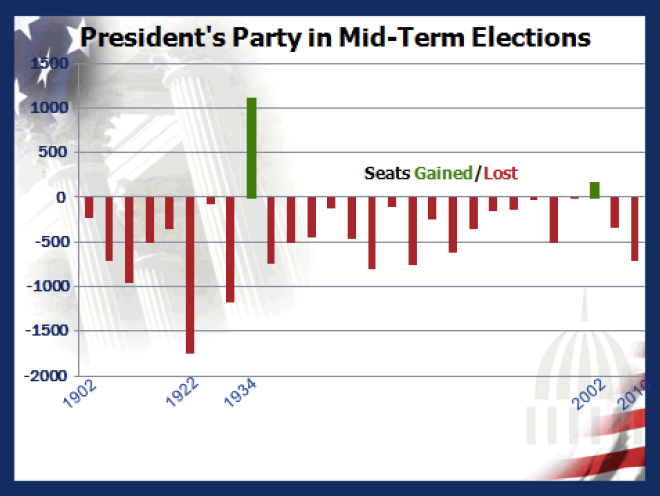
Midterms Local

Cillizza looks at how the midterms might impact state legislators:

It turns out that the six-year itch is even more devastating at the state legislative level, which, as we documented in a post late last week is a critical piece of the political and policy equation for both parties nationally.  Check out this chart, courtesy of the National Conference of State Legislators, to grasp just how daunting the history of second term, midterm elections are for the president’s party at the state legislative level.

When Press Is The Best Protection

Masha Gessen feels that the American gay rights movement failed the Russian LGBT activists who protested during the games:

These brave Russian activists came out to protest because they thought that the eyes of the world were fixed on them that day and that their American activist allies in Sochi would support them by word and deed, staging their own protests and ensuring that the thousands of international correspondents in Sochi would hear of their protest and the treatment they faced. They were wrong. Their American allies watched the opening ceremony, socialized with Team U.S.A., and visited the famed Sochi gay bar. Their American allies failed them.

Why the lack of publicity matters:

First and foremost, working with LGBTQ activists in Russia has to involve ensuring that their names and their individual arrests and court hearings are well-publicized in the Western media. It also means ensuring that their fines are paid: The point of those extremely high fines is to open the way for further prosecution for nonpayment. Only if Russian authorities know that the world is watching the specific individuals they are targeting will the LGBT activists on the ground be relatively safe—which is to say, alive and unlikely to face long prison sentences in the near future.

The Imperfect Science Of Justice

Balko brings us the latest on Shaken Baby Syndrome:

New research suggests that most humans aren’t capable of shaking an infant hard enough to produce the symptoms in SBS. It usually takes an accompanying blow to the head. And in about half to two-thirds of the 200 or so SBS cases prosecuted each year in the U.S., there are no outward signs of physical injury. Indeed, this is the reason SBS is such a convenient diagnosis. It allows prosecutors to charge a suspected abuser despite no outward signs of abuse. But we now know that other causes can produce these symptoms, which means that some percentage of the people convicted in SBS cases are going to prison for murders that may have never happened.

He contrasts this SBS research with DNA testing:

The blood or semen or hair either matches the defendant, or it doesn’t. It will show that either the defendant raped or murdered the victim, or that someone else did. Things get murkier when the question isn’t who committed the crime, but if a crime was committed at all. The new research into SBS doesn’t state definitively that without external injuries, a child couldn’t have died from shaking. It suggests only that there are other possibilities—that shaking wasn’t the only possible cause of death. It isn’t an advance in science that will produce dispositive exonorations. It’s an advance that merely calls prior convictions into question.