Why The Kansas Bill Backfired

New polling out of Kansas helps explain it:

PPP finds that Kansas voters are overwhelmingly opposed to the proposed bill in the legislature that would let businesses refuse service for same sex couples. Only 29% support it, compared to 59% who are opposed. The opposition to the bill is bipartisan with Democrats (13/80) and independents (24/61) overwhelmingly against it and even Republicans (40/44) narrowly so.

At the same time support for legalizing gay marriage has increased a net 8 points over the last year and now 44% of voters favor it to 48% who are opposed, compared to a 39/51 spread last February.

Maybe this is the moment when the over-reach became too obvious to ignore. But then I’ve thought that before in the past, and it keeps getting worse.

The Tiger Gets Hungrier

INDIA-ANIMAL-TIGER

For a long time now, the Republican party has essentially decided to ride the tiger of right-wing extremism to electoral victories and total Washington gridlock. The real action on the right side of the aisle has been on the far right, with each new anti-Obama movement and eruption out-doing the last in terms of upping the ante. Shock-jocks have defined the message, aided and abetted by key leadership figures. And so, in the latest manifestation, we have the former vice-president, Dick Cheney, telling Sean Hannity the following last night:

They peddle this line that now we’re going to pivot to Asia, but they’ve never justified it. And I think the whole thing is not driven by any change in world circumstances, it is driven by budget considerations. He would much rather spend the money on food stamps than he would on a strong military or support for our troops.

So a former vice-president is out there, saying the president prefers to spend money on food stamps than on “support for our troops.” He could have made an argument why he thinks we should maintain the stratospheric levels of defense spending that have been in place since 9/11; he could have argued that the US needs to maintain the ability to fight two major land wars simultaneously in perpetuity. He could have said a lot of things. But he decided to accuse the commander-in-chief of not supporting the troops and actually wanting to keep people in poverty. There is this belief out there that Republican extremism comes from the base and not the elites. But Cheney proves otherwise.

Now we get the extreme religious liberty bills across the country that are clearly a function of gay panic among fundamentalists and a decision to capitalize on it for electoral gain; we have a Republican lobbyist pulling a publicity stunt by drafting a law to ban gay players from the NFL; we have a state senator, using sarcasm in such a way as to describe mothers as “hosts” of unborn children; we have gubernatorial candidates proudly campaigning with a man who called the president a “subhuman mongrel”; and the list goes on and on:

attempting to make contraception illegal (North Carolina), requiring sonograms and their images of fetuses to be presented to women seeking abortions (several states), advocacy of secession (Colorado and Texas), making enforcement of federal laws regarding guns a crime (Missouri), adopting a tax code that puts a greater burden on the poor and middle class while advantaging the rich (North Carolina and Kansas), mandating photo identification for voting while making the availability of those IDs only in Department of Motor Vehicle offices where the non-driving majority of those without IDs never go (a number of states), refusing federal funds for expanding access to Medicaid for millions who need such access and protection (21 states, all with Republican governors) and, attempting to mandate the teaching of “creationism” in schools (several states).

Now, it’s true that some kind of pushback seems to have begun.

Nugent felt obliged to apologize; McCain is now against the Arizona law that puts religious liberty on steroids; the Chamber of Commerce has tried to push back on the more extreme Tea Party candidates. But the truth, it seems to me, is that the kind of cost-free extremism fostered by Fox News and Jim DeMint and Sarah Palin has a logic and momentum all its own. And at some point, a party that seems increasingly defined as angry, contemptuous of the president, constantly rabble-rousing (Jindal yesterday) and hostile to immigrants, gays, Latinos, African Americans and women will become so tainted in an increasingly diverse, pluralistic and multi-racial society it may take a generation to recover. Right now, there seems little cost to continuing to ride the tiger of senior rightwing rage – as the GOP looks confidently toward the mid-terms. The checks on it, however welcome, seem tactical and defensive rather than structural and positive. The lack of any unifying, multi-cultural message is gaping. Until these problems are more deeply addressed, until someone is capable of tackling them with clarity and reformist urgency, an entire generation may be lost to the left.

For Obama to win them over is one thing; for the GOP to tell the younger generation to get lost is quite another.

(Photo: Noah Seelam/AFP/Getty)

Medical-Grade Merde

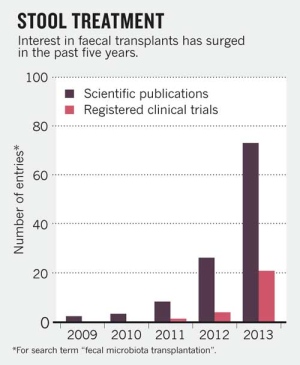
According to an op-ed in the latest issue of Nature, the FDA should rethink its classification of feces as a drug. Christine Gorman elaborates:

Stool-2Fecal transplants have become increasingly important over the past few years as a way of  basically taking the healthy gut bacteria out of one person and putting them in another person whose own gut bacteria are deficient in some way. … Currently, the FDA has given fecal transplants a kind of waiver from some of the stricter rules that govern the development and testing of medications. But that’s only as long as the treatment is used strictly for C. difficile infections, which cause debilitating gastrointestinal problems and are not otherwise easily curable. Many physicians and patients would like to know if the therapy could be made to work for other bowel problems – such as Crohn’s disease.

But the stricter FDA rules would make it harder to test fecal transplants for no good reason.

Regulating fecal transplants like other tissue products would still keep patients safe, the [Nature] authors argue. And it would undoubtedly keep the cost of treatment lower than would otherwise be possible if some large company with deep pockets had to undertake the sorts of tests that would need to be done to approve fecal transplants as if they were drugs. After all, if there’s something we have a lot of in this world, it’s poop.

Among other things, the researchers worry that people will make themselves sick with DIY transplants:

Websites explaining how to do fecal transplants at home are becoming common, they point out, but patients who pursue this outside of medicine cannot be protected from diseases transferred with the gut contents, or from injuries if the transplant is done badly.

Previous Dish on fecal transplants here and here.

(Graph from Nature)

Trade Deals Are Tricky

Banyan has a primer on the Trans-Pacific Partnership negotiations:

Some analysts fear that the compulsion to get the deal done may result in a lowest-common-denominator agreement, whereby each country’s sacred cows are respected and the potential benefits (estimated at nearly $300 billion a year to global income) squandered in advance.

That risk may have increased following the biggest of the many setbacks TPP has suffered recently: it now seems highly unlikely that Barack Obama will persuade Congress to grant him “fast-track” authority (also called Trade Promotion Authority, or TPA), to negotiate trade agreements before the mid-term elections in November (if ever). Without fast-track, agreements can be unpicked line-by-line by Congress, and other TPP countries will be reluctant to sign up.

James Traub looks at the big picture:

The TPP is the Obama administration’s bid to shape an Asia more in America’s image than China’s — which is precisely why it’s the pivot of the Asia pivot.

The traditional objection to trade pacts — and the default position of all too many Democrats — is that they do more harm than good to American workers. But the public-interest critique of the TPP focuses much more on harms that the United States will allegedly be perpetrating upon citizens elsewhere (even though the political representatives of those citizens will have signed the deal). The fear it reflects is a fear of the globalization of U.S. principles. For groups like Public Citizen, one of the most vocal opponents of the pact, the TPP’s hidden agenda is advancing “corporate policy goals, rights and privileges.” The domestic debate over the TPP is thus very largely a debate over the merits of the American economic model.

Noam Scheiber criticizes the priorities of the administration:

What we do know, based on leaked text of negotiations, is that U.S. officials are hard at work on priorities other than U.S. jobs. Many of them look like the priorities of the financial sector, as well as big energy, chemical, and pharmaceutical companies. For example, [Trade Representative Michael] Froman’s team, like the U.S. trade reps that came before him, is pressing to make it harder for countries to restrict the flow of capital across their borders, regulations that helped insulate the likes of Malaysia and Chile from recent financial crises, but which are unpopular on Wall Street. The U.S. negotiators also favor provisions that would make it easier for companies to challenge a variety of financial, consumer, and environmental regulations in foreign countries, and which could help, say, European banks to chip away at Wall Street reform in this country.

Crystal Myth, Ctd

A reader writes:

While the number of methamphetamine addicts in the United States may be overstated, I’m not sure the panic over meth use is overblown because the process of cooking the drug is so incredibly dangerous. Meth production requires toxic and carcinogenic chemicals that contaminate the homes in which the drug is cooked. Repeated exposure to even trace amounts of these chemicals can cause chemical burns, respiratory problems, and even cancer, especially in children. And children are quite likely to be present at places where meth is being cooked – between 2000 and 2005, more than 15,000 children were removed from meth labs across the country.

In places like the Midwest, where most meth is cooked for personal use (rather than in big, Breaking Bad-style super labs), the drug is often synthesized using a “shake and bake” method, in which the ingredients are placed into a 2-liter soda bottle and agitated. If anything goes wrong in this process the bottle can explode and cause horrific burns. For example, according to the Missouri Foundation for Health (pdf), 30% of the burn units in Missouri are dedicated to treating uninsured people injured while cooking methamphetamine – despite the fact that only .3% of the population of Missouri is estimated to be using the drug at any particular time.

As long as the effects of meth production have such an negative impact on its users and on the environment, it will remain a health crisis, regardless of the actual number of addicts.

Update from a reader:

That “30% of the burn units in Missouri are dedicated to treating uninsured people injured while cooking methamphetamine” number is pretty shocking, but is highly misleading: (1) the 30% is of “burn unit beds”, not ‘burn units’ as a whole; (2) the statement was “regionally,” not “Missouri-wide”—which would imply in the St Louis metro, given the cited author’s roll at a St Louis-area sheriff’s department; (3) According to Ameriburn (pdf), there are 36 non-pediatric burn-unit beds in the St Louis region; (4) so, we’re talking about 10 beds.

The Biological Basis Of Metaphors

Tom Bartlett reports on a relatively new area of inquiry:

Research on embodied cognition – the idea, basically, that the body strongly influences the mind in multiple ways we’re not aware of (though not everyone agrees with that definition) – is a fairly new field, and in the last few years it has produced a number of head-scratching results. For instance, there’s the 2009 study that seems to show that people holding heavy clipboards are more likely to disagree with weak arguments than people holding light clipboards. Or the study, also published in 2009, that found that people gripping a warm cup of coffee judged others as having a “warm” personality.

Another study indicated that that people who like sweet foods are more likely to volunteer – or as Bartlett puts it, “They were metaphorically sweet people who loved actual sweets”:

That finding hits on one of the underlying ideas of embodied cognition – that is, that the metaphors we toss around are grounded in more concrete, physiological truths. Warm things make you physically and psychologically warmer. Cold things make you feel more alienated. Sweet things make you sweeter, and liking sweet things means you behave more sweetly.

Now there are plenty of people, including some psychologists, who are skeptical about some of those results. I wrote about the critics of John Bargh’s research – he did the coffee-mug experiment – in an article last year. And a study that purported to show that people were more generous after riding an “up” escalator was shot down by Uri Simonsohn, an associate professor of psychology at the University of Pennsylvania and a dry-witted crusader against suspicious statistics. (The Dutch researcher who did the escalator study, Lawrence Sanna, later resigned.) But that doesn’t mean embodied cognition as a whole is wrong, of course.

The Blue Code Of Immunity

“Professional courtesy” among police officers refers to the idea that cops should not arrest or ticket other cops for traffic violations. Balko explains how this custom leads to miscarriages of justice and invites serious corruption:

Police officers who fail to extend professional courtesy to fellow officers can face ridicule, shaming and other retaliation. It’s an extension of the “Blue Code of Silence,” the informal admonition that cops refrain from implicating other cops. Several years ago there was even a Web site called “Cops Writing Cops” which provided a forum for police officers to publicly shame fellow cops who had the audacity to ticket them. (The site has since been taken down.) A 2007 Seattle Post-Intelligencer study revealed that off-duty cops put stickers in the windows of their private vehicles to identify themselves to their fellow officers. And then there are outfits like “LEO Pro Cards,” a business that prints up handy, wallet-sized cards that cops and their family members can flash to request professional courtesy from other officers. …

You’ll often see the tradition defended as just a small, insignificant gesture between professionals who share a tough job. But if anything, cops should be held to a higher standard than everyone else. They are after all given the considerable power to arrest, detain and kill. Once cops start letting other cops off for traffic offenses, you begin to instill in some police officers the idea that they’re less beholden to the law than the average citizen, not more. It isn’t difficult to see how that could set the stage for more consequential corruption.

The Negative Side Of Positive Thinking

Adam Alter explains:

According to a great deal of research, positive fantasies may lessen your chances of succeeding. In one experiment, the social psychologists Gabriele Oettingen and Doris Mayer asked 83 German students to rate the extent to which they “experienced positive thoughts, images, or fantasies on the subject of transition into work life, graduating from university, looking for and finding a job.” Two years later, they approached the same students and asked about their post-college job experiences. Those who harbored positive fantasies put in fewer job applications, received fewer job offers, and ultimately earned lower salaries. The same was true in other contexts, too. Students who fantasized were less likely to ask their romantic crushes on a date and more likely to struggle academically. Hip-surgery patients also recovered more slowly when they dwelled on positive fantasies of walking without pain.

Heather Barry Kappes, a management professor at the London School of Economics, has published similar research with Oettingen. I asked Kappes why fantasies hamper progress, and she told me that they dull the will to succeed: “Imagining a positive outcome conveys the sense that you’re approaching your goals, which takes the edge off the need to achieve.”

I wonder if she’s analyzed a few neoconservatives along the way.

The Vanilla Icing Of Rap, Ctd

A reader writes:

I’m not saying the white boy you posted doesn’t have skills, but the alphabet rapping concept, including progressive acceleration, was done a long time ago by Blackalcious [see above]. I’m more okay with white boys having their place in hip hop if they bring their own perspective and style to the table, like The Streets for example.

Another points to a true original:

A white (as in, albino white), legally blind, Muslim rapper from the Midwest: Brother Ali. He’s been, at times, inspiring to those who are perceived as different (a song called Forrest Whittaker); at times controversial (Uncle Sam, Goddamn); and, always, pretty intelligent and insightful (Dorian, about confronting his physically abusive neighbor, and Travelers, about slavery, African plight, and cultural repercussions for acting so immorally then). He’s not for everyone, but he is very talented.

This freestyle by Brother Ali is pretty amazing: