When Love Bids You Welcome

Miranda Threlfall-Holmes credits the 17th century poet and Anglican clergyman George Herbert for converting her to Christianity:

[Herbert’s] poems are, in effect, a spiritual autobiography. Although they are not individually dated and so cannot be directly related to different phases of Herbert’s life, dish_herbert many of them clearly describe his intensely personal struggles with faith and calling. Even those that are more formal explorations of particular religious doctrines or concepts have a similar air of spiritual authenticity. There are no mere statements of dogma. The poems record the poet’s own doubts and faith in a way that still rings true with many readers, even those with no explicit faith of their own. …

They are also full of genuine emotion. This makes them feel much more modern than their date would suggest. For Herbert, religion is never simply a set of dogmatic assertions, or a collection of cultural practices, as historical religion is sometimes caricatured. Nobody reading these poems can be left in any doubt as to Herbert’s emotional engagement with his subject matter. The question Herbert’s poetry raises is eternally contemporary. The poems don’t ask us “Is this true?” but “How do I feel about this?”

It is this question that slipped under my guard as a teenager. It was easy to dismiss the truth of the 20 impossible things that religion seemed to expect me to believe before breakfast. It was much harder to dismiss my own emotional reaction to these poems: the beauty, the yearning, the enticing danger. They left me with the sense that I was standing on a cliff, staring out to sea, hearing marvellous tales of lands beyond the horizon and wondering if they were, after all, just fairy tales or whether the intensity with which the tales were told was evidence that the teller had indeed seen a barely imagined kingdom.
Previous Dish on Herbert and his poetry here, here, and here.

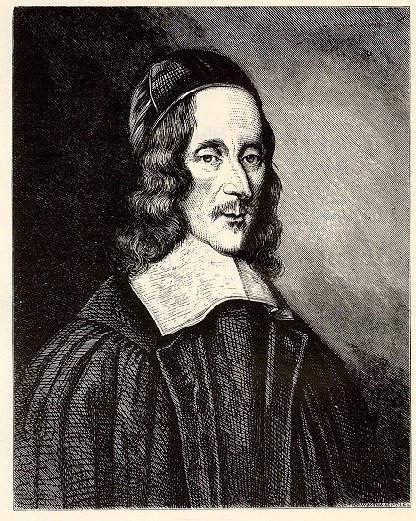
(Image of portrait of George Herbert by Robert White, 1674, via Wikimedia Commons)
Thinking Inside The Box

confessionbox

The confession box, in which Roman Catholics admit their sins to a priest, often separated by a screen or lattice, was an innovation of the 16th century Church. In an interview about his new book, The Dark Box: A Secret History of Confession, John Cornwell describes the impact it had on Western understandings of the self:

Confession in the box had an amazing shaping effect on the way that people thought about themselves. It helped foster a very private, and very modern, sense of interiority and guilt, and even new ways of articulating ideas about the body and sexuality. There’s a new focus on the idea of intention, too…. You go into the dark box, deep into your disembodied soul, and consider the degrees of intentionality in your actions. The emphasis is on the private rather than the public nature of sin.

He also highlights its connection to a more nefarious development – the Catholic sex abuse scandal:

Many priests in the wake of the scandal have admitted to using it as a way of grooming and testing children for their vulnerability.

This is something that the great John Jay Report, on pedophile priests, which was done in the US in the early part of the last decade, missed out on. They didn’t see the importance of confession. That’s why I think my book is important in an investigatory sense. I’m bringing that out. The statistics in the report show that a third of all of the crimes of abuse occurred in a confessional setting. … The interesting thing is that from the late 1950s, when all of this started to rise, to the mid 1980s—this was the period in which priests were going outside the box. So you get confession as something that takes place in the privacy of a priest’s room, or in the sacristy, or in his car. But something else happens that is very important: Many priests squared the circle of their offending lives and their pastoral lives by going to confession themselves. There you have the morally weak aspect of confession: this belief that you can commit terrible sins and then go and get them washed away…. There was a case in Australia not so long ago when a priest on trial admitted that he had confessed to sexually attacking children 1,500 times. He’d confessed it 1,500 times!

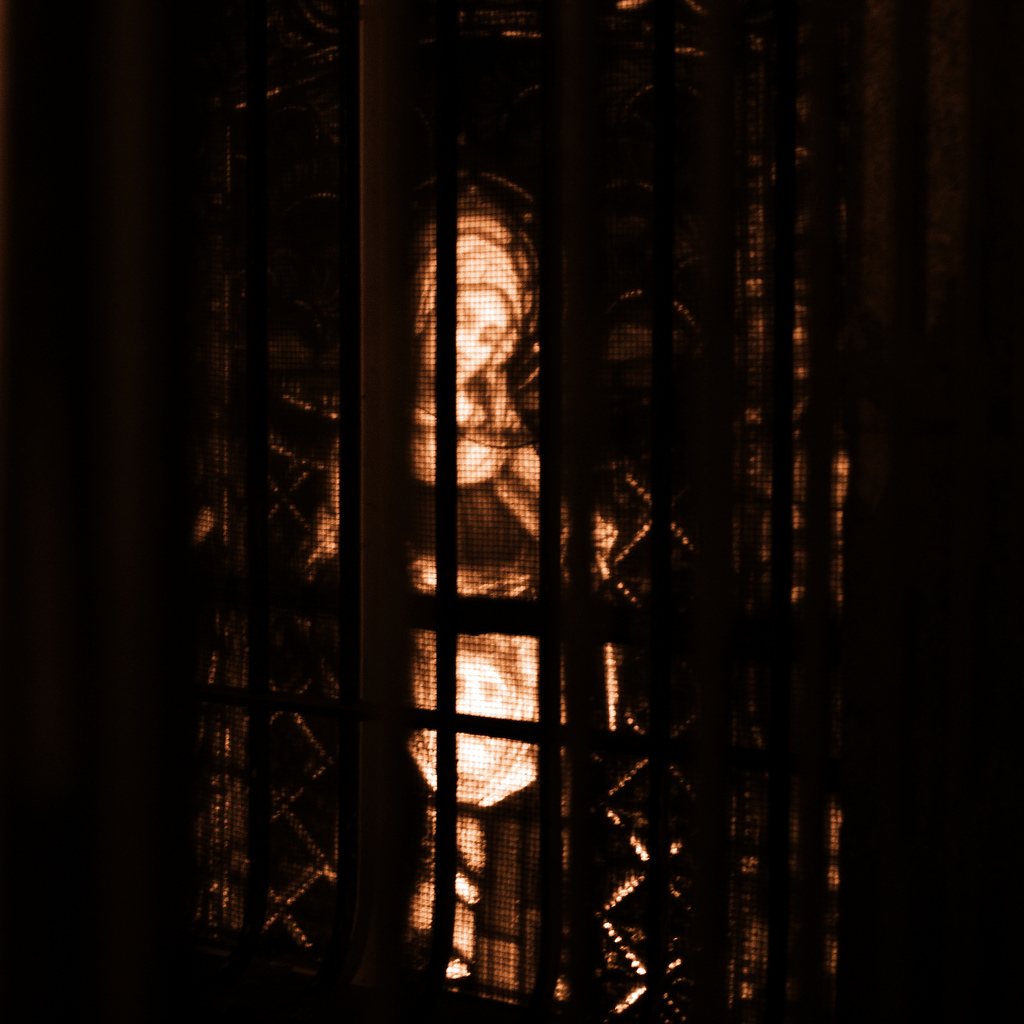
(Photo through screen of a confession box by Angie Chung)

Apathetic Atheism vs New Atheism

Thomas Wells explains why he rejects the atheism of Dawkins and Dennett:

The fundamental problem with all this is that the new atheists accept that religion is important enough that it matters whether one has the right or wrong beliefs about it, and have specific views about what religious beliefs one should hold. What separates them from me is that I don’t consider religion worthy of rational dissent, and I don’t consider that true freedom from religion would require me to rationally justify my lack of belief or interest in it. Of course god doesn’t exist. So what?

There are many supernatural things that some people believe in that I don’t, including Santa Claus, UFOs, crop circles, witches, ghosts, homeopathy, gods, fairies, and astrology. I see no particular reason to select out my non-belief in gods from that list of non-beliefs for special attention and justification. I see no no more reason to describe myself as an atheist, than as an afairieist, ahomeopathist, etc. To put it another way, my non-belief is apathetic: the nonexistence of God/Gods is a matter of great insignificance to me.

Update: Read the thread prompted by this post here.

What Porn Addiction Crisis?

Psychologist David Ley recently published a paper on the topic:

If there is so little empirical evidence for porn addiction, why has it become such a popular and widespread concept?

We put forth three reasons. One is that it is an easy answer. It is an easy answer and an easy scapegoat in a society and a media that applies the concept of addiction to any overuse of anything. Secondly, it is a cultural control of sexuality, and particularly the forms of sexuality that are now widely available and difficult to control due to modern technology. There is the old saying “don’t give away the milk away for free because nobody will buy the cow” as a way of controlling sexuality. Well, porn, and Internet porn in particular, doesn’t just give away milk, it puts it in a high-speed faucet right in your room. That is concerning to society, to people in relationships, because it represents a significant loss of control of sexual expression and experience.

Lastly, and this is one of the ones that is gonna be controversial, there is a large, lucrative industry that experiences tremendous secondary gain from the promulgation of this concept. As part of this paper we had a grad student call porn addiction facilities around the country and get an idea of the cost — and the costs were extraordinary. The average was $675 a day. These facilities were recommending or requiring stays anywhere between 15 and 90 days. Insurance doesn’t pay for this; it is cash only. The other thing that is really troubling is that there is no data to show that these very expensive programs generate positive results. There is an industry — and unfortunately I count the media in that as well, because the media makes lots and lots of hay by touting the issue ofporn addiction, and even by raising the controversy of “is it real or not?” There is a lot of money to be made in keeping this thing alive.

High-Tech Sex

A NSFW video demonstrates virtual sex:

When Brian Merchant got a visit from Japanese sex toy company Tenga, he found their robot-assisted virtual sex program “more creepy than erotic”:

Ugh. In terms of function, it was pretty accurate; the robotic sex arm synched up with the virtual sex arm on screen.

“The physical dimensions of the Tenga were narrow, which matched the avatar I was virtua-bangin’,” [Merchant’s colleague Dan] Stuckey said. “I wonder if you’re stuck with the same controller though. What if you’re interested in someone else?”

Still, it’s not hard to imagine a future where someone puts all the pieces together and this kind of thing works seamlessly.

Meanwhile, Daniel Engber is disappointed with “the failed promise of 3-D porn”:

“The main problem is there aren’t a lot of 3-D TVs out there. That’s the biggest hold-back,” [adult-industry reporter and erotic 3-D photographer Mark] Kernes argues. But there are other problems, too.

For one thing, the studios had convinced themselves that 3-D DVDs could not be ripped and spread online. Having lost half its business to freebie websites since 2005, executives sought safe harbor in a new video format. But content pirates were not deterred. “The way it was sold to me is that you can’t torrent a 3-D movie,” says porn journalist Gram Ponante, “and of course that’s not true.” Shooting on This Ain’t Avatar took a full week, more than twice the time it takes to shoot most conventional sex films, but the movie sold just 6,000 units, Ponante says, barely enough to make back its production costs. (Ten years ago, the best-selling porn films would sell about 60,000.)

The same occurred in mainstream soft-core. In 2010 Piranha 3D made a $60 million profit on topless ultra-gore and a dismembered penis flying off the screen. The sequel,Piranha 3DD, was released in 2012 and grossed just $375,000 in the U.S. An erotic import from China, 3-D Sex and Zen: Extreme Ecstasy, got lots of credulous press in 2011 for being the “world’s first ever 3-D porn film” (it wasn’t), but failed to sell that many tickets. And last week saw the release in theaters and streaming video of the latest tent-pole 3-D smut: Nurse 3D, the story of a man-killing, girl-kissing, clothes-not-wearing serial killer whose exploits are somehow neither sexy nor fun.

A Journey, Not An Escape, Ctd

Christine Sismondo traveled to the Peruvian rainforest to try ayahuasca, a brew with an active ingredient, dimethyltryptamine or DMT, “that, some claim, can cure illness and addiction, help people gain insight into primary relationships and, for others, offer glimpses into the origin of life.” She describes her own experience ingesting and then purging the drug:

For the next two hours, I felt better than I have – maybe in my whole life. It was like my body had never experienced stress – ever. Gravity was about half as strong as usual. My spine straightened. I listened to the songs and watched shapes form in the trees. I saw friends, Day of the Dead-like images, and, I’m pretty sure, President Taft. I thought thoughts – the kind you don’t really spend a lot of time thinking about in everyday life. Nothing profound. Mostly platitudes about how to have a better life and be a better person. But I felt those platitudes profoundly. This will be disappointing to those who want to hear about aliens and divine beings, I’m sure. I think I saw a third eye image at one point, but I’m also pretty sure I saw Donald Duck. My husband saw a geisha. He, incidentally, took a second dose, and never felt nearly the range of highs and lows I did.

did feel two things that are more on the esoteric side that I was genuinely surprised about. First, I felt, viscerally, for the first time in my life, that stress was a choice and that I might be able to eliminate it. Call it mind-body stuff or, as I prefer, stoicism, I could finally see a path wherein I could exercise some more power over my reactions to things.

Finally, I felt, also for the first time, a sense that the rainforest was a living, breathing thing. That’s obvious, I realize. But I felt the power of the place and even the plants in a non-intellectual way. I can’t explain it perfectly, but I felt I had honestly drunk the spirit of the vine. I didn’t come home with a new plant-based religion or anything. But I feel more like I understand how important it might be to save this sacred, pre-modern place, by patronizing it – or however we can.

Previous Dish on ayahuasca here and here. Further coverage of psychedelics here.

How Long Do You Go?

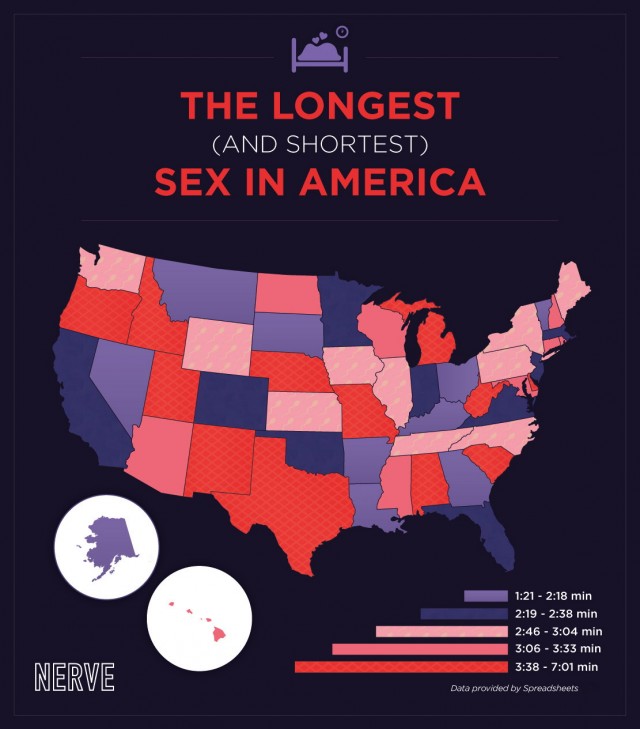
dish_sexmap2

Kate Hakala captions:

The Spreadsheets App, a mobile app that uses your phone’s accelerometer and speakers to provide statistical feedback about your duration, thrusts, and decibel peak, is taking big data to the bedroom. … Spreadsheets shared the stats of its 10,000 early adopters so we could investigate who has cross-country endurance and who’s a one-minute wonder. Averaging the intercourse time of all users in the United States (the app doesn’t cover foreplay), we’ve provided a ranking of duration in minutes for all 50 states and the District of Columbia as a little bonus. While finishing times of under three minutes may surprise you, remember that these are just the averages among two-pump chumps and Lotharios alike. Besides, previous research has shown that, despite the hubbub about hours-long tantric sessions, intercourse itself usually only lasts for about 3 to 13 minutes.

New Mexico had the longest average duration (7:01), and Alaska the briefest (1:21).  Check out the full list of rankings here.

An Algorithmic “Assault On The Novel”

Tristano, an experimental novel based on the legend of Tristan and Isolde, was way ahead of its time:

First published in Italy in 1966, it has only been in the last decade that digital technology has made it possible for Tristano to be printed as its author Nanni Balestrini intended. Each of its ten chapters has fifteen pairs of paragraphs, arranged differently by an algorithm in each published copy. These are numbered on their covers by Verso Books, who have issued four thousand of its possible 109,027,350,432,000 variations in English for the first time.

In his foreword, Umberto Eco – a member of Italy’s Neoavanguardia movement with Balestrini and others, founded in 1963 – suggests that “originality and creativity are nothing more than the chance handling of a combination”. … Eco suggests several ways to approach Tristano: by reading a single copy and treating it as “unique, unrepeatable and unchangeable”; or “considering it to be the best … possible” version; or by reading several and comparing the outcomes.

Lizzy Davies elaborates on the project:

The first versions were published in Italy in 2007, and subsequently in Germany. Before the English-language editions, 10,000 copies were in circulation. Each has 10 chapters with 20 of a possible 30 paragraphs in different orders, with the paragraphs within the chapters also shuffled. “And from these two rules,” says Balestrini, “comes this number of millions, millions, millions of possible copies.”

When it was published in 1966, Tristano – named in an ironic homage to the hero of the Tristan and Iseult legend – was already an experimental hodgepodge. Needless to say, its digitally-reordered descendants are not novels- let alone love stories- in any traditional sense. Verso describe the book, in fact, as a “radical assault on the novel”; for Balestrini, it is a literary work- but also “a game” into the spirit of which the reader, if he is to appreciate it, must enter.

Holly Baxter wonders if the novel is “just an incredibly astute marketing ploy”:

At its core, as the foreword by Umberto Eco states, Tristano celebrates “an elevated number of possible outcomes”. Its beauty then is in the fact that, like a real life love story, you’ll never quite know what is going to happen. But is this romance, or is it just a kind of extension of the infinite monkey theory? In all honesty, I struggle to see this novel, which is also the anti-novel, as anything more than contrived.

Meanwhile, Brendan C. Byrne considers the novel in the context of other experimental literature:

Tristano is still, at least nominally, a novel, one where the voice and temporality can change not only every line but within every line. … It is tempting to compare Tristano to hypertext fiction, which seems to be undergoing something of a resurgence with Twine, an open-source tool for telling interactive, non-linear stories. And both do indeed seem to be interested in extracting and making visible the “rules” which govern modern and post-modern lit, breaking narrative down into its consituent elements. However, hypertext fictions places great value on “exploring” the possible sequences of these elements, while each iteration of Tristano is fixed, concrete. The computer has already explored; we merely have the path.