The Psychology Of Trolling

Trolls

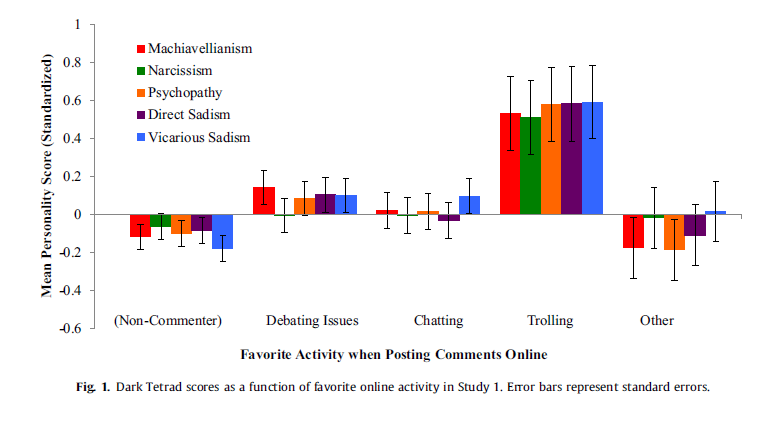
A study of Internet trolls finds that they are often Machiavellian sadists:

The research, conducted by Erin Buckels of the University of Manitoba and two colleagues, sought to directly investigate whether people who engage in trolling are characterized by personality traits that fall in the so-called “Dark Tetrad”: Machiavellianism (willingness to manipulate and deceive others), narcissism (egotism and self-obsession), psychopathy (the lack of remorse and empathy), and sadism (pleasure in the suffering of others).

It is hard to underplay the results: The study found correlations, sometimes quite significant, between these traits and trolling behavior. What’s more, it also found a relationship between all Dark Tetrad traits (except for narcissism) and the overall time that an individual spent, per day, commenting on the internet.

Digby chimes in:

If you are a person who has spent any time online over the past few years, this is self-evident. There is little doubt that internet trolls, whether in comment sections or on twitter or forums, are psychopaths of some form or another. What’s always interested me more than that obvious observation is how otherwise normal people sometimes turn into such trolls when they feel marginalized or misunderstood. For some it’s clearly a very short trip from being a regular person just mixing it up for entertainment and becoming an internet terrorist. For others the journey is more circuitous. But I suspect that many of us could get in touch with an inner Dark Tetrad given enough time crawling around the fetid fever swamps of internet argument. I’ve seen it happen.

Techno-Pessimism

Robert Gordon’s new paper casts doubt on our impending technological utopia:

This time Gordon  takes aim at the so-called techno-optimists, such as the authors of the new book “The Second Machine Age,” [Erik Brynjolffson and Andrew McAfee,] who claim that technological growth is accelerating.

Gordon disagrees, saying that we shouldn’t expect technology to dramatically improve economic performance over the coming half-century. In fact, he argues that the productivity slowdown began long ago, in essence because the wide availability of computers or cell phones still is not nearly as transformative for society as electricity or cars have been.

While real U.S. gross domestic product grew at an average of 2 percent pear year, Gordon estimates the pace will be much slower over the next 50 years. That’s because the economy faces four key headwinds: the retirement of the baby boomer generation; stagnating educational attainment; inequality; and rising national debt. Together, he argues, these trends will deplete — and have already begun to deplete — the pool of educated workers with higher incomes to spend, dampening growth.

Cowen agrees with much of what Gordon says but criticizes the paper’s short-sightedness:

There is a key passage on p.26: “My forecast of 1.3 percent annual total-economy productivity growth in the future does not require any foresight beyond suggesting that the past 40 years are a more relevant benchmark of feasible productivity growth than the 80 years of before 1972.”  Fair enough, but how about looking at the last 120 years or last 120,000 years for that matter?  The overall pattern is lots of pauses, followed by eventual new bursts of progress.  That’s no proof of a future subsequent burst of progress, but so far history is not on the side of the long-term tech pessimists.  It may be on the side of the short-term tech pessimists, at least for a while.

Drum is less charitable:

This is an embarrassingly bad argument. I can somehow imagine a circa-1870 version of Gordon arguing that all this folderol about electricity is ridiculous. Why, we’ve been studying electricity for over a century, and what do we have to show for it? Some clunky batteries, the telegraph, a few arc lamps with limited use, and a steady supply of techno-optimist inventors who keep telling us that any day now they’ll invent a practical generator that will replace steam engines and change the world. Don’t believe it, folks.

Yglesias points out that predicting the technological future is a fool’s errand:

[M]ore computing power will be added during the next two-to-three-year doubling cycle than has been added in the entire history of computing. And then that’s going to happen again. Unless you think about it in the correct exponential terms, you’re going to massively underrate the likely gains in the future. As it happens, I agree with Gordon that self-checkout technology is not incredibly promising but that’s because it addresses an uninteresting problem. What if you could automate grocery delivery? Or what if “the Internet of things” let you just put a bunch of stuff in your bag, walk out of the store, and then automatically have the cost tallied up and charged to your credit card? That’d be cool.

Matthew Klein compares Gordon’s vision of the future with that of the “techno-optimists”. His bottom line:

It’s hard to make the case that the ability to share the results of personality quizzes on social networks is a significant boon to humanity, but only a fool would deny the potential of driverless cars to improve the lives of commuters, to say nothing of the tens of thousands of lives that might be saved from traffic accidents.

The truth is that no matter who is right, growth of a few percent in gross domestic product each year can produce amazing progress after enough years. Instead of worrying about these long-run issues, which may never materialize, maybe we should ask our economists to focus on the problems that need fixing today.

Meanwhile, Freddie deBoer takes on Brynjolfsson and McAfee’s optimism about the rise of the machines:

Millions of people now have a printing press, reference library, school, and computer all at their fingertips. The number of them who do the things that the authors of this piece want people to do fits comfortably in a rounding error. When books ceased to be hand-copied by monks in monasteries, books stopped being the purview of the aristocratic and clerical elite, and yet most of the world’s population remained illiterate for hundreds of years. When televisions became ubiquitous, people wrote breathless pieces arguing that they would give all students the same skills as those taught in the most expensive schools, and yet the vast inequalities in our education system only deepened. And since I was in high school, we’ve been cramming internet-enabled computers into our places of learning, and arguing against evidence that the inevitable result would be the rapid democratization of knowledge and creation. We have seen nothing of the kind, and we have no satisfactory reason to believe that this will change in the coming days ahead. It’s great that you can go on Wikipedia and use it write your own blog. Most people are not doing even that, and that is a far cry from the absurd revolutionary utopianism of this piece and hundreds more like it.

Previous Dish on Brynjolfsson and McAfee’s book here and here.
The Punishing Paralympics

With the other Sochi games just a few weeks away, Drew Nelles spotlights the high-intensity and sometimes brutal world of sled (or, for Canadians, “sledge”) hockey:

Sledge hockey, invented in Sweden in the ’60s, is played by people with lower-body disabilities such as leg amputation, paraplegia, or partial paralysis. The rules are almost identical to those of traditional hockey, which sledge players call “stand-up.” However, because the athletes can only use their arms for propulsion, puck handling, and shooting, the sport is in many ways more physically demanding. It is played full contact, although T-boning another player with one’s sledge is illegal. “A lot of guys use those metal picks on the end of the stick to stab guys,” says Greg Westlake, the twenty-seven-year-old Team Canada captain. “I’ve had stitches. I have scars all over my rib cage. I wouldn’t say it’s necessarily a more physical game, but it might be a dirtier one.”

Totalitarianism Is A Young Man’s Game

Christian Caryl notes that, while young people are often the drivers of modern revolutionary movements, “that doesn’t automatically make them ‘progressive,’ and it certainly doesn’t mean that they’re democrats”:

The radical political movements of the twentieth century understood this very well. Both the Fascists and the Bolsheviks placed young people squarely at the center of their deeply illiberal programs. These totalitarians, knowing that the young were their natural allies in the fight against the old order, offered them quick access to power and careers — and the young were generally happy to accept. (And yes, both the Soviet Communists and the Nazis were “tech-savvy,” avidly embracing new technologies like radio and the movies, and capable of ferocious innovation in the realms of social policy and warfare.)

If we were to pick the most influential youth movement of the twentieth century, measured by sheer numbers and actual political effect on the lives of others, the title surely belongs to the Red Guards of Mao Zedong’s Cultural Revolution. When the Great Helmsman gave them official sanction to take bloody revenge on teachers, bureaucrats, and in some cases their own parents, millions of young Chinese responded with enthusiasm, unleashing a mass paroxysm of violence that remains without equal.

Uploading The Past Into The Present

“The Internet has muddled the line between past and present,” argues Paul Ford:

Pick any historical subject and the Internet will bring it to life before your eyes. If you’re interested in vaudeville, you’ll find videos galore, while college football scholars can browse Penn State’s 1924 yearbook, complete with all the players’ names and positions. And every day, more history keeps washing up. Not long ago the news went out that a Philadelphia woman named Marion Stokes had recorded 140,000 VHS tapes of local and national news from 1977 to her death in 2012. Her collection has been acquired by the Internet Archive, and soon it will trickle onto the web. [A similar compilation of old network news bloopers is seen above.]

This omnipresence of the past has weird effects on contemporary culture.

Take any genre of music, from death metal to R&B to chillwave, and the cloud directs you not just to similar artists in the present but to deep wells of influence from the past. Yes, people still like new things. But the past gets as much preference as the present—Mozart, for example, has more than 100,000 followers on Spotify. In a history glut, the idea of fashionability in music erodes, because new songs sit on the same shelf as songs recorded five, 25, and 55 years ago, all of them waiting to be discovered. In this eternal present, everything can be made contemporary.

Relatedly, Ted Scheinman appreciates the vastness of online info:

Today we have at least three different ways to follow [Lord] Byron on Twitter and can access facsimiles of certain crucial manuscripts via the Morgan Library. Indeed, each day more and more manuscripts appear on library and university websites, a massive boon for both scholars without one of those blank-check fellowships and civilians curious to see a poet’s hand, and to compare it with unattributed parchment passed down in a commonplace book.

Beyond Byron, whole realms of databases and scholarly communities are making dissertations better, even as they make grad school less lonely. Peter Beal’s Catalogue of English Literary Manuscripts 1450-1700 is appearing in fits and starts, while the Orlando Project at the University of Alberta brings to light hitherto un(der)-read work by women writers whose importance the pre-digital humanities have overlooked. The British Library seems to unveil a new flight of high-resolution images each day, while stateside enterprises, including the William Blake Archive and the Beinecke’s Boswell project, add significant collections annually.

Putting Russia On The Couch

Ioffe psychoanalyzes the country:

There’s something deeply adolescent about modern Russia. Her behavior smacks of the kid with identity issues, who takes out her growing pains on those around her; who withers and bristles in the face of the slightest criticism; who feels superior precisely because she is misunderstood (Russians often quote the famous poem, “The mind cannot comprehend Russia“); who wants desperately to be liked yet cannot keep her advances steady enough before the violent, vocal resentment and fear of rejection come bursting through, killing her chances of acceptance; who angrily, hopelessly yearns for acceptance from those she perceives as the cool kids and resents those who would accept her because if they could accept her, how cool could they really be?

Michael Idov’s take:

For all its protestations of self-sufficiency, Russia is utterly obsessed with how it’s seen in the West. In fact, these two notions are linked in a charmingly adolescent way: The louder the exceptionalist talk about the country’s “special path,” the stronger the curiosity to check how it’s being received. Since the mid-aughts, the Kremlin has been quietly wasting millions on PR firms like Ketchum in order to improve its image abroad; a government-funded news portal exists solely to translate foreign articles about Russia into Russian; and any modicum of success a Russian actor, artist, or writer enjoys in the West is immediately blown out of proportion back home.

Could American Internment Camps Return?

760px-A_young_evacuee_of_Japanese_ancestry_waits_with_the_family_baggage_before_leaving_by_bus_for_an_assembly_center..._-_NARA_-_539959

Seventy-two years ago today, FDR signed an order that ultimately forced more than 100,000 Japanese-Americans to shutter their businesses and abandon their homes. Civil libertarians are observing the anniversary alongside Japanese-American communities across the country:

The Day of Remembrance marks not only the day in 1942 when President Franklin Roosevelt signed an executive order allowing the internment of 120,000 people of Japanese origin after Japan attacked Pearl Harbor; it also serves as “a reminder to our communities – our civil rights are still not protected,” said Karen Korematsu, whose father, Fred Korematsu, famously challenged his detention in the landmark Supreme Court case Korematsu v. United States in 1944. Karen Korematsu cited the NDAA’s indefinite detentions as one attack on civil rights now faced primarily by American Muslims. Among the other issues they say they face are the mass infiltration of mosque communities by law enforcement and harassment by Transportation Security Administration staff at US borders.

Carl Takei shares some family history:

During the war, my grandfather served in a racially segregated US Army artillery unit. Scouts from his battalion were among those who liberated survivors of the Nazi death camp at Dachau. But while my grandfather fought in Europe, my grandmother waited for him in an American concentration camp. With these stories, I grew up with a visceral sense not only of the fragility of our constitutional rights, but also how profound a deprivation of liberty it is to be taken from one’s home and encircled by guards and barbed wire. That awareness is a significant part of why I chose to fight for the rights of prisoners, immigration detainees, and other people deprived of their liberty in the United States.

(Photo: A young evacuee in California waits with family baggage before leaving for assembly center in the spring of 1942. By the Department of the Interior/War Relocation Authority)

Face Of The Day

Almost frozen bear cub under protection

An almost-frozen bear cub found in Alapli, Turkey is recuperating at the Celal Acar Wildlife Protection and Rehabilitation Center in Bursa on February 19, 2014. The young cub is putting on weight by drinking a formula containing milk, protein, honey, salt, and egg yolk. By Ugur Ulu/Anadolu Agency/Getty Images.

Evidence That Gun Control Works?

A new study on the effects of Missouri’s 2007 decision to repeal its background check requirement for gun purchases has found that it led to an increase in gun homicides:

“Coincident exactly with the policy change, there was an immediate upward trajectory to the homicide rates in Missouri,” the study’s lead author Daniel Webster, director of the Johns Hopkins Center for Gun Policy and Research, told the BBC. “That upward trajectory did not happen with homicides that did not involve guns; it did not occur to any neighboring state; the national trend was doing the opposite – it was trending downward; and it was not specific to one or two localities – it was, for the most part, state-wide.”

The analysis of data compiled from the FBI’s Uniform Crime Reporting system controlled for changes in policing, incarceration, burglaries, unemployment, poverty, and other state laws adopted during the study period that could affect violent crime. “This study provides compelling confirmation that weaknesses in firearm laws lead to deaths from gun violence,” said Webster in a release.

The research is not conclusive, but scholars expect it to bolster pro-gun control arguments:

Since this is only a single study, “it’s just suggestive,” warned David Hemenway of Harvard’s School of Public Health. It is “another piece of evidence that is consistent with the bulk of the literature, which shows where there are fewer guns, there are fewer problems… But you want eight more studies that say background checks really matter.”

And the study isn’t perfect:

Missouri also enacted a “stand your ground” law in 2007, creating some challenges in disentangling the effects. But [Duke University gun expert Philip] Cook said he is confident that background checks played a major role because the authors tracked an increase in guns that went directly from dealers to criminals—exactly the scenario background checks are designed to prevent. The study also notes an uptick in guns “purchased in Missouri that were subsequently recovered by police in border states that retained their [permit-to-purchase] laws.”

Gun rights advocate John Lott pushes back:

You can’t do a study like this on one state over time. There are 17 states with “universal background checks” … You can’t just pick one state. Let me give you an example. You flip a coin 20 times — ten heads and ten tails. If you specifically picked just five heads from the sample, could you conclude that the coin was biased? Presumably not. There is research on these universal background checks across all the states. Indeed, the third edition of More Guns, Less Crime provided one study on this, and, the Webster study, it show no benefit in terms of murder rates from these laws. The question the media should ask is: why pick one state when there are so many states with this law? …

The other question is why the paper only examines murder rates and not any other type of violent crime. Again, the answer is clear: none of the other violent crime rates, including robbery, showed the change that Webster desired.

North Korea’s Enabler

North Korea

Kenneth Roth points out how China is complicit in North Korea’s crimes against humanity:

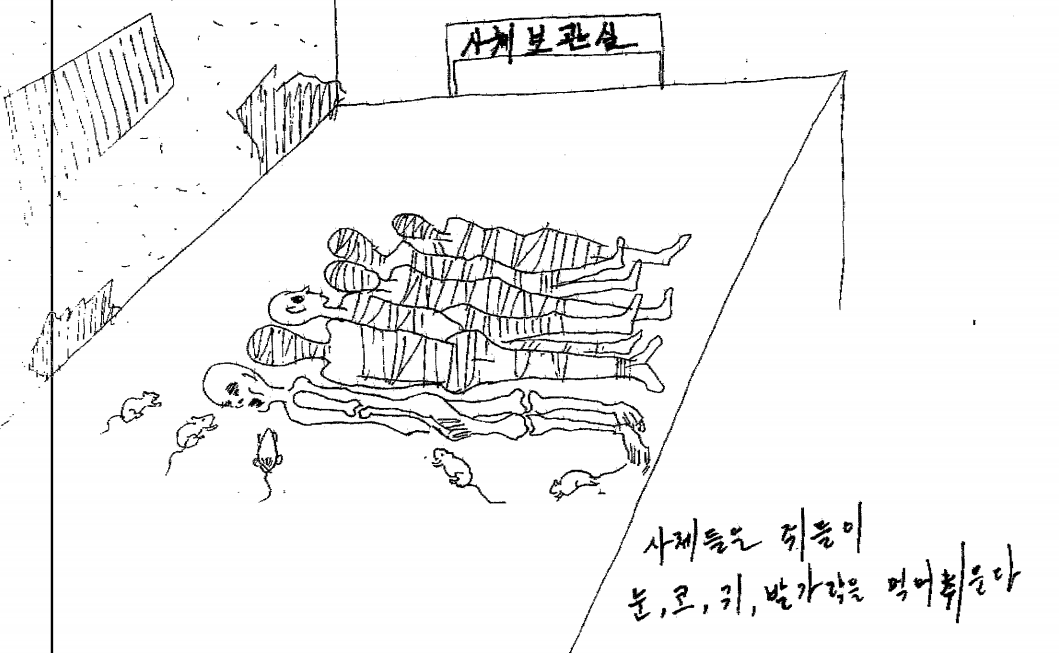
Beijing’s culpability is actually greater than the report states. No country has more influence over North Korea than China, which has long provided a lifeline of economic aid and political cover to the Kim dynasty of Kim Il Sung, Kim Jong Il, and, since Dec. 2011, Kim Jong Un, while refusing to do anything about the horrendous cruelty being committed next door. If it wanted to, Beijing could use its considerable influence to press Pyongyang to curb its atrocities. Or Beijing could simply begin welcoming North Koreans who manage to escape, instead of its current practice of treating them as “economic migrants” and forcibly repatriating them to their homeland, where they frequently face detention, torture and sometimes even execution. Instead, Beijing violates international law. Forcibly returning North Korean refugees in these circumstances is a blatant breach of the principle of non-refoulement — the most basic principle of international refugee law, which prohibits returning people against their will to face persecution.

(The illustration above is from the UN’s recent report on North Korea. It was drawn by a former North Korean prisoner Kim Kwang-il.)