Sorry, Clapper, You Lied To Us

I’ve long been ambivalent about the NSA’s massive spying program. In many ways, I think it is one of the least objectionable of various counter-terrorism measures. It doesn’t require us to invade and occupy other countries, capture or kill innocent civilians, torture prisoners, or engage in endless melodramas with men like Karzai. The trouble is: such a program relies to a great extent on trust and consent in a democracy, and our government has made both close to impossible.

They lied to us, to put it bluntly. James Clapper lied directly to the Congress. And he keeps lying. Does anyone believe for a second his new excuse for brazenly deceiving the public he is supposed to serve? He’s all contrite now and claiming that the massive NSA program should have been disclosed early on after 9/11. Fine. But his credibility is effectively over. If an official has lied directly to the public before, he can do so again. And, as Ed Morrissey notes,

Clapper still defends the 215 program as both constitutional and effective, even though the administration’s own select panel concluded the opposite on both points after its investigation. Another group reached the same conclusion about the effectiveness of the 215 program last month.

The only reason Clapper is still in his job is because the president wants him there. No other conceivable defense is possible.

And the obloquy directed at Snowden and, to a lesser extent, the journalists who aided him, is thereby rendered moot. No one can deny that Snowden exposed something our democracy needs to know about, as Clapper now acknowledges. That makes it a text-book case of whistle-blowing, however unwisely Snowden has acted since. And that’s why the journalistic community, despite misgivings, has rightly rallied behind Greenwald, Poitras, MacAskill and Gellman who helped break the stories. The Polk Award is a big deal – and Pulitzers may follow.

I guess what I’m saying is that whatever the ethical questions about the leak of highly classified material, the US government has behaved so mendaciously, secretly and covertly that the question about Snowden is basically over. You can try to smear him and others. But you can no longer deny that they exposed government lies about matters of serious constitutional import.

The View From Your Window Contest: Winner #192

vfyw_2-15

A reader writes:

First-time guesser, and I know this will not be a winning entry, but I figure I ought to throw my hat in the ring. The dumpster in the foreground looks American, but seeing as 49 out of 50 states (something I overheard, not sure of veracity) currently have snow, the only thing that could narrow it down would be the large lattice style radio tower in the background. Since I have two-year-old twins, I don’t have hours to spend on Google Maps. There is a list of lattice style radio towers on Wikipedia, however, and in light of Michael Sam’s recent announcement and your tendency to have thematic locations in the contest, I’m going to guess Kansas City, Missouri.

Another:

Once a “Winter Wonderland” (it’s Michigan’s state motto), this depressing shot has to be of one of the many bleak cities in the auto-industry decimated region of lower Michigan. Completely flat landscape, old Sears Roebuck building, little outdoor activity … might be Lansing, Dearborn, Battle Creek. Let’s go with Flint.

Another:

This was a really tough one. The extended weekend made it even harder (this is a Monday/Tuesday activity for me). Using the satellite dishes and the little bit of skyline in the upper left-hand corner, you know it’s a few miles northeast of a major city. Given the state of disrepair, I was leaning toward Detroit, but I can’t find any close-in industrial areas. Anyways, with the style of the triangle building and a strange feeling that I’ve seen that warehouse before, I’m going to guess Baltimore.

Another:

This is a wild guess. Today is the one-year anniversary of the meteor strike in Chelyabinsk, and it would be like you to feature them in the VFYW contest. But I have no idea how to find the building. I can’t find a large radio tower in Chelyabinsk in Google Earth. But yeah, that’s totally Chelyabinsk.

Another adds, “How frustrating is it that we can map the cosmic background radiation of the observable universe but we couldn’t see a huge meteor coming at us from the direction of the sun until it was streaking through our freaking atmosphere?” Another reader:

Omigod, omigod, omigod! This is Atlanta during one of the recent ClusterFlakes. It was taken in the the Old Fourth Ward, towards the former Sears warehouse (which became City Hall East and is now being redeveloped into lofts). The building on an angle is The Masquerade, a music venue, and next to that you can make out the Beltline, the amazing rails-to-trails (actually concrete bike and walking paths) that will someday ring the inner city.

The first ClusterFlake, three weeks ago, shut the city down for three days, but not on purpose. For the next storm, which occurred last week, the state leaders decided the best response was to shut the city down again for three days, but they mostly skipped the fun camping-in-your-car part this time.

Another:

Ah, some snowy big city in Yankeedom.  Atlanta, maybe?  (Finally the country is united.) But seriously, looks like somewhere on the southeast side of Chicago.

It is in the Midwest. Another gets the right city:

Holy crap I know this!!

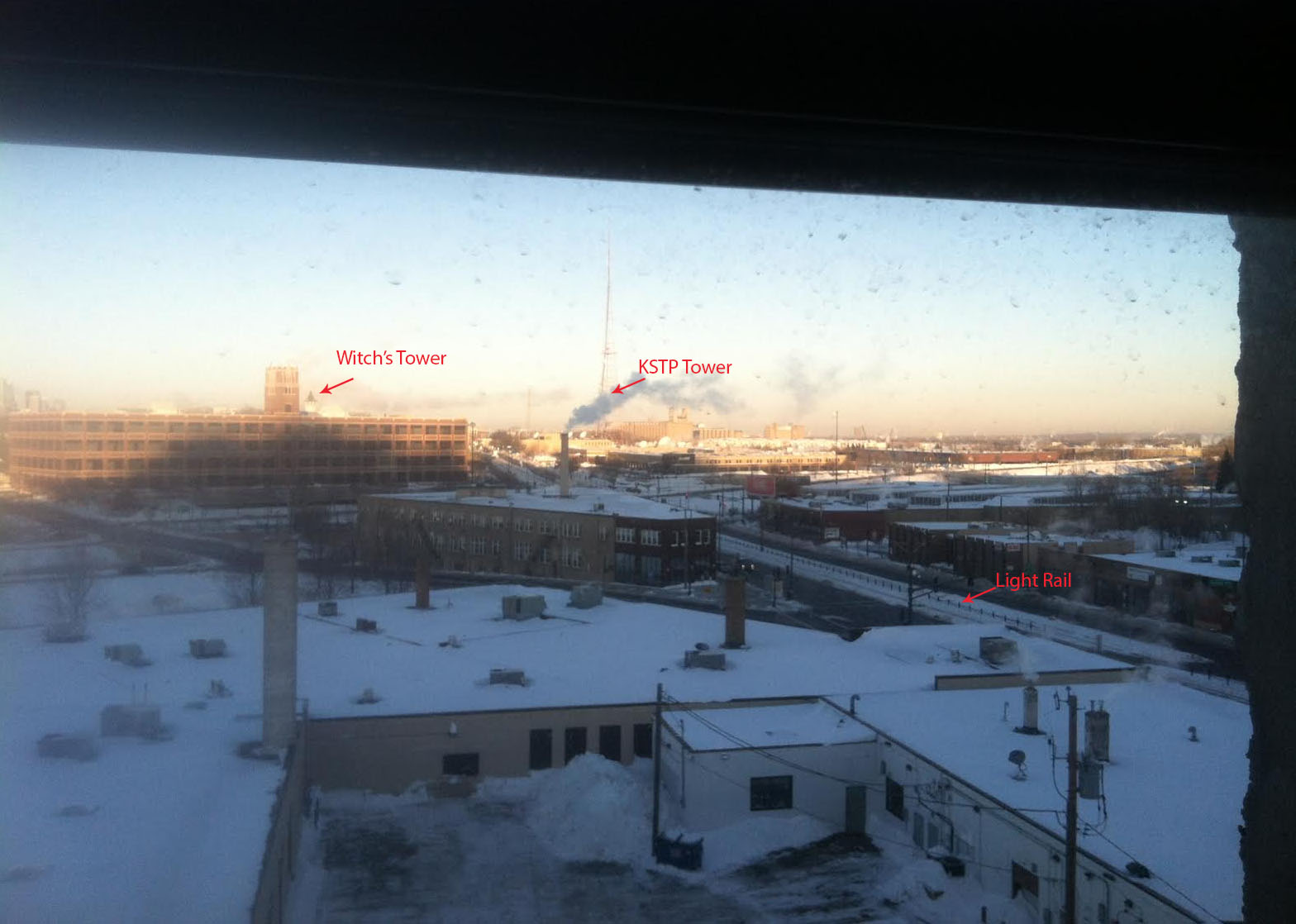
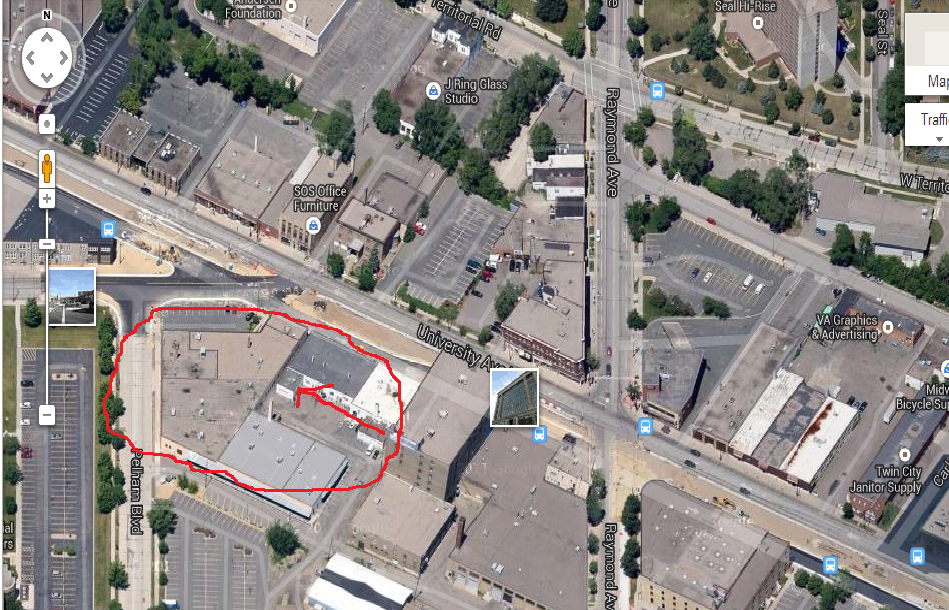
I don’t care enough to look it up to the exact cubic meter or whatever those people do, but this is in St. Paul, Minnesota (just at the Minneapolis/St. Paul city line, actually). It’s on the south side of University Avenue, between Raymond and Pelham, looking west. This picture was probably taken from the new condos being built there. You can see our new light rail transit track headed down the middle of University – it’s supposed to open in July. I work in a building just one block east of this. I wonder how many of my colleagues and friends will write in?

Clearly this picture was chosen because the winning goal in the USA-Russia hockey game today was scored by Minnesotan T.J. Oshie, right?

Well duh; everyone knows Oshie is from Warroad, MN. Another reader:

When I opened the picture my reaction was: “Hmmmm.  Not much to go on … wait that’s the Witch’s towerHat Tower. Oh, I live here.”  Well, I don’t live there as in inside the tower, but I do live in Minneapolis, so that landmark (the cone shaped tower partially obscured by the large building in the foreground) is instantly recognizable.  The photo is taken mere yards across the border into St. Paul looking west toward Minneapolis’ Prospect Park Neighborhood and the University of Minnesota.  I believe the photo is taken from the Chittenden and Eastman Building, which has been redeveloped into the C&E Lofts. The address is 2410 University Ave, St Paul, MN 55114.
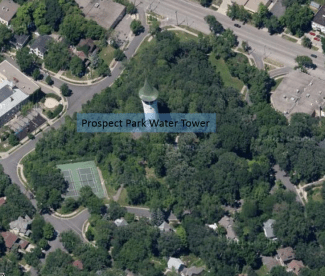
I’ve won recently, so I won’t spend any time trying to guess which precise window.  But here’s some fun trivia: The Witch’s Hat Tower is rumored to be the inspiration for Bob Dylan’s song “All Along The Watchtower.”

Another sends the above image of the tower. Another reader:

When I was a toddler growing up in Twin Cities, we used to drive by that white tower. I never knew its name, but my folks would tease me that an old hag lived up there, peering out from under the dark “hat” to surveil the traffic for naughty children. I would crouch under the back seat of our Oldsmobile station wagon until the tower was well out of sight. I’m not sure they understood how disturbing that little story was to a 5 year old, but it has stuck with me for over 35 years!

Another with local ties:

I interned on the campaign of the late Paul Wellstone across the street from this location in the summer of 2002. I will never forget that neighborhood. Now I sit in Austin, Texas getting occasionally homesick for St. Paul – this view brought me home again, if only for a few minutes. Thanks for sharing it.

Another:

The street that runs diagonally across the right side of the photo is University Avenue – there’s a new light rail line that goes down the street that will be open in a few months. There’s also a low office building near the center of the photo that was the campaign headquarters for Al Franken’s Senate campaign in 2008.

Another turns back to the building in question:

Chittenden Eastman bldg.Before

The Chittenden and Eastman Building, a furniture showroom and manufactory, was built in 1917 in a part of Saint Paul zoned for industry. One of its last tenants, Nelson Office Supply, displayed desks and office furniture; long after that enterprise closed, its sign lingered on. In the ’60s and ’70s, the industry moved to the suburbs, and the low rents and warehouse space attracted artists, musicians and poets.

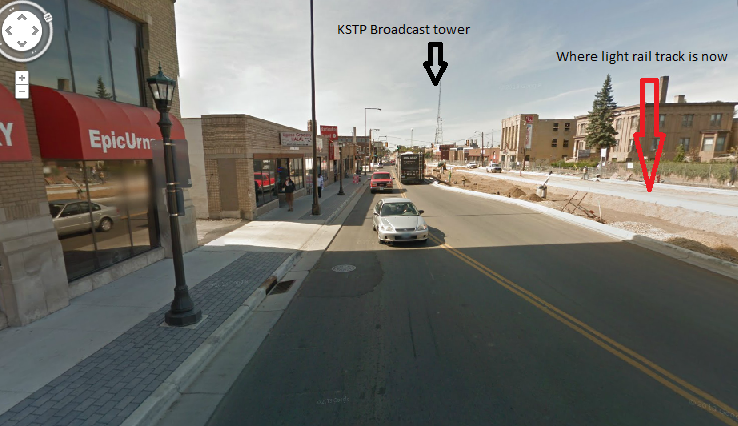
Over the past two years, University Avenue (the main drag in the center of your VFYW photo) has been under construction. A light-rail system has been installed (“the central corridor”) to join Saint Paul and Minneapolis, and a number of rundown warehouses along the route – the Chittenden & Eastman building among them – have been converted to apartments. In one of the attached photos [seen above], you can see the old building and the ripped up street. The second photo – just one google click from the previous one – shows the Chittenden & Eastman with a new lease on life as C&E Lofts, with many, many new windows:

C&E historic Lofts-after

Another leaves the exact location to chance:

VFYW is always so intimidating so I usually just glance at the picture and wait until the winner post, but this time I actually recognized the area! All of it, the Green Line LRT, the tv/radio tower, the witch hat water tower, the cool shaped building, and downtown Minneapolis to the far left. It has to be University Avenue in St. Paul where it intersects with 280. I sent an email to my brother to confirm, but he tells me that I need more than a guess. With his help we narrowed it down to C&E Lofts at 2410 University Ave. St. Paul, MN. His guess is apt. 410, mine, apt. 510. In true sibling fashion we flipped a coin. Apt. 410 it is!

510 actually!  Two readers guessed the right apartment number:
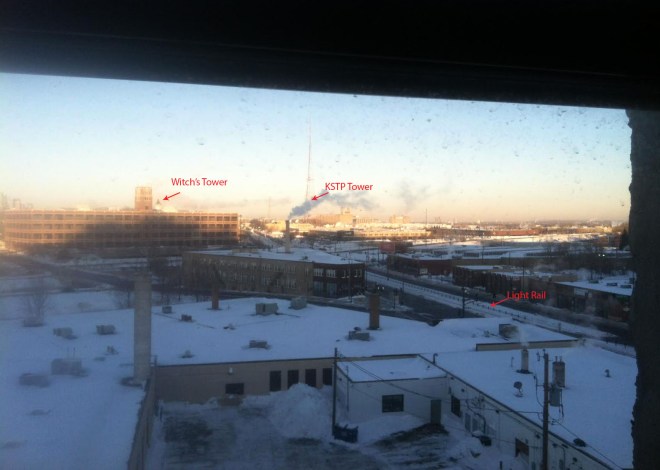
VFYW pic

Normally I spend about 5 minutes on the VFYW contest and give up, but when I saw this week’s contest I knew it had to be the Twin Cities. The sky, the huge pile of snow in the parking lot, the steam coming off the smoke stacks … it all screamed MSP, my hometown. Next, I noticed the dividers on the street that are part of the new light rail system. That probably places it on University Ave. Aha! That radio tower is KSTP, and the real give-away is the Witch’s tower that sites atop a hill blocks from the house where I grew up. Now I know it’s at the intersection of University and Franklin, and a couple reference points clearly show it’s the C&E Lofts building at 2410 University Ave. Specifically, it’s from the southern-most window:

Floorplan

The only question, then, is which floor? At first I assumed it was the top level, but after referencing Street View I’m reasonably certain it’s the 5th floor. The window, then, is the kitchen window (as opposed to the living room) in unit 510. You can’t get much more specific than that.

Indeed you can’t, but to break the tie this week, we had to check how many previous contests the two 510 guessers have entered. The above reader was a first-time player, but the following reader has played once before, so he’s the winner this week:

Every Saturday my wife and I check out the view from your window contest and list off a guess, that is at minimum 500 miles, if not a continent or two away. This week, due to a change in our routine, I didn’t pull up the post until Sunday evening. My first impression was “just like it is here (in the Minneapolis/St. Paul area) snowy and it looks cold.” While it has been cold throughout the country, the only word to describe it here this season is brutal. Then I saw the light rail line in the middle of the street and thought that it looked like the new divider that they were putting in the for the new Green Line light rail between Minneapolis and St. Paul. From there it all fell into place.

Back in graduate school at the University of Minnesota, I took a bus that went down that very street every day between the Minneapolis and St. Paul campuses. I used to see the unusual triangle shaped building and used to think it was an incredibly odd shape for a building. Directly ahead in the view you can faintly see the broadcast tower for KSTP television (local channel 5). On the very upper left edge you can see some of the skyscrapers of Minneapolis, poking above the red Court International building of 2550 University Avenue.

unnamed1

The building is the Chittenden and Eastman company building located at 2410 University Ave West in St Paul. The building’s history is as follows: The building was erected by M. Burg and Sons as a furniture showroom and warehouse. In 1927 they were joined by another furniture manufacturer, the Chittenden & Eastman Company. In the 1950s the building became widely known as the Chittenden & Eastman Building. Over time the C & E Building has been home to other furniture stores and offices. Beginning in 2011 the building was converted into apartments.

I have attached a Google street view photo of the front of the building from the summer which shows the light rail track construction underway:

VFYW2(1)

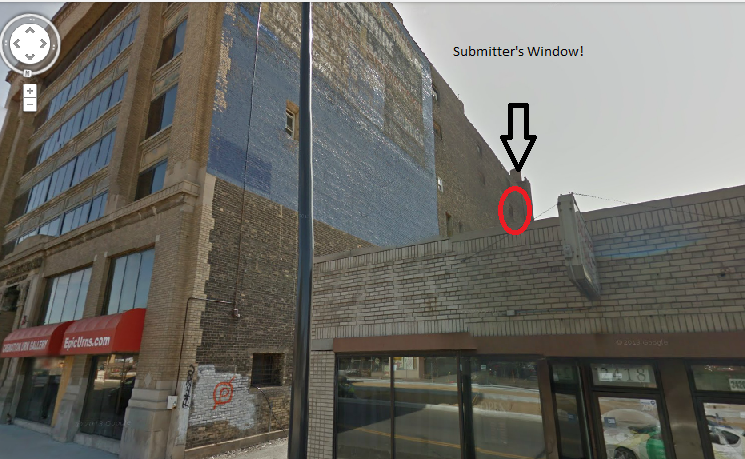
To get the view that you see in the photo, the window would need to be in the back corner (SW corner) of the building. The windows from that unit would face NW towards Minneapolis. To get the unit and angle I was able to find a floor plan of the building on the C&E Loft’s website. From everything I can tell, the location is unit 510

An exterior photo of the building with the submitter’s window is circled:

VFYW3(1)

Hopefully from everything I’ve written, I’ll be the winner! I have read from week to week of all the people who can get this, and it astounds me. At least I can now say I’ve gotten the location once! Thanks for the great blog and the weekly contest, and don’t worry, I’m a subscriber and I’ve renewed!

(Archive)

How Much Is Hillary Clinton Like Claire Underwood?

There seem to be two major responses to the Washington Free Beacon’s enterprising investigation into the Diane Blair documents at the Clinton library University of Arkansas Special Collections library. The first is: up and at ’em! She’s a candidate for president (well she hasn’t ruled it out); her record in public life is obviously germane; what’s the problem? The second is: can we not revisit the entire 1990s? It was bad enough at the time. And please, give the Clintons a break after all these years. Byron York makes the first case; Frank Bruni makes the second.

York wins by a mile, it seems to me. When you’re electing a president, obviously his or her character under pressure is an important thing to understand. Many candidates – like Obama, for example – have such a slim record in public life (and such an apparently impeccable private life) that the details can be a little sparse. Nonetheless, we know about his pot-smoking, his intimate family background (not least because he wrote his own book about them), his marriage, his friendships, his religious affiliations, and on and on. Now think of what we learned (and didn’t!) about a former half-term governor’s improbable rise. When you come to someone like Hillary Clinton, who’s been in the halls of power for two interminable decades, the record is much deeper and wider. It is not somehow prying into someone’s zone of legitimate privacy to note the following, as York does, in order to counter the hagiography that has emerged in the last decade or so:

New voters also need to learn about Mrs. Clinton’s checkered history as a lawyer and the game of hide-and-seek she played with federal prosecutors who subpoenaed her old billing records as part of the Whitewater investigation. After two years of defying subpoenas and not producing the records, she suddenly claimed that they had been in a closet in the White House residence all along.

Add to that Clinton’s amazing $100,000 windfall in cattle futures and the shenanigans in the White House travel office, and you’re dealing with completely legit questions about ethics in public life. The benefit of time passing is that these maneuvers can be seen more dispassionately, and dismissed as ancient news, if appropriate. I can’t imagine, for example, that cattle futures will figure prominently in the 2016 campaign. And Clinton’s stonewalling the largely-debunked Whitewater “scandal” may well burnish her rep for steeliness, rather than make her seem conniving.

But what about the Lewinsky mess, which was obviously not her doing, which derailed her husband’s second term, and in which she was much more sinned against than sinning? I don’t believe it should be a prominent feature of the campaign – and trying to shoehorn it into the debate, as Rand Paul has been doing, is bound to boomerang. Forcing a spouse to relive her husband’s infidelity and dishonesty and even perjury crosses a line in civility Americans are rightly sensitive to. But the trouble is – this wasn’t an entirely private matter – you can’t erase impeachment from history –  and the Clintons, in any case, have a strong story to tell about Republican over-reach. There is, moreover, a completely legitimate question to be drawn from the episode: What does it tell us about Hillary Clinton’s political character?

It tells us that she is one cool customer. Claire Underwood has a doppelganger. Here’s the money quote for me from the WFB piece:

In her conversations with Blair, the first lady gave her husband credit for trying to end the affair with Lewinsky, and said he did not take advantage of his White House intern. “It was a lapse, but she says to his credit he tried to break it off, tried to pull away, tried to manage someone who was clearly a ‘narcissistic loony toon’; but it was beyond control,” wrote Blair. “HRC insists, no matter what people say, it was gross inappropriate behavior but it was consensual (was not a power relationship) and was not sex within any real meaning (standup, liedown, oral, etc.) of the term.”

So for Clinton, there is no power dynamic at work in a female intern having an affair with the president of the United States. I’d love to see her make that case in other sexual harassment cases. And for Hillary, Bill Clinton was not lying when he said that he did not have sex with Lewinsky. On the question of Bill’s honesty, Hillary thinks he was always telling the truth. As for feminism, Hillary Clinton had more sympathy for Bob Packwood than for the countless women he grotesquely harassed and groped:

In a Dec. 3, 1993, diary entry, Blair recounted a conversation with the first lady about “Packwood”—a reference to then-Sen. Bob Packwood, an influential Republican on health care embroiled in a sexual harassment scandal. “HC tired of all those whiney women, and she needs him on health care,” wrote Blair.

If a Republican male candidate were on record calling the victims of Bob Packwood’s depravity “whiney women”, I have a feeling the Democrats would be using that quote quite expansively in any campaign. Then there’s the campaign to smear any women who might have had sexual relations with Bill:

In a confidential Feb. 16, 1992, memo entitled “Possible Investigation Needs,” Clinton campaign staff proposed ways to suppress and discredit stories about the then-Arkansas governor’s affairs. Campaign operatives Loretta Lynch and Nancy McFadden wrote the memo, addressed to campaign manager David Wilhelm. The first item on the itinerary discussed “GF,” a reference to Gennifer Flowers, the actress and adult model who had recently disclosed her 12-year affair with Bill Clinton. “Exposing GF: completely as a fraud, liar and possible criminal to stop this story and related stories, prevent future non-related stories and expose press inaction and manipulation,” said the memo.

Now of course Hillary knew full well of her husband’s long affair with Gennifer Flowers. But that didn’t stop her from trying to smear her as a “fraud, liar and possible criminal.” And that, it seems to me, speaks to a level of political calculation that is well worth considering in a future president. And it can work both ways. I suspect many partisan Democrats – after Obama’s civil, patient attempt to negotiate with a deranged GOP – will long for a president who will wage war on the right, take no prisoners, and generally Claire-Underwood the opposition. Maybe many independents will like that as well. But you cannot make that case while simultaneously portraying Clinton as a feminist icon. If someone describes the victims of sexual harassment as “whiney women,” if she buys Bill Clinton as a victim who told the truth in the Lewinsky scandal, and if she is capable of knowingly destroying the reputation of a woman who could disrupt her pursuit of power, then she is not, I’m afraid, a feminist icon. She is something a lot more formidable and cynical than that.

Putin’s Gift To Pussy Riot

Today in Sochi two members of Pussy Riot were arrested and quickly released. Ioffe calls the Russian government idiotic:

Something tells me that heads are going to get bopped at the local police station. The local cops probably got the tip that Pussy Riot was in town and were told to make the problem go away. Panicking about messing up Putin’s Sochi party, they made the situation far worse, given the group’s brand recognition in the West and the number of foreign journalists swarming the place and bored of covering ski jumps.

Simon Shuster wonders if this is a preview of things to come:

The arrest was the latest indication of a possible post-Olympic crackdown in Russia that seems to have begun even before the closing ceremony of the Games. On Monday, Russian authorities forbade the country’s leading opposition activist Alexei Navalny from visiting Sochi during the Olympics. Later that night, the Kremlin’s leading television channel, Rossiya, which is the official Olympic broadcaster in Russia, aired an hour-long propaganda film accusing opposition figures and activists of being traitors on the payroll of the United States, which the film compares to Nazi Germany.

The tweet seen above, from one of the women who was arrested, reads: “Masha Alyokhina, another member of Pussy Riot and I are being taken to the Blinovo [police] station for being in Sochi.”

Republican Senators Who Hate Ted Cruz

It’s a growing group:

By forcing the Senate to round up 60 votes to end debate and force a final vote on a clean increase of the debt ceiling, Cruz knowingly complicated things for the top two Republicans in the chamber — Senate Minority Leader Mitch McConnell (Ky.) and Senate Minority Whip John Cornyn (Texas). Both men face primary challenges from their ideological right and neither relished the idea of helping break a filibuster for a debt ceiling increase with no Republican proposals attached. …

There is nothing that politicians — and especially Senators — hate more than being forced into a politically uncomfortable vote by a colleague of the same party. McConnell and Cornyn, both of whom are favorites to win their primaries, will never forget Cruz’s move this past week.  And, Cruz is plenty smart enough to realize that.

Byron York ponders the maneuver:

In the end, the gambit accomplished nothing for Senate Republicans. Some GOP lawmakers who already disliked Cruz now dislike him even more. But the episode did remind the Republican leadership, as if it needs any reminding, that there are conservatives around the country who are deeply frustrated by the GOP and want it to show some fight. To them, Cruz represents that fight. Maybe they’ve been misled. Maybe they’re living in a fantasy land. But that’s what they believe. Republican leaders have to keep them in mind as November approaches.

Harsanyi thinks McConnell brought this on himself:

[I]f the debt ceiling isn’t a hill worth dying on – and it certainly isn’t – leadership should have explained this explicitly rather than leading on the base. It was only back in January when McConnell told the faithful on national television that some of “the most significant legislation passed in the past 50 years has been in conjunction with the debt limit. I think for the president to ask for a clean debt ceiling when we have a debt this size of our economy is irresponsible.” What McConnell should have added then is: but there’s nothing we can do about it right now. We have to work on winning more seats, and then we can stop this endless cycle of irresponsible spending.

Beutler sees Cruz’s actions as counterproductive:

[T]o the extent that the right’s shared ambition is to actually revive debt limit brinksmanship in the future, Cruz undermined the cause.

He made McConnell et al. vote to break his filibuster, and they are now half-pregnant with a clean debt limit increase. If he hadn’t forced the issue, Republicans would have an easier time justifying a return to extortive tactics in 2015. But unless McConnell and Cornyn and the 10 others who joined Democrats to break Cruz’ filibuster all disappear, Senate Republicans will have an extremely difficult time explaining why the debt limit is a legitimate source of leverage. After all, they all implicitly rejected that notion with their votes last week.

Yglesias Award Nominees

“We recognize that the scourge of AIDS has been devastating to the people of Uganda. Measures must be taken to encourage faithful marital love and to discourage sexual immorality of every type.  It is critical, however, that these measures be shaped in a just and Christian manner, and not in a punitive spirit. Harshness and excess must be avoided.  Those who experience homosexual desire and yield to it should not be singled out for extreme measures or for revulsion.  Homosexual persons, whether they struggle to live chastely or, alas, do not, are human beings. They are children of God made in His very image and likeness. They are our brothers and sisters.  Christ loves them as he loves all of us,” – the late Chuck Colson, Robert P. George, and Timothy George, in a 2009 letter to fellow Christians in Uganda. Mercifully, not all American Christians are aiding and abetting the anti-gay pogroms and violence and persecution now cresting in the developing world.

Can A Whistleblower Be A Journalist?

Daniel Soar suggests that “there’s a serious sense in which Snowden is more journalist than whistleblower”:

As journalist, Snowden was extraordinarily conscientious. [Glenn] Greenwald says that on the memory sticks he was given the documents were meticulously organised and indexed, with not a single one miscategorised: he didn’t doubt that Snowden had read them all. The evidence certainly points to Snowden’s knowing quite a bit about their contents.

In his book [The Snowden Files, author Luke] Harding describes the moment when Ewen MacAskill, the Guardian journalist who travelled to Hong Kong along with Greenwald and [Laura] Poitras to meet Snowden for the first time, took out his iPhone and asked Snowden whether he minded ‘if he taped their interview, and perhaps took some photos’.

‘Snowden flung up his arms in alarm,’ Harding writes, ‘as if prodded by an electric stick … The young technician explained that the spy agency was capable of turning a mobile phone into a microphone and tracking device; bringing it into the room was an elementary mistake in operational security, or op-sec.’ Every paranoiac probably supposes as much, but Snowden knew exactly what it was that the spooks might have done to MacAskill’s phone. We too now know, thanks to a document released at the end of January, that GCHQ has developed a virus called WARRIOR PRIDE that can be invisibly installed on devices. It comes with ‘iPhone specific plugins’: the one that does the tracking is TRACKER SMURF; the one that turns the thing into a microphone is NOSEY SMURF. These are facts that you wouldn’t want to unlearn.

How Scientific Is Astrology? Ctd

A reader writes:

A long-time Dish fan and subscriber here. I wanted to offer a reality check on the Mother Jones article. Newspaper horoscopes are the one topic that both professional astrologers and diehard skeptics actually agree on – they are ridiculous and an insult to common sense.  Everyone born during a specific month is going to have the exact same experience?  It’s laughable and rightly so.

However, the National Science Foundation study shows something is clearly shifting within the culture Fausto_Coppi's_Birth_Chartin regards to astrology, particularly for those under 45. What has shifted?  It’s that astrology is slowly winning hearts and minds, not through silly horoscopes, but through consistent, effective counseling that clients find useful, practical and relevant to their lives.  Professional astrologers cater to working-class individuals all the way up to lawyers, doctors, politicians, businessmen, and professionals of all stripes, every day in this country.  Since the field is not routinely covered in the media, many would be surprised to learn that the average professional astrologer is highly educated, socially and politically liberal, and extremely intellectual. I encourage you to google the names of the top three astrologers in the U.S. right now – Richard Tarnas (author of The Passion of the Western Mind), Robert Hand and Steven Forrest – to get an idea of the high-level of professionalism in the field.

Think of the profile of your average psychologist and you get the picture of the average astrologer.

Unfortunately, taking astrology seriously is still an extremely taboo topic in this culture.  Similar to the shame and derision people received when they visited psychologists in the 1940s and 1950s, people who visit astrologers are secretive about doing so. They do not want to be shamed, ridiculed, and discriminated against by people who do not understand them. So the majority of clients stay in the closet.  (A professional astrologer friend of mine is seeing two clients at the same law firm, but neither of them know the other is going because it’s not a topic they would think of discussing to each other. They are afraid they would be mocked by the other.)

Another is on the same page:

As a professional scientist, I wanted to throw out a perhaps unpopular opinion about astrology and see whether it’s enough to get your readers’ interest.  “Astrology” taken broadly includes horoscopes (which are clearly bunk) but also a typology of personalities on the Zodiac. I’m a father of a young child, so I’ve been thinking a lot about what goes into making a good person, or more generally how early childhood influences adult behavior.  I want to advance the idea that there may be insight to be had about a person based solely on when during the year they were born: weather.

There are innumerable “firsts” in a child’s life – from the first breath of air to the first steps to the first conceptualization of the self as a social being.  Particularly in ancient times, a very young child’s experience of these things was strongly mediated by the natural environment.  Is it really so odd to think that people born in July, when it’s 80 degrees in the afternoon and the sun is out for 15 hours a day, might have something in common that is distinct from people born in December, when it’s 40 out and the sun sits low in the sky?  Especially 2500 years ago, when the only way to be warm was to be indoors by a fire?

Even now we have no real idea (because no scientific way to properly study) how much of cognition is formed in the first three months or first year of life.  I don’t think it’s implausible to suggest that (a) natural seasonal variations could have a significant effect in this early period and (b) those variations could result in phenomenological differences that could be generalized into zodiac “types.”  Of course, the rest of it – with Jupiter in the house of Leo and mercury retrograde – is complete baloney. There’s no causal mechanism, but at least for predicting personality types (especially in an ancient and largely homogeneous culture) it doesn’t seem that far off the mark to blame the seasons.

I’m not saying “Astrology is very scientific,” but depending on the day, and the way the question is framed, I might well say “sort of” for the above reason. In this spirit, another good question to ask is: how many people identify with their Zodiac sign (“very much”, “sort of”, “a little”, or “not at all”)?  I suspect it would be a high proportion.  Even if the answers to that question are culturally mediated, does that make them less valid?

Another shifts to tarot:

As someone who teaches critical thinking and literature, and who has a reasonably literate level of knowledge and experience with both tarot cards and astrology, I have a unique take on this question. One unique quality of community college English professors is that we teach both literature and college-level writing, whereas in many larger four-year schools the professors teach literature and the GTF’s teach writing. So I have a mind that switches back and forth every day between the metaphor/symbolism/irony/tone part of my brain to the argument/critical-thinking/research part of my brain. This dual-mind ability has been very helpful for me as I explored tarot and astrology.

When I began to study tarot from a local teacher, I was immediately struck by the story-telling/metaphor/dream imagery of the cards and the narrative arc that a layout of cards would provide in response to someone’s question. I also felt like I was experiencing Jung’s concept of synchronicity in a powerful way – almost always the cards that come up in readings I do have very powerful metaphorical information about the question or situation being asked about.

I immediately began to see that the layout of cards almost always created the equivalent of a “short story” or a “dream-on-demand” about the person’s situation, both in terms of his or her psyche, and the outside situation. As I walk a person through my understanding of the images and metaphors of each card and how they might apply to the person’s situation or question, they often interrupt me to tell me that they’re seeing their situation much more clearly. They also tell me they see what’s holding them back, and what options and resources they have for moving forward. In other words, they’re getting useful “scientia” that resonates strongly with their situation and mind. I often use the term “a dream on demand” for a tarot card reading because they seem so helpful and appropriate to the question someone asks.

While I’m not as skilled in astrology, I see the same kind of synchronicity, insight, and practical information come through when a good astrologist does a reading for me. They don’t give silly predictions for the future, but help me see what kinds of “seasons” or “weather” are at play for me, and how I can work with my own particular set of impulses, ways of thinking and feeling, etc.

So, are these “scientific” or literal ways to knowing reality or the future? No. But neither are they cartoonish fortune-telling that yield nothing but arbitrary nonsense, unless the reader has been very poorly educated and the querent is only looking for cartoonish fortune-telling, in which case they get what they deserve.

(Image of Fausto Coppi’s Birth Chart via Wikimedia Commons)