Marriage Equality Update: Valentine’s Day Edition

A federal judge has ruled against Virginia’s marriage ban on equal protection grounds:

U.S. District Judge Arenda L. Wright Allen – a President Obama appointee – found that Virginia’s constitutional amendment banning same-sex marriage, enacted by voters in 2006, violated the equal protection clause of the Fourteenth Amendment. She issued a stay on her ruling pending an appeal, meaning gay couples cannot get married in the state until a higher court makes its decision.

Shackford examines Allen’s argument:

In the ruling, Wright Allen rejects the argument that gay couples are trying to establish a new right. Marriage, she notes, is treated as a fundamental right … She goes on to invoke the Loving decision to reject the state’s marriage recognition ban on the grounds of upholding “tradition.” She rejects federalist arguments because the civil liberties arguments involved permit federal constitutional review. And she rejects the “for the children” argument (which she actually titles “The ‘for-the-children’ rationale”), stating that, while the state has a compelling interest in protecting the welfare of children, “needlessly stigmatizing and humiliating children who are being raised by the couples targeted by Virginia’s marriage laws betrays that interest.”

Benen remarks on what a milestone this ruling could be:

If yesterday’s ruling stands, Virginia will be the first southern state – the only state of the old Confederacy – to extend equal marriage rights to all of its residents.

Tyler Lopez, who moved out of Virginia, notes how the state has evolved on the issue:

These days, things are looking up in Virginia. The majority of Virginians now support marriage equality; they’ve elected politicians who reflect their values; and now their judiciary has stood firm as a defender of equal rights. The commonwealth, in short, has signaled that it’s ready to welcome back its gay and lesbian sons and daughters—if we’re ready to return. For those of us who never thought this moment would come, the impact is overwhelming. When I finally crossed the Potomac and moved to D.C., I promised myself I’d never return. But reading the brave and beautiful words of Judge Wright Allen’s opinion on Thursday night, Virginia suddenly felt—for the first time in a long time—like home.

Looking at the landslide of recent court decisions, David S. Cohen and Dahlia Lithwick declare, “It’s over”:

Insofar as there was confusion about what Windsor meant at the time it was decided, the lower courts across the country have now effectively settled it. A survey of publicly available opinions shows that in the eight months since Windsor, 18 court decisions have addressed an issue of equality based on sexual orientation. And in those 18 cases, equality has won every single time. In other words, not a single court has agreed with Chief Justice Roberts that Windsor is merely about state versus federal power. Instead, each has used Windsor exactly as Justice Scalia “warned”—as a powerful precedent for equality.

Dreher plays the victim:

Traditional Christians are all segregationists now. The federal judiciary is making that clear. The rout that many of us have seen coming is upon us.

Well, Rod, if you act like segregationists, what do you expect?

The Downsizing Of Ratzinger’s Former Office

It’s one of those things only acute Vatican-watchers notice, but Francis’ demotion of the Congregation for the Doctrine of the Faith, the office for ensuring doctrinal orthodoxy that Joseph Ratzinger ran with an iron fist under John Paul II, is a big departure from the recent past:

There is no question that the Congregation for the Doctrine of the Faith was supreme under Popes John Paul II and Benedict XVI. No one would have questioned its supremacy when Cardinal Joseph Ratzinger was prefect. But the supreme congregation doesn’t look so supreme anymore. It has been publicly criticized by a curial cardinal from Brazil, by the president of the German bishops’ conference, and by two cardinals who are members of the Council of Cardinals, appointed by the pope to advise him on reforming the Vatican. Even Pope Francis told Latin American religious not to worry about the congregation.

Actually, what Francis said was the following:

“The [CDF] will make mistakes, they will make a blunder, this will pass! Perhaps even a letter of the Congregation for the Doctrine [of the Faith] will arrive for you, telling you that you said such or such thing. … But do not worry. Explain whatever you have to explain, but move forward.”

Translation: live the faith, don’t ideologize it.

Quote For The Day

“Think of it, you’re a young person eager to help your country, and they send you to a missile hole in the cold and tell you to be prepared to shoot, even though everybody knows it’s highly unlikely you’ll ever shoot anything. With all due respect to the great people of North Dakota, it’s an acquired taste,” – F. Whitten Peters, an Air Force secretary under President Bill Clinton, on the pressures of working the ICBM shift.

What The Hell Just Happened In Kansas?

68 peoples drug 18'wide

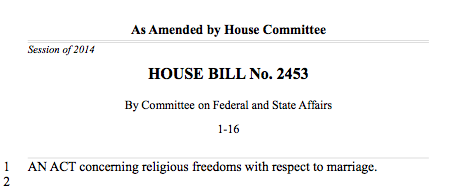
The bill that just overwhelmingly passed the Kansas House of Representatives is quite something. You can read it in its entirety here. It is premised on the notion that the most pressing injustice in Kansas right now is the persecution some religious people are allegedly experiencing at the hands of homosexuals. As Rush Limbaugh recently noted, “They’re under assault. You say, ‘Heterosexuality may be 95, 98 percent of the population.’ They’re under assault by the 2 to 5 percent that are homosexual.” As its sponsor, Charles Macheers, explained:

Discrimination is horrible. It’s hurtful … It has no place in civilized society, and that’s precisely why we’re moving this bill. There have been times throughout history where people have been persecuted for their religious beliefs because they were unpopular. This bill provides a shield of protection for that.

The remedy for such a terrible threat is, however, state support for more discrimination. The law empowers any individual or business to refuse to interact with, do business with, or in any way come into contact with anyone who may have some connection to a gay civil union, or civil marriage or … well any “similar arrangement” (room-mates?). It gives the full backing of the law to any restaurant or bar-owner who puts up a sign that says “No Gays Served”. It empowers employees of the state government to refuse to interact with gay citizens as a group. Its scope is vast: it allows anyone to refuse to provide “services, accommodations, advantages, facilities, goods, or privileges; counseling, adoption, foster care and other social services; or provide employment or employment benefits” to anyone suspected of being complicit in celebrating or enabling the commitment of any kind of a gay couple.
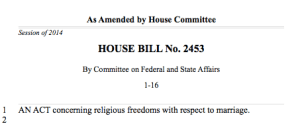
Screen Shot 2014-02-14 at 12.05.56 PMIf the Republican Party wanted to demonstrate that it wants no votes from anyone under 40, it couldn’t have found a better way to do it. Some critics have reacted to this law with the view that it is an outrageous new version of Jim Crow and a terrifying portent of the future for gays in some red states. It is both of those. It’s the kind of law that Vladimir Putin would enthusiastically support. But it is also, to my mind, a fatal mis-step for the movement to keep gay citizens in a marginalized, stigmatized place.

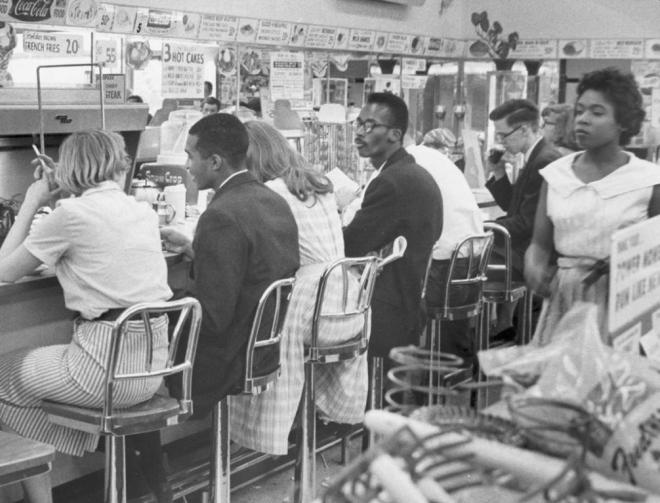
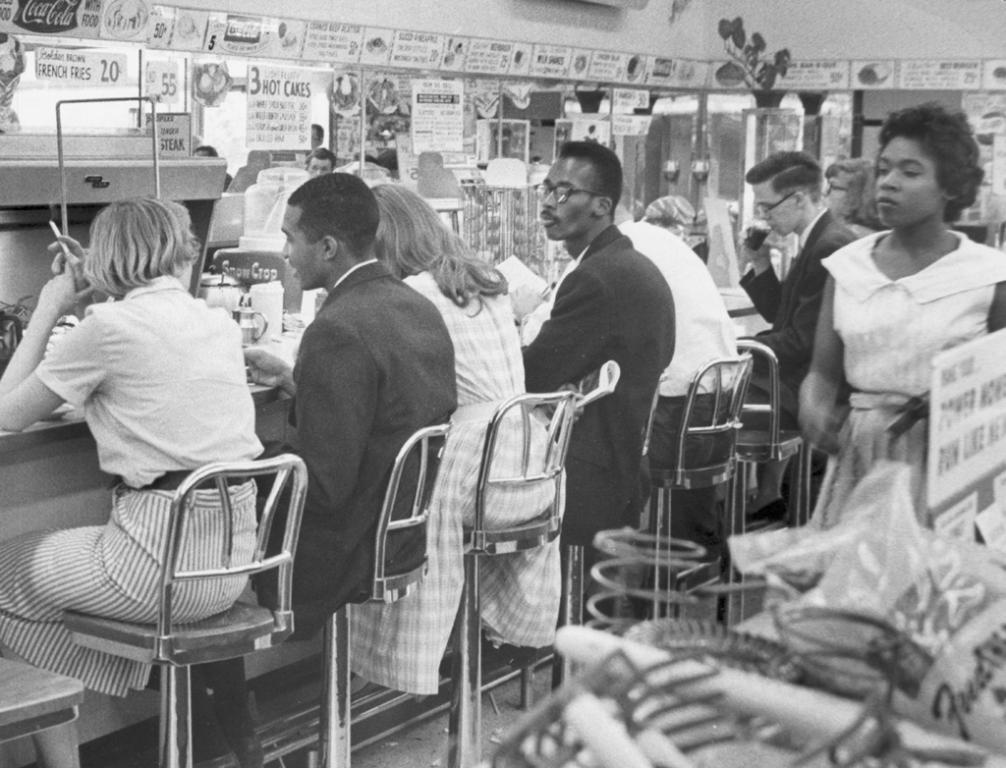
It’s a misstep because it so clearly casts the anti-gay movement as the heirs to Jim Crow. If you want to taint the Republican right as nasty bigots who would do to gays today what Southerners did to segregated African-Americans in the past, you’ve now got a text-book case. The incidents of discrimination will surely follow, and, under the law, be seen to have impunity. Someone will be denied a seat at a lunch counter. The next day, dozens of customers will replace him. The state will have to enforce the owner’s right to refuse service. You can imagine the scenes. Or someone will be fired for marrying the person they love. The next day, his neighbors and friends will rally around.

If you were devising a strategy to make the Republicans look like the Bull Connors of our time, you just stumbled across a winner. If you wanted a strategy to define gay couples as victims and fundamentalist Christians as oppressors, you’ve hit the jackpot. In a period when public opinion has shifted decisively in favor of gay equality and dignity, Kansas and the GOP have decided to go in precisely the opposite direction. The week that the first openly gay potential NFL player came out, the GOP approved a bill that would prevent him from eating in restaurants in the state, if he ever mentioned his intention to marry or just shack up with his boyfriend. Really, Republicans? That’s the party you want?

As for the allegedly Christian nature of this legislation, let’s not mince words. This is the inversion of Christianity.

Even if you believe that gay people are going to Hell, that they have chosen evil, or are somehow trying to subvert society by seeking to commit to one another for life, it does not follow that you should ostracize them. The entire message of the Gospels is about embracing those minorities despised by popular opinion. Jesus made a point to associate with the worst sinners – collaborating tax-collectors, prostitutes or lepers whose disease was often perceived as a sign of moral failing. The idea that Christianity approves of segregating any group is anathema to what Jesus actually preached and the way he actually lived. The current Pope has explicitly opposed such ostracism. Christians, far from seeking distance from “sinners”, should be engaging them, listening to them, ministering to them – not telling them to leave the store or denying them a hotel room or firing them from their job. But then, as I’ve tried to argue for some time now, Christianism is not Christianity. In some practical ways, it is Christianity’s most tenacious foe.

Jan_Wijnants_-_Parable_of_the_Good_SamaritanIf I am confident that this law is, in fact, a huge miscalculation by the far right, I do not mean to discount the very real intimidation and fear that many gay Kansans and their friends and families are experiencing right now. It’s appalling that any government should seek to place itself institutionally hostile to an entire segment of society. But in civil rights movements, acts of intemperate backlash are also opportunities. If this bill becomes law, and gay couples are fired or turned away from hotels or shown the door at restaurants and denied any recourse to the courts, the setback to the anti-gay movement could be severe, even fatal. Yes, of course this bill should never have seen the light of day. But now it has, that light will only further discredit the discriminators. Even they know this, hence the unhinged rationale for the entire bill: “Discrimination is horrible. It’s hurtful … It has no place in civilized society.”

It sure doesn’t. And that’s why the predictable silence on conservative blogs and news sites is so telling. This is about Kansas, but it is also about the Republican party. Are there any Republicans willing to oppose this new strategy? Do the GOP’s national leaders support it? As for Democrats and the left more generally, they are lucky in their enemies. But the gay rights movement, it seems to me, should tread a careful path. We should be wary of being seen to trample on religious freedom and be defined as discriminators of another sort. Allowing space for those in society whose religious convictions make homosexuality anathema, even Satanic, is what true liberals do. And to my mind, a better approach for gay couples and their families is not to try and coerce fundamentalist individuals and businesses into catering to them, but in publicizing the cases of discrimination and shaming them – and then actively seeking out and rewarding individuals and businesses who are not so constrained.

You counter rank discrimination with economic and cultural freedom. Because the side that tries to use the power of the state to enforce a single answer is the side that will seem to have over-stepped its bounds.

(Photo: lunch counter sit-in, Richmond, Virginia, 1960. Painting: Parable of the Good Samaritan, by Jan Winants.)
How Not To Say “I Love You”

Paul Oyer hates digital Valentines:

In the old days, keeping track of your friends’ birthdays and sending them birthday wishes even over Valentines-Day-Love-Greeting-Cards-with-Quotes2email took some effort. But Facebook ruined that. I used to get a weekly e-mail telling me which of my Facebook friends had a birthday that week. Now my iPhone lists these birthdays on my daily calendar. When I see it’s someone’s birthday, I can quickly get on Facebook and write “Happy Birthday” or similar on his or her wall. The same is true of sending Valentine’s Day e-cards to even just one person: it doesn’t cost us anything.

I hate to be anachronistic, but I don’t like this new system. Knowing that someone spent an average of 15 seconds wishing me a happy Valentine’s Day takes all the fun out of it. As for birthdays, more than one person has put a birthday wish on my Facebook page consisting of “hb.” Two lowercase letters!

Abortion Is A Poor Choice

Abortion researcher Tracy Weitz discusses the ongoing Turnaway Study, which examines the long-term outcomes for women who seek out abortions but can’t get them:

The take-home from that study is that most women are having an abortion because they say they can’t afford to have a child. And it turns out that they’re right: Two years later, women who had a baby they weren’t expecting to have, compared to the women who had the abortion they wanted, are three times more likely to be living in poverty. They knew they couldn’t afford a kid and it turns out they were correct. … The study has really exposed how hard it is to be a parent in this country. It is a huge economic investment. And if you don’t have the economic resources to be a parent, there’s nothing to help you.

Eyal Press looks at access to contraception to explain why poor women are more likely than others to have abortions:

Low-income women tend to have less access to the most reliable forms of birth control—in particular, long-acting intrauterine devices (I.U.D.s), which are extremely effective, and which the new Guttmacher study touted as a potential factor behind the recent decline in the over-all abortion rate. …

Thanks to publicly funded family-planning services provided to poor women under Title X—a federal program that House Republicans have repeatedly tried to eliminate—there is evidence that more low-income women have been using I.U.D.s in the past decade. But the total number of users is still small, and the cost, which can exceed a thousand dollars before insertion, remains prohibitive for many low-income women who don’t qualify for Medicaid and cannot afford private insurance. “We know that cost is a major factor in a woman’s ability to choose and access a method of contraception that works best for her, and behind the cost is access to health-insurance coverage,” Kinsey Hasstedt, a public-policy associate at the Guttmacher Institute, told me.

Recent Dish on abortion and contraception here and here.

What Television Might Become

House of Cards creator Beau Willimon discusses the series and the conventions of television:

I don’t know how much longer the idea of a “season” will be something that we feel like we need to adhere to in television. Even the idea of an episode. I think with streaming, you might have shows in the future where you have three or four hours released. And then three months later you’ll get another couple hours. And then nine months later you might get six more hours. I mean, do all of those constitute a season, or do you sort of dispense with the notion of seasons altogether?

I’ve toyed with the idea for a show that doesn’t have episodes at all. That would simply be one eight-hour stream for a season, and the viewer decides when they want to pause, if at all. That definitely could affect the writing of a show. But we’re in an in-between period now, where we have traditional broadcast networks on one end of the spectrum and streaming on the other, meaning that shows kind of have to be able to live in both worlds.

Scott Meslow wants Netflix to continue experimenting:

Someone could create a show where one episode is 75 minutes long, and the next episode is 15 minutes long. Someone could decide to release one episode every week, or every month, or every holiday — or at random, turning every new installment into a welcome surprise. Someone could release every episode of a series but the finale, then hold that finale back for six months — turning its premiere into a buzzy event that will be simultaneously shared by all of its viewers.

The structure of television is so deeply ingrained that it takes effort to even imagine these kinds of scenarios — but anyone who’s willing to break with convention has the opportunity to expand the very definition of TV storytelling.

Alex Soojung-Kim Pang defends binge-watching the new House of Cards. He calls doing so a “restorative experience”:

The term “restorative experiences” was coined by University of Michigan psychologistStephen Kaplan. He wanted to understand why walks in the park, or even looking at a picture of a landscape, can recharge your mental batteries. Restorative experiences, he found, share a few common features. They’re fascinating: Unlike a conference call or spreadsheet, they hold your attention without effort. They provide a sense of transporting you from your normal life and environment. They strike a balance between complexity and compatibility: They’re rich and fully realized worlds, but you can make sense of them. Natural environments like parks and beaches, and built spaces like churches and gardens, can be restorative. So can the theater or good books.

Previous Dish on the Netflix model here and here.

Winter Storm What?

http://twitter.com/TheMadameMeow/status/434030403423195136

As the WaPo and the Weather Channel offer competing titles for the latest winter blast, Claire Maiers notes that simply naming a snowstorm makes us more likely to freak out about it:

First, the list of names chosen for the 2013-2014 season—titles like Atlas, Maximus, and Xeni—are names that connote strength and might. Many of them are taken from Roman and Greek myths. These other-worldly labels differ significantly from typical (and somewhat benign) hurricane names like Larry, Erin, and Carl. Surely no one would tell you to brace for Winter Storm Titan if only a dusting of snow were expected.

Second, it matters that the new practice of naming snow phenomena was preceded by the practice of naming hurricanes. Hurricanes are destructive events. To be labeled a hurricane, storms must meet certain criteria (like dangerous wind speeds). Culturally, when we hear that Hurricane Jane is going to make landfall, we know that those in its path had better “batten down the hatches” or get out of the way. Likewise, when we hear that Cleon is expected to hit tomorrow morning, we are culturally primed to expect an event of a certain magnitude.