Who Obama Is Giving A Raise To

Plumer lists seven actions Obama said he would take unilaterally. The one that has gotten the most attention:

Boost the minimum wage for federal contract workers to $10.10 per hour.This will be phased in slowly, starting in 2015 — the federal government will give preference to companies that pay workers higher wages. This could raise pay for some 200,000 workers, although it will only affect future federal contracts, not existing ones. See here for more details.

All told, it’s a relatively incremental step. Boosting the federal minimum wage to $10.10 per hour, by contrast, would require an act of Congress. (And here’s an earlier look at why economists disagree so much on whether a higher minimum wage helps or hurts unemployment.)

Jordan Weissmann expects this to make little difference:

A mere 16,000 federal employees made the minimum wage or less in 2016, and according to The Wall Street Journal, it’s unclear how many of them were actually contractors. To tabulate the full effect of the hike, you’d have to know how many federal hands-for-hire earn less than $10.10 an hour, but the general point remains: This is a useful, but largely symbolic move.

Jonathan Cohn looks at other data:

2013 report from the think-tank Demos (where I used to be a fellow) found that nearly 2 million workers paid through federal contracts and other arrangements made less than $12 an hour. And a 2009 report from the Economic Policy Institute, based on 2006 data, found that about 400,000 workers for federal contractors had wages lower than $10 an hour. And that’s despite laws, like the Davis-Bacon Act, that require federal contractors to pay “prevailing wages” in their communities.

Philip Klein throws cold water:

Though the 2 million figure [from Demos] has been widely cited, it’s worth clarifying several points. To start, the 2 million estimate didn’t only include people who were employed through federal contracts, but also workers whose wages Demos estimated were funded through other federal spending, such as Small Business Administration loans, Medicare, and Medicaid. According to the Demos study, the number of workers who are employed directly through federal contracts was 560,000. A spokesman for Demos told the Washington Examiner that this is the category of people the group believes to be covered by the executive order.

But the number covered by the executive order would still be less than this 560,000.

One reason is that Obama’s executive order would raise the minimum wage to $10.10 per hour, which is lower than the $12 threshold used by Demos.

Drum wonders about the politics of the executive order:

On the one hand, public support for a higher minimum wage is very broad. On the other hand, this reinforces the widening gap between private sector workers and those who are paid (directly or indirectly) by taxpayer dollars. One side watches its wages stagnate and its standard of living drop, while its taxes are used to fund ever higher wages for the lucky few working for the government.

McArdle seizes on this point:

At a time of great economic insecurity, it’s not great politics to make government workers the “haves” of the labor market: paid above-market wages and shielded from the chronic risk of job loss that most of the rest of America faces. Oh, sure, this is true for everyone — professionals often have to take a pay cut to work for the government. But to the average person sweating it out through rounds of layoffs at a job they don’t like very much, government workers seem to have it very good by comparison.

Jay Richards is against the executive order:

In many parts of the U.S., such as the Washington, D.C., metro area, it would be tough to provide for a family of four with one full-time job that pays only $10.10 an hour. So why does the president not call for raising the minimum wage for all workers to, say, $50 an hour? Because such a policy would lead to massive and demonstrable unemployment among those whose labor is worth less than that. The fact that the president is calling for a minimum wage of only $10.10 an hour suggests that he understands these economic realities can’t be dissolved by executive order. The proposed wage hike would still harm the least-skilled workers, but at $10.10, that harm will be much harder to identify.

Ryan Avent looks at the mixed research on raising the minimum wage:

Under what assumptions can forcing a business to pay a higher wage be good for its business? The White House press release, which also cites the example of retailer Costco which pays well above the minimum wage, seems to invoke efficiency wage theory. This theory, which incoming Federal Reserve chairwoman Janet Yellen helped develop, suggests firms may pay above the market-clearing wage because to pay less would damage morale and productivity and raise turnover. This theory can certainly explain why some firms, such as Costco, sometimes choose to pay above the market wage. But it cannot justify forcing all firms to do so all the time. This would presume that numerous firms are systematically hurting themselves through their small-minded refusal to pay more. Sure, there are situations where people can be forced into doing something that makes them better off (wearing a seatbelt, getting vaccinated) but is it plausible that WalMart or McDonald’s know their own business so poorly that they are systematically hurting themselves by paying too little?

Finally, Christopher Flavelle notes that raising the minimum wage is a really low priority for the public:

So long as the public rates aiding the poor so low on Washington’s to-do list, Republicans will continue to calculate that blocking a higher minimum wage carries no significant political cost — even if a majority of Americans say they support raising the minimum wage.
Quote For The Night

“Nothing in the world can take the place of persistence. Talent will not; nothing is more common than unsuccessful men with talent. Genius will not; unrewarded genius is almost a proverb. Education will not; the world is full of educated derelicts. Persistence and determination alone are omnipotent. The slogan Press On! has solved and always will solve the problems of the human race,” – Calvin Coolidge.

A Prime-Time Pitch

If you appreciate the Dish’s live coverage of nights like this one, and subscribed early last year, take a couple of minutes (that’s all it takes, promise) and renew. We’ve had an amazing response so far – almost matching last January’s out-pouring of support – but still have a ways to go to secure our future. You’re our only means of support – with no ads, no sponsored content, and no corporate shelter.

Renew here! Renew now! Or if you’ve always intended to subscribe and have never gotten around to it, subscribe for the first time here (for just $1.99 a month or $19.99 a year) and help us change the future of online journalism.

And stay tuned for the Dish’s comprehensive summary of reax to the SOTU. Update from a reader:

Just re-subscribed tonight. I hardly ever read the Dish anymore, mostly because I’m trying to disconnect from the relentless media. So I ignored the initial pleas. But that was effective to ask for renewals right after the SOTU! It made me realize that you’re the source I turn to when it really counts. Even if it’s only once a month or year, it’s important to me that this effort thrives. So that’s worth a renewal.

Live-Blogging The SOTU 2014

US-POLITICS-STATE OF THE UNION-OBAMA

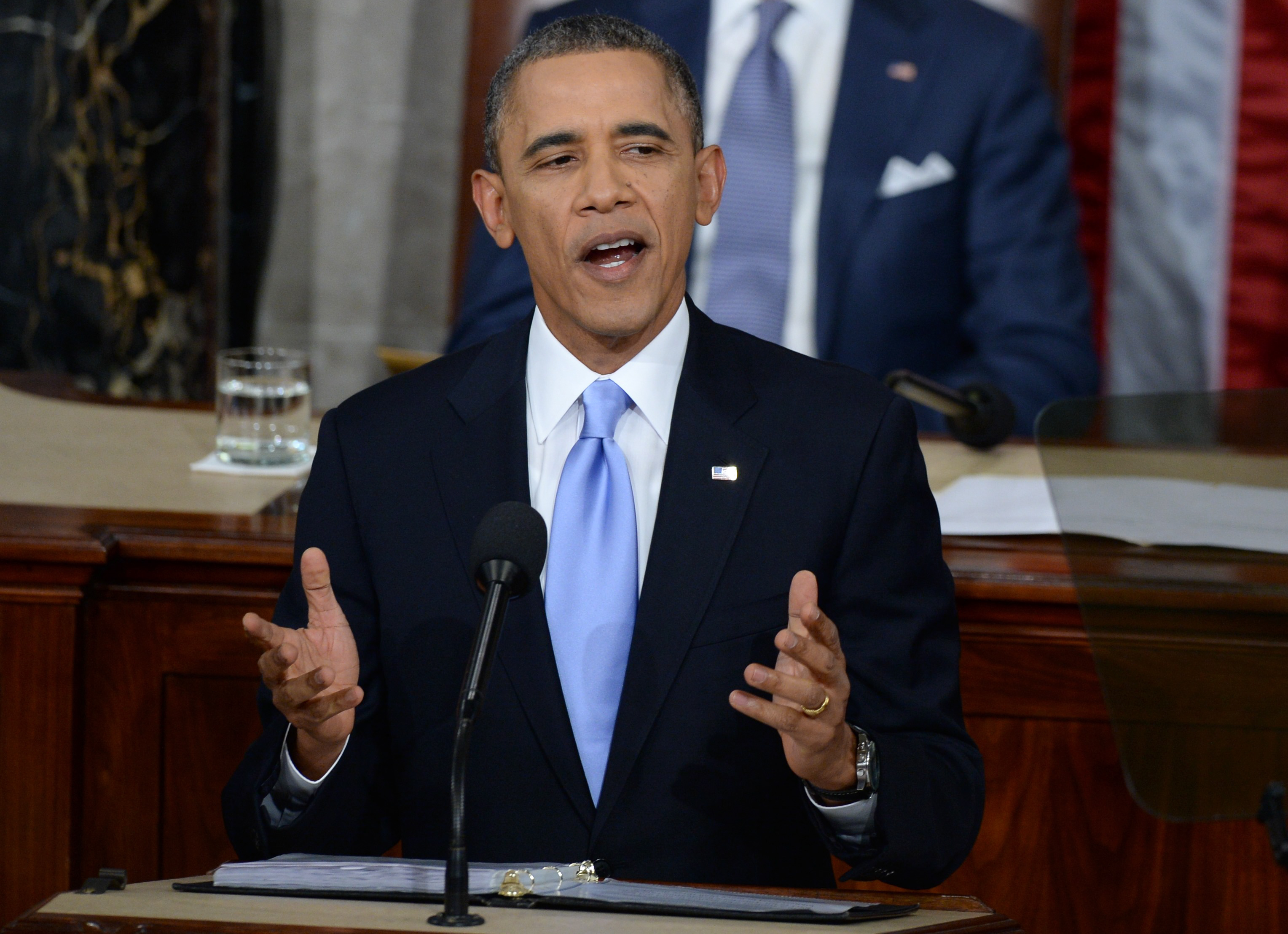
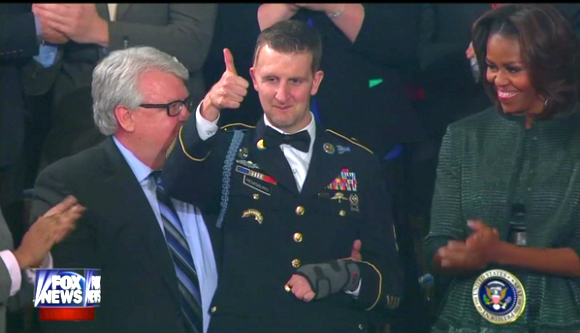
10.22 pm. The metaphor of the soldier slowly, relentlessly, grindingly putting his life back together was a powerful one for America – and Obama pulled off that analogy with what seemed to me like real passion. One aspect of his personality and his presidency is sometimes overlooked – and that is persistence. He’s been hailed as a hero and dismissed as irrelevant many times. But when you take a step back and assess what he has done – from ending wars to rescuing the economy to cementing a civil rights revolution to shifting the entire landscape on healthcare – you can see why he believes in persistence. Because it works. It may not win every news cycle; but it keeps coming back.

If he persists on healthcare and persists on Iran and persists on grappling, as best we can, with the forces creating such large disparities in wealth, he will look far, far more impressive from the vantage point of history than the news cycle of the Twitterverse sometimes conveys.

This was True Grit Obama. And it was oddly energizing.

10.17 pm. Why the fuck do I have tears in my eyes? Because what our servicemembers have sacrificed must never be forgotten. I saw “Lone Survivor” with Mikey Piro last night. Mikey, as some Dish readers will know (listen to the podcast here) served as a commander in Iraq, and now struggles with and overcomes PTSD each day. I was under my seat most of the movie. It’s a brutal combat picture. Mikey was fine, until the very end as the real-life photos of lost soldiers were displayed. Then he sobbed a little. I’ve heard several presidents invoke military heroism in their speeches. I cannot recall one so moving.

unnamed

10.12 pm. Another Obama-supporting reader bucks up a bit:

Does Obama’s shift in tone and confidence on the ACA signal that this could be a mid-term issue that Democrats will run on, not from? Did he intentionally let the Republicans endlessly call for repeals without much fanfare, so that Democrats can hoist them by those votes?

Maybe. But the idea that running on universal health insurance is an inevitable loser has always seemed dumb to me. What the Democrats need to do is stay simple: tell the human stories of those finally getting the care they need; capture the emotion and relief; appeal to a common decency. And demand that the GOP offers an alternative. When they do – and a whole lot of it looks a lot like Obamacare – this debate could turn.

10.10 pm. A reader writes:

This speech tonight reminds me why I voted for Obama.  I think the GOP made a ghastly strategic error in choosing to stand only for obstruction, and Obama is driving them into the mat on it tonight.  He’s clearly channeling the sane middle in the US electorate.  The 47 percent of the nation inside the Fox bubble won’t change their minds.  But Obama is reminding the majority that voted for him just why they did.

10.04 pm. Obama is now channeling his inner Eisenhower who understood better than any neocon the limits of American force. This is why I supported him in 2008:

We counter terrorism not just through intelligence and military action, but by remaining true to our Constitutional ideals, and setting an example for the rest of the world.

This is the money quote on Iran:

These negotiations do not rely on trust; any long-term deal we agree to must be based on verifiable action that convinces us and the international community that Iran is not building a nuclear bomb. If John F. Kennedy and Ronald Reagan could negotiate with the Soviet Union, then surely a strong and confident America can negotiate with less powerful adversaries today.

9.56 pm. This is the strongest defense of the ACA I’ve yet seen him give before a large audience. It’s about time. I don’t think he can still achieve what he wants to achieve without strongly making the case for universal healthcare: morally, economically, ethically. Bringing in the Kentucky governor was a nice touch, and goading the Republicans to offer an alternative appeals to Independents. But you get the sense that he knows – and the Republicans know – that large swathes of the bill will never be repealed, and much of it is approved of, when you isolate any actual part of it. It may be that the defensiveness on this may begin to fade.

9.55 pm. Someone’s attention is wandering:

9.51 pm. Yes, the minimum wage is lower than it was under Reagan. In a far tougher time. What I liked about this section, though, was how it spoke of the private sector as leading the way, and demanding that Congress follow. Announcing his own decision to raise the minimum wage of federal contractors also got out of the dynamic that has the president begging Congress to act. He still is. But not so pathetically.

9.48 pm. The speech is gaining momentum. This is powerful on the minimum wage:

Americans overwhelmingly agree that no one who works full time should ever have to raise a family in poverty.

9.46 pm. He’s not giving up on the gender gap either, is he? Money quote:

This year, let’s all come together – Congress, the White House, and businesses from Wall Street to Main Street – to give every woman the opportunity she deserves. Because I firmly believe when women succeed, America succeeds.

9.44 pm. Arne Duncan got some serious mileage this year, didn’t he?

9.40 pm. That letter from Misty DeMars puts the best possible gloss on the duty for government to help those in need. It also put a female face on it – and a mother’s. No accident either that the example of educational achievement was a young Latino man.

9.37 pm. If you are just tuning in to see how this president looks and feels, this performance must surely give the impression of executive energy, and some new, second term confidence. If you thought Obama had been rattled by that tough fifth year, you might be reassessing your assessment. That challenge to the Congress on expired unemployment insurance was strong. There’s passion in him tonight.

9.33 pm. Finally, some necessary, strong, emphatic dismissal of climate change denialism:

“The debate is settled. Climate change is a fact. And when our children’s children look us in the eye and ask if we did all we could to leave them a safer, more stable world, with new sources of energy, I want us to be able to say yes, we did.”

That’s more like it.

9.29 pm. The theme so far is practical, specific and optimistic. Of course, not much is likely to come of it. But reframing his second term as a renaissance of the American economy is not untrue and breaks out of the rubric that he’s a lame duck going nowhere. But it’s also kind of dry, and listy. But I guess that’s what these always are.

9.27 pm. The tax reform push comes first – another bipartisan nod. This is not the angry go-it-alone populism we were led to expect.

9.25 pm. Money quote: “Here in America, our success should depend not on accident of birth, but the strength of our work ethic and the scope of our dreams.” And a nice gracious nod to John Boehner. Classy and powerful. And then Boehner reciprocates. That may be the full extent of the bipartisanship this year, but it was lovely while it lasted.

thumbs-up

9.21 pm. Opportunity. Action. All the usual optimistic tropes so as not to be too much of a downer when talking about wage stagnation and economic inequality.

9.18 pm. A crisp, different, upbeat start. I like the way he begins with the people of the United States, and then pivots to asking if the Congress will let them down. A Reaganite beginning with an Obama-style end.

9.16 pm. That was just a boast about getting a poor kid some asthma treatment. Why that rather simple and powerful argument in defense of the ACA is not deployed more often I do not know. I guess the Democrats are too easily intimidated.

9.01 pm. I still get a bit of a thrill seeing an African-American First Lady enter the chamber. Even more of a thrill to see Chuck Hagel. He’s still alive!

Obama’s Shrinking Agenda

David Graham expects Obama to go small tonight:

Don’t tune in looking for a sweeping vision for transforming America: The White House has been telegraphing that this speech will feature the familiar litany of policy proposals but few grand ideas. (If it’s anything else, the White House has faked the press out very effectively.) That’s a recognition of reality. As the death of gun control and immigration reform show, Obama can’t force his ideas through a Republican House, and he can’t rely on getting anything past a filibuster in the Senate, either. Add to that jittery lawmakers facing voters in November’s midterm elections and you get a recipe for smallbore ideas.

Kilgore dreads tonight’s speech:

This year’s SOTU will likely represent an agenda of items the president thinks he can accomplish on his own, perhaps with a shout-out to an immigration reform contingency that Republican feel compelled to entertain as a possibility, perhaps a defiant defense of the Affordable Care Act, perhaps the long-awaited peroration on inequality (though the latest buzz is that Obama will return to the less threatening language of “opportunity,” which suggests some extensive focus-grouping). The president will be subject to vast exercises in armchair psychology as his mood, his energy-level, his “resolve,” are evaluated by way of how he delivers a rehearsed prepared text.

Sargent explains Obama’s executive-action plan:

Scott Wilson has a must read on what’s really driving the new thinking. Short version: Obama advisers have concluded that he’s coming across as too much of a prisoner of the Congressional stalemate that has resulted from GOP obstructionism.

Resorting to executive authority is also about resetting the prism through which the American people evaluate the president’s performance and his engagement with them — by conveying a sense that he has a plan to move the country forward, and he’s acting on it.

John Dickerson goes into more detail:

The president and his team say he will take executive action on the environment and the economy, with a special emphasis on improving social mobility. This may require a smaller definition of action and promoting a longer timeline for results than administrations usually use. An aide described one of the president’s proposed actions as merely “starting a conversation.” Or, the president might simply try to cajole CEOs of private companies.

Sometimes the president will hope to just plant a program he hopes will grow in other administrations. Earlier this month the president announced the creation of a manufacturing hub in North Carolina to spur innovation. It’s a tiny version of a larger program he proposed in last year’s State of the Union address. It won’t have a big effect on the economy, but if the program succeeds perhaps it will create the appetite for developing it further in later administrations.

Ambers zooms out:

As much as Republicans are carping today about the president’s imperial power grab, which apparently consists of recess appointments and strongly worded missives, the importance attached to the State of the Union says as much about the evolution of the presidency as it does about the president in power. Our political culture does not really recognize three equal branches. Only one gets the opportunity to set an agenda. (The “response” doesn’t count. When was the last response that actually moved anything?) The SOTU is important to America as a ritual reminder of the president’s monarchic status, subordinated just that night to the power of the people, who invited him there, who keep him captive, just long enough for them to listen to him, shake his hand, and then send him off.

The GOP Responds And Responds And Responds

Alex Altman previews tonight’s GOP responses. The main event:

The official Republican response will be delivered by Washington Representative Cathy McMorris Rodgers, the fourth-ranking Republican in the House. A married mom of three, she is “proof that with humility, hard work and dedication, you can overcome any obstacle,” House Speaker John Boehner said. More important, she offers a visual and biographical counterpoint to Democrats’ charges that the party is inhospitable to women. McMorris Rodgers is a dull speaker, but she sticks to the script. For a party struggling with message discipline, that may be enough.

Nora Caplan-Bricker calls McMorris Rodgers the “the quintessential Republican counterpoint to the contraceptive-popping, In-Leaning feminist Democratic voter”:

Like her male colleagues, she has dismissed charges of a Republican war on women as a “myth” and a “war on reality.” But like the most popular women on the left, she has embraced gender as a defining part of her identity.

Colleagues expect her family to anchor her speech. “What better type of person than a mom, and the parent of a disabled child, to talk about what we as Americans want and need right now,” Congressman Pete Sessions, who co-founded the Congressional Down Syndrome Caucus with McMorris Rodgers, told me. “Whether it be the Affordable Care Act, or our ability to create jobs for our children, all these things are immediately on parents’, and especially moms’ wish lists. She’s personally impacted by the decisions that are made in Washington, D.C.”

Jonathan Riehl wonders whether shutdown crusader Mike Lee, who will deliver the Tea Party response, will be able to “rebrand the Tea Party image”:

Few Americans may actually watch Lee’s entire speech on Tuesday, which will be broadcast just after Rep. Cathy McMorris Rodgers (R-Wash.) delivers the official GOP State of the Union response. But the Tea Party faithful are likely to tune in, and that will drive activism from the moment Lee’s address ends until its sound bites show up in TV spots and fundraising letters. Rather than a hectoring Joe McCarthy-stand-in, viewers are likely to see an amiable Utahan, an average man who speaks with a heartfelt and moderate tone.

Pareene notes that Rand Paul will also be giving a response:

Rand Paul’s response won’t be on the networks, because Rand Paul’s audience isn’t everyone, and his intention isn’t necessarily to persuade the median voter. He will sit for cable news interviews after the speech, and hit up the Sunday show circuit a few days later, because he’s still campaigning for 2016 and needs as much free media as possible, but a YouTube response sent directly to people who already support Paul is mainly about energizing and expanding his list.

And that’s sort of the problem the Republican Party faces right now: For Paul, there’s not really any reason not to distract from the “official” party response with a nakedly self-serving bit of early campaigning.

The State Of The SOTU

Friedersdorf fails to see the point:

If tonight’s State of the Union address is anything like the ones that President Obama delivered in 2009201020112012, or 2013, here’s what to expect: a banal, risk-averse, scattershot speech that could be cancelled without any great consequence. Obama is a capable orator. It’s easy to remember some of his best speeches. He rarely gets to address America in prime time with Congress assembled. I’d like to see him focus on one issue, or even one theme, and marshal logic to persuade Americans that some substantive step or other ought to be taken.

But that would be unconventional and risky. Everyone with a pet cause that wasn’t mentioned due to the narrowed focus would be upset. That’s why the speech is likely to be broad and shallow, addressing so many subjects that nothing deep or lasting can be said about any of them.

Favreau, who helped write Obama’s previous SOTUs, defends the ritual:

Along with a few championship games and award shows, the State of the Union is one of the few annual events that tens of millions of Americans still watch together, as a country.

For a brief moment, we get to witness our system of government as the proud, democratic institution it was meant to be, not the sad, partisan spectacle it has too often become. Elected officials of both parties gather in one chamber, and (minus Joe Wilson) treat each other with civility, respect, and even warmth. Republicans will line up early to pose for pictures with President Obama, just as Democrats would reach over their colleagues to shake hands with President Bush. Sure, there are many times during the speech where one party applauds and the other does not. But there are many more times when both parties stand to cheer their president’s words: about our troops or our veterans; our children or our workers; our shared love of this country and its special, indispensible place in the world.

Jeff Shesol, another former speechwriter, wishes for a modernized SOTU:

What compels this speech to drag as it does? The answer has to be inertia, an unwillingness to challenge convention—because no principle of aesthetics, no provision of the Constitution, requires the State of the Union to take this shape. The Constitution states only that the President “shall from time to time give to the Congress information of the state of the union, and recommend to their consideration such measures as he shall judge necessary and expedient.” I’m no constitutional scholar, but I see nothing in there about shout-outs to the Interstate Highway System. When George Washington delivered America’s first annual message, in 1790, he limited himself to a thousand words. If you had suggested to him that he increase its length by six thousand words and pack it with legislative proposals that stood no chance of passing, he would have given you that look. (It was not a nice look.)

It’s time, then, to save this speech—this gas-guzzling boat of a speech—from itself.

Face Of The Day

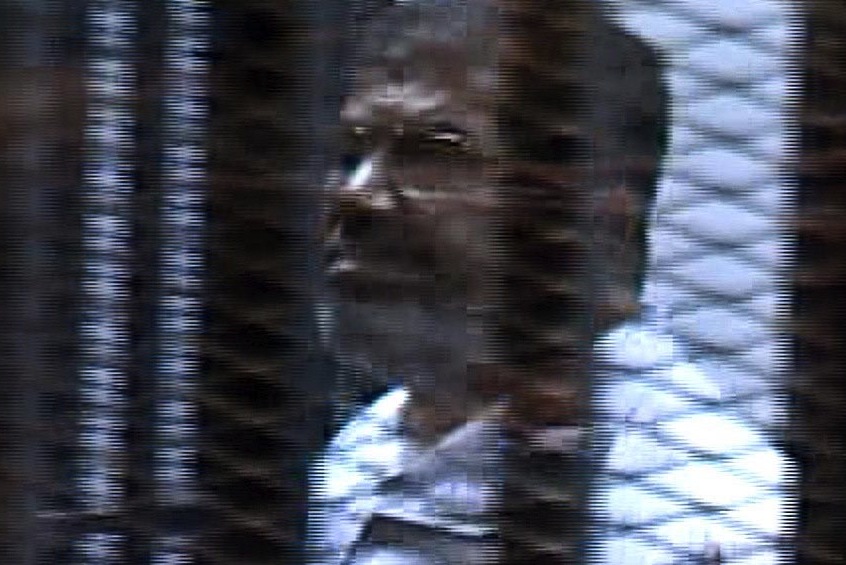
Egyptian president Mohamed Morsi' trial

Former Egyptian president Mohamed Morsi is seen inside the glass cage for the first time as the prosecutor began to read out the defendants’ names after Morsi and other defendants arrived at Cairo’s Police Academy to attend the first session of their trial on charges of breaking out of prison during Egypt’s 2011 uprising in Cairo, Egypt, on January 28, 2014. By Pool/Anadolu Agency/Getty Images.

Will The GOP Do Anything About Immigration?

As Republican leaders prepare to circulate a new “statement of principles” on immigration reform later this week, Sargent proposes a litmus test:

Here’s the question: What will Republicans demand as a condition for legalization?

If their basic principle is that legalization will be contingent on undocumented immigrants paying back taxes and a fine, and on the Department of Homeland Security producing a border security plan (as in the Senate bill), that could be a real stepping stone to negotiations and possibly even something approximating comprehensive reform.

But if their basic principle is that legalization will only happen after various border security metrics being met — such as E-Verify being fully operational, or proof that 90 percent of border crossers must be being apprehended and 100 percent of the border must be being surveilled — then that’s going to be a very discouraging sign.

Allie Jones doubts anything will come of it:

Democrats and Republicans may be able to find some middle ground with the Republicans’ new plan. While the Democrat-backed Senate bill includes a path to citizenship for children and adults who came into the country illegally, the Republican plan, which is really just a “statement of principles,” provides a path to citizenship for Dreamers only. This could possibly allay Republican fears that embracing immigration reform means handing Democrats 11 million new voters. Under the Republican plan, undocumented adults would be still be offered a path to “legal status.”

Still, the likelihood that the GOP comes to full agreement and puts this plan in action before November is slim.

The fact that the party can’t come to any consensus on the issue makes Byron York skeptical:

House Republicans are likely to remain deeply divided over legalization. And their divisions simply reflect larger divisions within the conservative world.

The Wall Street Journal editorial page is solidly pro-reform. National Review is solidly against it. The Weekly Standard is split, with editor William Kristol advising Republicans “don’t even try” to pass reform this year, and executive editor Fred Barnes praising McCarthy’s decision to support legalization as a blow against the “nativist axis” and a “brave step for his party and America.”