Capital Gains And Losses

012414_unemployment_v2-01

Suzy Khimm points out the staggering inequality in Congress’s backyard:

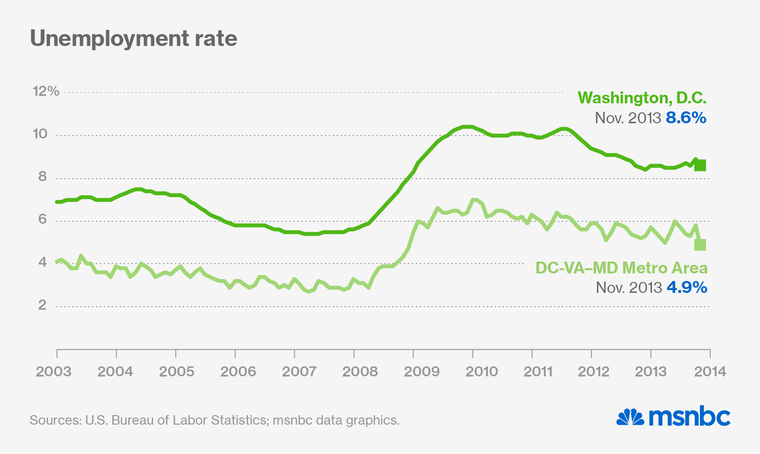
The gap between low- and high-income households in D.C. is one of the biggest in the country—the third-highest of the 50 largest cities in the U.S., according to the D.C. Fiscal Policy Institute. While the D.C. metro area was spared the worst of the recession, the downturn and subsequence recovery have exacerbated the long-standing differences between the area’s rich and poor.

Between 2007 and 2012, 18.5% of D.C.’s residents were in poverty, compared to 8.4% in the entire metro region, which includes six of the 10 richest counties in the U.S. The massive growth in federal contracting dollars—hitting $80 billion in 2010 alone—helped push the median household income to nearly $120,000 in Virginia’s Loudoun County. But the disparities aren’t just in terms of income. While the region’s unemployment rate has dipped to just 4.9%—far below the national rate—it’s stuck at 8.6% in the District. Within the city itself, the differences are even starker: The jobless rate in Ward 8, one of the city’s poorest neighborhoods is 18.6 percent; in Ward 3, it’s 1.8 percent.

Alex Leary examines the demographic shifts driving these changes:

Washington, which boasts one of the most educated workforces in the country, has gotten younger. The “millennials” — those 18 to 29 — now account for 35 percent of the population, while the same group is only 23 percent of the national population. It also has gotten whiter.

The black middle class began to leave after riots that followed the assassination of Dr. Martin Luther King Jr., leaving 14th Street, Columbia Heights and other parts of the city in ruins. In 1970, African-Americans made up 70 percent of the city’s population. In 2010, it was down to 51 percent and many of those left are among the poorest and least educated, concentrated in neighborhoods east of the Anacostia River that have been untouched by revitalization.

The Land Before Fidel

trinidad

Michael Totten visits the Spanish colonial town of Trinidad, Cuba:

Trinidad is not a nice place because of its communist government. Trinidad is a nice place despite its communist government. It’s five hundred years old. None of it was built by the communists. The city looked as it does now centuries before Karl Marx wrote The Communist Manifesto. Fidel Castro is responsible for precisely nothing I love about it. All he did was fail to destroy it. That’s not progress or a point scored for the revolution. It’s just damage control.

But I will give Cuban communists this much—they feel a connection with the pre-communist past and aren’t trying to obliterate it from the earth or from memory. They are not at war with every single last thing that predates them. There was no Year Zero in Fidel Castro’s Cuba like there was in Pol Pot’s Cambodia. The colonial buildings of Trinidad were not razed and replaced with horrifying tower blocks as was so much of the Soviet bloc. Cuban communists did build some ghastly new structures, but not at the expense of what came before, and not in the old center of Trinidad.

That’s a low bar for praise, to be sure, but so many communist regimes failed to live up even to that. Look at what the Soviet Union did to Chisinau in Moldova, which is even older than Trinidad.

(Photo by Flickr user F Mira)

Nearly There For January

Screen Shot 2014-01-27 at 3.28.26 PM

[Re-posted and updated from earlier today]

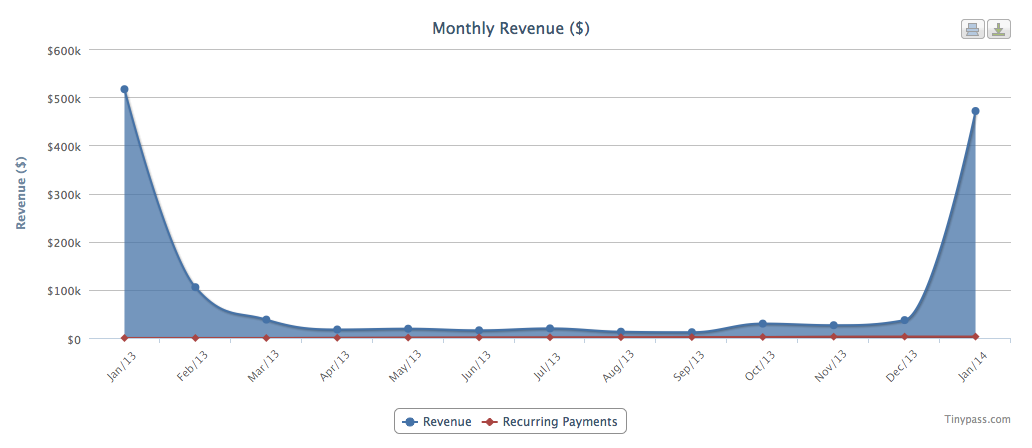
The above graph is the state of play in our renewals drive so far in January. That towering peak on the far left is the amount of revenue we raised for the entire month of January of last year – beginning on January 2. The peak on the right is the amount of revenue we have raised so far in renewals and new subs since January 13 this year. The revenue last year was $516,500 for all of January. The revenue in January 2014 – with five days to go until February – is, as of this posting [at 3.40 pm], $471,000 [currently $475,000]. We still have to match February 2013’s $105,000 and most of March 2013’s $35,000 in the coming two months, but January was the huge mountain we had to climb first.

And the summit is in sight –  we have five days to make that graph above exactly symmetrical. And what a statement that would make about the viability of reader-supported online journalism.

So if you haven’t gotten around to it yet, and still intend to renew, take a second to do it now. It’s real easy – only a couple of minutes of your time for a year’s worth of full Dish and Deep Dish access. And if you have howler beagleput off [tinypass_offer text=”subscribing in the first place”], now would be the perfect time to help push us over the top. Subscribe for the first time [tinypass_offer text=”here”] – and help us make it.

To say we’re grateful for this vote of confidence and support would be an understatement. But apart from gratitude, the other thing we’re feeling is excitement: that this simple, basic business model is beginning to prove it can work. And if it can, then the possibilities of rebuilding intelligent journalism online just began to expand a little.

Can you get us to match last January by February 1 – and blaze a trail for new reader-supported online journalism? We’ll keep you posted with the progress, as we have so far, and will do as long as we are around.

Renew here! Renew now! And help change the future of online journalism.

Update from a reader, who isn’t so sure:

Thank you for validating my decision not to subscribe today. As I have written previously (and you have published at least once), I will not subscribe to an online publication that allows an editor to decide which reader opinions are worthy of being aired and which can be safely ignored. We had that model with print newspapers and it’s one of the reasons I was an early adopter of online news sources.

You wrote today that “victimology … began on the hard left, of course, in the 1990s” without a single citation or example. You wrote it as something that is self-evident. If you allowed comments I would have called you out on that on your own website, and I assume other readers would have to. You would, of course, still have had the option of addressing us or ignoring us, but it would all be transparent. Until you allow that transparency I won’t be subscribing to the Dish.

P.S. I’m sure you’ve thought of it already, but there is probably money to be made from enhanced “subscription plus” model that allows the subscriber to comment for a higher price.

As long-time readers know, the Dish has run multiple polls asking readers if they want to see an unmoderated comments section, and each time they have voted it down. As far as the reader’s “P.S.”, the Dish will never be pay-to-play. The only speech here is free. Another reader:

I just re-upped for another year with a $10 a month subscription. We get at least that much use of the site as a marital aid. Let me explain …

I began reading the Dish during the 2004 election cycle, and not long after convinced my husband that he should as well. We had been married 3 years at the time, and though we were both interested in politics and such, I am convinced that our shared readership has inspired numerous opportunities for us to connect on a more intimate level. We usually discuss some link or another during dinner every night. That inevitably leads to a deeper conversation in which we sometimes agree and sometimes disagree. Either way, we have shared some intense conversations about what we individually believe and why we believe it. We have shared a lot of laughs as well as some passionate discussions. Occasionally, the proverbial soap box got dusted off.

Either way, the conversation often morphs into a discussion about our childhood and early adult experiences that have turned us into the people that we are today in this marriage together. Couples pay thousands of dollars on therapy in order to try to bridge that understanding gap, and here you are offering it for the lowly price of $19.99!
The Best Of The Dish Today

One of the interesting aspect in reviewing the data on the Dish is you see some patterns. Today, for example, the second most popular post remains one published on Friday night. It’s about the most extraordinary act of pandering to AIPAC by the new lefty mayor of New York City – and was deliberately kept off his public schedule and would never have seen the light of day if not for a Capital New York reporter getting hauled out of the room for recording it.

The story was covered elsewhere, but in many places it is simply not done to air the cravenness of so many politicians to various lobbies of all stripes. Or at least it is not done with respect to the Israel Lobby, whose very existence we have been told is a myth. Such a myth led De Blasio to say in ringing terms:

City Hall will always be open to AIPAC. When you need me to stand by you in Washington or anywhere, I will answer the call and I’ll answer it happily ’cause that’s my job.

Translation: “When you ask me to jump, just be extra sure to include how high.” And since that lobby is doing all it can to end a peaceful dialogue with Iran – in a Senate bill co-sponsored by 59 Senators, and mercifully pushed back on by two Senators today in the NYT – its ability to have politicians jump as soon as they call seems a relevant fact of public life in America. And readers seem to know this.

These posts – like the hugely popular ones on Sarah Palin in the 2008 campaign that asked questions the MSM wouldn’t – are very popular. The most recent one is the second most popular in the last week. You can’t bury them, even on a Friday evening. And that tells you something about what others may sometimes be too intimidated to publish and write about. And, not to add a plug for the Dish, but it’s the kind of thing that only a truly independent website can afford to do.

Three other posts worth noting: my attempt at psycho-analyzing the anger of the One Percent; the ethics of watching the Super Bowl; and the growing enrollment in Obamacare.

The most popular post was The Selective Secrecy Of Bill De Blasio; next up was “Ted Cruz’s Reality.”

See you in the morning.

Ukraine Reignites, Ctd

A handful of passionate readers are pressing us to stay on top of things:

US press coverage is, on the whole, pathetic.  Anne Applebaum’s recent piece is the most intelligent assessment I’ve read yet.  BBC and The Guardian have some good articles.  The German press is somewhat better; Der Zeit is doing a pretty good job, because they have contacts on the ground. But Twitter is the best place to work from.  Start with #Euromaidan, and work from there.

Please, do more.  What has happened since your last post is truly extraordinary.

Another reader who was in Ukraine recently recommends the Facebook page of Euromaiden, which is “translating into English the latest news being passed along the social networks and the Internet.” Another:

Ukrainska Pravda has a live feed that’s updating every day in English.  Here’s a summary of what’s going on and an updated map of who is in control of what from yesterday.  My friends who are there/have family there have been warning that the Internet in Ukraine and Kyiv might go down, so I’m not sure how accurate any updates can be or will be.

Another reader from a few days ago takes stock:

Sit with this news from Ukraine for a second. A country of 40 million people in the heart of Europe, divided between a pro-European, conservative-to-liberal, Christian (Catholic and Orthdox) west that is corrupt and a pro-Russian, illiberal east that lives by corruption too is descending into an extremely dangerous political crisis.

The president of the country, twice convicted of violent crimes in his youth, has grown obscenely wealthy at the expense of the people of his country, while mouthing platitudes about joining Europe. When he turns his back on Europe in November, protests turn up in Kyiv. That very night, student activists are beaten, some very seriously. Ukrainian society is outraged and the protests grow even more massive.

The protests last for weeks on end, and they attempt to disperse them violently December 11. The opposition negotiates with the government. Then things settle down. Then the government once again provokes the protesters by passing an insane law outlawing any protest activity whatsoever on January 17. Banned are: wearing helmets, wearing camouflage, driving in groups of more than 5 vehicles, criticizing the judiciary, and retroactively giving amnesty to members of the “Berkut” riot police for any beatings that they have delivered to protesters. It is at this point that the violence has truly escalated and protesters have began to arm themselves with clubs and helmets and actively fight with the police. I lived in Ukraine for 13 months in the last couple of years and can testify firsthand that the place is seething with political discontent with the Yanukovych regime. They will not be satisfied with anything short of a change in government; if Russia intervenes, the western half of Ukraine will fight to the death to defend its long-repressed statehood.

Given Ukraine’s regional divisions (which may be exaggerated, but which are nevertheless real), half the country completely rejects the legitimacy of the Yanukovych government. And they will be willing to fight the government, leading to a possible Syrian scenario in a state that borders on the European Union. When will Europeans wake up and see that this directly affects them? Ukraine is not some forgotten Siberia thousands of miles from Paris and Berlin (not to mention London). It is a border state with Poland, Slovakia, Romania, Hungary, Moldova, and Belarus! Not only that, but the fate of democracy and market reforms there are a hugely influential example to all of the post-Soviet states, from Belarus to Moldova to Kazakhstan and all the way to Moscow itself. If democracy in Ukraine succeeds, ordinary Russians will be forced to ask themselves, why not here?

And with all of this at stake, Obama remains absolutely silent. And you have remained largely silent yourself. Please! I urge you: take some time to reflect on this crisis and the stakes that it has for the U.S. and especially for Europe. I should mention that the U.S. and Russia are guarantors of the country’s borders and independence as a result of the country’s renunciation of its Soviet-era nuclear arsenal in 1994. This country cannot be ceded to the Russians to do whatever they want with simply because it borders on their country. The futures of millions of people and dozens of my personal friends and family are 0 in a Russian-dominated Ukraine.

I should know: I am the great-grandson of a Ukrainian Greek Catholic priest who spent 10 years in Siberia for continuing to practice his faith – performing baptisms, hearing confessions, and performing the liturgy -after his church was “outlawed” at a spurious synod in 1946. The Ukrainian Greek Catholic Church is by far the largest Eastern Rite Catholic Church, fully in communion with Rome, and for the 42 years during which it was outlawed by the Soviets, it was the largest “catacomb” church in the world.

Please educate yourself and speak out! This is an issue of fundamental importance to security on the European continent and a moral issue par excellence. I was inspired with your coverage of the Green Revolution and wonder why there has been so little about Ukraine! If you want to escape America’s foreign policy fixation on the Middle East, then take an interest in a major foreign policy issue outside of it!

The World Of Christian Meditation

Christopher Harding explores it:

People from all sorts of Churches — and none — come together to practise: meditation builds its own ‘community of faith’, Freeman says — faith, in this sense, being ‘our capacity for relationship, for enduring, transcending the instinct to run away and have an easier time somewhere else’.

This is ‘faith’, then, not as some watered-down alternative to propositional belief, but a commitment made and remade even while its object comes into view only gradually and uncertainly (‘through a glass, darkly’, as St Paul put it). It’s a commitment, too, to facing whatever silence throws at you. Boredom and busy schedules are familiar obstacles in any meditation practice, Christian or otherwise, but tougher still are those times when practitioners find themselves frightened or unwilling to follow where the silence seems to be leading them. Questions of theology and Church teaching will come up, of course, but Freeman insists that we must allow them to emerge in the midst of all the other doubts — about ourselves and the world — that arise as we practise. As he puts it, meditation ‘opens Pandora’s box… everything starts to look different’.

Face Of The Day

POLAND-JEWS-HOLOCAUST

A Holocaust survivor huddles in a blanket to stay warm during a ceremony in the former Nazi concentration camp Auschwitz-Birkenau in Oswiecim, Poland, on Holocaust Day, January 27, 2014. The ceremony took place 69 years after the liberation of the death camp by Soviet troops. By Janek Skarzynski/AFP/Getty Images.

Cashing In On The Campaign

It doesn’t end when a candidate loses:

The erectile-dysfunction ad is one of more than 50 similar pitches for miracle cures and easy-money tricks that [Herman] Cain has passed along to his e-mail followers over the past two years. While he has been particularly unabashed in his embrace of the practice, he is not the only past presidential candidate hawking sketchy products. Newt Gingrich now pings the e-mail subscribers to his Gingrich Productions with messages from an investment firm formed by a conspiracy theorist successfully sued for fraud by the Securities and Exchange Commission. Mike Huckabee uses his own production company’s list to blast out links to heart-disease fixes and can’t-miss annuities.

The joke about Cain and Gingrich during the 2012 campaign was that they weren’t at all serious about their pursuits of the presidency but instead just lining up future paydays. After Huckabee, who’d parlayed a strong showing in 2008 into publishing deals and his own Fox News show, declined to run again, some wags snickered that his new livelihood must have been too hard to give up. Now all three seem to be proving the cynics right.

A Linguistic Rift

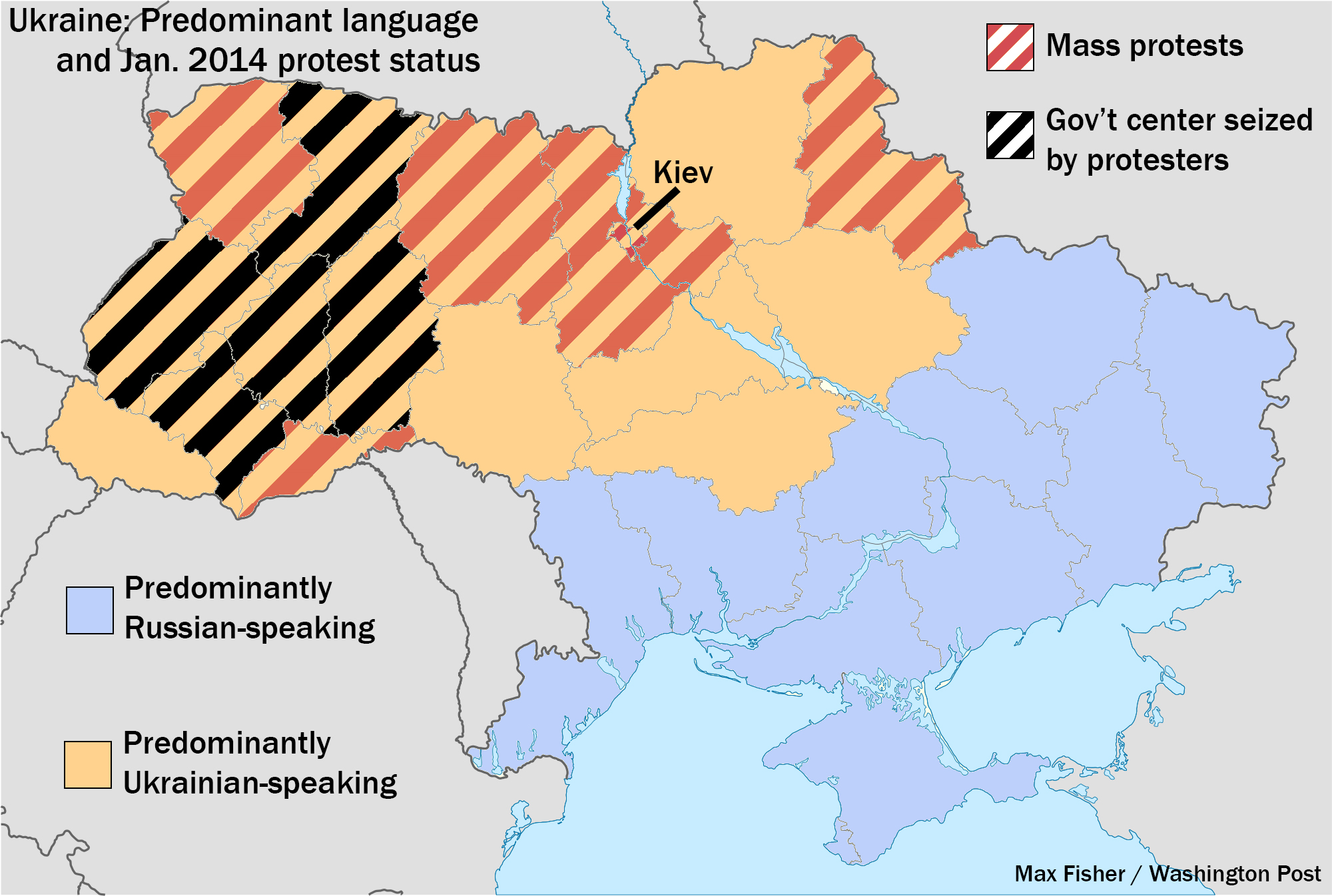
In 2010, Ukrainian President Viktor Yanukovych won all of the country’s Russian-speaking provinces and lost all the others. The recent protests have intensified this split:

ukraine-protests-map-by-language-k

Fisher explains:

Ukraine’s ethno-lingistic political division is sort of like the United States’ “red America” and “blue America” divide, but in many ways much deeper — imagine if red and blue America literally spoke different languages. The current political conflict, which at its most basic level is over whether the country will lean toward Europe or toward Russia, is part of a long-running and unresolved national identity crisis. Yes, it’s also about Yanukovych’s failures to fix the economy and his draconian restrictions against basic freedoms. But there’s so much more to it than that, which helps make the crisis so intractable.

Adding Insult To Injury

Joe Entwistle, a quadriplegic disability rights advocate, reveals how thin the safety net is for Americans with disabilities:

The reality for someone in my situation is that retirement usually isn’t an option. You work until you die, literally. A friend of mine is a perfect example. It’s almost creepy the similarities in our life. Both of us had a spinal cord injury at 16. Both of us were injured wrestling. Both of us are policy analysts. He’s a really good guy. He’s 63 years old. He started working for the state many years ago. Yet because of the odd rules around Medicaid eligibility and the differential treatment of earned and unearned income, he literally cannot retire. He knows he has to work until he’s dead or until some rules change. As soon as he starts to draw unearned income (retirement), he’s not going to be eligible for health-care programs or he’ll have to spend down to essentially $710 a month. He could no longer afford his house. He could no longer afford even the taxes on the house.